For many UK SMEs, generating consistent leads and sales online feels like assembling flat-pack furniture without the instructions. You know the pieces exist — SEO, Google Ads, social media, email — but connecting them into something that actually works is another matter entirely. The good news is that digital marketing does not have to be overwhelming or disjointed. This guide gives you a practical, stepwise framework built specifically for small and medium-sized businesses. Follow it carefully and you will have a structured process that turns digital activity into measurable results.
Table of Contents
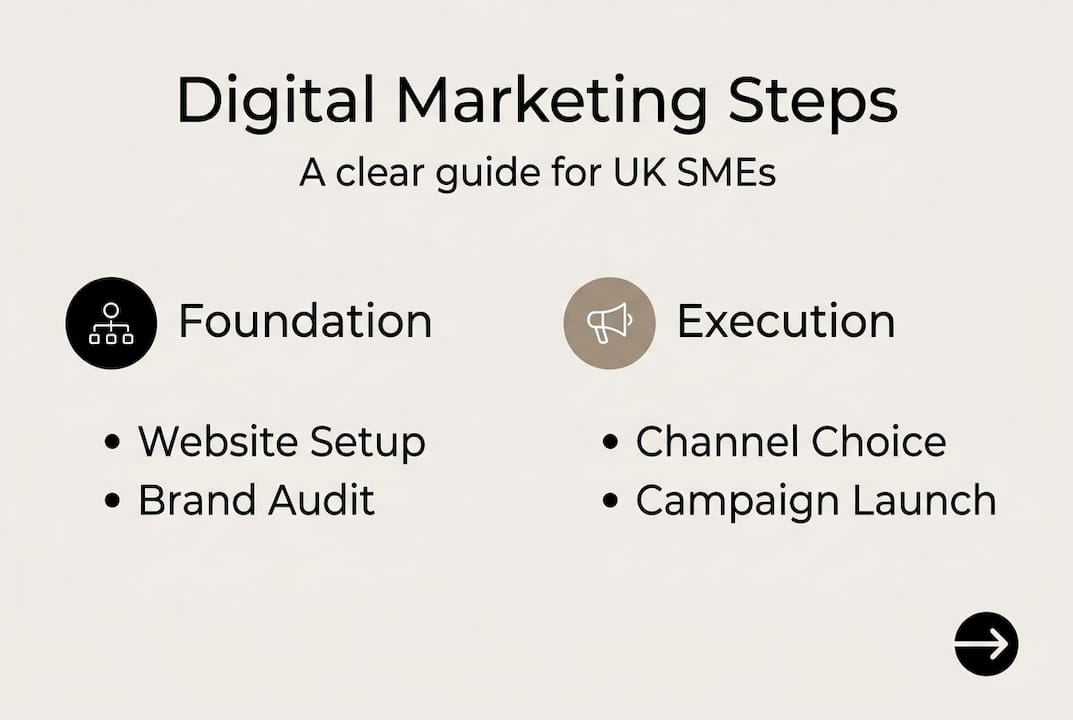
- Get your foundations right: digital marketing essentials
- Step-by-step: building your digital marketing strategy
- Executing the plan: launch, monitor and optimise
- Troubleshooting and refining your digital marketing efforts
- What most digital marketing guides miss for UK SMEs
- Take your digital marketing to the next level with Citricmedia
- Frequently asked questions
Key Takeaways
| Point | Details |
|---|---|
| Build a strong foundation | Before launching campaigns, ensure your website, branding and tools are robust and ready. |
| Follow a clear strategy | Stepwise planning tailored to your goals gives your digital marketing direction and higher ROI. |
| Monitor and refine continuously | Tracking results and adjusting regularly maximises your chances of sustained growth. |
| Fix problems quickly | Identify and address issues early to keep digital campaigns on track for success. |
Get your foundations right: digital marketing essentials
Before you spend a single pound on ads or content, you need to audit what you already have. Many SMEs jump straight into campaigns without checking whether their foundations are solid, and that is where budget gets wasted. Think of it like building on sand: even the best campaign will underperform if your website is slow, your branding is inconsistent, or your tracking is broken.
Start with your website. Is it fast, mobile-friendly, and clearly structured? A website and SEO basics review will quickly reveal whether your site is ready to convert traffic into enquiries. A poor user experience will kill your conversion rate regardless of how much traffic you drive.
Next, confirm you have the right tools in place:
- Google Analytics 4 (GA4): Tracks visitor behaviour, traffic sources, and conversions
- Google Search Console: Monitors your organic search visibility and flags technical issues
- A social media presence: At minimum, a business profile on the platforms your audience uses
- An email marketing platform: Mailchimp, Klaviyo, or similar for nurturing leads
- A CRM or lead tracking system: Even a simple spreadsheet works at the start
You also need to check your legal obligations. Under UK GDPR, you must have a clear privacy policy, a compliant cookie notice, and explicit consent mechanisms for email marketing. Skipping this is not just risky from a compliance standpoint — it erodes trust with potential customers.
Here is a quick reference table to help you assess your foundational tools:
| Tool | Purpose | Free option available? |
|---|---|---|
| GA4 | Website analytics and conversion tracking | Yes |
| Google Search Console | SEO performance monitoring | Yes |
| Klaviyo | Email marketing and automation | Yes (up to 500 contacts) |
| Canva | Brand visuals and social graphics | Yes |
| HubSpot CRM | Lead management and pipeline tracking | Yes |
Pro Tip: If budget is tight, prioritise the free versions of GA4, Search Console, and Mailchimp first. These three tools alone give you enough data to make informed decisions without spending anything upfront.
Step-by-step: building your digital marketing strategy
With your essentials in place, it is time to map out your approach. A strategy without clear goals is just activity for its own sake. Results-driven marketing approaches consistently outperform ad hoc efforts because every decision is anchored to a measurable outcome.
Here is how to build your strategy step by step:
- Define your objectives. Are you trying to generate leads, drive online sales, or build brand awareness? Be specific. “Get more enquiries” is not a goal. “Generate 30 qualified leads per month from Google Ads by Q3 2026” is.
- Identify your target audience. Who are your best customers? What problems do they have? Where do they spend time online? Build a simple customer profile covering age, role, location, pain points, and preferred channels.
- Select your channels. Not every channel suits every business. A B2B accountancy firm will get more traction from LinkedIn and SEO than from Instagram. A local trade business may do well with Google Ads and Google Business Profile.
- Create a content plan. Map out what content you will produce, on which platforms, and how frequently. Align topics to your audience’s questions and concerns rather than what you want to say about yourself.
- Set a realistic budget. Allocate spend across channels based on your objectives. If lead generation is the priority, PPC often delivers faster results than SEO, but SEO compounds over time.
Here is a practical comparison to help you choose the right channel mix:
| Channel | Speed of results | Cost | Best for |
|---|---|---|---|
| SEO | Slow (3 to 6 months) | Low to medium | Long-term organic growth |
| PPC (Google Ads) | Fast (days) | Medium to high | Immediate lead generation |
| Social media | Medium | Low to medium | Brand awareness and engagement |
| Email marketing | Fast | Low | Nurturing existing leads |
Pro Tip: Align your channel selection to your sales cycle. If you sell a high-consideration service, combine SEO for awareness with PPC for intent-driven searches. If you sell a product with repeat purchase potential, email marketing becomes your most cost-effective channel over time.
Executing the plan: launch, monitor and optimise
Having a plan is just the start. Execution is where most SMEs either gain real traction or quietly abandon their efforts after a few weeks. The stages of launching digital ads follow a clear sequence, and skipping steps is the fastest route to wasted spend.
Follow this launch sequence:
- Set up tracking before you spend anything. Install GA4, configure conversion goals, and test that data is flowing correctly. Launching without tracking is like driving with no dashboard.
- Build and review your campaign assets. Write ad copy, create landing pages, and prepare any creative. Review everything for clarity and relevance before going live.
- Launch with a controlled budget. Start smaller than you think you need to. This gives you real data without major financial exposure while you identify what works.
- Monitor daily for the first two weeks. Watch for anomalies: unusually high bounce rates, zero conversions, or runaway spend on irrelevant search terms.
- Optimise based on data, not assumptions. Pause underperforming ads, refine targeting, and test new copy. Digital campaign optimisation is an ongoing discipline, not a one-time task.
The key metrics every SME should track are:
- Conversion rate: The percentage of visitors who take a desired action
- Cost per acquisition (CPA): How much you spend to win each lead or sale
- Click-through rate (CTR): Indicates whether your ad or content is relevant to your audience
- Return on ad spend (ROAS): Revenue generated per pound spent on paid campaigns
Critical note: Ignoring early data signals is the single most expensive mistake we see SMEs make. If your CPA is three times your target after two weeks, something is structurally wrong. Do not wait for the month to end before acting.
Review your campaigns weekly during the first month, then move to a fortnightly rhythm once performance stabilises. Monthly strategic reviews should assess whether your overall channel mix is still aligned to your business goals.

Troubleshooting and refining your digital marketing efforts
Even the best digital marketing plans require ongoing attention and adjustment. Markets shift, competitor activity changes, and audience behaviour evolves. Regular auditing and adjustment greatly improve outcomes, and the SMEs that grow fastest are those that treat marketing as a living process rather than a set-and-forget system.
Watch for these warning signs that something needs attention:
- A sudden drop in organic traffic (could signal a Google algorithm update or a technical issue)
- Rising CPA without a corresponding improvement in lead quality
- Declining email open rates below 20%, suggesting list fatigue or deliverability problems
- High bounce rates on landing pages (above 70% is worth investigating)
- Social engagement falling despite consistent posting
When campaigns underperform, start with the simplest fixes before assuming the entire strategy is wrong. Check your landing page load speed, review your ad copy for relevance, and confirm your targeting has not drifted. Often the issue is a small technical or messaging problem rather than a fundamental strategic failure.
For continuous marketing improvements, build a simple monthly audit into your calendar. Review traffic, leads, spend, and conversion rates against your targets. Document what changed and why. This creates an institutional memory that helps you make smarter decisions over time.
Statistic callout: SMEs that review their marketing performance at least monthly are significantly more likely to report year-on-year revenue growth than those who review quarterly or less. Frequency of review is one of the strongest predictors of digital marketing success.
Pro Tip: If you find yourself consistently firefighting rather than improving, it is a strong signal that you need either dedicated internal resource or an experienced external partner. Knowing when to ask for help is a strategic decision, not an admission of failure.
What most digital marketing guides miss for UK SMEs
Most guides tell you to “be consistent” and “know your audience.” That is true, but it is not the whole picture. After working with UK SMEs across a wide range of sectors, the pattern we see most clearly is this: businesses that try to do everything at once rarely do anything well.
The instinct to copy what larger competitors are doing is understandable but often counterproductive. A well-funded brand can sustain activity across six channels simultaneously. Most SMEs cannot, and spreading effort too thin produces mediocre results everywhere rather than strong results somewhere.
Our practical view is that dominating one channel before diversifying is a far more reliable path to growth. Master Google Ads or SEO first. Build a repeatable system. Then layer in the next channel once you have proof of concept and a process that works.
Data-driven iteration matters far more than any single campaign. One well-optimised campaign running for twelve months will consistently outperform twelve separate campaigns launched and abandoned. Long-term success also requires either building internal skills or partnering with people who already have them. There is no shortcut around that reality.
Take your digital marketing to the next level with Citricmedia
If this guide has helped you see the shape of a proper digital marketing strategy, the next question is whether you have the time and resource to execute it consistently. Many SMEs find the process straightforward to understand but genuinely difficult to sustain alongside running a business.
At Citricmedia, we have spent over 27 years helping UK SMEs generate real leads and sales through performance-driven digital marketing. Whether you need expertly managed Google Ads for SMEs or high-converting Google Shopping campaigns, we build and manage campaigns that are anchored to your commercial goals. We are not interested in vanity metrics. We are interested in results you can measure. Get in touch today to discuss your specific needs and find out how we can help you grow.
Frequently asked questions
What is the very first step in digital marketing for SMEs?
Establishing a solid online presence, usually with a well-designed website and clear branding, is the critical first step. A digital presence is the prerequisite for every other marketing activity that follows.
How often should an SME review its digital marketing strategy?
Reviewing key metrics and strategy at least monthly helps SMEs adapt to new trends and opportunities. Regular auditing and adjustment are directly linked to improved digital marketing outcomes.
What are the most effective digital marketing channels for UK SMEs?
SEO, Pay-Per-Click advertising, and targeted social media are usually the most ROI-driven channels for British SMEs. A structured digital strategy that aligns channel selection to business goals consistently improves return on investment.
How do I know if my digital marketing is working?
Monitor core metrics like leads generated, website visitors, and conversion rates to track performance accurately. Ongoing monitoring and optimisation are essential to maintaining and improving ROI across all digital campaigns.