Marketing
Outbound marketing is defined as a push strategy where businesses proactively initiate contact with potential customers, rather than waiting for those customers to find them. As Salesforce describes it, outbound sends messages to the audience directly, covering channels from cold calls and TV advertising to direct mail and paid digital ads. The core goal is to create awareness and generate interest before a prospect is actively searching for your product or service. For marketing professionals and business owners focused on lead generation, understanding how outbound marketing works is the foundation of any serious demand-creation effort.
What is outbound marketing and how does it work?
Outbound marketing is the practice of pushing your message to a defined audience through channels you control and pay for. Unlike inbound approaches that rely on prospects discovering you organically, outbound puts your brand in front of people who may have no prior awareness of your offer. This makes it particularly powerful for entering new markets, launching products, or reaching cold audiences at scale.
The mechanics are straightforward. You select a channel, craft a message, define an audience, and broadcast. The audience receives your message whether or not they were looking for it. This is why outbound is often called “push” marketing: the business controls the timing and the reach, not the customer. That control is both its greatest strength and its most cited limitation.

Outbound is also the first step in full-funnel marketing, introducing products to audiences before they seek them actively. A prospect who sees your display ad in January may not search for your product until March, but the awareness you planted drives that search. This delayed-conversion dynamic is one reason outbound ROI is frequently underestimated by marketers who only track last-click attribution.
What are the main outbound marketing channels and strategies?
Common outbound channels span both traditional and digital media, and the most effective campaigns typically combine several of them.
Traditional outbound channels:
- Cold calling. Direct telephone outreach to prospects who have not previously expressed interest. Cold calls remain a core B2B tactic, particularly in sectors like financial services, SaaS, and professional services, where a conversation can qualify a lead faster than any digital form.
- TV and radio advertising. Broad-reach formats that build brand recognition at scale. A 30-second TV spot during a relevant programme can reach millions, though cost-per-contact is high and targeting is blunt.
- Print advertising. Newspaper, magazine, and trade publication ads. Still effective in niche B2B markets where decision-makers read specialist publications.
- Direct mail. Physical letters, catalogues, and postcards sent to postal addresses. Direct mail has seen a resurgence among UK SMEs because digital inboxes are saturated and physical mail stands out.
- Billboards and out-of-home advertising. Location-based awareness formats suited to local businesses and consumer brands.
Digital outbound channels:
- Paid search advertising (PPC). Google Ads and Bing Advertising place your message in front of users searching for related terms, combining outbound reach with intent-based targeting.
- Paid social advertising. LinkedIn, Meta, and X allow precise demographic and firmographic targeting, making them the most data-driven outbound formats available today.
- Display advertising. Banner and video ads served across publisher networks, effective for retargeting and broad awareness campaigns.
- Cold email. Structured sequences sent to prospect lists, often using tools like Outreach or Salesloft to personalise at scale.
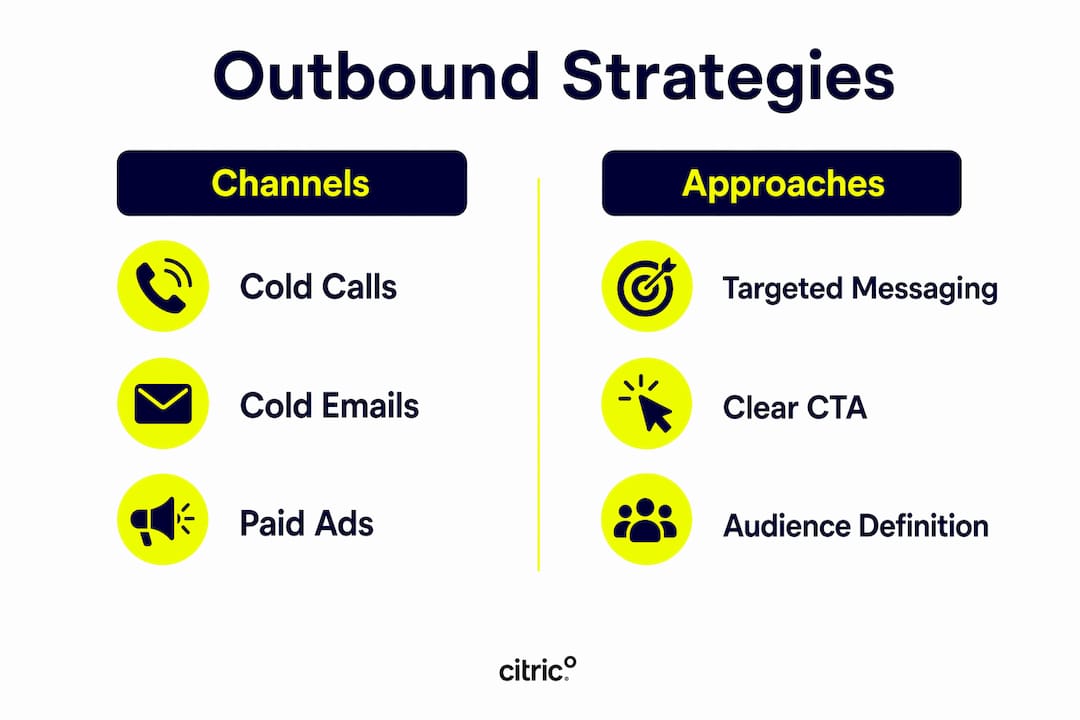
Cold calls and cold emails require compelling, scripted messaging with a clear call to action to succeed. The message must earn attention in the first three seconds because the recipient did not ask to receive it.
Pro Tip: Before writing any outbound message, define the single problem you solve for the specific audience segment you are targeting. Generic messages broadcast to broad lists waste budget and damage brand perception. Specificity is what separates outbound campaigns that generate pipeline from those that generate complaints.
How does outbound marketing compare to inbound marketing?
The distinction between outbound and inbound is not simply about channels. It is about who initiates the relationship and when. Outbound delivers messages to a broad audience regardless of current interest, whereas inbound attracts prospects who are already searching for solutions.
Outbound and inbound are complementary, not opposites. Outbound generates the initial awareness that later drives inbound research behaviour. A prospect who sees a LinkedIn ad for your software may not click immediately, but they will recognise your brand name when they encounter your blog post two weeks later through an organic search. This is the cycle that full-funnel marketers exploit deliberately.
| Dimension | Outbound marketing | Inbound marketing |
|---|---|---|
| Initiation | Business contacts the prospect | Prospect finds the business |
| Timing | Before active interest exists | During active research or consideration |
| Channels | Paid ads, cold calls, direct mail, TV | SEO, content, social media, email nurture |
| Targeting | Broad to moderately targeted | Highly intent-driven |
| Cost model | Higher upfront spend, faster reach | Lower cost over time, slower to build |
| Measurement | Awareness metrics, downstream engagement | Traffic, leads, conversion rates |
| Funnel stage | Top of funnel, demand creation | Mid to bottom of funnel, demand capture |
Understanding the marketing funnel makes this relationship clearer. Outbound fills the top of the funnel with cold audiences. Inbound content then nurtures those audiences through consideration and into purchase decisions. Businesses that run only one approach leave significant revenue on the table.
What are the benefits and limitations of outbound marketing?
Outbound marketing’s primary advantage is speed. You can reach thousands of cold prospects within hours of launching a campaign, which no organic or inbound strategy can match. For product launches, seasonal promotions, or entering a new geographic market, that speed is commercially decisive.
Key benefits:
- Rapid brand awareness. Paid channels deliver reach immediately, making outbound the fastest route to visibility among cold audiences.
- Control over messaging. You define exactly what is said, to whom, and when. There is no algorithm deciding whether your content gets seen.
- Scalability. Budget increases translate directly into reach increases, which is predictable in a way that organic growth is not.
- Audience access. Outbound reaches people who would never discover you through search or social content, particularly in markets where your prospects are not actively looking for solutions.
Outbound tends to be higher cost for broad reach and less measurable in terms of ROI compared to inbound, but it achieves fast awareness. This cost dynamic is the most common reason SMEs underinvest in outbound, often to their competitive disadvantage.
Limitations to manage:
- Higher cost per lead than inbound, particularly for TV and print.
- Risk of being perceived as intrusive, especially with untargeted cold outreach.
- Harder to attribute conversions accurately when outbound operates at the top of the funnel.
- Ad fatigue and audience saturation in heavily contested digital channels.
Broad, untargeted campaigns tend to perform poorly; targeted efforts deliver better ROI. The shift toward data-driven outbound targeting is the single most important development in outbound practice over the past decade. Segmenting your audience by industry, job title, company size, or purchase behaviour before launching a campaign is no longer optional. It is the baseline for acceptable performance.
Pro Tip: Resist the temptation to maximise volume on cold outreach campaigns. A list of 500 highly qualified prospects will consistently outperform a list of 5,000 loosely matched contacts. Precision reduces wasted spend and protects your sender reputation in email campaigns.
How to integrate outbound marketing into your overall strategy
Outbound marketing works best when it is treated as a demand-creation tactic that feeds a broader marketing system, not as a standalone lead-generation tool. The most effective approach connects outbound awareness to inbound content, so that prospects who see your ads have somewhere meaningful to go when they are ready to research further.
Here is a practical integration framework:
- Define your cold audience precisely. Use firmographic data (industry, company size, revenue) and behavioural signals (job changes, funding rounds, technology usage) to build prospect lists before you spend a penny on outreach.
- Map outbound channels to funnel stages. Use broad-reach formats like display and paid social for top-of-funnel awareness. Use cold email and paid search for mid-funnel prospects who show intent signals.
- Create inbound content that catches outbound-generated interest. When a prospect sees your LinkedIn ad and then searches your brand name, they need to find authoritative content that answers their questions. Pair every outbound campaign with a corresponding content marketing strategy that supports the research phase.
- Track downstream engagement, not just immediate clicks. Effective outbound connects to downstream inbound touchpoints and converts awareness into research behaviour. Set up UTM parameters, monitor branded search volume lifts, and track direct traffic increases during and after outbound campaigns.
- Test message variants systematically. Run A/B tests on subject lines, ad creative, and call-to-action copy. The data from these tests informs both your outbound refinements and your inbound content priorities.
| Outbound metric | What it measures | Why it matters |
|---|---|---|
| Reach and impressions | How many people saw your message | Indicates awareness potential |
| Click-through rate | Immediate response to the message | Signals message relevance |
| Branded search lift | Increase in brand name searches | Proves outbound drove awareness |
| Cost per qualified lead | Efficiency of outbound spend | Guides budget allocation |
| Downstream conversion rate | Leads that eventually convert | Measures full-funnel impact |
For B2B lead generation, the most productive outbound campaigns are those where the message, the channel, and the audience are tightly aligned. A cold email to a CFO about cost reduction lands differently than the same email sent to a marketing manager. Relevance is the multiplier that makes every other element of outbound work harder.
Key takeaways
Outbound marketing generates the fastest route to cold-audience awareness, but only delivers consistent ROI when targeting is precise, messaging is specific, and campaigns are connected to inbound nurture content.
| Point | Details |
|---|---|
| Push strategy by design | Outbound initiates contact with prospects before they express interest, giving businesses control over timing and reach. |
| Channel mix matters | Combining traditional formats like direct mail with digital paid advertising produces broader and more resilient awareness. |
| Complement inbound | Outbound fills the top of the funnel; inbound content captures and converts the interest that outbound creates. |
| Targeting over volume | Precise audience segmentation consistently outperforms high-volume, untargeted campaigns on both cost and conversion. |
| Measure downstream impact | Track branded search lifts and downstream conversions, not just immediate clicks, to capture outbound’s true value. |
Why outbound marketing still earns its place in a digital-first world
I have spent years watching businesses swing between extremes: all-in on inbound content one year, pivoting to cold outreach the next, then back again when the pipeline dries up. The pattern is predictable and expensive. My honest observation is that the businesses generating the most consistent pipeline are those that treat outbound as a permanent demand-creation engine, not a crisis response.
What has genuinely changed is the precision available. When I look at how data-driven targeting has evolved, the gap between a well-targeted LinkedIn campaign and a spray-and-pray cold call list is enormous. The tools exist to identify your ideal customer profile with remarkable accuracy before you spend a single pound on outreach. Businesses that use those tools are running outbound campaigns that feel relevant rather than intrusive, and the results reflect that.
My caution is this: do not treat outbound as a shortcut. A cold email campaign launched without a clear audience definition, a compelling message, and supporting inbound content to catch the interest it generates will underperform and frustrate your team. Outbound creates the spark. You still need the fuel.
The B2B outreach landscape is also shifting toward AI-assisted personalisation, which raises the floor for what prospects expect from cold contact. Generic messages are being filtered out faster than ever, both by spam algorithms and by human attention. The businesses winning with outbound in 2026 are those combining sharp audience intelligence with messages that speak directly to a specific problem. That combination has always worked. The tools just make it more achievable at scale.
— Martin
How Citricmedia can support your outbound marketing
If you are ready to put outbound marketing to work for your business, Citricmedia has over 27 years of experience helping UK SMEs generate high-quality leads through performance-driven digital channels.
From PPC advertising campaigns that place your message in front of high-intent prospects, to paid social advertising that targets your ideal customer by industry, role, and behaviour, Citricmedia builds outbound campaigns designed to generate measurable pipeline. Explore our online advertising solutions to see how targeted outbound can complement your existing marketing and accelerate growth.
FAQ
What is the outbound marketing definition?
Outbound marketing is a push strategy where businesses proactively send messages to potential customers through channels such as cold calls, paid advertising, direct mail, and TV ads, before those customers have expressed active interest.
Is outbound marketing still effective in 2026?
Outbound marketing remains effective, particularly for rapid brand awareness and reaching cold audiences. Modern campaigns use data-driven targeting to improve ROI and reduce wasted spend compared to traditional mass-broadcast approaches.
What are the main differences between outbound vs inbound marketing?
Outbound initiates contact with prospects before they are searching, using paid and broadcast channels. Inbound attracts prospects who are already researching, using content, SEO, and organic social. The two approaches work best when combined across the full marketing funnel.
What are the best outbound marketing channels for UK SMEs?
Paid search via Google Ads, paid social on LinkedIn and Meta, cold email, and direct mail are the most cost-effective outbound channels for UK SMEs. The right mix depends on your audience, budget, and sales cycle length.
How do you measure outbound marketing success?
Track immediate metrics such as click-through rate and cost per lead alongside downstream indicators including branded search volume lifts, direct traffic increases, and eventual conversion rates to capture outbound’s full impact on the funnel.