
Uncategorized
Most UK business owners assume local SEO is just regular SEO with a postcode added. It is not, and that misunderstanding costs them real customers every day. What is local SEO, exactly? It is a distinct discipline focused entirely on making your business visible to people searching for products or services in your area, specifically within Google Search and Google Maps. 46% of all Google searches carry local intent, and 76% of local mobile searchers visit a business within 24 hours. If you are not optimised for local search, you are invisible at the moment people are most ready to buy.
Key takeaways
| Point | Details |
|---|---|
| Local SEO is location-focused | It targets geographic search intent on Google Search and Maps, not general website rankings. |
| Three ranking factors matter most | Google weighs relevance, proximity, and prominence when deciding which local businesses to show. |
| Google Business Profile is central | A fully optimised profile is your most powerful local SEO asset, not your website alone. |
| NAP consistency drives trust | Your name, address, and phone number must match exactly across every UK directory listing. |
| Measurement enables improvement | Tracking profile insights, local rankings, and website traffic tells you what is working and what is not. |
What is local SEO and how does it work?
Local SEO optimises your business to appear in searches that carry geographic intent, both on Google Search and within Google Maps. Think of searches like “plumber in Bristol” or “Italian restaurant near me.” These trigger a completely different set of results to a standard web search. You see a map with three pinned businesses above the organic listings. That section is called the local pack, and winning a place in it is the primary goal of local search optimisation.
As Danny Goodwin notes, local SEO determines eligibility for these results based on the searcher’s precise location, not just keyword relevance. That distinction matters. You could have an excellent website and still not appear, because traditional SEO signals alone do not unlock the local pack.
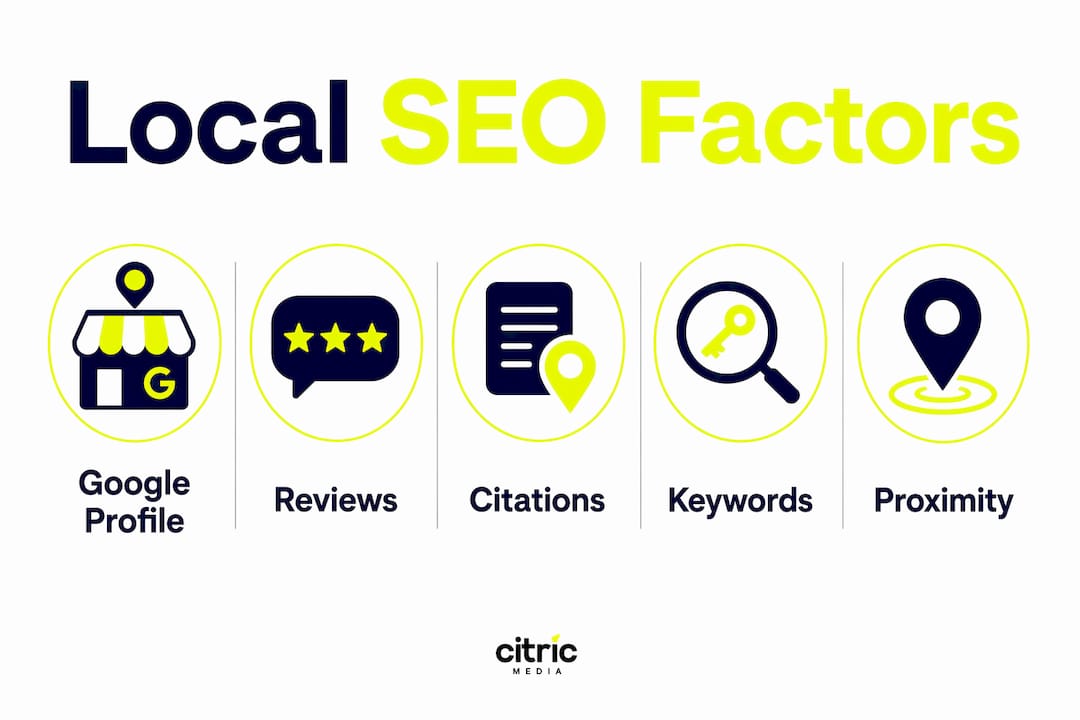
Google uses three core factors to rank businesses in local results:
- Relevance. How closely your business matches what the searcher is looking for. Accurate categories, services listed, and keywords on your profile all feed this signal.
- Distance. How far your location is from the searcher, or from the location they specified in the query. Closer is generally better, though not always decisive.
- Prominence. How well-known and trusted your business is, measured through reviews, backlinks, citations, and overall online authority.
“Local SEO is not simply traditional SEO with a location tag bolted on. It is a separate eligibility system, and the rules for winning are genuinely different.” — Search Engine Land
Your Google Business Profile sits at the centre of this system. It is the profile that populates your Maps listing, supplies your business hours, photos, and reviews to searchers, and signals to Google that you are a legitimate, active business at a specific address. Without a claimed and optimised profile, local visibility is close to impossible.
Key ranking factors and how to optimise for them
Understanding the signals that Google uses is one thing. Knowing how to act on them, specifically within the UK context, is where most businesses either pull ahead or fall behind.
Here is a structured approach to the most impactful optimisation steps:
Claim and complete your Google Business Profile. Fill in every field, choose primary and secondary categories with precision, upload real photos of your premises or team, set your service areas, and keep your hours current. An incomplete profile is a direct ranking disadvantage.
Fix your NAP consistency. NAP consistency across directories (your Name, Address, and Phone number) is foundational. Even minor discrepancies, such as “Street” in one listing and “St” in another, erode Google’s confidence in your data. UK businesses should prioritise Yell, Thomson Local, and Bing Places as citation sources, alongside the national directories.
Build and manage your reviews actively. Reviews influence both consumer trust and Google’s prominence factor. Volume matters, but so does recency and the language customers use. A plumber with 50 recent reviews mentioning “boiler repair in Leeds” will rank more prominently for that service than a competitor with 20 older, generic reviews.
Create localised website content. Localised content including city and neighbourhood names strengthens your relevance signals. If you serve multiple areas, dedicated location pages perform far better than a single “areas we cover” paragraph buried on your contact page. Add schema markup so Google can correctly interpret your address, phone number, and opening hours from your website code.
Earn localised backlinks and citations. Links and mentions from local newspapers, chambers of commerce, and community websites carry significant weight. A citation from the Hull Daily Mail or a sponsorship mention from a local sports club builds localised authority that a generic directory listing simply cannot replicate.
Stay active on your profile. Post updates, answer questions, and respond to every review, positive or negative. Ongoing activity signals to Google that your business is current and engaged.
Pro Tip: When responding to reviews, naturally include your service type and location in your reply. “Thank you for choosing us for your kitchen refurbishment in Manchester” reinforces your relevance signals without any awkward keyword stuffing.
The comparison below illustrates the difference between a neglected profile and one that is properly managed:
| Profile element | Neglected profile | Optimised profile |
|---|---|---|
| Categories | One generic category | Primary plus three relevant secondary categories |
| Photos | None | Regular uploads of premises, team, and work |
| Reviews | Fewer than 10, no responses | 50+ reviews with consistent, personalised responses |
| Posts and updates | None in 12 months | Weekly or fortnightly updates and offers |
| Service areas and hours | Incomplete | Fully populated, updated for bank holidays |
Overcoming proximity bias and local competition
Here is the challenge that no amount of profile optimisation fully solves: Google favours businesses that are physically closer to the searcher. This is known as proximity bias in local search, and it creates a real ceiling for businesses trying to attract customers from beyond their immediate vicinity.
If your shop is in Harrogate, you will naturally rank well for searches originating in Harrogate. But appearing in searches from Leeds, ten miles away, is harder. The businesses in Leeds have a structural proximity advantage, regardless of how good your profile is.
That said, proximity is not destiny. Building relevance and prominence can compensate for distance, and here are the most effective ways to do it:
- Accumulate reviews that mention specific locations. Encourage customers from further afield to mention their location in their reviews. “Excellent service, came all the way from Bradford and it was worth it” is a genuine relevance signal for Bradford-based searches.
- Build unstructured citations. These are mentions of your business name and location in local blogs, press coverage, event listings, and community forums. They do not need a link to carry weight. They build what is sometimes called entity recognition.
- Specialise to differentiate. A broad “general contractor” profile competes with every builder in a city. A contractor specialising in period property restoration in South Yorkshire suddenly has much less direct competition for that specific search intent.
- Consider paid local ads for coverage gaps. Google Local Services Ads appear above the standard local pack and are priced per lead rather than per click. For businesses in competitive areas or with a genuine distance disadvantage, they are a practical supplement while organic prominence builds.
Pro Tip: Do not chase every nearby town simultaneously. Pick one or two adjacent areas where you have existing customers or reviews, build your signals there first, and expand outward. Spreading too thin too early produces weak results everywhere.
Measuring progress and improving over time
Local SEO is not a project you complete. It is an ongoing process, and measuring it properly is what separates businesses that improve from those that plateau. You should understand how SEO drives real results before setting your benchmarks.
The most useful signals to track include:
- Google Business Profile insights. Profile views, search queries that triggered your listing, direction requests, and call clicks all tell you how visible you are and what people are searching for.
- Local pack rankings. Use a rank-tracking tool that reports from specific postcodes, not just national averages. Your position in Birmingham will differ significantly from your position in Solihull, even for the same keyword.
- Website traffic by location. Google Analytics lets you filter organic traffic by city or region. If your campaign is working in one area but not another, you will see it here.
- Review velocity. Track how many new reviews you receive each month. A slowdown in review volume often precedes a drop in local rankings.
- Citation audit results. Run a periodic audit through a citations tool to identify inconsistencies or duplicate listings that could be suppressing your rankings.
Set specific, realistic goals. For most UK SMEs, a practical starting target is appearing in the local pack for your three highest-value service keywords within your immediate town or city within three to six months of a thorough optimisation effort. From there, you expand.
My honest take on where most businesses go wrong
I have seen hundreds of UK businesses invest time in their websites while almost entirely ignoring their Google Business Profile. That is the wrong priority order. Your profile is your local storefront on the internet. The website reinforces it; it does not replace it.
The other thing I have noticed is that businesses treat local SEO as a one-time task. They set up a profile, collect a handful of reviews, and assume the work is done. Six months later, they wonder why a competitor with a less polished website is ranking above them. The answer is usually review volume, activity signals, and better citation coverage.
What genuinely works, in my experience, is starting small and being consistent. Claim your profile, fill every field, set up a simple system for asking customers to leave reviews, and check your profile insights monthly. Those three steps alone put you ahead of the majority of local competitors who are doing nothing. From there, you layer in citation building, localised content, and lead generation tactics that connect your improved visibility to actual enquiries.
Local SEO is also one of the most measurable forms of marketing available to a small business. You can see exactly how many people viewed your profile, called from it, and asked for directions. That feedback loop is genuinely useful. Treat the data as your guide and adjust accordingly. The businesses that do this well tend to win, not because they have bigger budgets, but because they are paying attention.
— Martin
How Citricmedia can help you win locally
Citricmedia has spent over 27 years helping UK businesses turn search visibility into real enquiries and sales. We know that local SEO is not a generic service. The tactics that work for a solicitor in Edinburgh differ from those needed by a trades business covering the M25 corridor, and our approach reflects that.
Our local SEO work covers Google Business Profile optimisation, citation building and auditing, review strategy, and localised content creation, all aligned with your specific service areas and commercial goals. We do not deliver reports filled with vanity metrics. We focus on the rankings, calls, and leads that actually matter to your bottom line. If you are serious about improving your local SEO and want a partner who treats your budget with the same care as their own, explore our services and let us show you what is possible.
FAQ
What does local SEO mean for a UK business?
Local SEO refers to the practice of optimising your online presence so your business appears in Google’s local pack and Maps results when people search for your services nearby. It covers your Google Business Profile, local citations, reviews, and location-relevant website content.
How does local SEO differ from regular SEO?
Regular SEO focuses on ranking your website pages for keyword searches across a broad geography. Local SEO specifically targets geographic search intent and determines your eligibility to appear in the local pack and Maps results, which are driven by relevance, proximity, and prominence rather than domain authority alone.
How long does it take to see results from local SEO?
Most UK businesses see measurable improvement in local pack visibility within three to six months of completing a thorough optimisation of their Google Business Profile, citations, and review acquisition strategy. Competitive markets may take longer.
What is the most important factor in local SEO?
Your Google Business Profile is the single most important asset. A fully completed, actively managed profile with consistent NAP data and a steady flow of genuine reviews gives Google the confidence it needs to rank your business prominently in local results.
Why do some competitors rank higher locally despite a worse website?
Proximity to the searcher, review volume, and profile activity often outweigh website quality in local results. A competitor with more recent reviews, an active profile, and a closer physical location to the searcher will frequently outrank a better-designed website with weaker local signals.