SEOSEO Optimization
Technical SEO is the practice of optimising a website’s backend infrastructure so search engines and AI systems can access, understand, and reliably index its pages. Where content SEO focuses on what a page says, technical SEO determines whether that page can be found at all. Googlebot’s crawling, rendering, and indexing process controls discoverability entirely, and technical SEO is the discipline that governs it. In 2026, with Google AI Overviews and ChatGPT drawing answers directly from indexed content, the stakes for getting this right have never been higher.
What is technical SEO and what does it include?
Technical SEO is the set of optimisations applied to a website’s architecture, server configuration, and code to make it fully accessible to search engine crawlers and AI indexing systems. It sits beneath content and off-page SEO as the foundation both depend on. If a page is blocked by robots.txt or returns a 404 error, Google cannot see or store it regardless of how strong the content is. That single fact defines why technical SEO must come first in any serious search strategy.
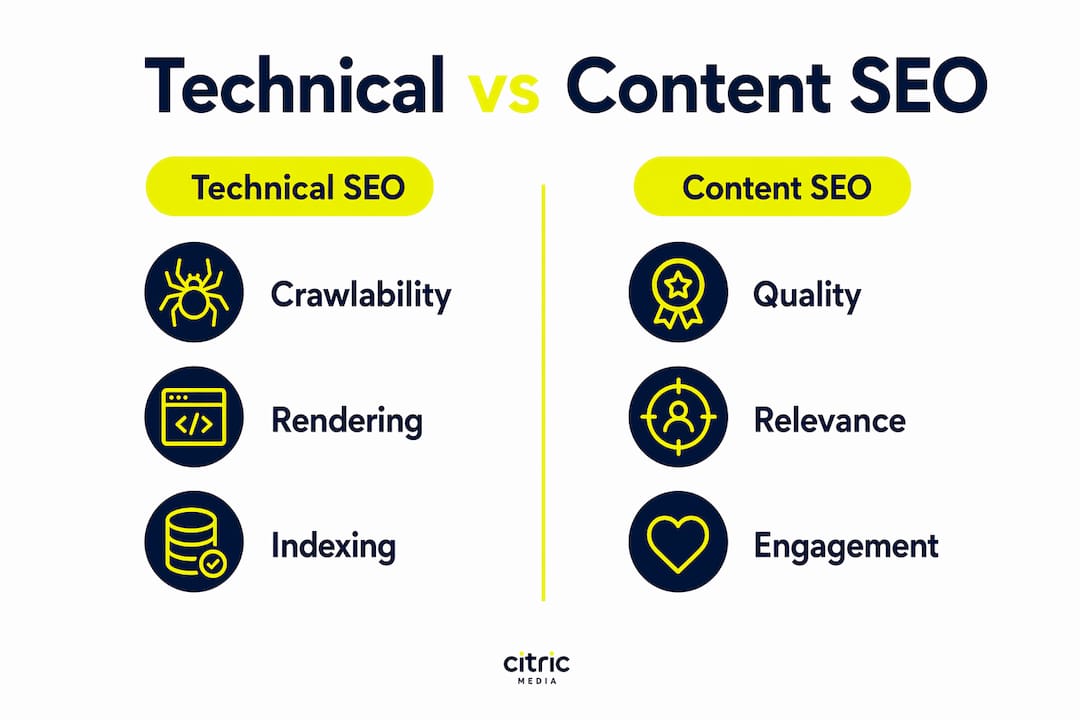
The discipline covers a broad set of components, each targeting a different stage of how search engines process a site:
- Crawlability: Googlebot must be able to reach your pages. Robots.txt rules, internal link depth, and crawl budget all influence which pages get visited and how often.
- Rendering: Once crawled, pages must render fully. JavaScript frameworks that load content client-side can produce a blank page for crawlers if server-side rendering is not configured correctly.
- Indexability: Canonical tags and noindex directives tell search engines which pages to store. Improper use of canonical and noindex tags can exclude pages from results even when they are crawlable.
- Page speed and Core Web Vitals: Google uses Largest Contentful Paint (LCP), Interaction to Next Paint (INP), and Cumulative Layout Shift (CLS) as direct ranking signals. Pages with LCP above 4 seconds are flagged as poor performers.
- Mobile-first indexing: Google indexes the mobile version of a site first. Responsive design alone is not sufficient if the mobile version omits structured data or internal links present on desktop.
- HTTPS: A secure connection is a confirmed ranking signal. Sites still running on HTTP face both a ranking disadvantage and a trust deficit with users.
- Structured data: Schema.org markup helps search engines and AI models interpret page content accurately, enabling rich results and increasing eligibility for AI-generated answers.
Pro Tip: Run a quick robots.txt check before any other audit task. A single misconfigured disallow rule can block an entire site section from Googlebot, and it takes less than two minutes to verify.
How does technical SEO interact with AI search in 2026?

AI search systems, including Google AI Overviews and ChatGPT’s browsing capability, rely on the same indexed content that powers traditional search. Sites with strong technical foundations are more likely to appear in AI-generated answers. This means clean metadata, complete rendering, and accurate structured data are now prerequisites for AI visibility, not just ranking improvements.
The relationship between technical SEO and AI discovery comes down to clarity. AI models need to parse page content quickly and confidently. Pages with ambiguous title tags, missing meta descriptions, or incomplete Schema.org markup give AI systems less to work with. The result is lower citation frequency in AI Overviews and reduced likelihood of appearing in ChatGPT responses.
JavaScript frameworks present the most significant technical challenge in this context. JavaScript-heavy pages that fail to render fully during Googlebot’s rendering phase are effectively invisible to search engines. If content loads client-side only, Google may index a blank shell rather than the actual page. This problem is compounded for AI systems, which often rely on cached indexed content rather than live rendering.
“Technical SEO is no longer an isolated discipline. It must be closely integrated with content strategy and AI indexing requirements to deliver consistent organic visibility.” — Conductor Academy
Practical steps to optimise for AI-driven search include:
- Implement server-side rendering (SSR) or static site generation for JavaScript-heavy pages.
- Use structured data from Schema.org for articles, products, FAQs, and organisations.
- Write clear, descriptive title tags and meta descriptions that accurately summarise page content.
- Maintain a clean XML sitemap and submit it via Google Search Console.
- Audit hreflang tags if operating across multiple regions or languages.
What are the best practices for auditing technical SEO health?
Regular audits are the only reliable way to maintain technical SEO health over time. Sites evolve continuously through new features, CMS updates, and content additions. Recurring audits prevent quiet slippage in rankings caused by unnoticed technical debt accumulating in the background. A one-time audit is a snapshot; an ongoing audit programme is a safeguard.
The audit process works best when structured around impact rather than volume. Fixing critical crawlability problems yields disproportionately large SEO improvements compared to resolving minor metadata warnings. A practical audit follows this priority order:
- Crawl the site with a dedicated tool. Screaming Frog, Semrush Site Audit, and Ahrefs Site Audit each surface crawl errors, broken links, redirect chains, and missing tags. Run a full crawl monthly on active sites.
- Check Google Search Console for coverage issues. The Index Coverage report in Google Search Console identifies pages excluded from the index and explains why. Address any “Excluded” or “Error” statuses before anything else.
- Audit Core Web Vitals. Google Search Console’s Core Web Vitals report and PageSpeed Insights both flag LCP, INP, and CLS failures at the URL level. Prioritise pages with the highest traffic volume.
- Verify mobile content parity. Mobile-first indexing requires mobile content, structured data, and internal links to match or exceed the desktop version. Use Google’s Mobile-Friendly Test and manually compare key page templates.
- Review structured data implementation. Google’s Rich Results Test confirms whether Schema.org markup is valid and eligible for rich results. Fix validation errors before adding new markup types.
- Check for duplicate content and canonicalisation issues. Tools like Semrush and Screaming Frog identify pages with duplicate or near-duplicate content. Confirm canonical tags point to the correct preferred URLs.
Pro Tip: Schedule a digital marketing audit at the same time as any major site deployment. New features are the most common source of accidental crawl blocks and rendering failures.
The complexities introduced by JavaScript frameworks mean that auditing rendering specifically requires specialist knowledge. Tools like Screaming Frog’s JavaScript crawl mode and Google Search Console’s URL Inspection tool both allow you to see a page as Googlebot sees it. If the rendered HTML differs significantly from the source HTML, you have a rendering problem that content quality cannot compensate for.
How does technical SEO complement content and off-page SEO?
Technical SEO and content SEO are deeply symbiotic. Technical optimisations remove the barriers that prevent high-quality content from being visible in search. Off-page SEO builds the authority signals that help that content rank competitively. All three disciplines must function together for organic visibility to reach its potential.
The clearest way to understand the relationship is through what breaks when the foundation is weak. A site with exceptional content and strong backlinks will still underperform if Googlebot cannot crawl key pages, if Core Web Vitals scores are poor, or if structured data is absent. The content and authority exist, but the technical layer prevents them from being surfaced.
| SEO discipline | Primary focus | What it depends on |
|---|---|---|
| Technical SEO | Crawlability, rendering, indexing, site speed | Server configuration, CMS, code quality |
| Content SEO | Relevance, keyword targeting, user experience | Technical access to pages being in place |
| Off-page SEO | Backlinks, authority signals, brand mentions | Content worth linking to, pages being indexable |
The table above shows a clear dependency chain. Off-page SEO amplifies content SEO, and content SEO amplifies technical SEO. Remove the technical layer and the other two lose most of their value. This is why SEO investment for UK SMEs consistently starts with a technical audit before any content or link-building work begins.
A common real-world failure pattern looks like this: a business invests heavily in blog content and link acquisition over 12 months, then discovers that a robots.txt update six months earlier had blocked the entire blog directory from Googlebot. Every piece of content produced during that period was invisible to search engines. The technical error cost more than the content investment was worth.
Key takeaways
Technical SEO is the non-negotiable foundation that determines whether your content and authority signals can produce any organic visibility at all.
| Point | Details |
|---|---|
| Crawlability comes first | A blocked or broken page cannot rank regardless of content quality or backlink volume. |
| Rendering failures are invisible | JavaScript pages that do not render server-side may appear as blank pages to Googlebot and AI crawlers. |
| Audits must be recurring | One-time checks miss the quiet technical debt that accumulates through site updates and new features. |
| Mobile parity is mandatory | Google indexes the mobile version first; missing structured data or links on mobile causes ranking issues. |
| AI search raises the stakes | Clean metadata and Schema.org markup are now prerequisites for appearing in AI-generated answers. |
Why I think most teams still underestimate technical SEO
After working across hundreds of site audits, the pattern I see most often is this: teams treat technical SEO as a one-off setup task rather than an ongoing discipline. They fix the obvious issues at launch, then shift focus entirely to content and paid channels. Six months later, a CMS update or a new JavaScript component has quietly broken something critical, and nobody notices until rankings drop.
My blunt view is that the rise of AI search has made this complacency more costly than ever. Google AI Overviews and ChatGPT do not surface pages that are poorly structured or incompletely indexed. The bar for technical hygiene has risen, not stayed the same. Sites that maintained clean foundations before AI search became dominant are now pulling ahead of competitors who relied on content volume alone.
The other underestimated issue is mobile content parity. Responsive design gives teams a false sense of security. I have audited sites where the mobile template stripped out internal links and structured data that existed on desktop, and the client had no idea. Google was indexing a thinner version of every page. Fixing that single issue produced measurable ranking improvements within weeks.
My recommendation is to treat technical SEO the way you treat server monitoring: continuous, automated where possible, and escalated immediately when something breaks. The SEO fundamentals that drive real results are not glamorous, but they are the difference between a site that compounds its gains over time and one that plateaus.
— Martin
How Citricmedia can strengthen your technical SEO
If you recognise any of the issues described in this article, the right move is a structured technical audit before investing further in content or paid channels.

Citricmedia has spent over 27 years helping UK SMEs build search visibility that produces real enquiries and sales. Our technical SEO audits identify the specific crawl, rendering, and indexing issues holding your site back, and we prioritise fixes by commercial impact rather than audit score. From Core Web Vitals remediation to structured data implementation, we work across the full technical stack. If you are ready to build a search foundation that supports long-term growth, explore our SEO services or see how digital marketing tips can complement your technical work.
FAQ
What is technical SEO in simple terms?
Technical SEO is the process of optimising a website’s infrastructure so search engines can crawl, render, and index its pages correctly. It covers site speed, mobile usability, structured data, and crawl configuration.
Why does technical SEO matter for rankings?
Without a sound technical foundation, content and backlinks cannot produce rankings. If Googlebot cannot access or render a page, that page will not appear in search results regardless of its quality.
What does technical SEO include in 2026?
Technical SEO now includes optimising for AI search systems such as Google AI Overviews and ChatGPT, alongside traditional elements like Core Web Vitals, mobile-first indexing, HTTPS, and Schema.org structured data.
How often should I audit my site’s technical SEO?
Sites should be audited monthly using tools like Screaming Frog or Semrush, with Google Search Console monitored continuously. Any major site deployment warrants an immediate audit to catch accidental crawl blocks.
What is the most common technical SEO mistake?
The most damaging mistake is a misconfigured robots.txt or noindex tag that blocks key pages from Googlebot. This single error can remove entire site sections from search results without any visible warning to the site owner.