General
Effective ad campaigns are defined by three converging disciplines: precise goal-setting, modular creative production, and hypothesis-driven optimisation. Knowing how to create effective ad campaigns means understanding that creative quality drives 56% of ad auction outcomes, outweighing bid strategy, targeting, and placement combined. That single fact reframes everything. Most marketing professionals and business owners spend the majority of their time adjusting budgets and audiences when the real lever is the creative itself. This guide covers the full process, from prerequisites and creative structure through to testing frameworks and common pitfalls, using tools and platforms including Meta, TikTok, Google Ads, and Conversions API.
How to create effective ad campaigns: prerequisites first
Before a single ad goes live, the groundwork determines whether the campaign can scale or stalls at the first obstacle. Skipping this stage is the single most common reason campaigns underperform from day one.
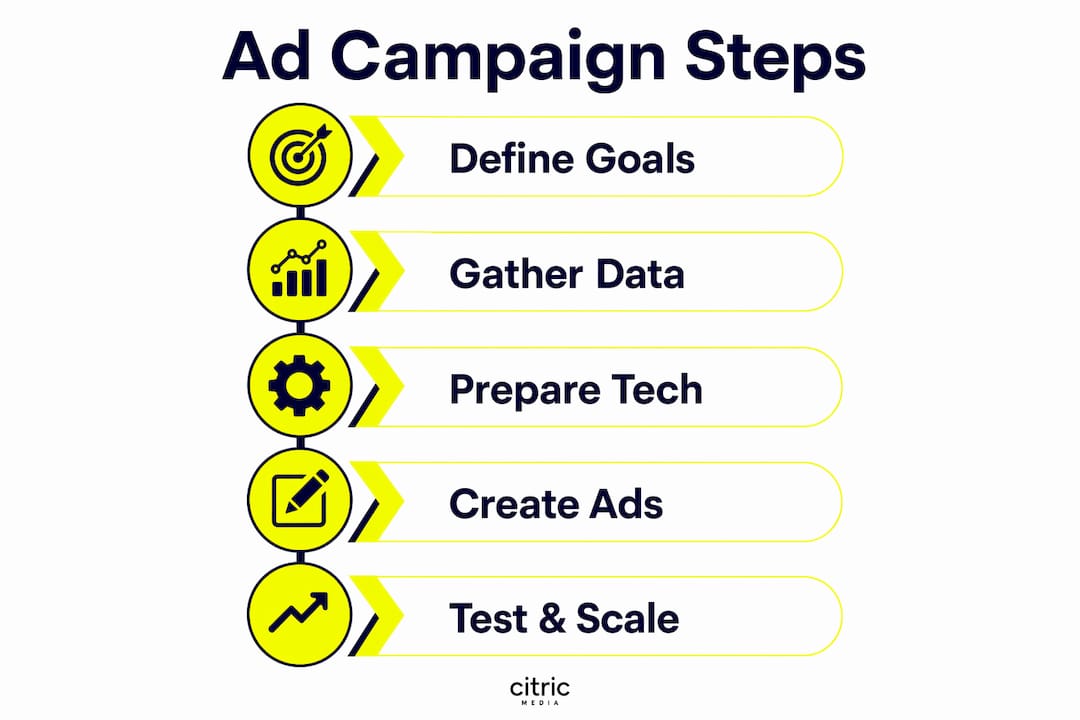
Define goals using SMART criteria
Every campaign needs a measurable objective tied to a business outcome. Use SMART criteria: Specific, Measurable, Achievable, Relevant, and Time-bound. “Increase leads” is not a goal. “Generate 150 qualified enquiries at a cost per lead below £40 within 30 days via Meta Ads” is a goal. This precision shapes every downstream decision, from bidding strategy to creative messaging.
Gather audience data and competitive intelligence
Audience data should come from multiple sources: first-party CRM data, Google Analytics 4 behavioural segments, and platform-native insights from Meta Audience Insights or TikTok Analytics. Competitive intelligence means reviewing what is already working in your category using tools like the Meta Ad Library or Google Ads Transparency Centre. Understanding the creative conventions in your market tells you both what to emulate and where to differentiate.
Prepare your technical infrastructure
| Tool / System | Purpose |
|---|---|
| Creative brief template | Aligns messaging, audience, and offer before production begins |
| Asset library | Stores approved images, videos, and copy variants for fast deployment |
| Conversions API | Provides server-side tracking for accurate attribution beyond browser cookies |
| Enhanced Conversions | Improves Google Ads measurement by matching hashed customer data |
| Testing platform (e.g., Meta Experiments) | Isolates variables for statistically valid creative tests |
| Marketing Mix Modelling (MMM) | Measures true incremental impact across channels |
Getting your PPC campaign checklist in order before launch is not optional. It is the difference between a campaign that generates learnings and one that burns budget without insight.
Pro Tip: Set up Conversions API before you spend a single pound. Platform-reported ROAS is unreliable without server-side data, and you cannot optimise what you cannot accurately measure.
How to structure ad creative for maximum impact
The anatomy of a high-performing ad is not accidental. It follows a repeatable structure that can be built, tested, and remixed at scale.

The five-component creative framework
Every effective ad contains five distinct components, each serving a specific function:
- Hook: The first 1–3 seconds of video or the headline in static ads. Its sole job is to interrupt the scroll and create a reason to keep watching or reading.
- Body: The core message explaining what the product does and why it matters to this specific audience.
- Proof module: Social proof in the form of testimonials, star ratings, user-generated content, or statistics that reduce scepticism.
- Offer card: The specific proposition, whether that is a price, a discount, a free trial, or a guarantee.
- Call to action (CTA): The instruction that tells the viewer exactly what to do next.
Strong hooks in the first three seconds produce 2–3x higher view-through rates. That figure explains why experienced creative strategists test 10 or more hook variants before changing anything else in an ad. The hook is the highest-leverage variable in the entire creative.
Why modular creative outperforms one-off production
Modular creative frameworks allow you to swap individual components without rebuilding the entire ad. A winning body and offer card can be paired with five different hooks, generating five testable variants from one production session. This approach extends the lifespan of winning ads and reduces production costs significantly.
Specific, urgent CTA text increases conversion rates by 20–30% compared to generic instructions like “Learn More.” “Claim your free audit before Friday” outperforms “Find out more” every time. The specificity signals value and the urgency reduces procrastination.
Pro Tip: High-spend accounts produce 10–20 creative variants monthly to satisfy platform diversity requirements. If you are running fewer than ten variants per month on Meta or TikTok, you are likely leaving performance on the table.
Proof types that actually convert
Not all social proof carries equal weight. Ranked by typical conversion impact:
- Video testimonials from real customers with specific outcomes (“I generated 40 leads in my first week”)
- Before-and-after demonstrations with measurable results
- Third-party review scores from platforms like Trustpilot or Google Reviews
- Statistics and data points that quantify the problem or solution
- Founder-led content shot on an iPhone, which creator-led UGC consistently outperforms polished studio production on social platforms in 2026
What is the best method to test and optimise ad campaigns?
Systematic testing separates campaigns that compound in performance from those that plateau. The method is hypothesis-driven, not aesthetic.
Build a hypothesis-driven testing framework
Hypothesis-driven creative testing with structured decision rules produces predictable scaling outcomes. Every test starts with a written hypothesis: “We believe that a hook featuring a customer pain point will outperform a hook featuring the product benefit, because our audience is problem-aware but not solution-aware.” That specificity forces you to define what a win looks like before the data arrives.
Follow this testing progression:
- Launch with Max Conversions bidding strategy to accumulate data quickly without constraining the algorithm.
- Once you have sufficient conversion volume, shift to target CPA (tCPA) to control efficiency.
- As confidence grows and data deepens, move to target ROAS (tROAS) for margin-focused scaling.
- Isolate one variable per test. Changing the hook and the CTA simultaneously makes it impossible to know which drove the result.
- Define failure thresholds before launch. A creative running 30% above your target CPA for seven days with statistical significance should be paused, not given more time.
- Tag every winning element: hook type, proof format, offer framing, CTA phrasing. This builds your winners library.
Scaling budgets gradually by 20–30% every 48–72 hours preserves algorithm stability. A sudden doubling of spend resets the learning phase and often collapses performance for days.
Build a winners library for repeatable success
A winners library documents which hook types, messaging angles, and offer framings have produced results. It means you never start a new campaign from a blank page. Each new brief draws on proven patterns, reducing the time to first winning creative and raising the floor on campaign performance across the board.
Pro Tip: After every test cycle, feed the learnings back into your next creative brief. Documented decision rules and feedback loops compound knowledge over time. Teams that do this consistently outperform those that treat each campaign as a standalone project.
For a deeper look at monitoring performance across channels, the Citricmedia guide on tracking digital campaign results covers the tools and methods in detail.
Which pitfalls cause ad campaigns to fail?
Most underperforming campaigns share the same handful of root causes. Recognising them early saves budget and time.
- Weak hooks tested too late. Teams frequently analyse ads aesthetically rather than examining the underlying mechanism. If a campaign is not performing, test new hooks before changing anything else.
- Creative and placement mismatch. A polished 30-second brand video performs poorly as a TikTok in-feed ad. Match creative format, length, and tone to the platform and placement.
- No testing structure. Running multiple changes simultaneously produces data that cannot be interpreted. One variable per test, always.
- Ignoring ad fatigue. Tracking creative decay with explicit metrics and rotating creatives around the 90-day mark significantly extends campaign effectiveness. Frequency rises, click-through rate falls, and cost per acquisition climbs. These are the warning signs.
- Sudden large budget increases. Jumping spend by 50% or more in a single day resets the algorithm’s learning phase. Gradual increases protect performance.
- Over-relying on platform ROAS. Platform-reported figures overcount conversions due to attribution window overlaps. Conversions API and Marketing Mix Modelling give a more accurate picture of true incrementality.
Pro Tip: When a campaign stops performing, resist the urge to change everything at once. Diagnose systematically: check hook performance first, then audience signals, then offer relevance. Changing everything simultaneously makes recovery impossible to replicate.
For practical examples of what successful campaigns look like in practice, the Citricmedia resource on advertising examples for UK SMEs is worth reviewing alongside this guide.
Key takeaways
Effective ad campaigns are built on creative quality, structured testing, and disciplined scaling, not budget size or platform selection alone.
| Point | Details |
|---|---|
| Creative quality is the primary lever | Creative drives 56% of auction outcomes, so prioritise production and testing above all else. |
| Structure every ad in five components | Hook, body, proof, offer, and CTA each serve a distinct function and should be tested independently. |
| Use hypothesis-driven testing | Define winning and failure thresholds before launch to remove subjectivity from scaling decisions. |
| Scale budgets gradually | Increase spend by 20–30% every 48–72 hours to maintain algorithm stability and protect performance. |
| Build a winners library | Document proven hook types and messaging angles so every new campaign starts from a position of strength. |
My honest view on what actually separates winning campaigns
After working with UK businesses across a wide range of sectors, the pattern is consistent. The teams that produce the best ad results treat creative production as an engineering discipline. They document everything, test with rigour, and build systems rather than relying on instinct or inspiration.
The single biggest shift I have seen in 2026 is the dominance of creator-led content. iPhone-shot, founder-narrated video ads are outperforming studio-produced content on Meta and TikTok with striking regularity. This is not a trend to wait and see on. It is already the standard for high-performing accounts.
What I find most underused is the winners library concept. Most businesses I speak to have no systematic record of what has worked and why. They repeat the same creative mistakes because the learnings from previous campaigns were never captured. Building that library is, in my view, the highest-return activity a marketing team can invest time in.
The future of paid advertising belongs to teams that combine creative intuition with data science. Creativity without measurement is guesswork. Measurement without creative ambition produces mediocre ads that technically perform but never break through. The balance between the two is where sustained success lives.
— Martin
How Citricmedia can help you build campaigns that perform
Citricmedia has spent over 27 years building performance-driven campaigns for UK businesses across Google Ads, Meta, TikTok, and Bing. The frameworks described in this article, from modular creative production to hypothesis-driven testing, are the same approaches the team applies daily for clients generating real enquiries and sales.
Whether you are starting from scratch or looking to improve the performance of existing campaigns, Citricmedia’s paid social campaign service gives you access to a team that combines creative strategy with rigorous data analysis. If you want campaigns built to scale, not just to launch, explore what Citricmedia offers and take the first step towards measurable growth.
FAQ
What makes an ad campaign effective?
An effective ad campaign combines a clear measurable objective, audience-matched creative, and a structured testing process. Creative quality alone accounts for 56% of ad auction outcomes, making it the single most important variable.
How many creative variants should i produce each month?
High-performing accounts produce at least 10–20 creative variants monthly to meet platform diversity requirements and maintain consistent testing. Fewer variants limits your ability to identify winning patterns quickly.
How do i know when to scale a campaign budget?
Increase budgets by 20–30% every 48–72 hours once a campaign is performing at or below your target CPA. Larger or faster increases reset the algorithm’s learning phase and typically cause performance to drop.
What is a winners library and why does it matter?
A winners library is a documented record of which hook types, messaging angles, and offer framings have produced results in previous campaigns. It prevents teams from starting every new campaign from scratch and raises the baseline quality of creative briefs over time.
How do i fix an underperforming ad campaign?
Start by testing new hook variants before changing any other element, as weak hooks are the most common cause of poor performance. If new hooks do not improve results, review creative-to-placement fit, audience targeting, and your tracking setup before drawing conclusions.