GeneralOnline Marketing
Many UK business owners assume that managing digital marketing in-house gives them more control and saves money. It feels logical: keep it close, keep it cheap. But that assumption quietly costs businesses growth every year. Data shows agencies deliver superior ROI and scalability for most UK SMEs, yet the myth persists. This article breaks down exactly what a digital agency does, compares it honestly against in-house marketing, and shows you where the real value lies. Whether you’re questioning your current setup or exploring your options for the first time, the evidence here may shift your thinking.
Table of Contents
- What does a digital agency actually do?
- Comparing digital agency and in-house marketing for SMEs
- How digital agencies drive business growth and ROI
- Technology and strategy: Tools agencies use to stay ahead
- Aligning agency support with your business goals
- The uncomfortable truth: Why most SMEs hold back from agency support
- How the right digital agency can transform your business
- Frequently asked questions
Key Takeaways
| Point | Details |
|---|---|
| Agencies deliver ROI | Most UK SMEs see better returns using digital agencies than in-house marketing teams. |
| Breadth of expertise | Agencies provide access to a mix of specialists and tools beyond the reach of most SMEs. |
| Tech advantage | Digital agencies leverage advanced analytics and platforms for measurable marketing gains. |
| Goal alignment | A quality agency will tailor strategy to your specific business objectives for best results. |
What does a digital agency actually do?
The phrase “digital agency” gets thrown around loosely, and that vagueness creates room for scepticism. In reality, a capable agency functions as an extension of your business, bringing together skills that most SMEs cannot replicate internally without significant investment.
At its core, an agency delivers a coordinated set of services designed to attract, engage, and convert your target audience. Understanding the specialised skills agencies bring to marketing campaigns helps clarify why this matters so much for growing businesses. Here is what that typically includes:
- Search engine optimisation (SEO): Improving your organic visibility in search results so the right people find you first.
- Pay-per-click advertising (PPC): Running targeted campaigns on Google and Bing that generate immediate, measurable traffic and leads.
- Content marketing: Creating articles, landing pages, and resources that build authority and support conversions.
- Analytics and reporting: Tracking what works, identifying what does not, and adjusting strategies based on real data.
- Paid social media: Reaching defined audiences on platforms like LinkedIn, Facebook, and Instagram with precision.
What makes agencies genuinely powerful is not just the list of services. It is the integration. Channels do not operate in isolation inside a strong agency. SEO informs content strategy, PPC data reveals audience intent, and analytics ties it all together into a feedback loop that continuously improves performance.
Agencies also provide access to enterprise-level tools that would be prohibitively expensive for most SMEs to purchase independently. Think advanced keyword research platforms, competitor intelligence tools, conversion rate optimisation software, and A/B testing infrastructure. These are not extras. They are the foundation of data-driven decision making.
Pro Tip: When evaluating agencies, avoid choosing solely on price. A lower monthly retainer that produces no measurable growth costs far more than a higher fee attached to clear, demonstrable results. Ask for case studies and specific performance metrics before signing anything.
The best agencies also stay current. Digital marketing evolves rapidly, and an in-house generalist simply cannot keep pace with algorithm changes, platform updates, and emerging channel opportunities the way a dedicated specialist team can.

Comparing digital agency and in-house marketing for SMEs
With a clear understanding of what agencies provide, many business owners still wrestle with the in-house question. Let’s compare the two approaches honestly, because the right answer depends on your specific situation.
When evaluating your options, consider these four criteria in order:
- Budget: In-house hiring involves salary, national insurance, benefits, training, and tools. A full digital marketing team costs significantly more than most agency retainers.
- Expertise depth: A single in-house hire is typically a generalist. An agency provides specialists in SEO, PPC, analytics, and content simultaneously.
- Scalability: Agencies scale up or down based on your needs. Hiring and redundancy cycles are expensive and slow.
- Strategic continuity: Agencies maintain institutional knowledge even when individual team members change.
| Factor | Digital agency | In-house team |
|---|---|---|
| Cost structure | Monthly retainer, predictable | Salaries, tools, training, ongoing |
| Expertise | Multi-specialist team | Usually one or two generalists |
| Scalability | High, adjust at short notice | Low, tied to headcount |
| Tool access | Enterprise-grade, included | Purchased separately |
| Speed to market | Faster, processes in place | Slower, learning curve applies |
| Cultural integration | Requires strong briefing | Deep by default |
Some experts do note that in-house teams offer deeper integration for businesses with highly complex internal processes or regulated industries where institutional knowledge is critical. That is a fair point. However, for the majority of UK SMEs operating in competitive markets, the agency vs. in-house comparison consistently favours agency support when ROI is the measure.
“The agencies vs. in-house debate is rarely about capability alone. For most SMEs, it comes down to whether you can genuinely afford the depth of talent an agency provides, and most cannot.”
The key insight here is that choosing the right team is not about pride of ownership. It is about results. And the data supports agencies as the stronger choice for scalable, cost-effective growth in most scenarios.
How digital agencies drive business growth and ROI
After understanding the comparison, the next key question is impact: how do agencies actually grow your business in practical terms?
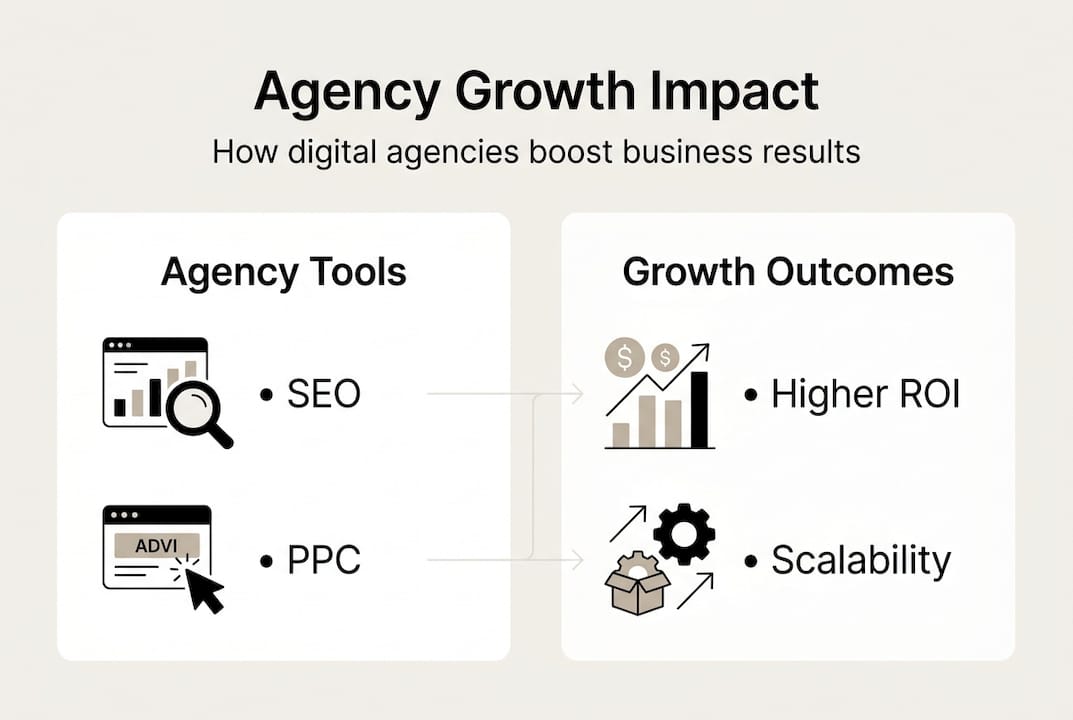
Digital agencies contribute directly to ROI and growth for companies of all sizes by applying structured, data-informed strategies across multiple channels simultaneously. The cumulative effect of well-managed PPC, SEO, and content working together compounds over time in ways that single-channel, in-house efforts rarely achieve.
Here are the primary growth levers agencies activate for SMEs:
- Lead generation: Targeted campaigns bring qualified prospects to your website, reducing wasted spend on broad, poorly defined audiences.
- Sales growth: Optimised landing pages, retargeting campaigns, and conversion-focused strategies turn traffic into revenue more efficiently.
- Brand awareness: Consistent presence across search and social platforms builds the recognition that shortens sales cycles over time.
- Customer retention: Email marketing and content strategies keep existing customers engaged and spending.
Research on agency outcomes consistently shows that SMEs working with specialist agencies outperform those relying solely on in-house efforts, particularly in competitive sectors.
| Service type | Typical SME improvement with agency support |
|---|---|
| Google Ads (PPC) | 30 to 60% improvement in cost per lead |
| SEO | 40 to 80% increase in organic traffic within 12 months |
| Paid social | 25 to 50% improvement in audience targeting efficiency |
| Conversion rate optimisation | 15 to 35% uplift in website conversion rates |
These figures are not guarantees, and results vary depending on sector, budget, and market conditions. But they reflect the kind of improvement that becomes possible when trained specialists work with the right tools and sufficient data. Most in-house teams, particularly in SMEs, simply do not have the bandwidth or expertise to achieve this level of performance consistently.
Technology and strategy: Tools agencies use to stay ahead
Beyond strategy and people, agency resources make a substantial difference. The technology gap between a specialist agency and the average in-house SME team is wider than most business owners realise.
Agencies invest heavily in platforms and tools because their entire business model depends on delivering measurable performance. The tools and technologies agencies use to enhance marketing outcomes include analytics suites, automation platforms, audience intelligence tools, and split-testing infrastructure that most SMEs would never justify purchasing independently.
Here is what that technology advantage translates to in practice:
- Deeper audience insights: Advanced data platforms reveal who your customers are, how they behave, and what motivates conversion.
- Faster optimisation: Automated bidding and A/B testing tools identify winning combinations at a speed no human team can match manually.
- Multichannel coordination: Platforms that connect Google, Bing, and social campaigns into a unified view prevent wasted spend and double-counting.
- Competitor intelligence: Tools that monitor competitor ad spend, keyword strategies, and content performance let agencies make smarter tactical decisions.
- Transparent reporting: Custom dashboards mean you see exactly where your budget goes and what it produces.
Agencies also have access to advanced marketing platforms and beta features that are not available to standard advertisers. Early access to new ad formats or bidding strategies can deliver a meaningful competitive edge in the months before those features become widely available.
Coupled with proven SEO strategies that adapt to algorithm changes in real time, this technology stack means agencies can protect and grow your performance even when market conditions shift unexpectedly.
Pro Tip: When speaking to a potential agency, ask them to walk you through their reporting dashboard. If they cannot show you a clear, client-facing view of performance data, that is a red flag worth taking seriously.
Aligning agency support with your business goals
Even with the right tools and talented people, alignment with your specific business goals is what separates a productive agency relationship from a frustrating one. Technology without direction is just noise.
Effective agencies do not apply the same template to every client. They begin by understanding your market position, your competitive landscape, your revenue targets, and the constraints you are working within. How agencies align marketing strategy with broader business objectives is what separates strong partnerships from transactional ones.
The alignment process in a well-run agency typically follows these steps:
- Needs analysis: A structured review of your current marketing performance, channels, and gaps.
- Target setting: Defining specific, measurable outcomes tied to your business goals, not just vanity metrics.
- Channel selection: Identifying which platforms and strategies are most appropriate for your audience and budget.
- Feedback loops: Regular reviews where data informs strategy adjustments, rather than annual check-ins that arrive too late to act on.
- Communication cadence: Agreed touchpoints that keep your team informed without overwhelming them with jargon.
The signs of a strong agency partnership are not always dramatic. They show up in consistent reporting, proactive recommendations, and the willingness to have honest conversations when something is not performing. Tailored marketing strategies built around your specific goals will always outperform generic campaigns built around industry templates.
What you want from an agency is not a supplier relationship. It is a growth partner who understands your business well enough to challenge your assumptions and back their recommendations with data.
The uncomfortable truth: Why most SMEs hold back from agency support
Here is what most articles on this topic avoid saying directly: the real barrier is rarely budget. It is trust.
Business owners who have built their companies from scratch find it genuinely difficult to hand over something as visible as their marketing to an outside team. There is a fear of losing control, a worry that an agency will not understand the nuances of their industry, and, if we are honest, a lingering belief that no one will care about the business as much as the owner does.
Those concerns are legitimate. But they are also often based on a misrepresentation of what a good agency relationship actually looks like. The data consistently shows superior ROI for SMEs that commit to agency partnerships, yet many hold back until a competitor forces the issue.
The SMEs that benefit most from trusted agency expertise are not the ones with the biggest budgets. They are the ones willing to evaluate capability, cultural fit, and long-term potential honestly, rather than defaulting to the comfort of in-house control that costs them growth.
How the right digital agency can transform your business
If the evidence in this article resonates, the next logical step is finding an agency that can actually deliver it for your business.
At Citric Media, we have spent over 27 years helping UK SMEs generate measurable growth through performance-driven digital marketing. From Google Ads support that reduces cost per lead and drives qualified enquiries, to SEO strategies that build long-term organic visibility, our approach is rooted in data and shaped around your specific goals. If you are ready to stop guessing and start growing, explore Citricmedia services to see how we can align our expertise with your ambitions. The conversation starts with understanding your business, not pitching a template.
Frequently asked questions
Is a digital agency worth it for small businesses?
For most UK SMEs, digital agencies deliver stronger ROI and scalability than in-house marketing, particularly when access to multi-specialist expertise and enterprise tools is factored in. Agency performance data consistently supports this for competitive markets.
What services should I expect from a digital agency?
Most agencies offer strategy, SEO, PPC, content creation, analytics, and ongoing campaign management as standard. The specialised skills agencies provide go well beyond what a single in-house hire can realistically cover.
How do I choose the right digital agency for my business?
Assess each agency’s track record, industry experience, and reporting transparency before committing. Understanding how agencies align strategy with your specific business objectives is the most reliable indicator of a productive partnership.
Can a digital agency guarantee results?
No reputable agency can guarantee specific outcomes, but strong agencies can demonstrate proven ROI improvements for comparable businesses. Documented agency contributions to growth provide a reliable basis for setting realistic expectations.