General
Trust is the foundational condition that determines whether a digital partnership thrives or quietly collapses under the weight of unmet expectations. In the context of business collaboration, the role of trust in digital partnerships is best understood as both a behavioural commitment and a systemic output. It governs how organisations share resources, make decisions under uncertainty, and sustain momentum through the inevitable friction of working across organisational boundaries. Research from Vanson Bourne and Frontiers in Psychology confirms that trust is not a soft concept. It is a measurable, manageable, and architecturally designable asset.
How does trust influence collaboration and innovation in digital partnerships?
Trust functions as the mediator that converts formal agreements into genuine collaboration. Without it, partners comply with contract terms but withhold the knowledge, candour, and creative risk-taking that produce real competitive advantage. Research confirms that resource complementarity mediates trust’s impact on strategic alliance outcomes, meaning trust alone does not achieve goals. It creates the conditions under which complementary capabilities can be shared freely.
The speed at which decisions get made in a digital partnership is a direct function of trust levels. Low-trust teams spend disproportionate time seeking reassurance, validating intentions, and managing political risk. High-trust teams move faster and avoid costly rework, which compounds into a significant performance gap over time. This is not anecdotal. High-trust teams move faster and sidestep the expensive cycles of renegotiation that plague low-trust arrangements.

Innovation rates are also directly affected. When partners trust each other, they are more willing to share early-stage ideas, flag problems before they escalate, and experiment with approaches that carry genuine risk. That openness is precisely what distinguishes a transformative alliance from a transactional vendor relationship.
Key ways trust shapes collaboration outcomes:
- Faster decision cycles. Trusted partners skip redundant approval layers and act on shared intent.
- Higher knowledge transfer. Teams share proprietary methods and internal data when they trust the recipient’s discretion.
- Greater risk tolerance. Partners propose bolder strategies when they believe the other side will absorb setbacks constructively.
- Reduced governance overhead. Trust reduces the need for exhaustive contractual controls, freeing resources for productive work.
Pro Tip: Before signing a partnership agreement, run a short pilot project with no contractual safety net. How your prospective partner behaves under mild pressure tells you more about their trustworthiness than any due diligence document.
What are the main challenges to building trust in digital partnerships?
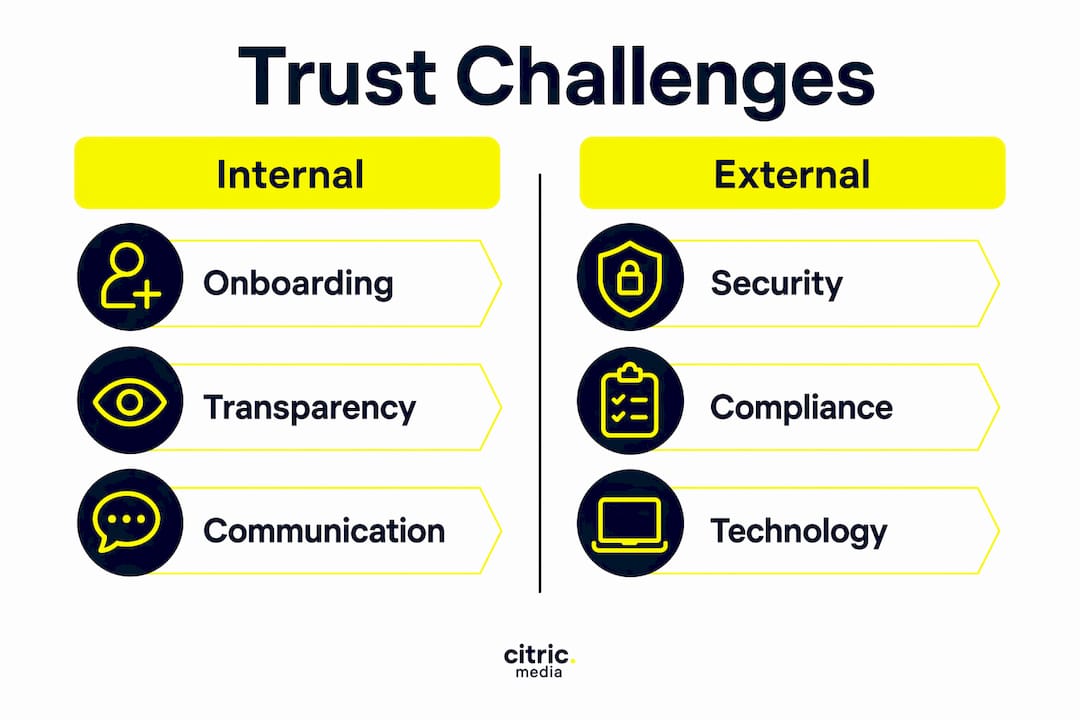
The most underestimated trust killer in digital partnerships is onboarding friction. One in three third-party users wait days for access to critical systems. That delay communicates a clear message before a single meeting has taken place: you are not a priority. Trust erodes before the work even begins.
The challenges compound in predictable patterns. Here are the four most common obstacles business leaders encounter:
- Access delays and the agility paradox. Slow onboarding processes signal organisational dysfunction. Partners interpret delays as indifference or distrust, which sets a negative tone that is difficult to reverse.
- Digital surveillance and psychological safety. Digital communication quality correlates strongly with trust (r=0.56, p<0.001), but perceived surveillance through monitoring tools actively lowers the feeling of being trusted. That paradox is particularly acute in remote and hybrid digital partnerships.
- Inconsistent communication and selective transparency. Partners who share good news promptly but delay bad news create an information asymmetry that breeds suspicion. Selective transparency is not a communication style. It is a trust liability.
- Cost optimisation at trust’s expense. Prioritising short-term savings over relationship investment is a compounding risk. Teams that cut corners on communication infrastructure, shared tooling, or partner enablement pay for it in rework, delays, and eventual alliance failure.
Pro Tip: Audit your partner onboarding process from the outside in. Ask a new partner to document every friction point they encounter in their first two weeks. The list will almost certainly surprise you.
The importance of trust in partnerships becomes starkly visible when these challenges accumulate. Each friction point is individually manageable. Together, they create a culture of low-trust collaboration that no contract clause can fix.
How are zero-trust and Sovereign SASE frameworks changing trust management?
Modern digital architectures are shifting trust from a subjective feeling to a verifiable system output. This is the most significant structural change in how organisations manage trust in digital collaborations. Sovereign SASE and zero-trust frameworks automate compliance and identity verification directly into network architecture, removing the need to rely on human judgement at every access point.
Zero-trust operates on a simple principle: no user, device, or system is trusted by default, regardless of location. Every access request is verified continuously. Sovereign SASE extends this by embedding data sovereignty and regulatory compliance into the same framework. Together, they transform trust from an assumption into an engineered attribute.
| Approach | Trust basis | Key mechanism | Best suited for |
|---|---|---|---|
| Traditional perimeter security | Location-based assumption | Firewall and VPN access | Single-organisation environments |
| Zero-trust architecture | Continuous verification | Identity governance and least-privilege access | Multi-partner digital ecosystems |
| Sovereign SASE | Verified and compliant | Automated policy enforcement with data sovereignty | Public-private partnerships and regulated sectors |
Automated identity governance transforms onboarding from a liability into a competitive advantage. Partners gain access faster, with greater security, and without the manual bottlenecks that undermine trust before the relationship matures. For public-private partnerships operating across jurisdictions, Sovereign SASE is no longer optional. It is the architecture that makes trust scalable.
What strategies can leaders use to sustain trust in digital collaborations?
Sustaining trust in digital partnerships requires deliberate behavioural choices, not just good intentions. The research is clear: partners who say yes to every request often signal weak trust, not strong commitment. Genuine trustworthiness is built through honest responses, proactive disclosure of constraints, and the willingness to admit mistakes promptly. That runs counter to the instinct many leaders have to project confidence at all times.
Here are the strategies that consistently produce durable trust in digital alliances:
- Reward candour explicitly. When a partner flags a problem early, respond with gratitude, not frustration. The way you receive bad news determines whether you receive it at all next time.
- Separate identity from performance. Criticise decisions and outputs, not people or organisations. Partners who fear reputational damage will withhold information to protect themselves.
- Test trustworthiness before full commitment. Assign a meaningful but bounded task early in the relationship. Observe how the partner handles ambiguity, pressure, and unexpected setbacks.
- Invest in shared communication infrastructure. Tools like Slack, Microsoft Teams, and Notion reduce the information asymmetry that erodes trust in distributed partnerships. The quality of your shared digital environment reflects the quality of your commitment.
- Balance short-term cost pressure with long-term trust investment. Cutting communication budgets or reducing partner enablement to hit quarterly targets is a false economy. Optimising for cost over trust leads to compounding risks and higher long-term costs.
Pro Tip: Schedule a quarterly trust review with each key digital partner. Ask directly: “What have we done in the last 90 days that made it harder to work with us?” The answers will be more valuable than any satisfaction survey.
The importance of transparency in marketing mirrors these principles precisely. Organisations that practise transparency externally tend to build more trusted internal and partner relationships as well. The two are not separate disciplines.
A finding from Vanson Bourne underscores the gap between perception and reality: 97% of leaders see collaboration as trust-positive, yet only 20% say it significantly increases trust without tangible evidence. That gap is where most trust-building strategies fail. Collaboration creates the opportunity for trust. Consistent, honest behaviour is what converts that opportunity into a durable asset.
Key takeaways
Trust in digital partnerships is a measurable, architecturally designable asset that determines collaboration speed, innovation quality, and long-term alliance success.
| Point | Details |
|---|---|
| Trust enables resource sharing | Trust mediates access to complementary capabilities, which drive strategic alliance outcomes. |
| Onboarding friction destroys trust early | One in three third-party users face access delays that signal indifference before work begins. |
| Technology can engineer trust | Zero-trust and Sovereign SASE frameworks shift trust from assumption to verifiable system output. |
| Candour builds durable trust | Partners who proactively admit constraints and mistakes create stronger alliances than those who always agree. |
| Cost cuts compound trust risk | Prioritising short-term savings over partner investment leads to rework, delays, and alliance failure. |
Why I think most leaders are building trust backwards
After working with UK SMEs and digital partners across multiple sectors, I have noticed a consistent pattern. Leaders invest heavily in legal frameworks, SLAs, and governance structures, then assume trust will follow. It rarely does. Trust is not a downstream output of good contracts. It is an upstream input that determines whether those contracts ever get tested.
The most common mistake I see is treating trust as a milestone rather than a process. Leaders say “we’ve established trust” after a successful first project, then coast on that assumption for months. Trust in digital collaborations is continuously negotiated. Every interaction either deposits into or withdraws from the relationship’s trust account. A single episode of selective transparency or delayed communication can undo six months of goodwill.
What I find genuinely encouraging in 2026 is the shift toward architecturally engineered trust through zero-trust and Sovereign SASE frameworks. These tools do not replace the behavioural work, but they remove the low-level friction that drains trust before leaders even notice it happening. The organisations scaling digital ecosystems fastest are those treating trust as both a leadership discipline and a technical design requirement simultaneously.
My blunt observation: if you cannot name the specific behaviours your organisation rewards that build partner trust, you are building it by accident. That is not a strategy. It is luck.
— Martin
How Citricmedia helps you build trust-led digital partnerships
Trust-led digital growth requires more than good intentions. It requires transparent, data-driven marketing that demonstrates credibility to partners and customers alike.
Citricmedia has spent over 27 years helping UK SMEs build the kind of digital presence that earns trust at every touchpoint. From Google Ads and SEO to paid social and performance-driven content, every service is built around measurable results and full transparency. If you are ready to make trust a competitive advantage in your digital partnerships, explore Citricmedia’s digital marketing guide for SMEs or visit the Citricmedia homepage to see how we can support your growth.
FAQ
What is the role of trust in digital partnerships?
Trust is the foundational condition that enables partners to share resources, make faster decisions, and sustain collaboration through uncertainty. Without it, alliances default to compliance rather than genuine co-creation.
Why does onboarding friction undermine trust so quickly?
One in three third-party users experience delays accessing critical systems, and those delays signal disorganisation or indifference before any productive work begins. First impressions in digital partnerships are largely structural, not personal.
How does zero-trust architecture relate to digital trust?
Zero-trust frameworks verify every access request continuously rather than assuming trust based on location or prior access. This shifts trust from a subjective judgement to a verifiable, automated system output.
Can trust be rebuilt after it breaks down in a digital alliance?
Trust can be rebuilt, but it requires proactive disclosure of what went wrong, consistent follow-through on new commitments, and patience. Research from Frank Smits confirms that admitting constraints and mistakes promptly is more effective than projecting confidence.
How do you measure trust in a digital partnership?
Practical indicators include decision cycle speed, the frequency of proactive problem disclosure, knowledge-sharing depth, and onboarding completion times. A strong correlation between communication quality and trust (r=0.56) confirms that communication metrics are a reliable proxy for trust levels.