General
Marketing automation is one of those terms that sounds technical but describes something most businesses already wish they were doing. At its core, what is marketing automation? It is software that handles repetitive marketing tasks for you, from sending emails to scoring leads, so your team can focus on work that actually requires human thinking. Studies show it delivers £4.30 per £1 spent on average, with payback under six months. That is not a large enterprise figure. It applies to growing SMEs and lean marketing teams just as much.
Table of Contents
- Key takeaways
- What is marketing automation, and how does it work?
- Why businesses are investing in marketing automation
- How AI is reshaping marketing automation
- Integrating automation with CRM: getting it right
- My honest view on marketing automation adoption
- How Citricmedia can support your digital marketing growth
- FAQ
Key takeaways
| Point | Details |
|---|---|
| Automation is not just for big businesses | SMEs can adopt marketing automation starting with simple lead capture and nurture sequences at low cost. |
| CRM and automation serve different roles | CRM stores your data; marketing automation acts on it. Both must work together in real time. |
| AI is changing what automation can do | Modern platforms use predictive modelling, not just fixed rules, to trigger personalised campaigns. |
| Starting simple produces better results | Businesses that begin with core workflows avoid the costly mistakes of over-complicating automation too early. |
| ROI is measurable and fast | Marketing automation pays back under six months, making it one of the highest-return tools in digital marketing. |
What is marketing automation, and how does it work?
The definition of marketing automation is straightforward: it is software that manages and executes marketing tasks across multiple channels without requiring manual input for each action. Think of it as a set of rules and triggers that run in the background, responding to what your prospects and customers actually do.
When a visitor downloads a guide from your website, marketing automation can immediately send a follow-up email, tag that lead based on their interest, add them to a nurture sequence, and alert a salesperson when the lead reaches a certain score. All of that happens without anyone pressing a button.
Multichannel campaign management is central to how most platforms operate. A single customer behaviour, such as clicking a product page, can trigger coordinated responses across email, SMS, paid retargeting, and even direct mail. The system ensures your messaging stays consistent regardless of which channel the customer uses.
The core features you will find across most marketing automation tools include:
- Email automation. Triggered sequences sent based on specific actions or time intervals, not just bulk broadcasts.
- Lead scoring. A point system that ranks leads by their behaviour and profile data, so sales teams focus on the most sales-ready prospects.
- Workflow triggers. Logic-based rules that decide what happens next when a contact takes a specific action.
- Segmentation. Automatically grouping contacts by behaviour, demographics, or funnel stage to deliver relevant messaging.
- Reporting and attribution. Tracking which campaigns, sequences, and touchpoints contribute to conversions.
One distinction worth making clear: marketing automation is not the same as a CRM. A CRM, such as Salesforce or HubSpot, is primarily a system of record. It stores contact data, tracks deals, and manages your sales pipeline. Marketing automation is the system of action. It takes that data and executes campaigns, triggers workflows, and moves leads through the funnel. Both are necessary. Neither replaces the other.
Why businesses are investing in marketing automation
The benefits of marketing automation are not theoretical. They show up in time saved, leads converted, and revenue generated. Here is where the numbers become hard to ignore.

Reporting time drops from 15 hours to 2 hours per client when AI-powered automation handles data collection and analysis. Content drafting, which typically consumes a significant portion of a marketer’s week, falls by 75% with automation-assisted production. For a business owner wearing multiple hats, those hours are not a minor convenience. They represent the difference between managing your marketing reactively and leading it strategically.
The documented benefits span every part of the marketing and sales process:
- Efficiency. Repetitive tasks like follow-up emails, lead assignment, and report generation run without manual effort.
- Lead quality. Lead scoring filters out low-intent contacts so your sales team engages prospects who are genuinely ready to buy.
- Personalisation at scale. Automated sequences can deliver messages tailored to a contact’s behaviour without someone writing each one manually.
- Sales and marketing alignment. When both teams work from shared data and agreed lead definitions, sales and marketing alignment improves significantly, reducing the friction that kills deals.
- Measurable ROI. Marketing automation delivers an average ROI of $5.44 per $1 spent, with payback typically under six months.
For UK SMEs in particular, the ability to compete with larger teams through automation is not just appealing. It is a practical necessity. You can run sophisticated, personalised lead generation with a small team if the systems are set up correctly. That is what automated marketing does at its best.
How AI is reshaping marketing automation
The shift happening right now in marketing automation tools is not incremental. It is architectural. Early automation ran on fixed rules: if a contact opens email A, send email B. That logic was useful but brittle. It could not respond to nuance, could not learn, and required constant manual updates as customer behaviour changed.
AI changes that entirely. Modern platforms now use predictive modelling and real-time signals to decide when and how to engage a prospect. Rather than firing a sequence after a set number of days, an AI system might detect that a contact has revisited your pricing page three times in a week and trigger an urgent, highly personalised outreach sequence without anyone setting that rule in advance.
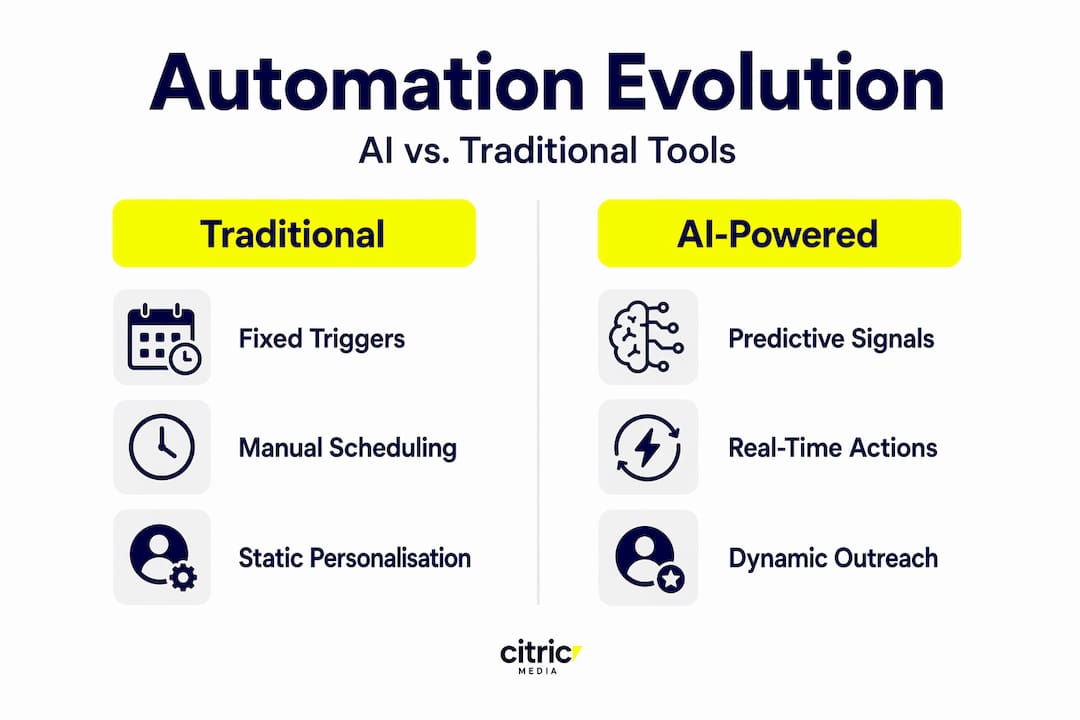
| Feature | Traditional automation | AI-powered automation |
|---|---|---|
| Trigger logic | Fixed rules set manually | Predictive signals and real-time behaviour |
| Personalisation | Segment-based | Individual-level, dynamically adjusted |
| Optimisation | Manual A/B testing | Continuous self-optimisation |
| Campaign planning | Marketer-led | Increasingly autonomous agent-driven |
| Forecasting | Historical reports | Predictive modelling of future behaviour |
The next phase is already arriving. By the end of 2026, 40% of enterprise applications are expected to include AI agents that can autonomously plan and execute marketing campaigns. These are not tools that assist marketers. They are systems that can independently manage campaign logic, allocate budget, and respond to performance data without human instruction on each step.
Pro Tip: Do not confuse AI autonomy with removing strategy from the equation. The best AI-driven marketing automation still requires a human to define goals, set quality standards, and review outputs. AI complements human creativity rather than replacing the thinking behind your campaigns.
Machine learning also makes personalisation dynamic rather than static. Timing, tone, channel, and offer can all be adjusted based on what the system learns about individual behaviour. For businesses that want to understand how to build a data-driven marketing strategy, this is where automation becomes genuinely powerful. The platform learns what works for your specific audience, not just what worked for someone else’s.
Integrating automation with CRM: getting it right
This is where most businesses stumble. They invest in either a CRM or a marketing automation platform, treat them as separate tools, and then wonder why leads are falling through the gaps. The problem is almost always the same: the two systems are not talking to each other in real time.
Bidirectional, real-time integration between your CRM and marketing automation platform is not a technical nicety. It is what makes the whole system function as intended. When a lead’s score changes in your automation platform, your CRM should reflect that instantly. When a salesperson updates a deal stage in the CRM, your automation should respond accordingly, perhaps pausing nurture emails or triggering a different sequence.
Misunderstanding these distinct strategic roles is one of the most common causes of poor marketing ROI and lost leads.
Here is a practical approach for businesses starting out with marketing automation strategies:
- Document your current workflows first. Before touching any software, write down what actually happens when a lead comes in today. Identify the bottlenecks and the tasks that genuinely repeat. Automation that maps to a real process works. Automation that maps to a theoretical one creates new problems.
- Start with three core workflows. Lead capture, a nurture sequence, and lead scoring. Many SMBs fail by trying to automate too much too quickly. These three workflows handle the majority of value and are manageable to build and test.
- Connect your CRM from day one. Even a basic integration prevents data siloes from forming. If you add automation later without integration, you will spend significant time cleaning up duplicate records and misattributed leads.
- Define your lead scoring criteria before you build. Agree with your sales team on what constitutes a qualified lead. Score based on both behaviour, such as page visits and email engagement, and profile fit, such as company size or job title.
- Review and iterate monthly. Automation is not set and forget. Review sequence performance, adjust scoring thresholds, and retire workflows that are no longer serving their purpose.
Pro Tip: Use your marketing funnel understanding to map which automation workflows belong at each stage. Awareness-stage leads need education. Decision-stage leads need proof and urgency. The same nurture sequence should not run for both.
A phased approach, starting with core automation workflows like lead capture and nurture, is more sustainable than attempting to automate every process at once. Build confidence in each workflow before adding complexity.
My honest view on marketing automation adoption
I have spoken to dozens of business owners who feel they are behind on automation, and almost none of them have the problem they think they have. The real issue is rarely a lack of tools. It is a lack of clarity about what problem automation is supposed to solve.
In my experience, businesses that invest in marketing automation tools without first documenting their workflows and agreeing on lead definitions with their sales teams almost always fail to see meaningful returns. The software becomes a graveyard of half-built sequences and abandoned campaigns. Not because the tools are bad, but because strategy was skipped in favour of setup.
What actually works is treating automation as a system, not a subscription. That means being deliberate about what you automate, building integrations before you scale, and recognising that the human job does not disappear. It shifts. Marketers who use automation well spend less time on repetitive output and more time on the decisions that genuinely require creative judgement. That trade, when done properly, changes the trajectory of a marketing team.
For SMEs in particular, my honest advice is to resist the pressure to build elaborate automation architectures from the start. The businesses I have seen get the most from it began with three workflows, got those running well, and expanded gradually. The ROI follows the discipline, not the platform.
— Martin
How Citricmedia can support your digital marketing growth
At Citricmedia, we have spent over 27 years helping UK SMEs generate high-quality leads and sales through digital channels that actually perform. Marketing automation works best when it sits alongside strong paid media, SEO, and social campaigns. A well-run paid social advertising strategy feeds leads into your automation workflows, while SEO builds the organic traffic that makes nurture sequences worth having. If you are thinking about how to connect these channels and make them work together, we are the right people to speak with. We focus on measurable results and have the track record to back that up. Get in touch to discuss how we can help you build a digital marketing system that generates real growth.
FAQ
What is the simple definition of marketing automation?
Marketing automation is software that handles repetitive marketing tasks such as email sequences, lead scoring, and campaign triggers automatically, based on contact behaviour and predefined rules, without manual effort for each action.
How does marketing automation differ from a CRM?
A CRM is a system of record that stores contact data and manages your sales pipeline. Marketing automation is the system of action that uses that data to execute campaigns and nurture leads.
What are the main benefits of marketing automation for SMEs?
The key benefits include time saved on repetitive tasks, improved lead quality through scoring, personalised communication at scale, and measurable ROI. Payback typically arrives in under six months.
What marketing automation tools should a small business start with?
Start with a platform that combines email automation, lead scoring, and CRM integration in one place. Begin with three core workflows: lead capture, a nurture sequence, and basic scoring, before building anything more complex.
How is AI changing marketing automation in 2026?
AI is moving automation beyond fixed rules to predictive modelling and real-time signals, allowing platforms to personalise and optimise campaigns dynamically. By late 2026, 40% of enterprise applications are expected to include autonomous AI agents capable of planning and executing campaigns independently.