Digital Marketing
Many UK SMEs pour budget into digital marketing and see frustratingly little in return. Unclear priorities, fragmented channels, and generic advice that ignores B2B buying dynamics all play their part. This guide cuts through that noise. We have structured it as a practical, evidence-based pathway covering strategic foundations, channel selection, campaign execution, and ongoing measurement. If you are a marketing manager or business owner at a UK SME looking for a clear process rather than abstract theory, this is written for you. Follow these steps and you will have a functioning, measurable B2B marketing machine rather than a collection of disconnected tactics.
Table of Contents
- Lay the groundwork: audit, audience and digital assets
- Choose and implement the most impactful channels
- Plan and run high-converting B2B campaigns
- Measure, optimise, and adapt your marketing machine
- What most B2B marketing guides miss: minimum viable loop, not perfect funnel
- Supercharge your B2B marketing with tailored SME support
- Frequently asked questions
Key Takeaways
| Point | Details |
|---|---|
| Start with foundation | Audit your assets and clarify your ideal client before launching campaigns. |
| Pick high-ROI channels | Focus on LinkedIn, email, and SEO for the strongest early returns. |
| Run buyer-driven campaigns | Build campaigns that match each stage of your B2B buyers’ journey. |
| Measure meaningful KPIs | Prioritise pipeline and revenue metrics over superficial numbers. |
| Embrace the loop | Continuous, flexible improvement outpaces perfection in B2B marketing. |
Lay the groundwork: audit, audience and digital assets
Before execution, it is vital to check your marketing infrastructure and understand exactly whom you are trying to reach. Skipping this stage is the single biggest reason SME campaigns underperform, regardless of budget or channel.
Start by assessing your current marketing state. Review your website, CRM, analytics, existing content, and data compliance. Then define your Ideal Customer Profile (ICP), which is a detailed description of the company type and decision-maker most likely to buy from you. The B2B Marketing for SMEs guidance from HubSpot is clear: start with a strategy audit, focus on audience research, and tailor your digital asset focus to your company size. Skipping audience definition at this stage leads to wasted spend at every subsequent step.
Once you have your ICP, map the buyer journey for your key segments. B2B buying decisions involve multiple stakeholders and longer timelines than B2C, so your content and channels must match how buyers actually research and evaluate options. B2B marketing strategy advice from Forrester consistently highlights this as a priority.
Your digital marketing guide for SMEs should then establish a strong digital foundation before any campaign goes live.
Audit checklist: what to review before launching campaigns
| Area | What to check |
|---|---|
| Website | Speed, mobile performance, conversion tracking, clear CTAs |
| CRM | Data quality, lead source tracking, sales pipeline visibility |
| Analytics | Goals configured, attribution model set, historical data accessible |
| Existing content | Relevance to ICP, gaps across the buyer journey |
| Compliance | GDPR consent processes, cookie policy, email opt-ins |
Key audience questions to answer before you proceed:
- Who are the decision-makers and influencers within your target accounts?
- What problems are they actively trying to solve right now?
- Where do they research solutions, online communities, search engines, or professional networks?
- What objections consistently arise during your sales process?
- What does success look like for them in measurable terms?
Pro Tip: Involve your sales team in the audit. They hear real buyer language every day, and that insight will sharpen your messaging far more effectively than any desk research alone.
Choose and implement the most impactful channels
With your groundwork set, selecting the right marketing channels is your next critical step. The temptation is to be everywhere, but for SMEs with limited resource, that approach dilutes effort and obscures data.
High-ROI channels for SMEs should be prioritised in this order: your company website, content and SEO, email marketing, and then paid media and social. Once those foundations are performing, you can branch into more specialist channels. This sequencing matters because each foundational channel feeds data into the next.

LinkedIn stands out for paid B2B social. It delivers a 121% ROAS for B2B advertisers, and digital ad spend now accounts for 61% of total B2B marketing budgets. If you are going to invest in paid social, LinkedIn is where the evidence points.
Gartner digital strategy insights reinforce the principle of channel integration. Treating each channel as a silo is a common SME mistake that inflates cost-per-lead and makes attribution almost impossible.
Channel comparison for UK B2B SMEs
| Channel | Typical ROI | Resource need | Best fit |
|---|---|---|---|
| Website and SEO | High, long-term | Medium | All SME sizes |
| Email marketing | High | Low | Small to mid-sized SMEs |
| LinkedIn Ads | High for B2B | Medium | Mid to larger SMEs |
| Google Ads / PPC | Fast, measurable | Medium to high | Growth-stage SMEs |
| Content marketing | High, cumulative | Medium | All SME sizes |
Low-hanging fruit to start today:
- Optimise your Google Business Profile and ensure your website has clear, benefit-led messaging for your ICP.
- Build a short email nurture sequence for inbound enquiries not yet ready to buy.
- Publish two to three pieces of search-optimised content targeting your buyers’ most common questions.
Understanding why you should invest in digital marketing as an SME is closely linked to matching channels with where your buyers actually spend their time. And if you need support navigating this, choosing a digital agency with a genuine B2B track record makes a significant difference.
Plan and run high-converting B2B campaigns
After selecting channels, you need a stepwise approach to running targeted campaigns. Building campaigns without a clear workflow leads to scattergun spend and missed opportunities at every stage of the buying cycle.
Follow this campaign workflow:
- Segment your audience based on ICP criteria, company size, sector, and buying stage.
- Select your goal and offer such as a whitepaper download, demo request, or consultation booking.
- Create content and assets that match the buyer stage you are targeting.
- Automate and sequence your communications using your CRM or marketing automation platform.
- Launch and monitor early data to catch underperforming ads or low-engagement emails quickly.
- Nurture and respond to engaged prospects with relevant follow-up content.
- Follow up with sales to ensure hot leads are contacted promptly and feedback flows back into the campaign.
Your content mix should follow the TOFU, MOFU, BOFU framework. Content split recommendations suggest 40% top-of-funnel (awareness), 35% middle-of-funnel (consideration), and 25% bottom-of-funnel (decision). Most SMEs over-invest in BOFU content and wonder why their pipeline feels thin at the top.
“Nurture sequences boost deals by 47%.” This single statistic from B2B marketing research should change how you think about follow-up. Most SMEs send one email and move on. The data says that is a costly habit.
Pro Tip: Use intent data signals, such as repeat website visits or content downloads, to trigger your outbound outreach. Reaching out to someone showing active buying signals converts at significantly higher rates than cold outbound.
For a fuller breakdown of campaign construction, the step-by-step marketing guide on our site covers this in practical detail. You can also explore B2B email marketing tips from HubSpot to sharpen your sequencing logic.
Measure, optimise, and adapt your marketing machine
Even the best campaign will stall without ongoing measurement and adaptation. Too many SMEs run campaigns, collect some data, and then move onto the next initiative without extracting the lessons that would make the next one more effective.
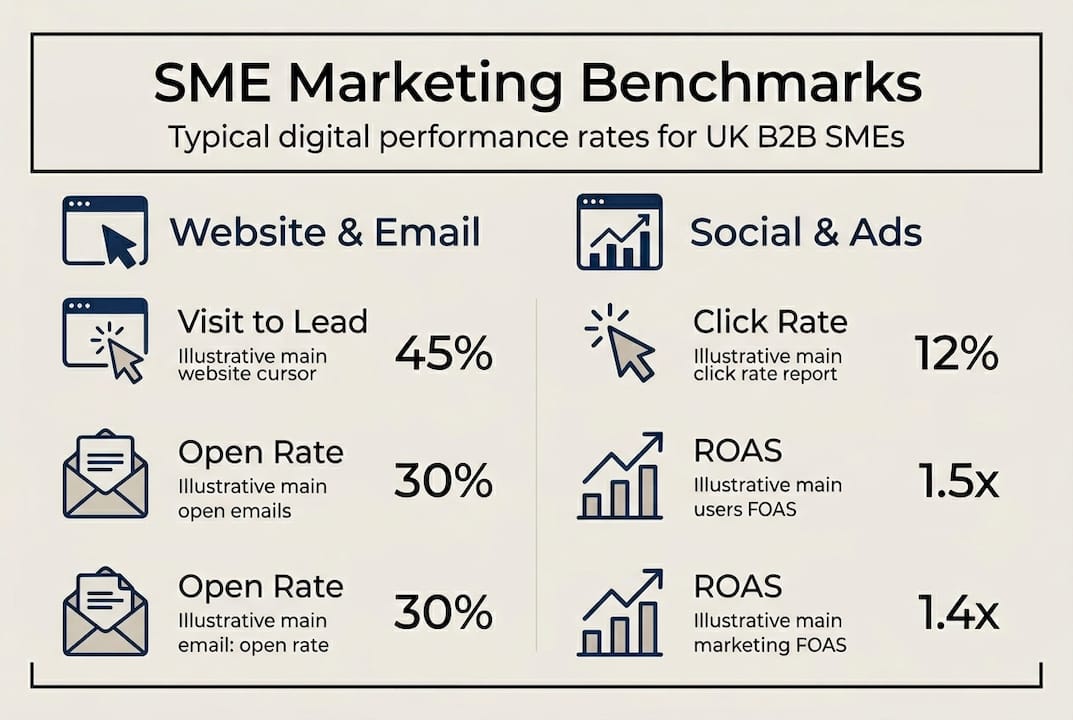
Start with your benchmarks. Visitor-to-lead conversion sits at 3 to 5% for most B2B websites. Email open rates benchmark at 43%, with click-through rates around 2%. AI is now used weekly by 95% of B2B marketers for analysis, targeting, and content generation. If you are not yet integrating AI tools into your measurement workflow, you are already behind the majority of your competitors.
Key campaign metrics benchmarks for UK SMEs
| Channel | Key metric | SME benchmark |
|---|---|---|
| Website | Visitor-to-lead rate | 3 to 5% |
| Open rate | 43% | |
| Click-through rate | 2% | |
| Paid search | Cost-per-lead | Varies by sector |
| LinkedIn Ads | ROAS | 121% for B2B |
Leading B2B marketers consistently outpace their competitors by aligning sales and marketing around shared revenue metrics, not just lead volume. Build a monthly review loop where marketing presents pipeline contribution data to sales, and sales feeds back on lead quality. This loop is where continuous improvement actually happens.
Pipeline and revenue KPIs to track (not vanity metrics):
- Marketing-qualified leads (MQLs) converting to sales-qualified leads (SQLs)
- Cost per opportunity created, not just cost per click
- Revenue influenced by marketing in the pipeline
- Average deal velocity compared to non-nurtured prospects
- Customer acquisition cost (CAC) relative to customer lifetime value (CLV)
For SMEs running paid campaigns, the analytics and PPC expertise available through a specialist agency can dramatically shorten the time needed to reach optimised performance. Track recent B2B marketing trends from Gartner to understand where buyer behaviour and privacy regulations are heading next.
What most B2B marketing guides miss: minimum viable loop, not perfect funnel
With the main steps outlined, it is worth challenging a longstanding marketing assumption. Most guides, including well-intentioned ones, present the B2B marketing process as a linear funnel: awareness flows neatly down to conversion. In reality, modern B2B buying is messy. Buyers revisit earlier stages, involve new stakeholders mid-process, and rarely follow a tidy sequence.
The loop marketing approach consistently outperforms traditional funnel thinking for modern buyers, and it is particularly well-suited to SMEs with lean teams. Rather than engineering a perfect funnel before going live, build a minimum viable loop: a basic but connected set of channels, content, and follow-up processes that generate feedback quickly.
Start good enough. Learn fast. Then improve. This approach means your sales, product, and marketing teams are collaborating from week one, sharing what they hear from buyers, rather than waiting for a polished strategy document to arrive. The teams that win in B2B are not necessarily the ones with the biggest budgets or the most sophisticated tech stacks. They are the ones who act on feedback faster than anyone else. Growth-focused digital approaches that embrace iteration over perfection consistently deliver better commercial outcomes for SMEs.
Supercharge your B2B marketing with tailored SME support
Following a structured process is the right starting point, but execution at pace is where most SME marketing teams hit a wall. Priorities compete, specialist skills are stretched thin, and optimisation often gets deprioritised in favour of the next campaign.
At Citric Media, we work exclusively with UK businesses to build and run performance-driven digital marketing programmes tailored to B2B buying dynamics. From auditing your current assets and setting channel strategy to managing Google Ads, SEO, and paid social, we handle the detail so you can focus on closing the leads we help you generate. Download our free actionable marketing guide or explore why UK SMEs boost growth with the right digital partner. Ready to accelerate? See our full range of SME marketing solutions and book a free diagnostic review today.
Frequently asked questions
What are the core steps in a B2B digital marketing strategy?
Start with an audit, define your customer and buyer journey, then build core assets, choose priority channels, create campaigns, and measure for ongoing improvement. The six-step B2B process from HubSpot provides a solid framework to follow.
Which channels work best for B2B lead generation at UK SMEs?
LinkedIn, your company website, targeted email, and SEO are the main high-ROI channels for UK B2B SMEs starting out. LinkedIn outperforms most other paid channels on B2B return on ad spend.
How do I measure if my B2B marketing is working?
Track visitor-to-lead rates (3 to 5%), email engagement, and opportunities in your sales pipeline, not just vanity metrics. Key B2B benchmarks give you the reference points needed to judge genuine performance.
What is the difference between funnel and loop in B2B marketing?
A loop is a continuous, feedback-driven approach, while a funnel is linear. SMEs benefit from starting lean with ongoing improvement rather than waiting to build a perfect funnel. The shift to loop marketing is increasingly critical for modern B2B buyers.
Is AI really necessary for modern B2B marketing?
AI powers analysis, targeting, and content creation and is now used weekly by 95% of B2B marketers. It is not a future consideration; it is already the standard operating environment for competitive B2B teams.