Digital Marketing
Most businesses understand marketing as something you push out at people. Ads, cold calls, sponsored posts, flyers through the door. But what is inbound marketing, and why does it represent such a sharp departure from that way of thinking? Simply put, inbound marketing is the practice of attracting customers by creating content and experiences that are genuinely useful to them, rather than interrupting them with messages they never asked for. For UK business owners and marketing professionals trying to build sustainable growth, understanding this methodology is not optional. It is the foundation of how modern customer acquisition actually works.
Table of Contents
- Key takeaways
- What is inbound marketing, really?
- The flywheel: attract, engage, delight
- Core inbound marketing strategies and techniques
- The real benefits of inbound marketing
- How to start inbound marketing without wasting time
- My honest take on inbound marketing
- Ready to put inbound marketing to work?
- FAQ
Key takeaways
| Point | Details |
|---|---|
| Inbound earns attention | Rather than pushing ads, inbound draws customers in by solving their real problems with relevant content. |
| The flywheel replaces the funnel | Attract, engage, and delight stages create momentum, with satisfied customers driving future growth. |
| Content is non-negotiable | SEO, blogs, and targeted resources form the backbone of any effective inbound marketing strategy. |
| Sales and marketing must align | The methodology only delivers results when both teams share data, goals, and a unified customer view. |
| Measure revenue, not just traffic | Success means tracking lead quality and conversions, not vanity metrics like page views alone. |
What is inbound marketing, really?
Inbound marketing earns attention by solving problems prospects are already trying to address, using content aligned to their journey stages rather than broadcasting unwanted messages. That definition matters because it tells you what inbound is not. It is not simply “digital marketing.” It is not content for content’s sake. It is a deliberate system for positioning your business in front of people at the precise moment they are searching for what you offer.

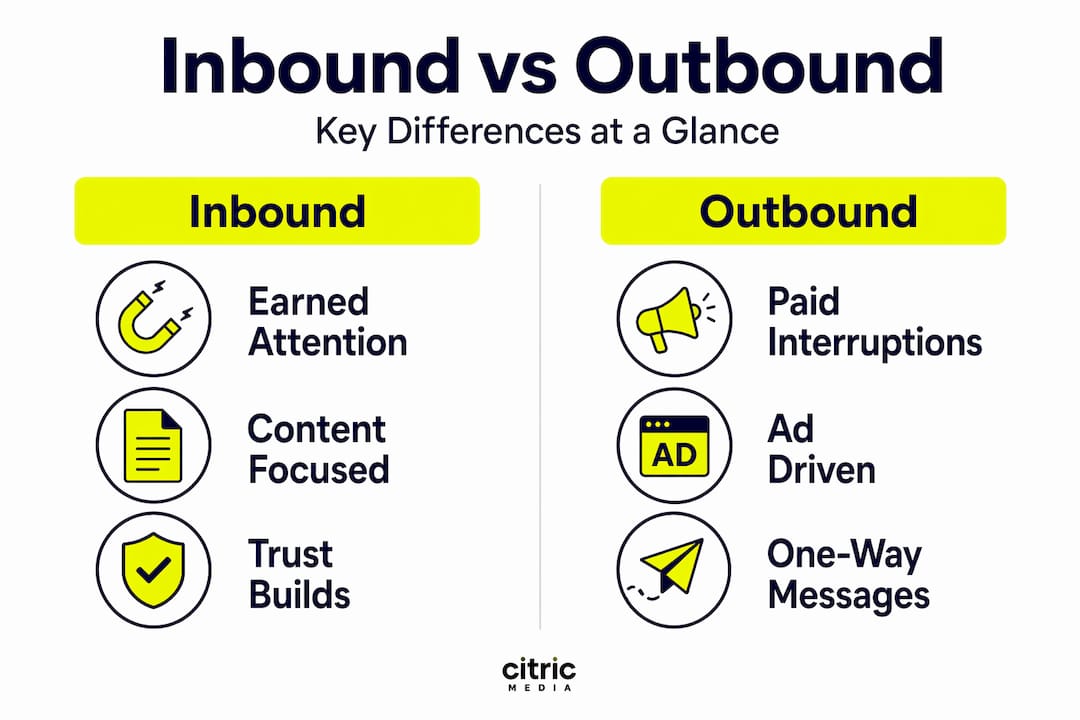
The contrast with outbound marketing is stark. Outbound relies on rented attention. You pay for a TV slot, buy an email list, or run cold call campaigns, and the moment your budget stops, so does your visibility. Inbound, by contrast, builds owned attention over time. A well-optimised article, a thoughtful case study, or a practical video tutorial keeps working for you months and years after publication.
The channels inbound marketing uses most effectively include SEO, content marketing, social media, and email. What unites them is intent. Inbound marketing uses channels like SEO to attract prospects who are actively searching for solutions, generating lower-cost leads over time compared to paid outbound tactics. You are not guessing who might be interested. You are meeting people who have already raised their hand.
Inbound vs outbound at a glance
| Factor | Inbound marketing | Outbound marketing |
|---|---|---|
| Attention model | Earned through value | Bought through spend |
| Lead quality | Higher, intent-driven | Lower, often speculative |
| Cost over time | Decreases as content compounds | Remains constant or rises |
| Customer relationship | Builds trust gradually | Often transactional |
| Primary channels | SEO, content, social, email | Paid ads, cold outreach, TV |
The flywheel: attract, engage, delight
The traditional marketing funnel treated customers as an end point. They entered at the top, moved through stages, converted, and that was largely the relationship concluded. The inbound flywheel model works entirely differently. The flywheel shifts focus from a linear funnel to a circular model where satisfied customers create momentum and ease new customer acquisition through referrals and advocacy.
Understanding the three stages is worth taking seriously.
- Attract. This is where you use SEO, blog content, social media, and educational resources to draw in people who match your ideal customer profile. The goal is not volume for its own sake. It is qualified traffic from people who have a genuine need your business can meet. A UK-based software company, for example, might attract decision-makers by publishing practical guides on GDPR compliance, a topic their audience is actively researching.
- Engage. Once someone arrives, the job is to give them reasons to take the next step. This means clear calls to action, well-designed landing pages, and content that speaks to their specific concerns. Lead nurturing improves response rates, shortens sales cycles, and increases deal size through consistent personalised outreach. This stage is where your CRM and email workflows become critical.
- Delight. This is where most businesses under-invest. Delighting existing customers through proactive support, personalised follow-up, and genuinely useful post-purchase content turns buyers into advocates. Those advocates then refer others, write reviews, and generate organic word of mouth that feeds the attract stage again. The flywheel keeps spinning.
Pro Tip: Map your existing content to each flywheel stage. Most businesses discover they have plenty of attract-stage content and almost nothing designed to delight customers after purchase. That gap is where growth is being lost.
The flywheel model also forces a more honest conversation between marketing and sales. Inbound sales aligns marketing and sales in a continuous feedback loop, where sales insights inform marketing content, creating personalised buyer experiences that build trust and increase conversions. When both teams share the same data and objectives, the entire system compounds more effectively.
Core inbound marketing strategies and techniques
Knowing the philosophy is one thing. Applying it is where most businesses struggle. Here is how inbound marketing strategies actually translate into day-to-day tactics.
Build an SEO-led content programme. Start by identifying the questions your ideal customers are typing into Google. Write thorough, well-structured answers. Understanding how SEO drives results for SMEs is critical here, because organic search is the most cost-effective long-term traffic source available to most businesses. Prioritise topics at every stage of the buyer’s journey, not just awareness-level content.
Create conversion paths, not just content. Inbound marketing requires well-designed conversion paths like landing pages and lead capture mechanisms alongside lifecycle lead nurturing to create real pipeline impact. A brilliant blog post that ends with no clear next step is a missed opportunity. Every piece of content should connect logically to a relevant offer, whether that is a guide, a free consultation, or a product demo.
Build personalised email workflows. Once a prospect submits a form, a generic email blast is a waste of that opportunity. Segment your list by behaviour and interest, then send content that matches where each person is in their decision-making process. This is what separates organisations that generate leads from organisations that generate revenue.
Use social media for dialogue, not broadcasting. LinkedIn, in particular, is a powerful platform for B2B inbound in the UK. Share content that provokes genuine conversation, respond to comments thoughtfully, and use it as a channel to listen to what your audience is worried about. That intelligence feeds directly back into your content strategy.
Build customer advocacy programmes. Ask your happiest customers for case studies, testimonials, and referrals. Create a structured process for gathering this social proof, not an ad hoc one. The role of content in inbound marketing extends well beyond attracting new visitors. Customer stories are some of the most persuasive assets you can publish.
Pro Tip: Do not treat lead nurturing as an email automation tick-box exercise. Review your workflows quarterly, check where contacts are dropping off, and update the content to reflect new product features, customer objections, or seasonal relevance.
The real benefits of inbound marketing
The case for inbound marketing is not theoretical. The performance advantages are grounded in how modern buyers actually behave.
| Benefit | What it means in practice |
|---|---|
| Lower cost per lead | Content compounds over time, reducing acquisition costs as your library grows |
| Higher lead quality | You attract people actively seeking solutions, not passive audiences |
| Stronger brand authority | Consistent, useful content builds credibility with both buyers and search engines |
| Shorter sales cycles | Nurtured prospects arrive better informed, requiring less persuasion to convert |
| Sustainable, compound growth | Inbound delivers compound growth through better customer acquisition compared to costly outbound reach |
The compounding effect is the most important advantage to grasp. A pay-per-click campaign stops generating leads the moment you pause it. A well-optimised piece of content continues attracting visitors and converting prospects independently. For SMEs with finite marketing budgets, this distinction significantly affects how far every pound spent can go.
Trust-building is the other underrated benefit. Inbound sales connects with prospects on educational, trust-building terms, facilitating faster and higher-quality deal closures compared to cold outbound approaches. When a prospect has already read three of your articles, watched a webinar, and downloaded a guide, they arrive at a sales conversation with a very different level of confidence in you.
How to start inbound marketing without wasting time
Getting inbound marketing wrong is surprisingly easy. Businesses publish content without a strategy, chase traffic without a conversion plan, and wonder why the leads never materialise. Here is how to avoid the most common traps.
- Build detailed buyer personas first. Know precisely who you are trying to attract: their role, their goals, their frustrations, and the questions they ask before buying. Generic content attracts generic visitors who rarely convert.
- Map the buyer’s journey before you create anything. Understand what your prospects need to know at the awareness, consideration, and decision stages. Then create content that serves each stage specifically.
- Set revenue-aligned goals from the start. Inbound marketing must link visibility with conversion and revenue for true effectiveness. Agree with your team what a successful inbound programme looks like in terms of qualified leads and pipeline contribution, not just traffic growth.
- Align sales and marketing around a shared definition of a qualified lead. This is the single biggest structural failure in inbound programmes. When sales and marketing disagree about what constitutes a good lead, the entire system breaks down. A shared CRM and regular cross-team reviews fix this.
- Invest in lead nurturing infrastructure early. A solid CRM and email automation platform are not optional extras. They are what transform a content strategy into a revenue engine. For a detailed look at how nurturing works in practice, Citricmedia’s guide to lead nurturing for UK SMEs is worth reading before you build your first workflow.
The measurement discipline matters as much as the execution. Measuring inbound effectiveness must go beyond traffic and engagement, tracking revenue outcomes and retention to confirm alignment with business goals. Too many inbound programmes celebrate page views while ignoring whether any of those visitors ever became paying customers.
My honest take on inbound marketing
I have worked with enough businesses to know that most of them underestimate one thing above all else: the delight phase. They pour energy into attracting new visitors and converting them into leads, then drop the ball the moment someone becomes a customer. The post-purchase experience is treated as a support function rather than a marketing one.
That is a significant strategic error. In my experience, the businesses that grow fastest through inbound are not the ones with the most blog posts. They are the ones whose customers actively recommend them. That advocacy costs almost nothing to generate if you have genuinely served people well, and it feeds your attract stage with the highest-quality signal you can get.
The other misconception I see constantly is treating inbound as a content volume game. Publishing more is not the answer. Publishing content that is precisely aligned to a real prospect question, connected to a clear conversion path, and supported by a nurturing sequence is what generates pipeline. Inbound is a comprehensive system linking content, automation, and lifecycle management, not a publishing schedule.
If you are a marketing professional trying to get leadership buy-in for inbound, I would recommend shifting the conversation from traffic to pipeline. Show them how content generates leads, how those leads are nurtured, and how they close at a different rate to cold outbound contacts. That is the argument that moves budgets.
— Martin
Ready to put inbound marketing to work?
Inbound marketing is a long game, and it rewards those who build it properly from the start. At Citricmedia, we have spent over 27 years helping UK businesses generate high-quality leads through precisely the kind of performance-driven digital strategies that underpin inbound marketing at its best.
Whether you are starting from scratch or trying to fix a content programme that is driving traffic but not conversions, our team can help you build an approach grounded in data, aligned to your sales process, and designed to compound over time. Explore our lead generation strategies for UK SMEs to see how we approach the attract and convert stages, or get in touch directly to discuss a strategy tailored to your business.
FAQ
What is inbound marketing in simple terms?
Inbound marketing is the practice of attracting customers by creating genuinely useful content that addresses their questions and problems, rather than interrupting them with unsolicited advertising. It earns attention instead of buying it.
How does inbound marketing differ from outbound marketing?
Inbound marketing draws customers in through SEO, content, and social engagement, whilst outbound pushes messages out through paid ads, cold calls, and direct mail. Inbound leads are typically lower cost and better qualified because they come from people actively seeking solutions.
What are the three stages of the inbound marketing flywheel?
The three stages are attract, engage, and delight. Attract brings in qualified visitors through content and SEO, engage converts them into leads and customers through personalised nurturing, and delight turns customers into advocates who generate further organic interest.
How long does inbound marketing take to produce results?
Most businesses begin seeing meaningful lead generation within three to six months of a structured inbound programme, though the compounding benefits of content and SEO typically accelerate significantly after twelve months of consistent effort.
What tools do you need to start inbound marketing?
At a minimum, you need a CRM for lead management, an email marketing and automation platform, an SEO tool for keyword research and content planning, and a website capable of hosting conversion-optimised landing pages and forms.