Digital Marketing
Audience targeting is defined as the process of identifying specific groups within a broader market and delivering tailored messages to each group to improve marketing relevance and efficiency. Marketers and business owners who skip this step pay a steep price: 23% of programmatic ad spend is wasted due to poor targeting, amounting to roughly $20 billion lost every year from an $88 billion global budget. That figure alone explains why audience targeting sits at the centre of every serious digital marketing strategy. When you know exactly who you are speaking to, every pound of ad spend works harder.
What is audience targeting and why does it matter?
Audience targeting is the practice of selecting defined customer groups and reaching them with messages built around their specific needs, behaviours, or interests. The industry standard term for the analytical step that precedes it is audience segmentation. Segmentation groups customers by shared characteristics; targeting activates those groups by choosing which ones to pursue and how to reach them. Segmentation analyses; targeting activates campaigns. Understanding that distinction stops marketers from confusing data analysis with campaign execution.
The importance of audience targeting becomes clear when you look at consumer expectations. 71% of consumers expect personalised brand interactions, and 76% report frustration when that personalisation is absent. Frustration translates directly into lost sales and weakened brand perception. Targeting is not a nice addition to a campaign. It is the mechanism that makes personalisation possible at scale.

Audience targeting has also evolved from basic demographics to granular customer journey and behavioural analytics. Early campaigns targeted by age and postcode. Modern campaigns target by purchase intent, content consumption patterns, and community membership. That shift means marketers now have far more precision available, but also far more complexity to manage.
What are the main audience segmentation techniques?
Modern audience segmentation covers four core types: demographic, behavioural, psychographic, and community-based. Each serves a different purpose, and the best campaigns combine more than one.
| Segmentation type | What it measures | Best used for |
|---|---|---|
| Demographic | Age, gender, income, location | Broad reach campaigns, product launches |
| Behavioural | Purchase history, browsing patterns, engagement | Retargeting, upsell, loyalty programmes |
| Psychographic | Values, attitudes, lifestyle, motivations | Brand positioning, emotional messaging |
| Community-based | Online communities, cultural affinity, shared interests | Niche campaigns, influencer alignment |
Demographic segmentation is the most widely used starting point. It is easy to measure and widely available across advertising platforms. The limitation is that two people with identical demographics can have entirely different buying motivations.
Behavioural segmentation addresses that gap. It groups customers by what they actually do rather than who they are on paper. A customer who has visited a pricing page three times in a week signals purchase intent far more clearly than their age bracket does.
Psychographic segmentation goes deeper still, grouping people by values and attitudes. This approach works particularly well for brand marketing, where emotional resonance drives decisions. Community-based segmentation maps audiences by their online communities and cultural affiliations, and it consistently outperforms traditional demographic grouping in brand campaigns. A fitness brand targeting members of running communities on social platforms will outperform one targeting “adults aged 25–44.”
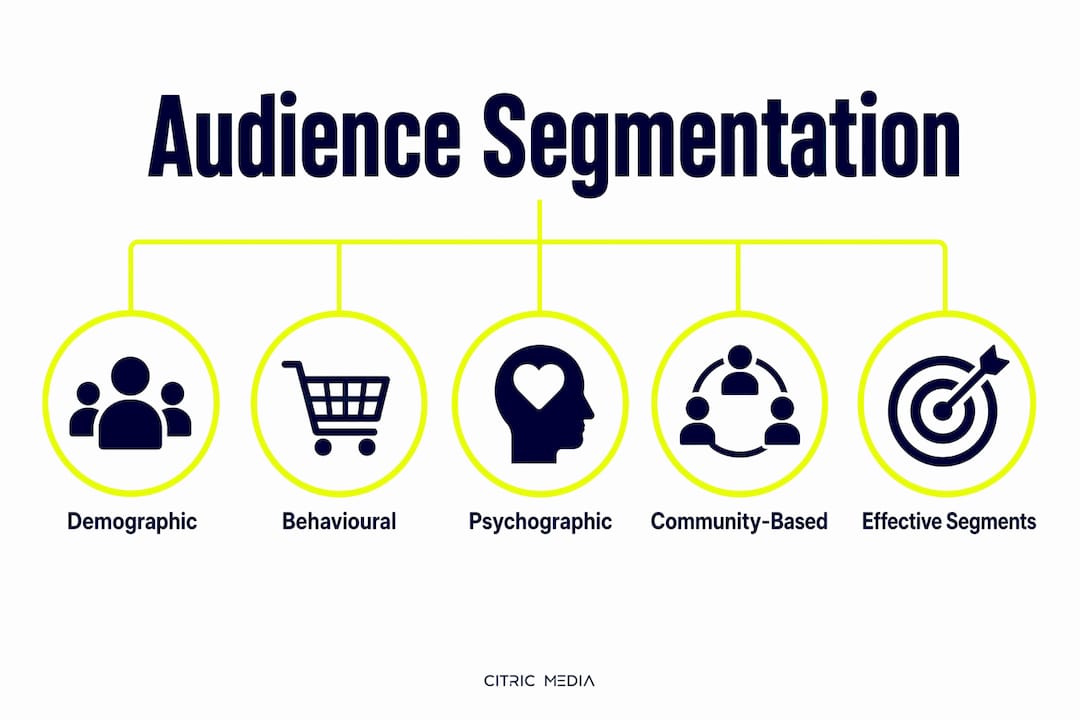
For any segment to be worth pursuing, it must be observable, meaningful, accessible, and stable over time. A segment you cannot reach through any paid, organic, or partner channel is a segment you cannot activate.
Pro Tip: Combine behavioural data from your CRM or analytics platform with psychographic insights from social listening tools. Survey data alone measures how people want to be perceived, not how they actually behave.
How to implement audience targeting strategies in digital campaigns
Effective implementation follows a clear sequence. Skipping steps leads to wasted budget and misleading results.
Define your segments before you build your campaign. Write a clear target audience definition for each group, including who they are, what they need, and what channel they use. Include a negative persona for each segment, defining who you are explicitly not targeting. Negative persona definition reduces wasted spend by excluding poor-fit audiences from the outset.
Pilot with 3–5 high-value segments. Best practice guidelines recommend starting with 3–5 segments before scaling. Testing a smaller number of segments first gives you clean data on what works without spreading budget too thin.
Validate segment accessibility. Before committing significant budget, test whether you can actually reach each segment through paid, organic, or partner channels. A segment that is well-defined but unreachable through available platforms has no practical value.
Match message to segment. Each segment needs a distinct message that speaks to its specific motivation. A behavioural segment of repeat visitors to your pricing page needs a different message than a cold demographic audience seeing your brand for the first time.
Monitor and adjust. Use campaign performance data to identify which segments respond and which do not. Adjust bids, creative, and channel mix based on actual results rather than assumptions.
Address both decision-makers and influencers. Effective targeting requires messaging that reaches both the person who makes the final purchase decision and those who influence it. In B2B campaigns especially, ignoring the influencer layer means your message never reaches the decision-maker.
A well-structured PPC campaign checklist helps UK SMEs apply these steps systematically before launch.
Pro Tip: Validate your messaging by gathering direct feedback from members of your defined segments before scaling spend. Messaging failures almost always trace back to a flawed audience definition, not a weak headline.
What are common challenges and misconceptions in audience targeting?
The most damaging misconception is that poor campaign performance is a messaging problem. Marketers often rewrite copy and redesign creative when the real issue is that they are speaking to the wrong audience entirely. Messaging failures often stem from flawed audience definitions. Fix the audience definition first, then refine the message.
Several other challenges trip up even experienced marketers:
- Over-reliance on survey data. Surveys measure how respondents want to be perceived. Combining attitudes with behavioural data produces far more accurate segments. Use surveys to generate hypotheses, then validate them with behavioural evidence.
- Ignoring negative personas. Most targeting strategies define who to reach. Few define who to exclude. A negative persona is a cost-saving tool that stops budget flowing to audiences who will never convert, such as existing customers in an acquisition campaign or students in a high-ticket B2B campaign.
- Assuming a well-defined segment is automatically reachable. Segment accessibility must be tested. A psychographic segment of “environmentally conscious urban professionals” may be clearly defined but difficult to reach cost-effectively through available ad platforms without community-based or contextual targeting.
- Targeting only the final decision-maker. In most purchasing decisions, especially in B2B and considered consumer purchases, influencers shape the outcome before the decision-maker acts. A campaign that reaches only the buyer and ignores the influencer layer leaves significant impact on the table.
Each of these challenges has a practical fix. The common thread is that audience targeting requires ongoing research and testing, not a one-time setup.
How does audience targeting improve engagement and ROI?
Personalised marketing directly addresses the frustration consumers feel when brands ignore their specific needs. When 76% of consumers report frustration at generic messaging, the business case for precise targeting is straightforward. Campaigns built around well-defined segments produce higher click-through rates, lower cost per acquisition, and stronger brand recall than untargeted equivalents.
The table below illustrates the contrast between targeted and untargeted campaign outcomes across key metrics.
| Metric | Untargeted campaign | Targeted campaign |
|---|---|---|
| Relevance to audience | Low | High |
| Cost per acquisition | Higher | Lower |
| Message personalisation | Generic | Segment-specific |
| Wasted impressions | High | Reduced |
| Brand perception | Neutral or negative | Positive |
Behavioural targeting produces particularly strong results because it reaches people at the right moment in their decision process. A customer who has already engaged with your product pages is far closer to converting than someone who matches your demographic profile but has never heard of your brand.
Community-based targeting adds another dimension. Reaching audiences through the online communities they already trust means your message arrives with implicit social endorsement. That context improves both engagement rates and brand perception simultaneously.
For UK SMEs, the practical implication is clear. Budget is finite. Every pound spent reaching an audience that will never buy is a pound not spent reaching one that will. Precise targeting is not a luxury reserved for large brands with sophisticated data teams. It is the most direct route to better returns from whatever budget you have available. Citricmedia works with UK SMEs specifically on this challenge, building paid social campaigns that reach the right segments from day one.
Key takeaways
Audience targeting is the single most direct lever marketers have for improving campaign efficiency, reducing wasted spend, and meeting the personalisation expectations that consumers now treat as standard.
| Point | Details |
|---|---|
| Targeting activates segmentation | Segmentation groups customers; targeting chooses which groups to reach and how. |
| Consumer expectations are high | 71% of consumers expect personalisation; 76% are frustrated when it is absent. |
| Start small and scale | Pilot with 3–5 high-value segments before committing full budget. |
| Define who you are not targeting | Negative personas reduce wasted spend by excluding poor-fit audiences from campaigns. |
| Combine data sources | Behavioural data combined with psychographic insights produces more accurate segments than surveys alone. |
My honest view on where audience targeting goes wrong
After working with UK SMEs across dozens of digital campaigns, the pattern I see most often is this: businesses invest heavily in creative and copy, then point it at an audience defined by nothing more than age range and location. The results disappoint, the creative gets blamed, and the cycle repeats.
The real problem is that most marketers treat audience definition as a one-time task completed at campaign setup. Audiences shift. Behavioural patterns change with seasons, economic conditions, and cultural moments. A segment that converted well in one quarter may behave entirely differently six months later. Continuous audience research is not a refinement. It is a core part of the job.
Community-based segmentation is the approach I find most underused by SMEs. Demographic and behavioural data are widely available, so most campaigns use them. But the richest signals often come from understanding which online communities your customers belong to and what those communities value. That knowledge shapes not just who you target but how you speak to them, and that combination is where campaigns genuinely pull ahead.
The other thing I would push back on is the idea that audience targeting is primarily a data problem. Data gives you the map. But reading the emotional and cultural context of a segment, understanding what they fear, what they aspire to, and what language they use, requires human judgement that no platform algorithm fully replicates. The marketers who get this right use data to identify segments and human insight to speak to them.
— Martin
How Citricmedia helps UK SMEs with audience targeting
Citricmedia has spent over 27 years helping UK businesses generate high-quality leads and sales through performance-driven digital marketing. Audience targeting sits at the core of every campaign we build, from Google Ads and Bing Advertising to paid social media.
If you are a marketing professional or business owner looking to improve campaign efficiency and reduce wasted spend, Citricmedia’s digital marketing services cover the full process from audience definition through to campaign optimisation. We work with UK SMEs specifically, so our approach is built around the budgets, channels, and competitive pressures you actually face. Get in touch to discuss how precise audience targeting can improve your results.
FAQ
What is the difference between audience segmentation and targeting?
Audience segmentation is the analytical process of grouping customers by shared characteristics. Audience targeting is the activation step, selecting which segments to reach and delivering tailored messages to them through chosen channels.
How many audience segments should I start with?
Best practice recommends piloting with 3–5 high-value segments before scaling. Starting with fewer segments produces cleaner data and prevents budget from being spread too thinly across untested groups.
What is a negative persona in audience targeting?
A negative persona defines who you are explicitly not targeting. It is a cost-saving measure that stops ad spend flowing to audiences who are unlikely to convert, such as existing customers in a new acquisition campaign.
Why is survey data unreliable for audience segmentation?
Survey data measures how respondents want to be perceived rather than how they actually behave. Combining survey responses with behavioural data from analytics platforms produces significantly more accurate audience segments.
Does audience targeting work for small businesses with limited budgets?
Precise audience targeting is especially valuable for businesses with limited budgets because it reduces wasted impressions and focuses spend on the groups most likely to convert. The smaller the budget, the more important it is to define segments clearly before spending.