General
Many UK SMEs pour money into Google Ads, paid social, and SEO without ever truly knowing whether those campaigns are generating genuine business growth or simply burning through budget. The gap between running campaigns and running effective campaigns is wider than most business owners realise. Campaign optimisation is what closes that gap. It transforms guesswork into a structured, repeatable process that connects every pound you spend to measurable outcomes. In this article, we clarify what campaign optimisation means, why it matters for UK SMEs, how to do it practically, and what to measure to prove it’s working.
Table of Contents
- Defining campaign optimisation in digital marketing
- Why campaign optimisation matters for UK SMEs
- Key steps and techniques for campaign optimisation
- Measuring success: KPIs and metrics to track
- Common pitfalls and how to avoid them
- Our perspective: Why campaign optimisation is an ongoing journey
- Take the next step in campaign optimisation
- Frequently asked questions
Key Takeaways
| Point | Details |
|---|---|
| Campaign optimisation defined | It means adjusting your marketing campaigns to achieve measurable business results. |
| SMEs gain true ROI | UK SMEs benefit most by optimising campaigns for more leads and fewer wasted resources. |
| Success demands the right KPIs | Tracking metrics like qualified leads and sales is vital to judge improvement. |
| It’s an ongoing effort | Optimisation is not a one-time fix but a continuous process for sustained growth. |
Defining campaign optimisation in digital marketing
There is a common misconception that launching a campaign is the hardest part. In reality, launching is simply the starting point. What happens after launch determines whether your investment pays off or quietly drains your budget.
“Campaign optimisation is the process of adjusting and improving elements of a marketing campaign to achieve specific business goals.” Understanding this definition is the first step toward treating your Google Ads campaigns as a living, evolving system rather than a set-and-forget exercise.
The distinction matters enormously. Running a campaign means you have ads live, a budget allocated, and targeting configured. Optimising a campaign means you are actively reviewing performance data, identifying what is working and what is not, and making deliberate adjustments to improve results over time. One is passive; the other is purposeful.
Campaign optimisation covers a broad range of elements. Experienced marketers know that nearly every component of a campaign can be refined. The most commonly optimised elements include:
- Audience targeting: Refining who sees your ads based on demographics, interests, behaviour, and intent signals
- Bidding strategy: Adjusting bids by device, location, time of day, or audience segment to maximise efficiency
- Ad creative: Testing headlines, images, copy, and calls to action to improve click-through rates
- Landing pages: Improving the page experience after the click to increase conversion rates
- Budget allocation: Shifting spend toward the campaigns, ad groups, or keywords delivering the strongest returns
- Keywords and negative keywords: Adding high-intent terms and excluding irrelevant searches that waste budget
- Ad scheduling: Running ads at the times when your target audience is most likely to convert
Each of these levers, when pulled in the right direction and at the right time, compounds into significantly better campaign performance. The challenge for most SMEs is knowing which lever to pull first.
Why campaign optimisation matters for UK SMEs
Once you understand what campaign optimisation is, the next step is knowing why it is a non-negotiable for competitive SMEs operating in a crowded digital landscape.

The most immediate benefit is financial. Optimised campaigns deliver higher ROI and reduce wasted ad spend, which is a critical advantage for businesses with limited marketing budgets. For an SME spending £2,000 per month on paid advertising, even a 20% improvement in cost per lead can free up £400 monthly to reinvest elsewhere. Over a year, that is a meaningful difference.
Beyond cost savings, optimisation directly improves lead quality. Reaching the right audience with the right message at the right time means fewer tyre-kickers and more genuinely interested prospects. Higher quality leads translate into better conversion rates through your sales process, which ultimately means more revenue from the same level of ad spend.
The benefits for UK SMEs are substantial and measurable:
- Lower cost per acquisition: You pay less for each new customer or lead
- Higher conversion rates: More of your website visitors take the action you want
- Better audience relevance: Your ads reach people who are genuinely likely to buy
- Improved ad quality scores: Platforms like Google reward relevant, well-optimised ads with lower costs and better placement
- Stronger competitive positioning: Well-optimised campaigns outperform competitors who are simply running ads without refinement
- Clearer business intelligence: The data you gather during optimisation reveals insights about your customers that inform wider business decisions
Pro Tip: Before you start optimising, define what “success” looks like in concrete terms. Is it cost per lead below £30? A conversion rate above 5%? Without a clear target, you cannot measure whether your optimisation efforts are actually working.
Key steps and techniques for campaign optimisation
After seeing the benefits, it is time to break down what campaign optimisation actually involves for your team. The process is more structured than many SMEs expect, and following a consistent framework prevents the common trap of making random changes and hoping for improvement.
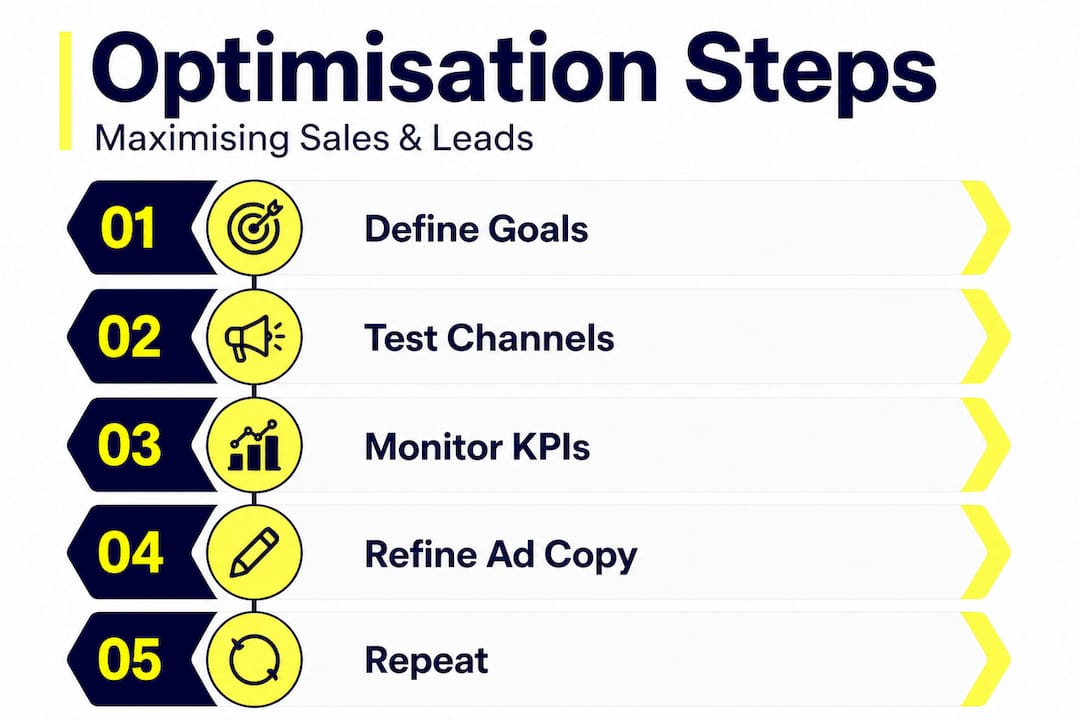
Effective campaign optimisation uses testing, data analysis and ongoing adjustments to drive meaningful performance gains. Here is a practical step-by-step process you can follow:
- Set clear, measurable objectives. Define specific goals tied to business outcomes, such as generating 50 qualified leads per month at a cost per lead below £25.
- Establish your baseline. Before making any changes, record your current performance metrics so you have a benchmark to measure improvement against.
- Audit your existing campaigns. Review audience targeting, keyword lists, ad creative, landing pages, and bidding strategies for obvious inefficiencies or gaps.
- Prioritise your optimisation actions. Focus on the changes most likely to have the biggest impact first, rather than trying to fix everything simultaneously.
- Implement one change at a time. Changing multiple elements simultaneously makes it impossible to know which change drove any improvement or decline.
- Run A/B tests on key elements. Test two versions of an ad headline, landing page layout, or call to action to identify which performs better with your audience.
- Allow sufficient data to accumulate. Resist the urge to judge results after just a few days. Most campaigns need at least two to four weeks of data before conclusions are reliable.
- Analyse results and apply learnings. Review what the data tells you, implement the winning variation, and begin the next test cycle.
- Document every change and its outcome. Maintaining a log of what you changed, when, and what happened creates an invaluable knowledge base over time.
- Repeat the cycle continuously. Optimisation is not a project with an end date; it is an ongoing operational discipline.
The table below illustrates the kind of improvements that structured optimisation typically delivers:
| Metric | Before optimisation | After optimisation | Improvement |
|---|---|---|---|
| Cost per lead | £48 | £27 | 44% reduction |
| Conversion rate | 1.8% | 3.4% | 89% increase |
| Click-through rate | 2.1% | 4.6% | 119% increase |
| Cost per click | £1.90 | £1.55 | 18% reduction |
| Monthly leads generated | 42 | 74 | 76% increase |
Pro Tip: When running A/B tests, only change one variable at a time. If you simultaneously change your headline and your landing page, you will never know which element drove the improvement. Patience here pays dividends.
Measuring success: KPIs and metrics to track
With techniques in mind, measuring what matters ensures your optimisation is delivering tangible results rather than just activity.
One of the most important distinctions in campaign measurement is the difference between leading and lagging indicators. Leading indicators signal future performance, such as click-through rates and engagement metrics. Lagging indicators confirm outcomes that have already occurred, such as sales revenue and cost per acquisition. Both matter, but lagging indicators are the ultimate proof of business impact.
The best metric for campaign success is tied to business objectives, such as qualified leads or sales growth. This is why vanity metrics, while tempting to celebrate, can be dangerously misleading for SMEs with limited resources.
| Vanity metric | Why it misleads | Value metric | Why it matters |
|---|---|---|---|
| Impressions | High reach without results | Cost per qualified lead | Shows true acquisition efficiency |
| Likes and follows | Engagement without revenue | Lead-to-sale conversion rate | Connects marketing to revenue |
| Total clicks | Traffic without intent | Return on ad spend (ROAS) | Measures direct financial return |
| Page views | Visits without action | Revenue per campaign | Ties spend directly to income |
The KPIs that genuinely matter for SME lead generation and sales campaigns include:
- Cost per lead (CPL): How much you spend to generate each enquiry or lead
- Cost per acquisition (CPA): How much you spend to secure each new customer
- Conversion rate: The percentage of visitors or ad clicks that complete a desired action
- Return on ad spend (ROAS): Revenue generated for every pound spent on advertising
- Lead quality score: A measure of how well leads match your ideal customer profile
- Customer lifetime value (CLV): The total revenue a customer generates over their relationship with your business
Aligning your measurement framework to actual business goals, rather than platform-level metrics, is what separates businesses that grow through digital marketing from those that simply spend on it.
Common pitfalls and how to avoid them
Once key metrics are in focus, it is important to know what can go wrong and how to stay on track. Many SMEs make the same avoidable errors when approaching campaign optimisation.
Many SMEs fail to revisit and update campaigns, losing out on potential gains that consistent review would have captured. The most common pitfalls include:
- Making changes too quickly: Pausing or overhauling campaigns before sufficient data has accumulated leads to poor decisions based on statistical noise
- Optimising for the wrong metric: Focusing on click-through rate while ignoring conversion rate can inflate traffic without improving revenue
- Ignoring negative keywords: Failing to exclude irrelevant search terms wastes significant budget on unqualified traffic
- Neglecting landing page quality: Improving ads without improving the landing page experience creates a leaky funnel where gains are lost after the click
- Treating optimisation as a one-off task: Running a single round of improvements and then leaving campaigns untouched for months is one of the most costly mistakes SMEs make
- Not segmenting audiences properly: Showing the same ad to vastly different audience segments reduces relevance and wastes budget
- Overlooking mobile performance: UK audiences increasingly convert on mobile devices, and campaigns not optimised for mobile miss a substantial portion of potential leads
Consistency is the defining characteristic of successful campaign optimisation. Businesses that build regular review cycles into their marketing operations, whether weekly or monthly, consistently outperform those that treat optimisation as an occasional project.
Pro Tip: Set a recurring calendar reminder for campaign reviews. Even a 30-minute weekly check-in to review key metrics and flag anomalies can prevent small problems from becoming expensive ones. Refer to B2B marketing guidance for structured review frameworks tailored to SMEs.
Our perspective: Why campaign optimisation is an ongoing journey
After outlining tactics and pitfalls, let us reflect on something that most articles in this space gloss over. Campaign optimisation is not a destination. It is a discipline, and the SMEs that treat it as such are the ones that consistently outgrow their competitors.
We have worked with UK businesses across a wide range of sectors over more than 27 years, and the pattern is remarkably consistent. The businesses that see the strongest long-term results from digital marketing are not necessarily the ones with the biggest budgets. They are the ones that embrace iteration without ego. They test, they learn, they adjust, and they repeat. When a campaign underperforms, they treat it as data rather than failure.
There is a tendency, particularly among smaller businesses, to view a failed ad test as wasted money. We see it differently. Every test that does not work narrows the field and brings you closer to the combination that does. The cost of not testing is far higher than the cost of a failed experiment, because without testing you are simply guessing indefinitely.
We also believe that paid social advertising deserves more attention from SMEs as part of a joined-up optimisation strategy. Businesses that optimise across multiple channels simultaneously, rather than treating each platform in isolation, develop a compounding advantage. Insights from your Google Ads campaigns can inform your social targeting, and vice versa.
The honest truth is that campaign optimisation requires patience, curiosity, and a genuine willingness to let data lead decisions rather than gut instinct. That is harder than it sounds. But for SMEs willing to commit to it, the rewards are measurable, repeatable, and scalable.
Take the next step in campaign optimisation
Understanding campaign optimisation is one thing. Implementing it consistently while running a business is another challenge entirely. That is where expert support makes a genuine difference.
At Citric Media, we have spent over 27 years helping UK SMEs turn underperforming campaigns into reliable engines for lead generation and sales growth. Whether you are looking to understand the value of digital marketing investment or need hands-on paid advertising help to improve your results, our team brings the experience and data-driven rigour to make it happen. We do not just run campaigns; we optimise them relentlessly on your behalf. If you are ready to stop guessing and start growing, we would welcome a conversation.
Frequently asked questions
What is the main goal of campaign optimisation?
The primary goal is to improve campaign performance so that every pound spent generates more leads or sales. Optimised campaigns improve ROI and achieve specific business goals rather than simply generating activity.
Do I need specialist software to optimise my campaigns?
While software tools can accelerate the process, you can begin with manual review of platform analytics and clearly defined objectives before investing in additional technology.
How often should I review and optimise my marketing campaigns?
Review and optimise campaigns at least monthly, though weekly check-ins deliver even better results. Ongoing updates are important for sustained campaign performance and preventing budget waste.
Which metric matters most for SME campaign success?
Qualified leads and sales driven are the most critical metrics for SME campaign success. The best metric is tied to your specific business objectives rather than platform-level vanity figures.