General
Most UK business owners assume that paid adverts or a busy social media feed are the fastest routes to new customers. That assumption is costing them growth. Most site visits come from organic search rather than paid channels, which means the businesses ranking on page one of Google are quietly winning the lion’s share of enquiries every single day. SEO, done properly, is the most sustainable and cost-effective way to put your business in front of people who are actively searching for what you offer. This article explains what SEO actually is, why it matters for UK SMEs right now, and what you need to do to make it work in 2026 and beyond.
Table of Contents
- What is SEO and why does it matter for UK SMEs?
- The real business impact of investing in SEO
- How SEO complements other digital marketing channels
- 2026 and beyond: The evolving SEO landscape for small businesses
- What most experts miss about SEO for UK SMEs
- Take your first step with expert SEO support
- Frequently asked questions
Key Takeaways
| Point | Details |
|---|---|
| SEO builds trust | Ranking higher organically signals credibility to UK customers and keeps your business visible. |
| Long-term cost savings | SEO brings sustained leads and sales with less ongoing spend than paid ads. |
| Keeps you competitive | Adopting modern SEO—AI, schema, entity authority—helps SMEs outpace larger rivals in 2026. |
| Works with other channels | SEO supports and amplifies paid and social marketing efforts, not just replaces them. |
What is SEO and why does it matter for UK SMEs?
SEO stands for Search Engine Optimisation. In plain terms, it is the practice of improving your website so that search engines like Google rank it higher when people search for products or services you provide. No jargon required. Think of it as making your business easier to find by the right people at the right moment.
For UK small and medium-sized businesses, this matters enormously. Your prospective customers are searching online before they pick up the phone or walk through a door. If your website does not appear near the top of those results, a competitor’s does. It is that straightforward.
Here is what SEO actually covers:
- On-page optimisation: Improving the content, structure, and keywords on each page of your website
- Technical SEO: Ensuring your site loads quickly, works on mobile, and is easy for search engines to read
- Local SEO: Helping your business appear in location-based searches, such as “accountant in Manchester” or “plumber near me”
- Link building: Earning mentions and links from other reputable websites to signal authority
- Content strategy: Publishing useful, relevant material that answers your customers’ real questions
One of the most important distinctions to understand is the difference between SEO and paid advertising. Paid ads stop the moment your budget runs out. SEO, by contrast, builds compounding value over time. A well-optimised page can generate enquiries for months or years without additional spend. As a digital marketing investment, the return on SEO tends to grow rather than plateau.
Local presence is particularly powerful for SMEs. When someone in your area searches for a service you provide, Google’s local results and map listings appear prominently. Claiming and optimising your Google Business Profile, alongside consistent on-site SEO, means your business shows up where it counts most. SEO builds authority with users and search engines alike, and that authority translates directly into trust from prospective customers.
The businesses that treat SEO as an ongoing discipline rather than a one-off task are the ones that consistently outperform their competitors in organic search. It is not a quick fix. It is a strategic asset.
The real business impact of investing in SEO
Now you know what SEO is, let’s explore what measurable difference it can make for your business.
The numbers tell a compelling story. Businesses that invest consistently in SEO typically see higher quality leads, lower cost-per-acquisition over time, and stronger customer retention because organic visitors tend to arrive with genuine intent. They are searching for a solution; you are providing it.

Consider a fictional but realistic example. A UK-based independent surveying firm, let’s call them Meridian Surveys, was spending £2,000 per month on Google Ads with reasonable results. After investing in SEO over 12 months, their organic traffic tripled, their cost-per-lead dropped by nearly 40%, and they began ranking for high-value local terms without ongoing ad spend. The SEO investment did not replace their paid activity immediately, but it raised the floor on their overall performance significantly.
| Metric | Before SEO investment | After 12 months of SEO |
|---|---|---|
| Monthly organic visitors | 320 | 960 |
| Cost per lead | £48 | £29 |
| Page one keyword rankings | 4 | 31 |
| Enquiry conversion rate | 2.1% | 3.4% |
These figures are illustrative but grounded in what we see regularly with UK SME clients. The pattern is consistent: steady investment in SEO produces compounding returns that paid channels simply cannot replicate at the same cost.
“Hybrid human-AI content and advanced schema markup are driving results in 2026, raising the bar for what search engines expect from quality content.”
This matters for SMEs because it signals that the quality of your content and the technical structure of your site are now more important than ever. Businesses that invest in both will pull ahead of those relying on outdated tactics.
Pro Tip: Before scaling your SEO budget, audit your existing content. Refreshing underperforming pages with updated information and better structure often delivers faster gains than creating new pages from scratch. Your SME digital marketing guide can help you prioritise where to start.
How SEO complements other digital marketing channels
Understanding SEO’s value is clearer when you see how it interacts with your wider online strategy.
SEO does not operate in isolation. It works best when it is integrated with your other digital efforts, including pay-per-click advertising, social media, and content marketing. Each channel plays a different role in the customer journey, and understanding those roles helps you allocate budget more intelligently.
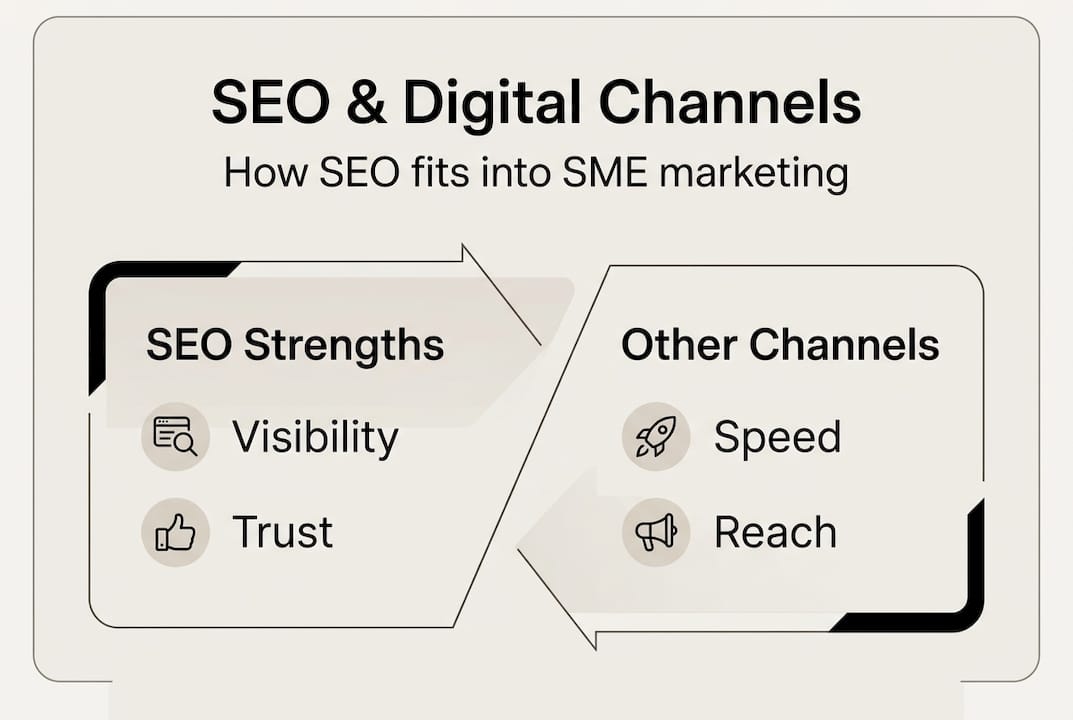
| Channel | Strength | Weakness | Best used for |
|---|---|---|---|
| SEO | Long-term visibility, trust | Slow to start | Sustainable lead generation |
| PPC | Immediate traffic | Stops when budget ends | Quick wins, testing |
| Social media | Brand awareness, engagement | Low purchase intent | Top-of-funnel reach |
| Content marketing | Authority, organic reach | Time-intensive | Supporting SEO and trust |
SEO complements PPC for full-funnel marketing effectiveness, meaning the two channels reinforce each other rather than compete. A prospect might click a paid ad first, then later search organically and find your site again before converting. That second touchpoint, earned through SEO, is often the one that closes the deal.
Here is a typical journey for a UK SME prospect:
- They search for a service on Google and see a paid ad from your business
- They do not click immediately but notice your brand name
- Days later, they search again and find your organic listing, which now feels familiar and trustworthy
- They read a blog post on your site that answers a specific question they have
- They submit an enquiry form, having built enough confidence in your expertise
That journey illustrates why SEO and PPC compared as separate decisions misses the point. They are most powerful when planned together. The practical tasks for integrating SEO with your wider efforts include aligning keyword research across paid and organic campaigns, using content to support both channels, and ensuring your landing pages are optimised for both conversions and organic ranking.
2026 and beyond: The evolving SEO landscape for small businesses
With the foundations covered, it is crucial to understand how SEO is shifting in the rapidly evolving digital world.
The SEO landscape in 2026 looks meaningfully different from even two years ago. AI has changed what search engines expect from content, how results are displayed, and what it takes to earn visibility. For UK SMEs, this creates both risk and real opportunity.
The biggest shifts you need to understand:
- AI Overviews: Google now surfaces AI-generated summaries at the top of many search results. To appear in these, your content must be structured clearly, answer questions directly, and demonstrate genuine expertise
- Zero-click searches: A growing proportion of searches are answered without the user clicking any result. Structured data and FAQ schema help your content appear in these answer boxes
- Entity authority: Search engines increasingly evaluate brands as entities, assessing your overall topic credibility rather than just individual pages
- Hybrid content: The most effective content in 2026 blends human expertise with AI-assisted production, maintaining authenticity while scaling output
- Core Web Vitals: Page speed, visual stability, and interactivity remain ranking signals, making technical performance non-negotiable
AI-driven and entity-focused SEO tactics are essential in 2026, and smaller businesses that act on this now have a genuine window to outperform larger, slower-moving competitors.
Pro Tip: Add FAQ schema markup to your key service pages. It takes relatively little technical effort and significantly increases your chances of appearing in zero-click answer boxes and AI Overviews, both of which are prime real estate in modern search results.
Action steps for staying competitive:
- Audit your site’s structured data and add schema where it is missing
- Build topical depth by creating content clusters around your core services
- Strengthen your Google Business Profile with regular updates and customer reviews
- Monitor your Core Web Vitals in Google Search Console monthly
What most experts miss about SEO for UK SMEs
The pace of change in SEO can feel overwhelming, and most guides respond by telling you to focus on more keywords, more content, more links. My honest view, after working with UK SMEs across many sectors, is that this advice flatters the wrong priorities.
The businesses seeing the sharpest gains right now are not the ones with the largest content libraries. They are the ones that have invested in entity authority and structured data, often through relatively small, targeted changes. A handful of well-structured FAQ pages, proper schema implementation, and a consistent brand presence across authoritative directories can move the needle faster than churning out generic blog posts.
Hybrid content and entity-level SEO will define the leaders in 2026, and here is the counterintuitive part: smaller businesses can actually move faster than larger ones in this area. There is no internal bureaucracy slowing down a decision to add schema or refresh a service page. That agility is a genuine competitive advantage, and most SME owners do not realise they have it.
If you are serious about digital growth with SEO, stop chasing volume and start chasing relevance, structure, and authority. The returns are more durable and more defensible.
Take your first step with expert SEO support
If you want real growth in 2026, the right expertise can make the difference between incremental progress and a step change in your online performance. Understanding the strategy is one thing; executing it consistently, with the technical precision and content quality that search engines now demand, is another.
At Citric Media, we have spent over 27 years helping UK SMEs generate high-quality leads and sales through performance-driven digital marketing. Whether you are starting from scratch or looking to improve what you already have, our team can provide the clarity and direction you need. Explore our expert SEO support options or find out how we can help you boost your online visibility and turn organic search into a reliable growth channel for your business.
Frequently asked questions
How long does it take to see SEO results for a UK SME?
You can usually see meaningful improvement within 3 to 6 months, though lasting SEO results build over 12 months or more as authority compounds. Patience combined with consistent effort is the formula that works.
Is SEO or PPC better for small businesses?
For immediate traffic, PPC delivers faster. For sustainable growth and lower cost-per-lead over time, SEO wins. The strongest approach uses both channels together to cover the full customer journey.
How does AI impact SEO for small businesses in 2026?
AI tools raise the standard for content quality and speed up production, but they also make hybrid content strategies and demonstrated expertise essential for standing out in search results.
What is entity authority and why does it matter?
Entity authority is how strongly search engines associate your brand with a specific topic or field of expertise. In an AI-driven search landscape, it is increasingly the deciding factor in whether your content earns visibility or gets overlooked.