Digital Marketing
86% of UK businesses already use content marketing, yet most SMEs still treat it as an afterthought rather than a growth engine. The assumption that content is a luxury reserved for multinationals with sprawling marketing teams is simply wrong. In reality, smaller businesses often see sharper returns precisely because they can move faster, speak more authentically, and target niche audiences that large brands struggle to reach. This guide breaks down what content marketing actually means for a UK SME, how it drives leads and sales, what investment looks like in practice, and how to build a strategy that compounds over time.
Table of Contents
- What is content marketing and why does it matter?
- The role of content marketing in lead generation and sales
- Maximising ROI: how much should UK SMEs invest?
- Building a winning content marketing strategy
- Our take: why most SMEs miss out on content marketing’s true power
- Grow your business with expert content marketing support
- Frequently asked questions
Key Takeaways
| Point | Details |
|---|---|
| Content drives real results | UK SMEs using content marketing see higher website traffic and 67% more leads on average. |
| Strategy matters most | Having a documented content strategy is the biggest success factor for small businesses. |
| Invest early for compound returns | Return on investment grows over time, so starting now yields greater long-term gains. |
| Blend AI with human creativity | Efficiency tools boost production, but authentic, trust-building content demands the human touch. |
What is content marketing and why does it matter?
Content marketing is the practice of creating and distributing genuinely useful material, whether articles, videos, guides, or social posts, that attracts and retains a clearly defined audience rather than interrupting them with adverts. Where traditional advertising says “buy this now,” content marketing earns trust first and converts second. That distinction matters enormously for SMEs operating with tighter budgets and smaller brand recognition.
Traditional advertising demands continuous spend to maintain visibility. The moment your budget stops, so does your reach. Content, by contrast, keeps working. A well-optimised guide published today can generate enquiries twelve months from now without a single additional penny spent. That compounding quality is what makes content marketing particularly powerful for businesses that cannot afford to outbid large competitors in paid channels.
The practical benefits for UK SMEs are substantial:
- Increased visibility through search engines, without relying solely on paid ads
- Authority and trust built incrementally as you consistently answer your audience’s real questions
- Lower cost per lead compared to outbound methods over the medium to long term
- Adaptability to niche markets, local audiences, and specific buyer personas that generic campaigns cannot serve
- Sustainable pipeline growth as existing content accumulates search traffic and inbound enquiries
The risk of ignoring content is equally concrete. Competitors who invest consistently will occupy the search results, earn backlinks, and build reputations you will find increasingly hard to displace. As the B2B content marketing trends research from the Content Marketing Institute illustrates, the gap between businesses with mature content programmes and those without is widening every year.
“Content marketing is not a campaign. It is an ongoing investment in your audience’s trust, and that trust is what eventually converts browsers into buyers.”
For SMEs looking to generate measurable business returns without burning through an outsized budget, content marketing is arguably the most capital-efficient channel available. The data backs that up and we will get into the specifics shortly.
The role of content marketing in lead generation and sales
Content marketing does not generate leads by accident. It does so by guiding potential customers through a structured journey: from first becoming aware of a problem, to considering their options, to choosing a supplier they trust. Each stage calls for a different type of content, and SMEs that understand this tend to outperform those who simply publish blog posts and hope for the best.
Here is how the journey typically unfolds:
- Awareness — A prospect searches for an answer to a problem and finds your article or guide. They have never heard of you before, but the quality of your content signals credibility immediately.
- Engagement — They explore more of your site, subscribe to your email list, or follow your social channels. Familiarity builds.
- Consideration — A case study, comparison guide, or detailed how-to positions you as the most knowledgeable option in their shortlist.
- Conversion — A targeted call to action, consultation offer, or demonstration nudges them to make contact. Trust does the heavy lifting.
The numbers behind this journey are striking. SMEs using blogs see 55% more traffic and 67% more leads than those without, which is a meaningful difference for a business where ten additional enquiries per month can transform revenue.

The compounding effect is worth stressing. A single well-researched guide might generate five leads in its first month and fifty by its eighteenth. Understanding blog-driven traffic gains in terms of bounce rate and dwell time helps SMEs refine content quality over time, ensuring that traffic converts rather than bounces.
Pro Tip: Resist the temptation to publish frequently at the expense of quality. Two genuinely useful, thoroughly researched pieces per month will outperform ten thin articles every time. Search engines reward depth, and readers reward authenticity.
Consider a practical illustration. An SME in the facilities management sector published just two targeted guides answering specific procurement questions their clients regularly asked. Within six months, those two pieces accounted for 40% of all inbound enquiries, without any paid promotion. The investment was modest. The return was not.
Maximising ROI: how much should UK SMEs invest?
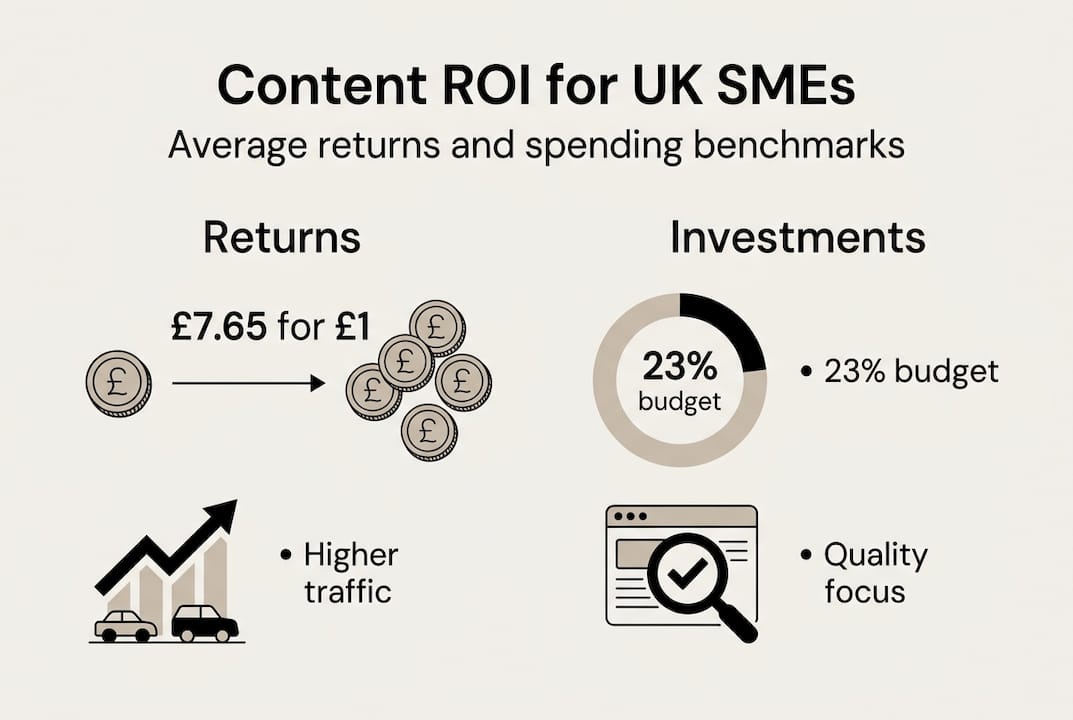
Budget is always a sensitive conversation for SMEs, but the data gives us clear benchmarks to work with. UK SMEs typically allocate around 23% of their total marketing budget to content marketing, and that figure correlates with measurable success. Irish SMEs investing 41% less in content still achieve 34% higher engagement, suggesting that smart allocation and strategic targeting matter as much as raw spend.
The table below summarises what a typical content investment framework looks like for UK SMEs at different stages:
| Stage | Monthly content budget | Priority channels | Expected timeframe for results |
|---|---|---|---|
| Early stage | £500 to £1,000 | Blog, on-site SEO | 6 to 12 months |
| Growth stage | £1,000 to £3,000 | Blog, email, social | 3 to 6 months |
| Established | £3,000 and above | Video, guides, paid distribution | 1 to 3 months |
The main areas where SMEs should consider investing include:
- Blog and long-form articles for organic search visibility
- Email marketing to nurture warm leads and retain existing customers
- Social media content to build community and signal authority
- Video and visual content for higher engagement on competitive topics
- Downloadable guides or whitepapers to capture leads at the consideration stage
Two common mistakes undermine ROI before it has a chance to materialise. The first is underinvesting, expecting significant results from one or two articles per quarter. The second is publishing without a plan, producing content that serves no clear audience or business objective. Exploring content budget strategies and reviewing marketing spend insights can help you calibrate your approach against realistic benchmarks.
Content marketing delivers an average return of £7.65 for every £1 spent when executed with a clear strategy. That figure alone should shift how SMEs think about where their marketing money goes.
Building a winning content marketing strategy
A content marketing strategy is not a content calendar. It is a documented plan that connects your audience’s needs to your business goals, defines the channels you will use, and sets measurable outcomes. This distinction matters more than most SMEs realise. 67% of SMEs fail without a documented content strategy, yet only 40% have one written down.
The comparison between documented and undocumented approaches tells a clear story:
| Approach | Strategy clarity | Content consistency | Measurable ROI |
|---|---|---|---|
| Documented strategy | High | Consistent | Trackable |
| Undocumented strategy | Low | Sporadic | Difficult to attribute |
Here is a practical framework for building yours:
- Define your audience — Create specific profiles of the people you want to reach, including their questions, challenges, and decision-making triggers.
- Set clear goals — Identify whether you are building brand awareness, generating leads, or nurturing existing customers. Each goal demands a different content approach.
- Audit what you have — Review existing content to identify gaps, outdated material, and high-performing pieces worth expanding.
- Choose your channels — Focus on two or three channels where your audience is most active rather than spreading yourself thinly across everything.
- Plan for SEO for content — Every piece should target a specific search term or question your audience is already asking.
- Measure and iterate — Track traffic, leads, and conversions monthly, and adjust based on what the data tells you.
On the question of AI: it is genuinely useful for speeding up research, drafting outlines, and scaling output. But success hinges on relevance and authentic voice, not volume. The AI and human blend that works best is one where automation handles repetitive tasks and humans handle judgement, storytelling, and trust-building.
Pro Tip: Start with one audience, one channel, and one content type. Do it exceptionally well for three months before expanding. Most SMEs fail by trying to do everything at once and doing none of it well.
Our take: why most SMEs miss out on content marketing’s true power
After working with SMEs across numerous sectors, we see the same pattern repeatedly. Businesses understand content marketing conceptually but dramatically underestimate how long the compounding effect takes to kick in. They invest for two or three months, see modest early results, and conclude it is not working. Then a competitor who stayed consistent for twelve months starts dominating the search results they abandoned.
Conventional advice rarely mentions that the most valuable thing content builds is not traffic. It is authority. When your audience encounters your name repeatedly across well-crafted, genuinely useful material, you become the default choice before a conversation even starts. That is a form of trust that no paid ad can replicate quickly or cheaply.
We also see SMEs leaning too heavily into AI-generated content without the human layer that makes it credible marketing content. AI can accelerate output, but readers, particularly business buyers, are increasingly sharp at detecting generic material. Authentic expertise, real examples, and a distinct point of view are what separate the brands that build lasting pipelines from those that simply add to the noise.
Grow your business with expert content marketing support
Content marketing rewards patience and precision, but it rewards them handsomely. If you are ready to move beyond ad hoc publishing and build a strategy that generates consistent leads and long-term authority, expert guidance makes the difference between slow progress and scalable results.
At Citric Media, we have spent over 27 years helping UK SMEs turn content and digital strategy into real, measurable business growth. Whether you are starting from scratch or looking to sharpen an existing approach, our team can help you build a content programme that compounds over time. Explore our content marketing expertise or discover how we help businesses increase measurable returns through performance-driven digital channels. The next step is simply getting in touch.
Frequently asked questions
How much should a UK SME budget for content marketing?
UK SMEs typically allocate around 23% of their marketing budget to content, though the quality of your strategy and targeting will ultimately determine the return more than the exact figure you spend.
What is the biggest mistake SMEs make with content marketing?
The most damaging mistake is publishing without a documented strategy. 67% of SMEs fail with undocumented approaches, which leads to inconsistent output, wasted budget, and results that are almost impossible to attribute or improve.
Does content marketing really generate more leads for SMEs?
Absolutely. SMEs with active blogs see 67% more leads and 55% higher website traffic on average, making blogging one of the most cost-efficient lead generation tools available to smaller businesses.
How can AI help SMEs with content marketing?
AI accelerates research, ideation, and drafting, but blending automation with authentic human insight is what builds the trust and relevance that actually converts readers into customers.