Online Marketing
UK SMEs are under more pressure than ever to make every pound of marketing budget count. Broad-brush campaigns that prioritise visibility over results are increasingly difficult to justify when margins are tight and competition is fierce. Performance marketing offers a fundamentally different approach: one where spend is tied directly to outcomes, and every campaign decision is guided by real data. This article covers what performance marketing actually means, its core benefits for small and medium-sized businesses, how it compares to traditional methods, and a practical framework to help you decide whether it’s the right move for your business right now.
Table of Contents
- What is performance marketing and why SMEs need it
- Top performance marketing benefits for UK SMEs
- Comparing performance marketing to traditional marketing
- When to choose performance marketing: A decision guide for SMEs
- What most SMEs overlook about performance marketing
- Ready to boost results? How Citric Media helps SMEs win with performance marketing
- Frequently asked questions
Key Takeaways
| Point | Details |
|---|---|
| Pay for results | Performance marketing lets SMEs spend only on actions that drive their growth, such as leads or online sales. |
| Easy ROI tracking | Transparent analytics and reporting make it easy to see the impact of every campaign. |
| Low-risk investment | By focusing on measurable outcomes, SMEs reduce risk and avoid wasted budget. |
| Rapid experimentation | Performance marketing supports quick campaign testing and optimisation for faster improvements. |
What is performance marketing and why SMEs need it
Performance marketing is a model where you pay for specific, measurable actions rather than for the chance to be seen. Those actions might be a completed sale, a qualified lead, a phone call, or a click through to your website. The fundamental shift is that risk moves to results, paying only for completed actions rather than for impressions or airtime.
For SMEs, this matters enormously. Traditional advertising asks you to spend upfront and hope for the best. Performance marketing inverts that logic. You define what success looks like, set up tracking, and only pay when that success is delivered. That structure is far more forgiving for businesses operating with limited budgets and tight cash flow.
The core channels you’ll encounter include:
- Paid search advertising (Google Ads, Bing Ads): You bid on keywords relevant to your product or service and pay per click.
- Paid social media advertising (Meta, LinkedIn, TikTok): Targeted ads served to specific audience segments, charged per click or conversion.
- Affiliate marketing: Third-party publishers promote your product and earn a commission only when a sale or lead is generated.
- Display and retargeting: Banner ads served to users who’ve already visited your site, designed to bring them back.
One of the most underappreciated advantages for SMEs is the ability to compete with larger businesses. A well-structured Google Ads campaign targeting a niche keyword can outperform a national brand’s generic campaign. Strategic targeting levels the playing field in a way that a full-page newspaper advert simply cannot. Our actionable digital marketing guide walks through how to build this kind of strategy from the ground up.
“Performance marketing is not just a budget model. It’s a discipline that forces clarity about what you actually want your marketing to achieve.”
Pro Tip: Use performance marketing campaigns to test new audience segments with a small budget before scaling. A two-week pilot on paid social can tell you more about your customers than months of brand awareness activity.
If you’re new to working with specialists in this space, understanding working with digital agencies can help you identify what to look for in a performance-focused partner.
Top performance marketing benefits for UK SMEs
Now that performance marketing’s principles are clear, let’s explore the most valued benefits for SMEs.
Measurable ROI benefits are the headline advantage, but the full picture is richer than a single metric. Here are the key benefits, ranked by the impact we consistently see across SME campaigns:
Precise targeting reduces wasted spend. Rather than broadcasting to a wide audience and hoping some of them are buyers, performance marketing lets you define exactly who sees your ads by location, device, search intent, job title, or browsing behaviour. That precision directly reduces the cost of reaching the wrong people.
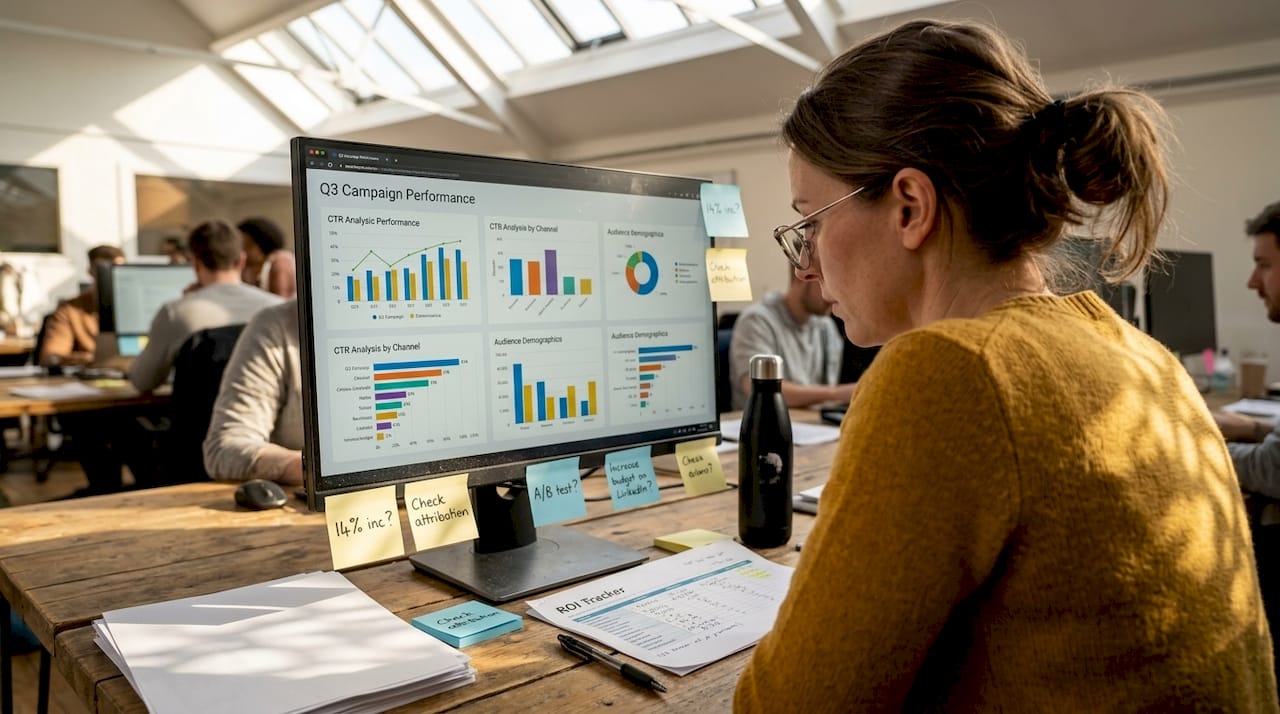
Real-time campaign feedback. You can see within hours whether an ad is working. Click-through rates, conversion rates, and cost per acquisition are visible in your dashboard as they happen. This speed of feedback is something traditional marketing simply cannot match.
Pay-per-action models protect your budget. You are only charged when someone takes the action you’ve defined. If nobody clicks, nobody converts, and your campaign underperforms, your exposure to wasted spend is far lower than with a fixed-cost media buy.
Scalability on your terms. When a campaign works, you can increase the budget incrementally and watch results scale with it. When it doesn’t, you pause and adjust. This flexibility is particularly valuable for SMEs navigating seasonal demand or testing new markets.
Rapid experimentation and validation. Performance marketing supports a test-and-learn culture. You can run two versions of an ad simultaneously, identify the stronger performer within days, and redirect budget accordingly. This iterative approach accelerates learning and reduces the cost of getting things wrong.
Statistic callout: Over 70% of UK marketers reported increased ROI after shifting to performance-led strategies, according to Smart Insights research on digital marketing effectiveness.
For SMEs evaluating whether to commit budget here, our thinking on digital marketing investments sets out the broader case for why this category of spend consistently outperforms alternatives. And if paid search is your primary interest, the specifics of using Google Ads effectively are worth exploring in detail.
Comparing performance marketing to traditional marketing
While these advantages are compelling, how do they contrast with more conventional marketing? See the direct comparison below.
| Factor | Performance marketing | Traditional marketing |
|---|---|---|
| Cost model | Pay per action (click, lead, sale) | Fixed cost upfront |
| ROI tracking | Granular, real-time | Estimated, delayed |
| Targeting | Precise audience segmentation | Broad demographic reach |
| Speed to results | Days to weeks | Weeks to months |
| Upfront risk | Low | High |
| Scalability | Highly flexible | Often fixed commitments |
| Attribution | Direct and measurable | Often unclear |
Traditional advertising often lacks direct attribution and clear ROI metrics, making it difficult to know which activity drove which result. That’s not a fatal flaw for brand-building, but it’s a significant limitation when you need to justify spend or optimise quickly.
That said, traditional marketing still has genuine use cases. The two approaches aren’t mutually exclusive:
- Performance marketing works best for: Direct response campaigns, lead generation, e-commerce sales, retargeting warm audiences, and testing new offers.
- Traditional marketing works best for: Long-term brand awareness, local community presence, reaching audiences with low digital engagement, and high-impact launch moments.
“What gets measured, gets managed.” This principle, often attributed to Peter Drucker, sits at the heart of why performance marketing has become the default choice for growth-focused SMEs. When your data tells you exactly what’s working, you stop guessing and start compounding your wins.
For SMEs looking to boost business growth in a measurable, repeatable way, performance marketing provides the infrastructure to do exactly that.
When to choose performance marketing: A decision guide for SMEs
A comparison is helpful, but deciding if and when to move towards performance marketing is crucial. The next section walks you through this process.
Active management is key for best results, and that means assessing your readiness honestly before committing budget. Use this checklist to gauge where you stand:
- Do you have conversion tracking set up on your website (e.g., form completions, phone calls, purchases)?
- Can you define a clear cost-per-acquisition target?
- Do you have someone with the time and skills to monitor campaigns regularly?
- Is your landing page optimised for the action you want visitors to take?
- Do you have at least a modest test budget to run a pilot campaign?
If you answered yes to three or more of these, you’re likely ready to start.
Common scenarios and best-fit approaches:
| Business scenario | Recommended approach |
|---|---|
| Launching a new product or service | Paid search pilot with tight keyword targeting |
| Generating leads for a service business | Google Ads and LinkedIn lead generation |
| Re-engaging past website visitors | Retargeting via display or paid social |
| Building brand awareness in a new region | Combination of paid social and SEO |
| Scaling an existing profitable campaign | Increase budget incrementally, expand keywords |
Steps to launch a performance marketing pilot:
- Define your primary goal (leads, sales, calls) and set a target cost per acquisition.
- Choose one channel to start with, ideally paid search if you have clear search demand.
- Build a dedicated landing page aligned to your campaign message.
- Set a modest test budget (typically £500 to £1,500 for a two to four week pilot).
- Install tracking before you spend a single penny.
- Review performance weekly and make one change at a time to isolate what’s working.
- Scale what works, pause what doesn’t, and document your learnings.
Our step-by-step digital marketing resource provides further detail on structuring these early campaigns.
Pro Tip: Assign a clear owner to monitor your campaigns and optimise in real time. Campaigns left unattended for weeks will drift, waste budget, and give you a misleading picture of what performance marketing can actually deliver.
What most SMEs overlook about performance marketing
Here’s the uncomfortable truth we see repeatedly: most SMEs approach performance marketing as a short-term fix rather than a long-term discipline. They run a campaign for six weeks, don’t see the results they hoped for, and conclude that it doesn’t work for their industry. What they’ve actually discovered is that their tracking was incomplete, their landing page wasn’t converting, or their budget was too small to generate statistically meaningful data.
The biggest returns in performance marketing don’t come from a single well-crafted ad. They come from months of iterative improvement, where each campaign cycle teaches you something new about your audience and your offer. The SMEs we see winning consistently are the ones who treat every campaign as a learning exercise, not a one-shot bet.
Investing in the right skills, tools, and agency partnership is what separates sustained growth from a temporary spike. Performance marketing rewards patience and rigour. If you’re willing to commit to both, the compounding effect on your cost per acquisition over twelve to eighteen months can be remarkable.
Ready to boost results? How Citric Media helps SMEs win with performance marketing
If you’re ready to move from insight to action, we can help you master performance marketing with strategies built specifically around your goals and budget.
At Citric Media, we’ve spent over 27 years running and optimising performance campaigns for UK SMEs across a wide range of sectors. Our approach is ROI-driven from day one: no vanity metrics, no vague promises. Whether you need expert Google Ads management or a broader set of digital growth strategies, we build campaigns that are tracked, transparent, and designed to scale. Explore our full range of Citric Media services or get in touch for a no-obligation conversation about what performance marketing could realistically deliver for your business.
Frequently asked questions
What is the main difference between performance marketing and traditional marketing?
Performance marketing centres on measurable results, meaning you pay only for actions like leads or sales, while traditional marketing typically charges for exposure without any guaranteed commercial outcome.
How can SMEs measure the success of performance marketing campaigns?
SMEs can use analytics platforms to track conversions, cost per acquisition, and return on ad spend, giving full visibility into which campaigns are driving measurable ROI and which need adjustment.
Is performance marketing suitable for all types of businesses?
Most SMEs can benefit, but the strongest results come to those with clear conversion tracking in place and a genuine commitment to active campaign management and ongoing optimisation.
Which channels are most effective for SME performance marketing?
Paid search, social media advertising, and affiliate marketing consistently produce strong results for SMEs, with paid search typically delivering the fastest return when there is clear search demand for your product or service.