Digital MarketingOnline Marketing
Pay-per-click advertising is often dismissed as a luxury reserved for large brands with deep pockets, but that perception is outdated and, frankly, costly for any UK SME that believes it. PPC is one of the few digital channels where a business with a modest budget can appear alongside national competitors, target buyers at the exact moment of intent, and measure every penny of return. This article explains what PPC is, how it works in the UK market, what realistic costs and results look like, how it compares to SEO, and what practical steps you can take right now to generate more leads and sales.
Table of Contents
- What is PPC advertising?
- How PPC works: platforms, budgets, and targeting for UK SMEs
- PPC vs SEO: which is right for your business?
- Common PPC pitfalls and how to avoid them
- Maximising PPC results: tracking, analytics, and advanced strategies
- Our take: what most PPC guides miss for UK SMEs
- Discover digital marketing solutions for UK SMEs
- Frequently asked questions
Key Takeaways
| Point | Details |
|---|---|
| PPC delivers instant results | PPC advertising can drive leads and sales quickly for UK SMEs with precise targeting. |
| Budgets vary by industry | Typical UK SME PPC budgets range from £2,000 to £9,000 per month, with costs influenced by sector. |
| Combine PPC with SEO | A hybrid approach ensures rapid testing and sustainable growth for SME marketing. |
| Avoid common PPC pitfalls | Effective tracking, keywords, and campaign structure are essential to maximise returns. |
| Profit metrics matter | Focus on lifetime value and profit, not just return on ad spend, for true campaign success. |
What is PPC advertising?
At its core, PPC advertising is an online advertising model where advertisers pay a fee each time one of their ads is clicked. Rather than paying upfront for ad space and hoping people notice, you only pay when a real, interested person takes action. That shift in accountability makes PPC fundamentally different from traditional advertising.
PPC ads can appear across a wide range of digital environments:
- Search engines: Text ads that appear at the top and bottom of Google or Bing results pages when a user searches for a relevant term.
- Display networks: Visual banner or image ads placed on thousands of websites across the internet, targeting users by interest or browsing behaviour.
- Social media platforms: Sponsored posts and ads on Meta (Facebook and Instagram), LinkedIn, and TikTok, targeting users based on demographic and behavioural data.
The three platforms that matter most for UK SMEs are Google Ads, Microsoft Advertising (Bing), and Meta. Google Ads commands the largest search market share in the UK and is the logical starting point for most businesses. Microsoft Advertising often delivers lower cost-per-click figures and reaches an older, higher-income demographic. Meta excels at building awareness and retargeting warm audiences.
The main campaign types you will encounter are Search (text ads triggered by keywords), Display (visual ads shown across websites), Shopping (product listings for ecommerce), and Social (ads within social feeds). Each serves a different purpose, and the right combination depends entirely on your business model and customer journey.
“For most UK SMEs, search PPC is the fastest route to qualified leads because it intercepts buyers who are already looking for what you sell, rather than interrupting them mid-scroll.”
PPC suits small and medium-sized UK businesses precisely because it is scalable. You can start with £500 a month, prove the model, and increase investment once the data supports it. You control the targeting, the timing, and the messaging. No other channel offers that level of precision at entry-level cost.
How PPC works: platforms, budgets, and targeting for UK SMEs
With the basics understood, let us examine how PPC campaigns are actually run and the numbers that matter for UK SMEs.
A PPC campaign is structured in layers: the campaign itself (which holds the budget and broad targeting), ad groups (clusters of related keywords or audiences), and individual ads. This structure lets you control spend and messaging at a granular level. Google Ads, for example, allows you to target by keyword, location, device, time of day, audience intent, and even household income bracket.
The setup process follows a clear sequence:
- Define your goals: Lead generation, ecommerce sales, phone calls, or brand awareness each require different campaign structures.
- Research keywords: Identify the exact phrases your customers use when searching for your product or service.
- Build ad groups and write ad copy: Group related keywords together and write compelling, relevant ads for each group.
- Set bids and budgets: Choose between manual bidding (you control each click cost) or automated strategies (Google’s algorithm optimises toward your stated goal).
- Create landing pages: Send traffic to a page built specifically to convert, not just your homepage.
- Implement conversion tracking: Track phone calls, form submissions, purchases, or any action that represents real business value.
- Monitor, test, and refine: Review performance weekly, adjust bids, test new ad copy, and eliminate wasted spend.
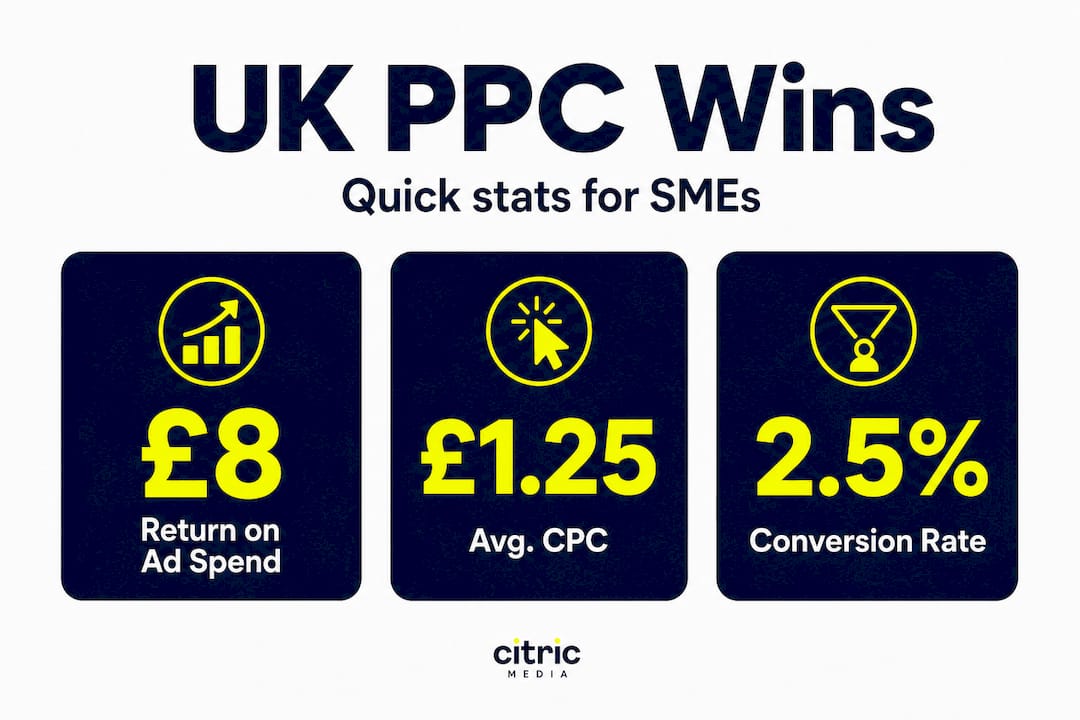
Understanding the cost landscape is critical before you invest. UK PPC costs show that average Google Ads CPC ranges from £0.66 to £5.00 depending on the industry, with most SMEs paying between £1.50 and £2.50 per click. Legal services sit at the high end at around £8.25 per click, while retail averages closer to £0.95. Monthly budgets for UK SMEs typically range from £2,000 to £9,000, though many smaller businesses start below that range and scale up once they see returns.
| Industry | Average CPC (UK) | Typical conversion rate |
|---|---|---|
| Legal services | £8.25 | 2.5% |
| Financial services | £5.50 | 3.1% |
| Retail / ecommerce | £0.95 | 5.9% |
| B2B services | £3.20 | 2.23% |
| Home services | £2.10 | 4.8% |
Return on ad spend can be compelling. Research on UK ROAS suggests businesses achieve approximately £8 in revenue for every £1 spent on Google Ads, though that figure varies considerably by sector and campaign quality. B2B cost per lead ranges from £56 to £116 depending on industry and targeting.
Working with a dedicated Google Adwords agency can substantially accelerate results, particularly in competitive sectors where campaign structure and bid strategy require ongoing expertise.
PPC vs SEO: which is right for your business?
Now, understanding PPC’s mechanisms, it is vital to see how it compares to other online strategies, especially SEO.
PPC and SEO serve fundamentally different functions in a digital marketing strategy, and the choice between them is rarely either/or. PPC delivers immediate visibility; the moment your campaign goes live, you can appear on page one of Google. SEO builds organic rankings over time, typically taking three to twelve months to generate meaningful traffic, but the results are far more sustainable and do not stop the moment you pause investment.
Here is how the two compare across key dimensions:
| Factor | PPC | SEO |
|---|---|---|
| Speed to results | Immediate (days) | Slow (3 to 12 months) |
| Cost model | Pay per click | Investment in content/links |
| Traffic sustainability | Stops when paused | Continues without ongoing spend |
| User trust | Lower (labelled as ad) | Higher (organic results) |
| Targeting precision | Very high | Limited |
| Scalability | Instant with budget | Gradual |
The most important insight here is that trust works differently across channels. Users do see PPC ads as paid placements, which introduces a small credibility gap compared to organic results. However, for high-intent searches such as “emergency plumber in Manchester” or “accountant for small business Birmingham,” that gap largely disappears because the user wants a solution immediately.
For most UK SMEs, the practical answer is a hybrid approach. Use PPC to generate leads quickly, gather data on which keywords and messages convert, and use those insights to inform your SEO for UK SMEs strategy. PPC also funds the business while SEO builds its longer-term foundation.
Pro Tip: Run PPC for your highest-intent keywords from day one. Use the conversion data to identify which keywords generate real enquiries, then prioritise those same terms in your SEO content plan. This approach removes the guesswork and shortens the SEO learning curve significantly. A structured digital marketing plan for SMEs will show you exactly how these channels connect.
Common PPC pitfalls and how to avoid them
To maximise the impact of PPC, business owners need to steer clear of avoidable mistakes. The list of ways to waste money in PPC is long, but the most damaging errors tend to cluster around a few recurring themes.
According to expert analysis of Google Ads mistakes, the most common pitfalls include broken or inconsistent conversion tracking, using broad match keywords without negative keyword lists, making too many changes too quickly, allowing low Quality Scores to inflate click costs, ignoring the search terms report, and over-relying on automated bidding without human oversight.
Here are the most critical mistakes and how to avoid them:
- Broken conversion tracking: If Google cannot see which clicks lead to enquiries or sales, it cannot optimise your campaigns effectively. Audit your tracking before spending a single pound.
- No negative keywords: Broad and phrase match keywords will attract irrelevant traffic without a well-maintained negative keyword list. Review the search terms report weekly and exclude anything that does not align with your offer.
- Sending traffic to the homepage: A homepage rarely converts well because it is not tailored to the specific intent of someone who clicked a particular ad. Build dedicated landing pages.
- Over-editing during the learning phase: Google’s automated bidding needs data to function. Changing bids or budgets too frequently during the learning phase resets the algorithm and wastes time and budget.
- Ignoring Quality Score: Quality Score is Google’s rating of the relevance of your keywords, ads, and landing pages. Campaign management best practice recommends using manual CPC bidding initially (especially if you generate fewer than 30 conversions per month) and transitioning to Target CPA or Target ROAS once you have sufficient data.
“The single most expensive PPC mistake we see from UK SMEs is running ads without conversion tracking in place. You are essentially driving blind, spending money without knowing what is working.”
Pro Tip: Do not assume that Google’s Smart campaigns or fully automated solutions will handle everything. Automation raises the floor of campaign performance but rarely delivers the ceiling that well-structured, manually supervised campaigns achieve. Keep a close eye on automated bidding and override it when the data tells you to. If you are also exploring paid social advertising for SMEs, the same principle of human oversight applies across all platforms.
Maximising PPC results: tracking, analytics, and advanced strategies
Having addressed what can go wrong, let us focus on strategies to ensure PPC campaigns deliver meaningful value.
The most important mindset shift for UK SMEs is moving beyond surface-level metrics. Click-through rate and cost per click are useful diagnostics, but they do not tell you whether the campaign is actually profitable. The metrics that matter are return on ad spend (ROAS), cost per lead (CPL), and customer lifetime value (LTV).
A critical but often overlooked nuance in PPC measurement is that ROAS ignores profit margins entirely. A campaign generating £8 for every £1 spent sounds excellent until you discover that the product sold has a 10% margin. Aligning your metrics with actual business profitability, particularly LTV-weighted analysis, gives you a far more honest picture of campaign health.
Incrementality testing is another underused tactic. This involves measuring whether your PPC activity is genuinely adding new customers rather than simply claiming credit for conversions that would have happened organically. Running controlled spend-pause experiments across geographic regions or audience segments can reveal the true incremental value of your investment.
Practical tactics to optimise ongoing campaigns include:
- A/B testing ad copy continuously: Small changes to headlines and descriptions regularly produce 15 to 30% improvements in click-through rate.
- Audience layering: Overlay remarketing lists, in-market audiences, and customer match data on top of keyword targeting to increase relevance and reduce wasted spend.
- Negative keyword expansion: Schedule a weekly 15-minute review of the search terms report and add irrelevant terms to your negative keyword list.
- Landing page optimisation: Test page headlines, call-to-action button copy, and form length systematically. Conversion rate improvements here multiply the return from every pound of ad spend.
- Dayparting and device adjustments: Analyse conversion data by hour, day, and device type, then adjust bids accordingly. Many B2B businesses, for instance, see dramatically lower conversion rates on weekends or mobile devices.
- Utilise the paid social advertising guide to understand how retargeting across social channels can recapture visitors who clicked your PPC ad but did not convert on the first visit.
The businesses that extract the most from PPC are those that treat it as an ongoing process of testing and refinement rather than a set-and-forget channel.
Our take: what most PPC guides miss for UK SMEs
Most PPC content focuses almost exclusively on what clicks cost. That is understandable because cost is tangible and easy to benchmark. But in our experience working with UK SMEs across a wide range of sectors, the businesses that struggle with PPC are rarely overpaying for clicks. They are underpaying attention to what happens after the click.
Conversion tracking is not a technical nice-to-have. It is the foundation upon which every intelligent decision in PPC rests. Without it, you are guessing. And guessing at scale is an expensive habit.
The second thing most guides miss is the relationship between ROAS and real profitability. A business generating a 6x ROAS on a product with a 12% margin is losing money. We always encourage SMEs to work backwards from desired profit, not from ad spend benchmarks.
There is also a tendency among newer advertisers to treat Google’s automation as a replacement for strategy. Automation is a powerful tool when it has sufficient data and clear objectives. When it does not, it can burn budget at remarkable speed. The businesses we see winning with PPC in 2026 are those that combine smart automation with disciplined human oversight and regular campaign audits.
Finally, PPC does not exist in isolation. The businesses achieving the strongest results are those integrating paid search with SEO, paid social, and a coherent content strategy. If you are exploring B2B SME digital marketing, the evidence is clear: channels that reinforce each other produce outcomes that no single channel achieves alone.
Discover digital marketing solutions for UK SMEs
If this article has clarified what PPC can do for your business, the logical next step is to understand how it fits into a broader digital marketing strategy designed for measurable growth.
At Citric Media, we have spent over 27 years helping UK SMEs generate high-quality leads and sales through performance-driven digital channels. Whether you are ready to launch your first PPC campaign or looking to improve an underperforming one, our team brings the data, structure, and oversight that campaigns require to deliver real profit. Explore our paid social advertising solutions alongside search PPC, or read our practical guide on digital marketing growth for SMEs to see how the channels fit together. For a structured starting point, our digital marketing guide for SMEs is an excellent place to begin.
Frequently asked questions
How quickly can PPC generate leads for a UK SME?
PPC delivers leads almost immediately after a campaign goes live, often within hours of activation, but traffic and leads stop as soon as the campaign is paused.
What is a typical monthly PPC budget for a small UK business?
UK SME budgets typically range from £2,000 to £9,000 per month, though many businesses begin at a lower level and scale once they have validated performance.
Should I use PPC or SEO to promote my business?
The strongest approach for most SMEs is to combine both: PPC for quick results and immediate lead generation, and SEO to build sustainable organic visibility over the longer term.
What are the main PPC campaign pitfalls to avoid?
The most damaging mistakes include broken conversion tracking, broad match without negatives, making too many changes during the learning phase, ignoring Quality Score, and over-relying on automated bidding without regular human review.
How do I know whether PPC is profitable for my SME?
Look beyond ROAS alone, since ROAS ignores profit margins. Align your PPC metrics with actual margin and customer lifetime value to get an honest measure of campaign profitability.