Digital Marketing
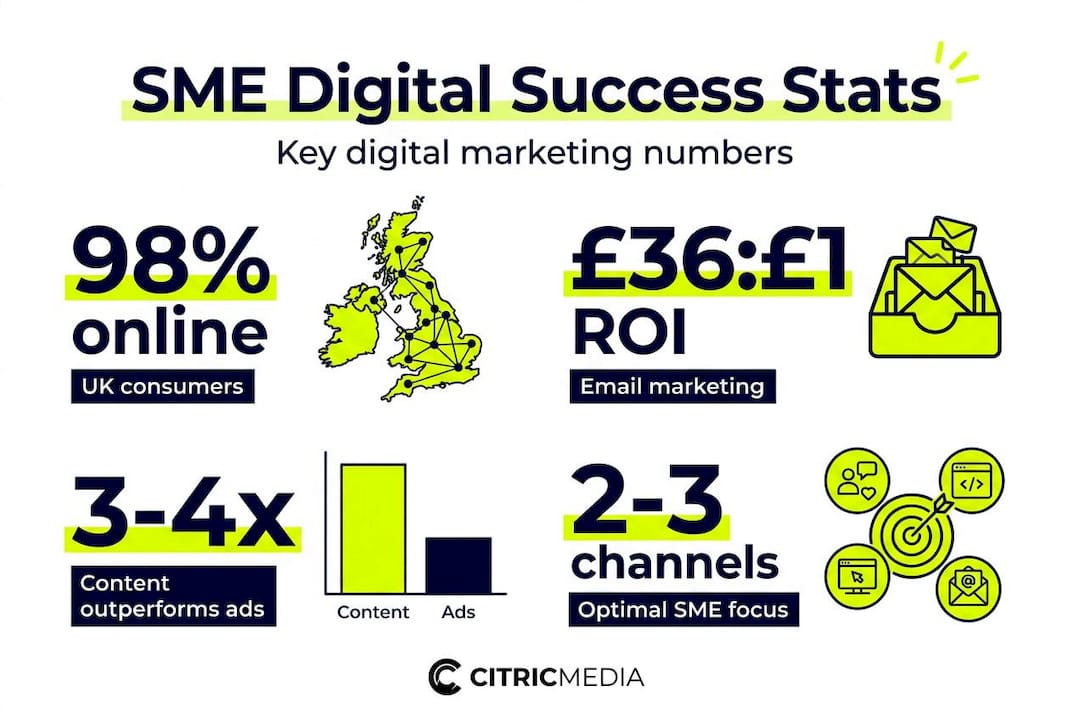
With 98% of the UK population now online, the question is no longer whether your customers are reachable through digital channels — it’s whether your business is showing up when they search. For UK SMEs, the challenge is less about understanding that digital marketing matters and more about deciding which channels to invest in, how to measure results, and how to avoid wasting precious budget on tactics that simply don’t fit. This article cuts through the noise and gives you a grounded, practical guide to digital marketing strategies that genuinely move the needle for small and medium-sized businesses across the UK.
Table of Contents
- What is digital marketing? Key concepts explained
- Top digital marketing channels for UK SMEs
- Digital marketing best practices for SMEs in 2026
- Common SME mistakes and how to avoid them
- Why most advice on digital marketing misguides UK SMEs
- Get expert digital marketing support for your UK SME
- Frequently asked questions
Key Takeaways
| Point | Details |
|---|---|
| Digital is essential | Almost all UK consumers are online and SMEs need digital channels to compete. |
| Choose channels wisely | SEO, email, and social ads each serve different goals—pick what fits your audience and resources. |
| Value-driven content wins | Focus marketing on helping and informing, not just promotion, for trust and long-term results. |
| Integrate and automate | A joined-up, data-led strategy with some automation lets SMEs outpace competitors and cut waste. |
| Avoid common SME pitfalls | Many mistakes are avoidable with clear priorities, consistent measurement, and continuous learning. |
What is digital marketing? Key concepts explained
Digital marketing covers every online activity a business uses to reach, attract, and convert its target audience. That includes search engine optimisation (SEO), pay-per-click advertising (PPC), email campaigns, paid social media, and content marketing. What sets it apart from traditional channels like print or direct mail is that every element is measurable, targetable, and adjustable in real time.
Think about a full-page ad in a local newspaper. You spend the money, it goes out, and you hope it reaches someone relevant. Digital marketing flips that model entirely. You define your audience precisely, track how many people see your message, and measure exactly how many become customers. That level of control is why investing in digital marketing has become the default growth strategy for forward-thinking UK SMEs.
With the UK population overwhelmingly online, your customers are already there. The question is whether your business is visible when they look. Here’s how digital stacks up against traditional marketing for SMEs:
| Factor | Traditional marketing | Digital marketing |
|---|---|---|
| Cost | High (print, TV, radio) | Scalable (start small, grow) |
| Targeting | Broad, demographic-based | Precise, intent and interest-based |
| Measurability | Limited, estimated reach | Full data: clicks, leads, conversions |
| Speed to adjust | Slow (days to weeks) | Instant (hours) |
| Longevity | Expires quickly | Content and SEO compound over time |
| Best for SMEs | Local awareness | Lead generation, sales, visibility |
The core channels UK SMEs rely on most effectively include:
- SEO: Building long-term organic visibility in search engines so customers find you without paid spend
- PPC: Paying for prominent placement in search results when users search for what you sell
- Paid social: Advertising on platforms like Meta, LinkedIn, and TikTok with precise audience targeting
- Email marketing: Communicating directly with prospects and existing customers at low cost
- Content marketing: Creating useful articles, videos, and guides that attract and educate your audience
SME marketing strategies that perform well consistently combine at least two or three of these channels rather than relying on one alone. The reason is simple: your customers rarely convert at first contact. They need multiple touchpoints, and different channels serve different stages of that journey.
SEO for SME growth is particularly compelling because it builds equity over time. Every piece of content that ranks in Google continues working for you months or even years after publication. That makes it one of the most cost-effective long-term investments a UK SME can make.
Top digital marketing channels for UK SMEs
Now you have a foundation, let’s break down which digital marketing channels are most impactful and affordable for UK SMEs.

Not all channels are equal, and budget decisions need to be grounded in your specific business goals. Here’s a practical breakdown of the most relevant options:
| Channel | Typical cost | Difficulty | Time to results | Ideal SME use |
|---|---|---|---|---|
| SEO | Low to medium | Medium to high | 3 to 9 months | Brand visibility, long-term leads |
| PPC (Google/Bing) | Medium to high | Medium | Days to weeks | Immediate lead generation |
| Email marketing | Very low | Low to medium | Immediate | Nurturing, retention, upselling |
| Paid social | Low to medium | Medium | Days to weeks | Brand awareness, targeted sales |
| Content marketing | Low (time-intensive) | Medium | Months | Authority building, organic traffic |
The key insight from high-intent SEO and email research is that content consistently outperforms paid advertising for long-term results, while paid channels efficiently fill short-term gaps. For most UK SMEs, the most realistic approach is to build SEO and content as your long-term foundation while using PPC or paid social to generate leads immediately.
Email advantages for SMEs are frequently underestimated. Email delivers an average return of £36 for every £1 spent, making it one of the highest-performing channels available. When combined with a well-structured SEO content strategy, email becomes the mechanism through which you convert readers into paying customers at scale.
Paid social advertising for SMEs works best when your targeting is tight and your creative speaks directly to a defined audience problem. The mistake most SMEs make is treating paid social like a billboard rather than a conversation. Specific, benefit-led messaging aimed at a narrow audience segment consistently outperforms broad, generic campaigns.
The step-by-step digital marketing guide for SMEs shows how these channels interact in practice. SEO pulls in high-intent traffic. Content builds trust with that traffic. Email nurtures leads. Paid channels amplify what’s already working. That compounding effect is where real growth lives.
Pro Tip: If your budget is tight, start with SEO and email. These two channels, done consistently, generate compounding returns without requiring significant ongoing spend. Add PPC once you have conversion data from your organic traffic to ensure paid campaigns target the right queries.
Digital marketing best practices for SMEs in 2026
With your channel priorities in mind, here’s how to execute digital marketing effectively as a UK SME in 2026.
The GOV.UK SME Digital Adoption Taskforce found that adopting digital tools and practices can raise SME productivity by 7 to 18%. That is not a marginal gain. For a business generating £500,000 in annual revenue, a 10% productivity improvement translates to £50,000 in value. Digital marketing is not just a visibility exercise; it is a business performance lever.
“Digital adoption can raise SME productivity by 7 to 18%, making it one of the most impactful investments a small business can make.” — SME Digital Adoption Taskforce Final Report, GOV.UK
Here are five essential best practices every UK SME should follow in 2026:
Apply the 80/20 content rule. As supported by the 80/20 content rule framework, 80% of your content should add genuine value — answering questions, solving problems, educating your audience. Only 20% should promote your products or services directly. Audiences disengage quickly when every post or email is a sales pitch.
Prioritise integration over isolation. Running SEO, email, and social as separate activities is a missed opportunity. When these channels share messaging, audiences, and data, each one strengthens the others. A blog post optimised for search can be repurposed into an email sequence and shared across social platforms, multiplying its reach and impact.
Use data, not assumption, to guide decisions. What you think your customers want and what they actually respond to are often different things. Set up Google Analytics 4, track which pages convert, monitor email open rates, and let real behaviour data inform your next campaign. This approach consistently outperforms intuition.
Find and own a niche position. Generic messaging struggles in a crowded market. The SMEs seeing the strongest results in 2026 are those who have identified a specific audience segment and speak directly and confidently to that group’s particular needs. Niche positioning is not limiting; it is clarifying.
Leverage marketing automation to scale without headcount. Email sequences, social scheduling, and CRM workflows allow small teams to deliver consistent, personalised communication at scale. The cost of automation tools is now accessible even for the smallest SMEs, and the time savings are substantial.
SME performance marketing benefits are most visible when these practices work together rather than in isolation. A business that creates genuinely useful content, delivers it to the right audiences across multiple channels, and measures results with rigour will consistently outperform competitors who rely on volume and activity alone.
Pro Tip: Review your content output quarterly. Are at least 80% of your articles, emails, and social posts solving a problem for your audience? If the balance is skewed towards promotion, realign before diminishing returns set in.
Common SME mistakes and how to avoid them
Understanding best practices is vital, but knowing what not to do can be just as valuable — here’s how to avoid classic SME pitfalls.
The most common digital marketing errors we see UK SMEs make are not complex or unusual. They are predictable, avoidable, and unfortunately expensive in terms of both budget and time lost. Recognising them early is the first step to building a more effective approach.
Trying to be everywhere at once. Spreading effort across six channels with limited resources results in mediocre performance on all of them. Choose two or three channels strategically and execute them well before expanding.
Ignoring measurement and analytics. If you are not tracking leads, conversion rates, and cost per acquisition, you are guessing. Automation scales limited resources and integrated strategy avoids this scattergun problem by forcing clearer attribution and decision-making.
Too much self-promotion, too little value. Constantly broadcasting product features without addressing customer pain points builds no trust. Audiences follow and buy from businesses that demonstrate they understand the problem first.
Inconsistent publishing. Posting on social media twice a week for a month and then going quiet for six weeks signals unreliability to both your audience and search engines. Consistency, even at a modest volume, outperforms bursts of intense activity followed by silence.
Neglecting mobile optimisation. Over 60% of UK web traffic now comes from mobile devices. If your website loads slowly or displays poorly on a smartphone, you are losing leads before they have a chance to engage with your content or offer.
Skipping the follow-up. Most leads do not convert on first contact. Without an email sequence, retargeting campaign, or CRM follow-up process, you are leaving a significant proportion of potential revenue on the table.
The SME marketing step-by-step approach is specifically designed to help businesses avoid these errors by building a structured, sequential plan rather than reacting to trends or copying competitors without context.
Pro Tip: Before adding a new channel, ask whether you have enough resource to manage it consistently for six months. If not, strengthen what you already have rather than diluting your effort further.
Why most advice on digital marketing misguides UK SMEs
My blunt view is this: the majority of digital marketing advice written for SMEs is either too generic to be actionable or too channel-specific to reflect how businesses actually grow. The “do all the things” approach is particularly damaging because it creates activity without results, and activity without results drains confidence as quickly as it drains budget.
We have worked with UK SMEs across a wide range of sectors for over 27 years. What consistently separates the businesses that grow from those that plateau is not the number of channels they use. It is the clarity of their focus, the quality of their measurement, and the discipline to optimise what is working rather than chasing the next shiny tactic.
The idea that every SME should be on LinkedIn, Instagram, TikTok, YouTube, and Pinterest simultaneously is, frankly, poor counsel. A plumbing company in Sheffield has no business spending time on TikTok if its customers are searching Google for “emergency plumber Sheffield” at 11pm on a Wednesday. Channel selection should follow audience behaviour, not industry fashion.
What actually delivers growth for UK SMEs is a focused, evidence-led approach: two or three channels chosen deliberately, campaigns built around real customer intent, and a measurement framework that ties activity to revenue rather than vanity metrics like follower counts or impressions.
The perspective on digital marketing ROI we consistently advocate is grounded in this reality: UK SMEs have more affordable, powerful digital tools available to them today than at any point in history. The opportunity is real. But extracting value from those tools requires strategy, not just activity. The businesses that will lead their markets over the next five years are those that choose precision over volume and evidence over assumption.
Get expert digital marketing support for your UK SME
Knowing the right strategies is one thing. Executing them consistently, measuring them rigorously, and adjusting them as the market evolves is where most SMEs need support. If you are ready to move from theory to measurable results, Citric Media brings over 27 years of experience helping UK SMEs generate high-quality leads and sustainable growth through performance-driven digital marketing.
Whether you are starting from scratch or looking to improve an existing strategy, our team can help you prioritise the right channels, build campaigns that convert, and track every pound of your marketing spend. Explore how we can boost your SME growth with a strategy tailored to your business, or work through our actionable SME digital guide as a practical starting point. The right support makes the difference between a marketing budget that feels like a cost and one that functions like an investment.
Frequently asked questions
Why is digital marketing so important for small businesses in the UK?
With 98% of the UK population online, digital channels offer SMEs the most measurable and cost-effective route to reaching customers and generating consistent enquiries. Traditional marketing simply cannot match the targeting precision or real-time measurement that digital provides.
Which digital marketing channel gives the fastest results for SMEs?
Paid channels fill gaps quickly: PPC and paid social can generate leads within days of launch. Content marketing and SEO build lasting value over months but reduce long-term cost per acquisition significantly once they gain traction.
What is the 80/20 content rule in marketing?
The 80/20 content rule means 80% of your content should genuinely help your audience by answering questions or solving problems, while only 20% directly promotes your products or services. This balance builds trust and authority before asking for a sale.
How does digital marketing improve SME productivity?
The SME Digital Adoption Taskforce found that digital adoption raises SME productivity by 7 to 18%, largely through more efficient processes, better-targeted outreach, and reduced reliance on time-intensive manual marketing activities.