Marketing
Most business owners assume marketing consultants are a luxury reserved for large corporations with sprawling budgets. That assumption costs smaller firms dearly. The role of a marketing consultant is, in practice, one of the most targeted and commercially focused external investments a growing UK business can make. Whether you are facing rising acquisition costs, a product launch that has underperformed, or a marketing function that is simply pulling in too many directions, an experienced consultant can reframe the problem and point clearly at what needs to change.
Table of Contents
- Key takeaways
- The role of a marketing consultant
- When UK businesses should hire one
- Types of marketing consultants
- How consultants add value beyond agencies
- Choosing and engaging a marketing consultant
- My perspective on consultant engagements
- How Citricmedia supports consultant-led growth
- FAQ
Key takeaways
| Point | Details |
|---|---|
| Consultants focus on outcomes | They diagnose problems and advise on measurable results, not headcount or activity levels. |
| Type of consultant matters | Strategy, execution, and fractional CMO roles differ significantly in scope, cost, and accountability. |
| Briefs must be specific | Vague objectives lead to failed engagements regardless of consultant skill or experience. |
| Data access is non-negotiable | Sharing commercial numbers, not just marketing dashboards, produces better strategic guidance. |
| Right timing makes the difference | Engage a consultant when facing a defined problem requiring senior expertise you do not hold internally. |
The role of a marketing consultant
A marketing consultant is an external specialist hired to diagnose marketing performance, recommend strategic changes, and either guide internal teams or execute specific work directly. The distinction from an in-house marketer is fundamental. An in-house team member operates within the business, carrying out ongoing tasks within defined processes. A consultant enters with an outside perspective, focused on solving a specific problem rather than maintaining the status quo.
This is also distinct from a marketing agency relationship. Agencies typically charge for time, resources, and channel management. A consultant charges for expertise and judgement. The scope is tighter, the output more strategic, and the accountability more directly tied to business outcomes.
In terms of marketing consultant duties, the scope is broad but purposeful:
- Strategy development: Building go-to-market plans, positioning frameworks, and channel strategies aligned to commercial goals.
- Marketing audits: Reviewing existing channel performance, spend allocation, messaging, and competitive positioning.
- Channel optimisation: Identifying where budget is being wasted and where opportunity is being missed across paid, organic, and owned channels.
- Capability building: Setting up systems and processes that continue delivering value after the engagement ends.
- Specialist advisory: Providing expert guidance in areas such as SEO, paid advertising, content strategy, or social media without taking over day-to-day management.
Within that broad description, consultants may specialise in areas such as SEO, content strategy, paid social, or brand reputation. Some operate as senior generalists who can span multiple functions. Others focus on a single discipline where they have deep technical knowledge. Understanding which type you need is the starting point for any successful engagement.
When UK businesses should hire one
The right time to engage a consultant is not when things are generally “not working.” That is too vague, and it produces expensive, frustrating engagements. Hire when you face a specific problem requiring senior expertise that does not exist internally.
Some of the most productive scenarios UK business owners encounter include:
- A product launch that has underdelivered and the internal team cannot diagnose why.
- Customer acquisition costs rising consistently without a clear explanation rooted in data.
- A business scaling into new markets or customer segments without prior experience in those areas.
- An internal marketing team that is active but not aligned to commercial priorities.
- A period of transition, such as a rebrand, acquisition, or significant shift in product positioning.
What makes these situations appropriate for a consultant is that they involve a defined problem, a window of urgency, and a need for senior external judgement. A useful resource for understanding how this applies to B2B digital marketing challenges specifically gives further context on where targeted expertise pays dividends.
The importance of a clear brief cannot be overstated. Vague briefs like “we need more leads” without defined product context, sales stage data, or margin information lead to failed engagements despite the consultant’s skill. The business owner carries responsibility for this. If you cannot define what success looks like in measurable terms before the engagement begins, you are not ready to hire a consultant.
Pro Tip: Before contacting any consultant, write down the three commercial outcomes you want to see in 90 days. If you cannot do this with confidence, spend a week on internal alignment first. The quality of your brief determines the quality of your results.
Types of marketing consultants
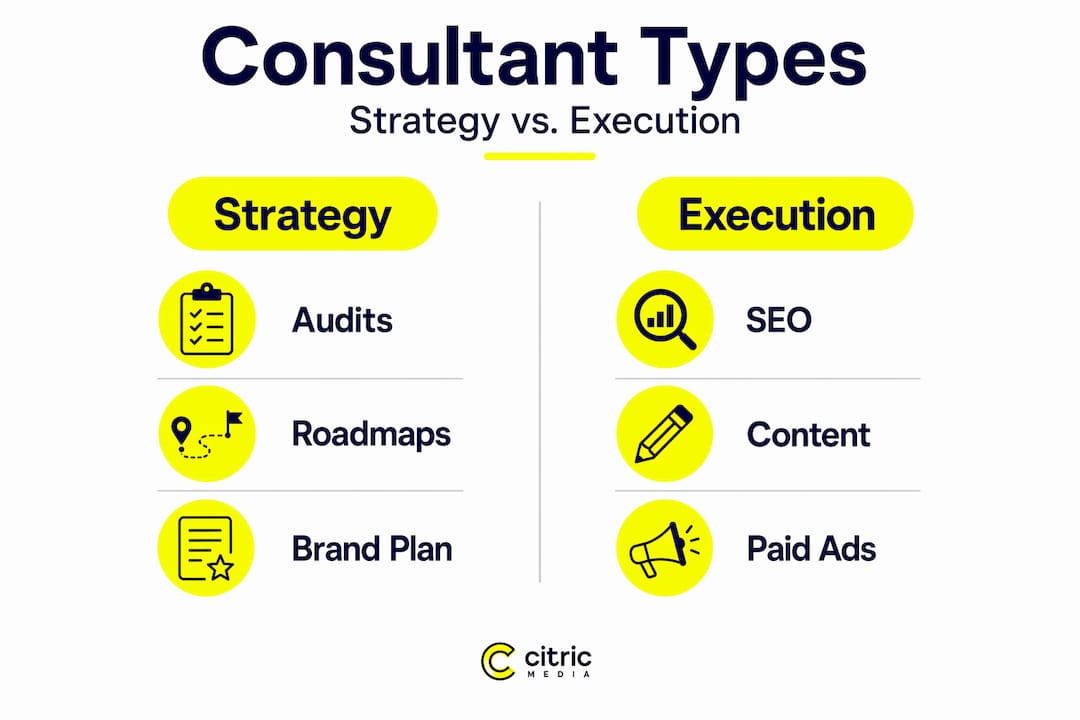
Not all consultants operate the same way, and the differences matter significantly for budget, integration, and what you should expect at the end of an engagement. The strategy versus execution distinction is the clearest dividing line.
| Type | What they deliver | Best for |
|---|---|---|
| Strategy consultant | High-level plans, audits, roadmaps, and recommendations | Businesses needing direction and clarity before acting |
| Hands-on consultant | Execution support including copywriting, vendor management, and campaign oversight | Businesses with gaps in capability or capacity |
| Fractional CMO | Part-time senior marketing leadership with commercial accountability | Scale-ups, PE-backed firms, and businesses not yet ready for a full-time hire |
| Specialist consultant | Deep expertise in one channel or discipline such as SEO or paid social | Businesses with a specific technical or channel-level challenge |
The fractional CMO model has grown significantly in the UK over the past few years, particularly among scale-ups and private equity backed businesses. A fractional CMO brings senior leadership, carries accountability to commercial targets, and often draws on experience across multiple portfolio businesses. For a company at the £2m to £10m revenue stage, this is frequently a better use of budget than a full-time marketing director hire.

Pro Tip: Clarify upfront whether you need strategic advice, execution support, or both. This single question will help you shortlist the right consultant type and avoid paying strategy-level day rates for execution tasks, or vice versa.
The model you choose also affects how embedded the consultant becomes in your business. A pure strategy consultant may deliver a document and exit. A fractional CMO may attend board meetings, lead a team, and hold a seat at the commercial table. Neither is inherently better. The right choice depends on the specific gap you are trying to fill.
How consultants add value beyond agencies
A marketing consultant’s value is not simply as an alternative to an agency. In many cases, the most effective model involves both. The consultant acts as the strategic coordinating layer above the agencies, keeping all channels pointed toward the same commercial objective. Without this, individual agencies optimise for their own metrics. The paid search team chases click-through rates. The SEO agency tracks keyword rankings. The social team reports on engagement. None of it necessarily connects to revenue.
Here is where the case for consultants becomes particularly clear in fast-growth or transition phases:
- Preventing channel siloes: A consultant aligns paid search, SEO, content, and social toward shared goals rather than allowing parallel but disconnected optimisation.
- Outcome-based accountability: Consultants charge for expertise and outcomes. This typically results in tighter scopes and lower total engagement costs compared to agencies billing for time and resources.
- Avoiding scope creep: Agencies have commercial incentive to expand their remit. A consultant with no channel to sell has incentive only to give you the right recommendation.
- Challenging assumptions: Independent expert judgement includes the willingness to challenge your existing beliefs and ask uncomfortable questions. That is something internal teams often cannot do without political cost.
You can read more about the strategic case for digital agencies and how consultants fit alongside them when coordinating complex marketing functions. The combination of a strong consultant and a capable agency partner is often more powerful than either alone.
Choosing and engaging a marketing consultant
Getting the engagement right from the start matters more than most business owners realise. The quality of your preparation determines whether you get transformational advice or an expensive set of slides. Here is what to consider before and during the hiring process:
- Define your internal gaps first: Identify where your team lacks expertise or capacity. This tells you which consultant type you need and what scope to propose.
- Write specific success criteria: Outcomes must be measurable. “Improve brand awareness” is not a success criterion. “Reduce cost per acquisition by 25% within six months” is.
- Assess relevant track record: Look for consultants who have worked with businesses of a similar size, sector, or growth stage. Ask for specific case studies with commercial outcomes, not just campaign metrics.
- Provide access to real data: Sharing commercial numbers, including revenue, conversion rates, and margins, rather than only marketing dashboards, produces far better strategic output.
- Establish clear deliverables: Agree on what will be produced, by when, and how progress will be reviewed. Consultants who resist this are a warning sign.
- Understand the cost structure: Consultants may charge a daily rate, a project fee, or a retainer. Understand what each model incentivises. A project fee aligns incentives toward completion. A retainer can drift without strong governance.
For UK SMEs specifically, the performance marketing principles that drive the best consultant engagements also map closely to broader growth strategy. Knowing what measurable marketing success looks like in your sector will help you hold any consultant genuinely accountable.
Marketing strategy consultants at the senior end of the market also work on operating model design, technology selection, and team capability building. This is worth knowing even if it is beyond your current budget. Understanding the full scope of what the role can encompass helps you ask better questions when evaluating candidates at every level.
My perspective on consultant engagements
I have watched dozens of UK businesses hire marketing consultants and I have seen the full range of outcomes. The engagements that work share one consistent characteristic: the business owner came in with a real problem, not a vague ambition.
The ones that fail almost always start with a brief that sounds like “we need to grow our marketing.” That is not a brief. It is a wish. And no consultant, regardless of their credentials, can turn a wish into a strategy without commercial specificity.
What I find genuinely undervalued is the consultant’s willingness to disagree. The best consultants I have encountered do not validate your existing thinking. They interrogate it. They ask why your conversion rate is what it is, why you are targeting that audience, why your sales cycle is that long. That discomfort is the service. If a consultant is agreeing with everything you say, you are not getting value.
My practical advice: treat the first two weeks of any engagement as a diagnostic phase. Give the consultant access to your commercial data, your analytics, your sales pipeline. See what questions they ask. The quality of their questions tells you more about their calibre than any proposal document ever will.
— Martin
How Citricmedia supports consultant-led growth
If you are working with a marketing consultant or considering bringing one on board, the executional layer beneath the strategy matters just as much as the direction itself. Consultants set the course. The right agency partners deliver the results.
Citricmedia has spent over 27 years working alongside UK businesses to deliver performance-driven digital marketing across Google Ads, SEO, paid social, and Bing Advertising. We work with business owners who need more than activity; they need measurable enquiries, leads, and sales. Whether a consultant has shaped your strategy or you are building one from scratch, explore how Citricmedia’s services can turn strategic direction into commercial results. You can also explore our thinking on SEO investment as a starting point for understanding where organic growth fits your broader plan.
FAQ
What does a marketing consultant do?
A marketing consultant diagnoses marketing performance issues, advises on strategic changes, and either guides internal teams or executes specific work. Their focus is on solving defined problems and delivering measurable commercial outcomes.
What are the main benefits of hiring a marketing consultant?
The core benefits include access to senior expertise without a full-time hire, an objective external perspective, and outcome-focused accountability. Consultants also tend to have tighter scopes than agencies, which can make engagements more cost-effective overall.
How do I choose the right marketing consultant?
Start by defining the specific problem you need solved and the commercial outcomes you expect. Then look for consultants with a relevant track record in your sector or growth stage, and ask for case studies with measurable results rather than general references.
What is a fractional CMO and do I need one?
A fractional CMO is a part-time senior marketing leader who carries commercial accountability and leads your marketing function without the cost of a full-time director. They are best suited to scale-ups and businesses at a growth inflection point that need senior leadership but cannot yet justify a permanent hire.
How much does a marketing consultant cost in the UK?
Costs vary significantly by type and seniority. Day rates for experienced consultants typically range from £600 to £2,000 or more. Project fees and retainers offer more predictability. The total cost is often lower than an equivalent agency engagement because the scope is tighter and the work moves faster.