General
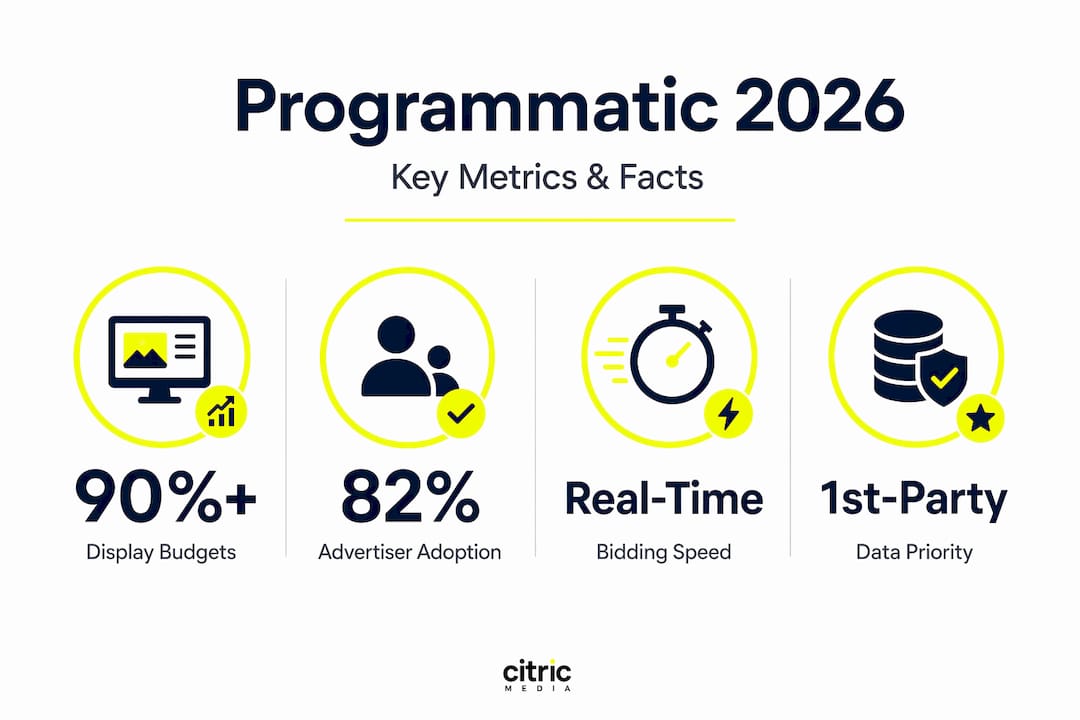
Programmatic advertising now commands nearly every pound spent on digital display media. By 2026, 90% of display budgets worldwide flow through programmatic channels, yet many marketing professionals and business owners still have only a vague sense of what it actually involves. This guide cuts through the confusion. You will learn precisely what programmatic advertising is, how the technology works in practice, why adoption has surged, where the real challenges lie in 2026, and how to integrate it meaningfully into your own marketing strategy.
Table of Contents
- Key takeaways
- What is programmatic advertising and how does it work?
- Benefits and challenges of programmatic in 2026
- The role of data and measurement in programmatic
- Integrating programmatic into your marketing strategy
- My honest take on programmatic advertising
- How Citricmedia can help you with programmatic
- FAQ
Key takeaways
| Point | Details |
|---|---|
| Programmatic dominates display | Over 90% of digital display ad budgets globally are bought programmatically, making it the default channel. |
| Automation speeds buying | Ad auctions complete in roughly 100 milliseconds, replacing slow, manual insertion-order processes entirely. |
| First-party data is vital | Privacy changes have made first-party data and CDPs the foundation of precise, durable audience targeting. |
| Measurement must go beyond clicks | Sophisticated campaigns now link programmatic exposure to revenue using closed-loop attribution models. |
| Integration beats isolation | Programmatic delivers maximum value when connected to your CRM, analytics stack, and broader media strategy. |
What is programmatic advertising and how does it work?
Programmatic advertising is the automated buying and selling of digital ad space through software, in real time, using data to decide which ad to show to which person at which price. Compare this to traditional media buying, where an agency negotiates a fixed placement manually, signs an insertion order, and waits days or weeks for a campaign to launch. Programmatic replaces all of that with code and algorithms.
The process that underpins programmatic ad buying is called real-time bidding (RTB). When a user loads a web page, the publisher’s ad server sends a bid request to an ad exchange within milliseconds. Demand-side platforms (DSPs), used by advertisers, evaluate that request against audience data and campaign goals, then submit a bid automatically. The entire auction takes roughly 100 milliseconds per page load, completing before the page has even finished rendering.
The key components you need to understand are:
- DSP (Demand-Side Platform): The advertiser’s buying interface. It lets you set targeting parameters, budgets, and bidding logic.
- SSP (Supply-Side Platform): The publisher’s selling interface. It connects available ad inventory to multiple exchanges and buyers simultaneously.
- Ad exchange: The marketplace where DSPs and SSPs transact in real time.
- DMP (Data Management Platform): A data repository that segments audiences based on behavioural, contextual, and demographic signals.
- Ad server: Delivers the winning creative to the user and records the impression.
Programmatic is not limited to banner ads. It spans display, video, connected TV (CTV), digital out-of-home (DOOH), podcast audio, and mobile in-app inventory. That breadth is precisely what makes it so powerful as an overview of programmatic media for UK businesses of any size.
Pro Tip: If you are just starting out with programmatic, begin with display or video through a single DSP before expanding to connected TV or DOOH. Mastering one channel first gives you a cleaner data set to learn from.
Benefits and challenges of programmatic in 2026
The case for programmatic advertising is compelling, and advertiser adoption has doubled from 41% in 2022 to 82% in 2026. That growth is not accidental. The core benefits are concrete.
Precision at scale. You can target a very specific audience segment, say, B2B finance directors in the Midlands who visited your pricing page, across millions of publisher sites simultaneously. No manual insertion order gets you close to that granularity.

Speed and efficiency. Campaign set-up that once took days now takes hours. Automation enables real-time targeting across multiple channels, freeing your team from repetitive trafficking tasks so they can focus on strategy and creative.
Cost control. You bid only for impressions that match your audience criteria, reducing wasted spend. Budget pacing tools prevent overspend, and you can pause, adjust, or redirect spend in real time based on performance signals.
Yet the honest picture includes genuine challenges, and glossing over them does not serve you.
“Programmatic has a trust problem.” That is how industry leaders describe the current state of the channel. Transparency over where ads actually appear, how fees are distributed across the supply chain, and whether reported metrics reflect genuine business impact remains a live concern for many advertisers.
The principal challenges in 2026 are:
- Fee opacity: Multiple intermediaries (DSPs, SSPs, exchanges, data providers) each take a cut. Without a clear audit, advertisers often see only 50 to 60 pence of every pound reaching actual media.
- Brand safety: Automated buying at scale means ads can appear alongside unsuitable content unless you actively curate your supply path and use inclusion lists.
- Measurement complexity: Attributing revenue to a programmatic impression, as opposed to a click, requires infrastructure most small teams have not yet built.
- Privacy regulation: The decline of third-party cookies and tightening UK GDPR enforcement mean privacy-first, curated supply paths are no longer optional. They are the operating standard.
The businesses winning with programmatic in 2026 are those treating these challenges as engineering problems to solve, not reasons to avoid the channel.
The role of data and measurement in programmatic
Data is not a supporting feature of programmatic advertising. It is the engine. Understanding this distinction separates campaigns that waste budget from those that generate measurable returns.
Why first-party data has become non-negotiable
Third-party data, the kind purchased from data brokers and audience platforms, is degrading rapidly. Cookie deprecation, mobile identifier restrictions, and evolving regulation mean first-party data offers higher match rates and greater control than any external data source. Your CRM, your website behavioural data, your email lists: these are now your most valuable targeting assets.
The practical implication is that you need a Customer Data Platform (CDP) or at minimum a clean CRM integration to pipe first-party audiences directly into your DSP. Effective data-driven campaign strategies build durable audience segments that do not evaporate when a browser update changes tracking rules.
Moving beyond clicks
Here is where most programmatic campaigns fall short. Click-through rate is a proxy metric. It measures whether someone clicked, not whether they became a customer. Sophisticated marketers are moving beyond single metrics like clicks, adopting multi-dimensional measurement models for better campaign attribution.
The measurement framework that works in 2026 typically involves three components:
- Incrementality lift testing: Run holdout groups to measure what business outcomes your programmatic spend genuinely caused, rather than correlated with. This is the only method that reveals true additionality.
- Media mix modelling (MMM): Statistical models that apportion revenue across all marketing channels, giving programmatic its fair share of credit without relying on individual user tracking.
- Closed-loop attribution: Connecting programmatic data with CRM to reflect pipeline impact. An impression that influenced a £50,000 contract shows up in your revenue data, not just your ad dashboard.
Pro Tip: Before you scale programmatic spend, configure your CRM to capture the first-touch source for every lead. Without that foundation, you cannot close the measurement loop, and you will struggle to justify budget to senior stakeholders.
Integrating programmatic into your marketing strategy
Understanding what programmatic advertising is matters far less than knowing how to make it work within your existing operation. The future of programmatic hinges on integrating it as a core marketing function with unified customer data, rather than running it as a siloed ad-buying channel in the corner of your media plan.
Here is how to approach that integration practically:
- Define your objective before choosing a platform. Awareness, retargeting, and lead generation each require different bidding strategies, creative formats, and measurement approaches. Choosing a DSP before you have a clear objective is the most common mistake we see from businesses new to programmatic.
- Connect your marketing stack. Your DSP should receive audience segments from your CDP or CRM, and it should send exposure data back to your analytics platform. Fragmented data means fragmented decisions.
- Curate your supply path. Do not accept every exchange’s open inventory uncritically. Build inclusion lists of trusted publishers, or use Private Marketplace (PMP) deals to buy inventory directly from premium publishers at scale. This improves both brand safety and measurement accuracy.
- Choose partners who show you their fees. Transparency is a negotiating point, not a given. Ask any DSP or managed service provider to disclose the full breakdown of where your media budget goes. Reputable partners will not hesitate.
- Report on business outcomes, not just media metrics. When you present programme results to leadership, lead with revenue influenced, pipeline generated, or cost per qualified lead. Impressions and viewability scores mean very little outside the media planning room.
If you are weighing up whether to manage programmatic in-house or work with a specialist agency, the advantages of a digital agency include access to preferred DSP rates, established publisher relationships, and measurement expertise that takes years to build internally.
My honest take on programmatic advertising
I have spent years watching businesses approach programmatic with unrealistic expectations in both directions. Some assume it is a magic tap you turn on and revenue flows out. Others dismiss it as too complex or too expensive for anyone outside a global brand. Both positions are wrong.
What I have found consistently is that programmatic underdelivers when it is disconnected. A well-configured campaign running against the wrong audience data, or feeding into an analytics setup that cannot track past the click, will spend budget and produce nothing you can defend to a board. The technology is genuinely powerful. The surrounding infrastructure is where most teams are underprepared.
Privacy changes have forced a reckoning that I think is ultimately healthy. The shift to first-party data and curated supply paths is pushing marketers to know their audiences properly, rather than relying on third-party data they never really understood. That is better for advertisers, better for consumers, and better for the long-term credibility of the channel.
My blunt forecast: the gap between businesses that have invested in measurement infrastructure and those that have not will widen sharply over the next two years. If you are still reporting programmatic performance in terms of impressions and CTR alone, brands seeking proof of impact will leave you behind. The channel has matured. Your measurement approach needs to match it.
— Martin
How Citricmedia can help you with programmatic
At Citricmedia, we have spent over 27 years helping UK businesses get real, measurable results from digital advertising. Whether you are exploring programmatic for the first time or looking to bring more rigour to an existing campaign, we can help you build the strategy, data connections, and measurement frameworks that make it worth the investment.
Our paid social and digital advertising services are built around the same data-first principles that make programmatic work, giving you a clear view of what your budget is actually achieving. If you want to understand how digital advertising can drive qualified leads and revenue for your business, investing in digital marketing with the right partner makes the difference. Get in touch with our team to discuss where programmatic fits in your marketing strategy.
FAQ
What is programmatic advertising in simple terms?
Programmatic advertising is the automated buying of digital ad space using software and data, replacing manual negotiation with real-time algorithmic auctions that match ads to audiences in milliseconds.
Why use programmatic advertising over traditional media buying?
Programmatic offers precision targeting, real-time budget control, and the ability to reach specific audiences across millions of sites simultaneously, which manual media buying cannot replicate at comparable speed or scale.
How does programmatic ad buying actually work?
When a user loads a page, an auction runs automatically between advertisers’ demand-side platforms, completing in roughly 100 milliseconds, with the winning ad delivered before the page finishes loading.
What data do I need to run effective programmatic campaigns?
First-party data from your CRM and website is now the most reliable foundation, as third-party cookie deprecation and UK GDPR enforcement have made external data sources less accurate and harder to rely on.
How do I measure whether programmatic advertising is working?
Move beyond clicks and impressions. Use incrementality lift tests, media mix modelling, and CRM-integrated attribution to connect programmatic exposure to pipeline and revenue, giving you proof of genuine business impact.