General
Transparency in marketing has shifted from a nice-to-have virtue into a hard commercial requirement. Yet many businesses still treat it as an afterthought: a privacy policy buried in the footer, a vague pricing page, or an influencer post with a barely visible “#gifted” tag. The cost of that approach is steeper than most realise. Consumers are more sceptical and better informed than ever, and the brands that win their loyalty are the ones willing to communicate openly, price honestly, and disclose clearly. This guide explores why transparency in marketing is now central to building trust, staying compliant, and driving sustainable growth.
Table of Contents
- Key takeaways
- What transparency in marketing actually means
- How transparency builds trust: what the evidence shows
- Putting transparency into practice across your campaigns
- Challenges and nuances you will actually encounter
- Transparency as a competitive differentiator
- My perspective: transparency is not a trend
- How Citricmedia helps you build marketing that earns trust
- FAQ
Key takeaways
| Point | Details |
|---|---|
| Transparency spans multiple elements | It covers pricing, ad labelling, origin claims, and ethical practices, not just legal disclaimers. |
| Consumer demand is measurable | 60% of consumers rank transparency as the top trait they want from brands. |
| Regulation raises the stakes | CMA and ASA guidelines make opacity a legal and reputational risk for UK businesses. |
| Operational embedding matters | Transparency must appear before the purchase decision, not buried in post-click small print. |
| It drives commercial results | Transparent brands benefit from stronger loyalty, better word-of-mouth, and reduced churn. |
What transparency in marketing actually means
Transparency in marketing is the practice of communicating openly and honestly with your audience about what you are selling, how you operate, and what customers can expect from you. That sounds straightforward, but in practice it covers a surprising range of activities.
The core elements include:
- Pricing transparency: Displaying total costs upfront, including delivery fees, service charges, and any unavoidable extras, rather than revealing them at checkout.
- Advertising disclosure: Clearly labelling paid promotions, sponsored content, and influencer partnerships so audiences understand the commercial relationship.
- Origin and product claims: Making accurate, substantiated statements about where products are made, the ingredients they contain, or the ethical credentials they hold.
- Business practice transparency: Being open about how customer data is used, how complaints are handled, and what your company’s values actually look like in practice.
Regulatory bodies on both sides of the Atlantic are paying close attention to all four areas. The CMA’s 2026 price-transparency guidance mandates that traders present total prices clearly upfront, including all unavoidable charges, and that where variable charges apply, consumers must be given enough information to calculate the true cost themselves. Across the Atlantic, the FTC has made origin claim enforcement a priority, requiring that “Made in America” labels are fully substantiated. These are not voluntary best-practice guidelines. They carry legal weight.
For marketing professionals, the practical implication is clear: transparency is not a section you hand to the legal team. It needs to be built into campaign briefs, creative execution, and platform strategies from day one.
How transparency builds trust: what the evidence shows
The link between transparency and consumer trust is no longer anecdotal. Research now quantifies it in ways that should inform every campaign you plan.
60% of consumers in 2023 identified transparency as the single best trait an international company can demonstrate, ahead of price competitiveness and product quality. That is not a marginal finding. It means that for the majority of your potential customers, how openly you communicate matters more than how cheaply you sell.
“Transparency in digital advertising ranks highly as a desirable company characteristic among consumers, fostering trust that leads to loyalty and advocacy.” — Claspo, 2023
The Statista 2022 survey reinforces this, showing a clear upward trend in the importance consumers place on trustworthiness and transparency when choosing brands. This is not a temporary post-pandemic sensitivity. It represents a structural shift in consumer expectations that is continuing to accelerate.
Influencer marketing provides one of the sharpest illustrations of what happens when transparency is absent or ambiguous. ASA research from 2026 found that 8 in 10 people want influencer ads clearly labelled upfront, with around 70% preferring the disclosure to appear at the start of the content. The same research confirmed that labels like “#gifted” or “#thanks” are significantly less effective than a plain “Ad” or “#ad” label, because they leave consumers uncertain about the commercial nature of what they are watching. Uncertainty erodes trust. Clarity builds it.

The business implication is direct. Upfront ad labelling gives consumers certainty in their decision-making, making transparent marketing both an ethical and a functional choice. Audiences do not reject sponsored content because it is sponsored. They reject it when they feel deceived about the fact that it is.
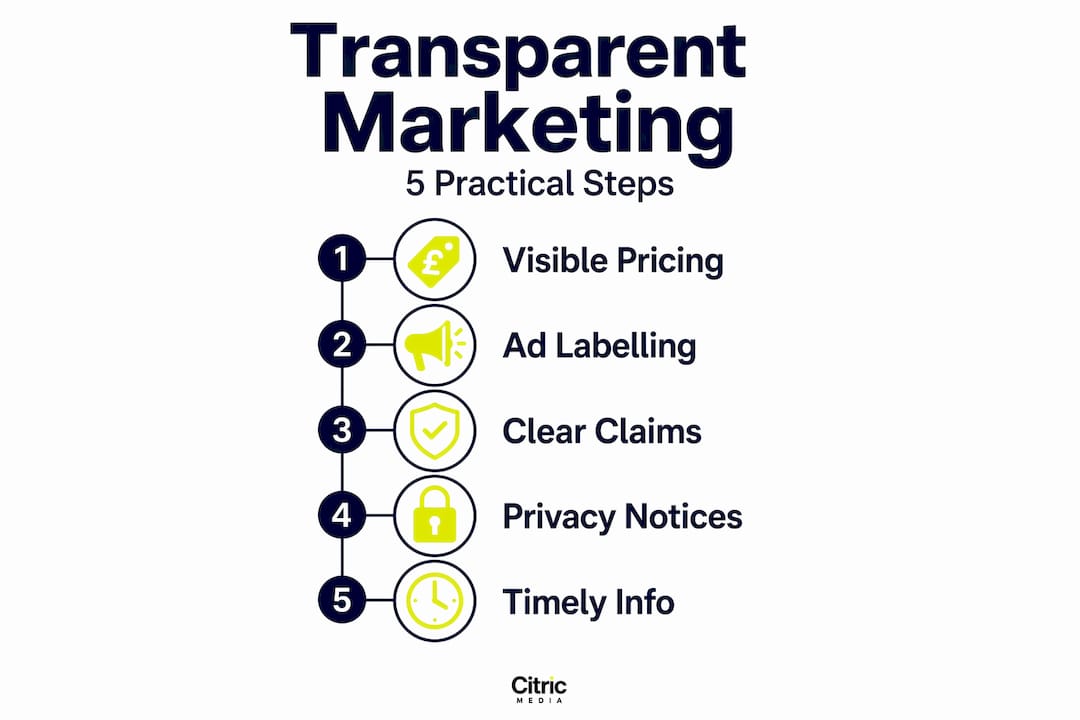
Putting transparency into practice across your campaigns
Understanding why transparency matters is the starting point. Knowing how to embed it operationally is where most businesses falter. Here is a practical framework for applying it across your key marketing channels.
1. Pricing pages and product listings
Total pricing must be visible before the checkout stage. Delivery charges that are calculable at the point of listing should be included in the displayed price. Where variable charges exist, provide a clear calculator or explicit explanation so the customer can work out the true cost. Hiding fees until the final payment screen is not only bad practice. Under the CMA’s 2026 guidance, it can be treated as omitted material information, exposing you to enforcement action.
2. Influencer and content marketing disclosures
Labels must appear prominently at the start of the content, not tucked beneath a long caption or buried in a cluster of hashtags. For multi-part formats such as Instagram Stories or TikTok series, the disclosure should be repeated across each segment. Platform flags alone do not meet the standard. The label needs to be visible to an ordinary consumer without effort on their part. If you are commissioning influencer content as part of a social media strategy, build these requirements into your briefs and review process from the outset.
3. Product origin and ethical claims
If you are making claims about provenance, sustainability, or ethical sourcing, every claim needs substantiation you can produce on request. Vague terms like “eco-friendly” or “sustainably made” without supporting evidence are precisely what regulators are targeting. Be specific, be accurate, and be prepared to show your working.
4. Data and privacy communications
Transparency extends to how you handle customer data. Plain-language privacy notices, clear opt-in processes, and honest explanations of how data is used are not just GDPR requirements. They are brand signals that tell customers whether you can be trusted.
5. Purchase invitations and promotional communications
All material information must be presented clearly and in a timely way. Where communication constraints exist, such as character limits in paid search ads, supplementary means like hyperlinks to full terms should be used to give consumers genuine access to the information they need.
Pro Tip: Review your customer journey from first ad impression to post-purchase confirmation. At each touchpoint, ask: “Would an ordinary person feel fully informed at this stage?” If the answer is no at any point, that is where your transparency gap lies and where your legal and reputational risk is concentrated.
Challenges and nuances you will actually encounter
Transparency is not always simple to deliver, and pretending otherwise does not help you. Here are the genuine challenges marketers face, alongside practical responses.
| Challenge | Practical response |
|---|---|
| Variable or dynamic pricing | Display a clear price range or provide an estimator tool; explain the variables that affect cost |
| Protecting proprietary information | Distinguish between what consumers need to know to make a decision and what is genuinely commercially sensitive |
| Unavoidable fees that arrive late in the purchase flow | Move them earlier; use a running total or fee breakdown visible from the product page onwards |
| Influencer contracts that restrict disclosure language | Review contracts to ensure they comply with ASA and FTC standards; non-compliant contracts create legal exposure |
| Balancing clarity with creative execution | Treat disclosures as a design constraint, not an afterthought; brief your creative team to work within them |
| Consumer perception versus legal compliance | Compliance is the floor, not the ceiling; consumers expect transparency to feel genuine, not formulaic |
The most common misunderstanding marketers bring to this area is treating transparency as a legal checkbox rather than a communication standard. Technically compliant disclosures that are practically invisible do not meet the spirit of the requirement. Under unfair commercial practices legislation, opacity is treated as a legal and reputational risk regardless of whether a disclosure technically exists somewhere in your documentation.
When your channel has genuine limitations, the solution is to use supplementary means. A short-form ad that cannot carry full pricing detail should link to a landing page that does. A social caption with character constraints should direct users to a clear, accessible summary. The standard is that the average consumer must be able to access the information without unusual effort.
Transparency as a competitive differentiator
Beyond compliance, the importance of marketing transparency lies in what it does for your competitive position. Most brands in any given sector are operating at a similar quality level and price point. Transparency is one of the few differentiators that is genuinely difficult to fake and genuinely valued by customers.
Consider what transparent marketing delivers:
- Stronger customer retention: Customers who feel they were never misled are far less likely to churn. The absence of negative surprise is one of the most powerful loyalty drivers available.
- Word-of-mouth and advocacy: Transparent brands generate organic recommendations precisely because customers feel confident referring others to them. There is no reputational risk in recommending a brand you trust completely.
- Reduced acquisition costs over time: A trusted brand converts better across every channel, from paid search to organic SEO. Trust functions as a multiplier on every pound you spend on digital marketing growth.
- Alignment with corporate social responsibility: Transparent marketing practices signal to employees, investors, and partners that your business operates with integrity. That has commercial value well beyond the marketing function.
The brands that have understood the relationship between transparency and loyalty do not treat honesty as a constraint. They treat it as a positioning asset. In markets where competitors are still hiding fees, using ambiguous labels, and making unsubstantiated claims, operating transparently is a genuine market advantage. That advantage compounds over time as your reputation for trustworthiness becomes harder for others to replicate.
My perspective: transparency is not a trend
In my experience working across digital marketing campaigns for well over two decades, the businesses that struggle most with transparency are not the ones trying to deceive their customers. They are the ones that inherited opaque practices and never questioned them.
I have watched brands lose significant ground not because of a major scandal but because customers quietly stopped trusting them. A delivery fee that appeared at checkout. An influencer post where the ad label was invisible. A “sustainable” claim that nobody could substantiate. These are not dramatic failures. They are slow erosions that accumulate into a reputation problem.
My honest view is that the brands which treat transparency as purely a compliance exercise are missing the strategic point entirely. Clear pricing, honest ad labelling, and substantiated claims are not just legal requirements. They are the foundation of every customer relationship worth having.
The uncomfortable truth is that transparency occasionally means telling customers something they would rather not hear. A fee that cannot be waived. A lead time that is longer than the competitor. A product that is not right for their use case. In my experience, that honesty consistently outperforms the alternative. Customers who were told the truth and chose you anyway are your best customers.
My practical recommendation: build a transparency audit into your annual marketing review. Look at every touchpoint where a customer could feel misled or uninformed. That audit will be more valuable than most campaign planning exercises you do all year.
— Martin
How Citricmedia helps you build marketing that earns trust
Transparency-led marketing is not just an ethical stance. It is a performance strategy. At Citricmedia, we have spent over 27 years helping UK businesses build digital marketing programmes that deliver measurable results without cutting corners on honesty or compliance.

Whether you are looking to tighten your paid search approach, improve your social media ad disclosures, or build a data-driven marketing strategy that holds up under regulatory scrutiny, we bring the experience and rigour to get it right. Our step-by-step SME marketing guide is a good starting point if you want to understand how transparent, performance-focused digital marketing actually works in practice. If you are ready to talk about your specific situation, get in touch with the Citricmedia team today.
FAQ
What is transparency in marketing?
Transparency in marketing means communicating openly with customers about pricing, product claims, advertising relationships, and business practices. It covers everything from displaying total costs upfront to clearly labelling influencer partnerships.
Why does transparency in marketing build trust?
60% of consumers rank transparency as the best trait a company can demonstrate. When customers feel fully informed, they are more likely to purchase, return, and recommend a brand to others.
What are the legal requirements for marketing transparency in the UK?
The CMA’s 2026 guidance requires businesses to display total prices upfront, including unavoidable charges. The ASA mandates clear, prominent disclosure for influencer advertising. Failing to comply can be treated as an unfair commercial practice under UK consumer protection law.
Does labelling influencer content as an ad reduce engagement?
No. ASA research shows that clear ad labelling preserves audience trust without harming engagement. Consumers do not reject sponsored content because it is disclosed. They reject it when the disclosure is absent or unclear.
How can small businesses apply transparency practically?
Start with your pricing pages, your ad disclosures, and any product claims you make. Check that a first-time visitor can understand the true cost and the commercial nature of any content before they make a decision. For more structured guidance, the B2B digital marketing steps framework from Citricmedia offers a practical starting point for SMEs.