General
Many UK SMEs pour money into paid social advertising and see little in return. Clicks arrive, budgets disappear, and the sales pipeline stays stubbornly quiet. The frustration is real, and it is widespread. Many SMEs struggle to turn paid social ads into repeatable sales growth, often because they lack a structured approach to planning, targeting, and optimisation. This guide changes that. We will walk you through choosing the right channels, setting meaningful goals, building compelling creatives, and measuring what actually matters, so your ad spend starts working as hard as you do.
Table of Contents
- Understanding paid social advertising: channels, formats, and what works for SMEs
- Preparing your SME for paid social success: goal setting, audience, and tools
- Creating and testing paid social ads: best practices for engagement and conversion
- Measuring and optimising your paid social campaigns: key metrics and trouble-shooting
- Our take: what most paid social guides miss for UK SMEs
- How Citric Media helps SMEs win with paid social advertising
- Frequently asked questions
Key Takeaways
| Point | Details |
|---|---|
| Choose the right channel | Selecting the best social platform maximises SME ad performance and lead generation. |
| Set clear goals and tracking | Establish campaign objectives and use tracking tools to measure ROI and optimise results. |
| Test diverse ad creatives | Experimenting with different adverts helps find winners that drive engagement and sales. |
| Monitor key metrics | Regularly track ROAS, CTR, and CPL to scale successful paid social campaigns. |
| Combine organic and paid | Mixing organic and paid social boosts reach and effectiveness for SMEs. |
Understanding paid social advertising: channels, formats, and what works for SMEs
Having outlined what you will learn, let us start with the basics: where and how to advertise most effectively. The paid social landscape can feel overwhelming, but for UK SMEs, the choice usually narrows to a handful of platforms that consistently deliver results.
Facebook and Instagram remain the dominant force for consumer-facing businesses. Facebook’s targeting capabilities are unmatched for reaching specific demographics, interests, and behaviours. Instagram excels when your product or service is visually compelling. Together, they offer enormous reach at a relatively accessible cost per thousand impressions.
LinkedIn is the clear choice for B2B lead generation. If you are selling professional services, software, or anything aimed at decision-makers, LinkedIn’s job title and company-size targeting is worth the higher cost per click. The audience is smaller but far more commercially minded.
TikTok has emerged as a serious contender for SMEs targeting younger audiences. Its algorithm rewards creative authenticity over polished production, which can actually level the playing field for smaller businesses.
Ad formats matter just as much as platform choice. Here is a quick comparison to guide your decisions:
| Platform | Best ad format | Best for SMEs |
|---|---|---|
| Carousel, lead ads | Lead generation, retargeting | |
| Stories, reels | Brand awareness, product showcases | |
| Sponsored content, InMail | B2B leads, professional services | |
| TikTok | In-feed video | Younger audiences, brand discovery |
Combining paid and organic efforts is a proven strategy for SME growth, and the platform you choose should support both. Before you spend a single pound, however, make sure you have these foundations in place:
- A clear, mobile-optimised landing page for each campaign
- Conversion tracking installed and verified
- A defined audience segment, not just a broad demographic
- Ad creative assets prepared in platform-specific dimensions
- A minimum test budget allocated for at least four weeks
Skipping any of these steps is where most SME campaigns go wrong before they even begin.
Preparing your SME for paid social success: goal setting, audience, and tools
With channels and formats in mind, it is vital SMEs prepare strategically before clicking ‘start’. The single biggest mistake we see is launching campaigns without a measurable goal. ‘Getting more customers’ is not a goal. ‘Generating 30 qualified leads per month at a cost per lead below £40’ is.

SMART goals (Specific, Measurable, Achievable, Relevant, Time-bound) give your campaigns direction and make it possible to judge whether they are working. Without them, you are guessing.
Tracking tools are equally non-negotiable. Here is a summary of the essential ones:
| Tool | Platform | Primary use |
|---|---|---|
| Meta Pixel | Facebook/Instagram | Track conversions and build audiences |
| Google Analytics 4 | All channels | Monitor traffic, goals, and attribution |
| LinkedIn Insights Tag | Track B2B conversions and retarget visitors | |
| UTM parameters | All channels | Identify which ads drive traffic and leads |
Monitoring ROAS, CTR, and CPL is essential for scaling paid social campaigns, and none of that is possible without the right tracking in place from day one. For SMEs already running Google Ads metrics, many of these measurement principles transfer directly.
Defining your ideal customer profile is the next critical step. Work through this process before you build a single ad set:
- Identify your best existing customers and list their shared characteristics
- Note their job roles, industries, or life situations depending on whether you are B2B or B2C
- Map the problem they had before finding you and the outcome they wanted
- Identify which social platforms they use most actively
- Use that profile to build your first targeting audience
Pro Tip: Social platform algorithms need data to optimise your campaigns. If your daily budget is too low, the algorithm cannot gather enough signals to improve delivery. As a rule, avoid spending less than £15 to £20 per day per ad set during the learning phase.
Creating and testing paid social ads: best practices for engagement and conversion
Now that you are prepared, let us cover how to create and test ads that truly engage and convert. Creative quality is the single biggest lever you control. Targeting gets your ad in front of the right person; the creative determines whether they stop scrolling.
Effective social ad creatives share a few consistent traits. They lead with a clear, specific benefit rather than a feature. They use imagery or video that reflects the audience’s world, not a generic stock photo. And they include a call to action that tells the viewer exactly what to do next, whether that is ‘Get a free quote’ or ‘Download the guide’.
For A/B testing, follow this process to avoid wasting budget on inconclusive experiments:
- Test one variable at a time, either the headline, the image, or the CTA, never all three simultaneously
- Run each variant for a minimum of seven days or until you reach statistical significance
- Ensure each variant receives equal budget and audience exposure
- Declare a winner only when one variant shows a clear and consistent advantage in your primary metric
- Scale the winning variant and retire the underperformer before testing the next variable
Testing diverse creatives and scaling winners is especially important for SMEs with limited budgets, because every pound spent on a losing ad is a pound not spent on a proven one.
Common creative mistakes to avoid:
- Using the same image across all placements regardless of dimension requirements
- Writing copy that talks about your business rather than the customer’s problem
- Ignoring video entirely, even short, simple clips consistently outperform static images
- Setting and forgetting: ads fatigue quickly and need refreshing every three to four weeks
Pro Tip: Boost your best-performing organic posts as paid ads. Content that already resonates with your existing audience often converts better than cold ad creative, and it costs less to test. Explore creative testing techniques and optimising social ads to sharpen your approach further.
Measuring and optimising your paid social campaigns: key metrics and trouble-shooting
After launching your ads, it is time to analyse performance and make improvements for maximum impact. Data without interpretation is just noise. The goal is to understand what the numbers are telling you and act on them quickly.
Here are the essential metrics every SME should track:
- ROAS (Return on Ad Spend): Revenue generated for every £1 spent. A ROAS of 3x or above is a common target for product-based businesses
- CTR (Click-Through Rate): The percentage of people who click after seeing your ad. Typical benchmarks sit between 0.5% and 1.5% for social platforms
- CPL (Cost Per Lead): Total spend divided by number of leads generated. This is your clearest indicator of campaign efficiency
- CPC (Cost Per Click): Useful for diagnosing creative performance. A rising CPC often signals audience fatigue
- Conversion rate: The percentage of clicks that become leads or sales. Low conversion rates usually point to a landing page problem, not an ad problem
ROAS, CTR, and CPL should be tracked consistently to scale winning campaigns and cut losing ones before they drain your budget. For tracking ad performance across multiple channels, a unified dashboard saves significant time.
“Running paid social on a shoestring budget without proper tracking is like driving with no mirrors. You will not see the hazards until it is too late.” This is a warning we give every SME client before they launch.
When campaigns underperform, the cause usually falls into one of three categories. Audience issues occur when your targeting is either too broad, wasting spend on unqualified viewers, or too narrow, starving the algorithm of reach. Creative fatigue sets in when the same ad has been shown too many times to the same people. Spend problems arise when daily budgets are too low for the algorithm to exit the learning phase and optimise effectively.
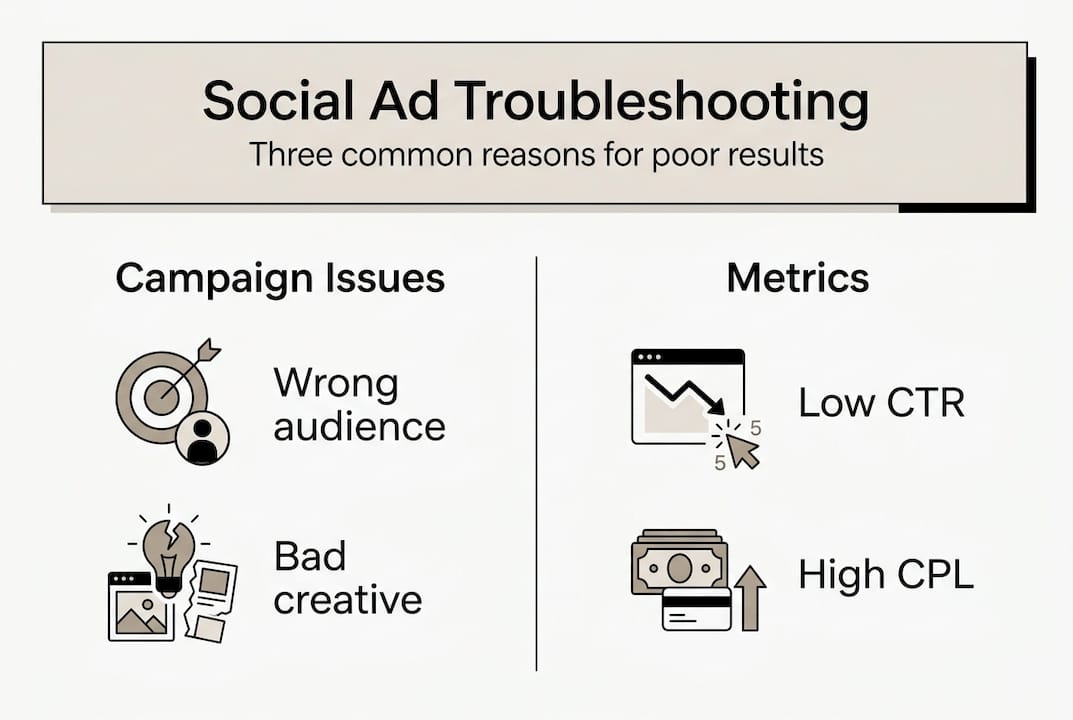
Trouble-shoot systematically. Check your metrics in order: CTR first, then CPL, then ROAS. Each one tells a different part of the story.
Our take: what most paid social guides miss for UK SMEs
Most guides on paid social advertising are written for businesses with comfortable budgets and dedicated marketing teams. They assume you can run 10 ad variants simultaneously, wait 30 days for data, and iterate calmly. For UK SMEs operating in competitive, often saturated markets, that is rarely the reality.
What our experience actually shows is this: the SMEs that get the best results from paid social are not the ones with the biggest budgets. They are the ones who are ruthlessly focused. They pick one platform, one audience, and one offer, and they test it properly before expanding. They resist the urge to be everywhere at once.
The ‘set and forget’ mentality is the quiet killer of SME ad budgets. Algorithms change, audiences shift, and creative fatigue is relentless. Campaigns need weekly attention, not monthly check-ins.
We also find that most SMEs underestimate the importance of minimum viable budget. Spreading £300 across three platforms produces nothing useful. Concentrating it on one platform with a clear goal produces learnable data. That data is the real asset. Read more about digital marketing for SMEs to see how this focused approach fits into a broader growth strategy.
How Citric Media helps SMEs win with paid social advertising
If this guide has clarified what good paid social looks like but the execution still feels daunting, that is exactly where we come in. At Citric Media, we have spent over 27 years helping UK SMEs generate measurable leads and sales through performance-driven digital marketing.
We manage paid social campaigns with the same rigour we apply to Google Adwords Agency work: clear goals, precise targeting, disciplined testing, and transparent reporting. If you are ready to understand why investing in digital marketing delivers compounding returns, or simply want a second opinion on your current campaigns, explore what Citric Media can do for your business.
Frequently asked questions
Which social advertising platforms deliver the best ROI for UK SMEs?
For most UK SMEs, Facebook and Instagram offer the strongest ROI for consumer audiences, while LinkedIn delivers better returns for B2B lead generation. ROI varies by platform and campaign specifics, so testing on one platform before expanding is advisable.
How much should a UK SME budget for paid social advertising to get leads?
A starting budget of £500 to £2,000 per month gives the algorithm enough data to optimise and provides meaningful reach. Low budgets starve algorithms and reduce learning, making it nearly impossible to draw reliable conclusions from results.
What are the signs my paid social ads are not performing well?
Low click-through rates, a rising cost per lead, and minimal engagement are the clearest warning signs. CTR and CPL are standard indicators of performance and should be reviewed weekly rather than monthly.
Can SMEs combine organic and paid social for better results?
Absolutely. Boosting high-performing organic content as paid ads reduces creative risk and often improves conversion rates. Combined paid-organic strategies increase ROI and help SMEs stretch limited budgets further.