Digital Marketing
A business growth strategy is a deliberate, integrated plan that aligns marketing, sales, operations, finance, and talent to achieve sustainable expansion and long-term market competitiveness. Unlike a loose collection of tactics, a true growth strategy tells you what to prioritise, what to measure, and critically, what to stop doing. For UK SMEs operating in increasingly competitive digital markets, understanding what is business growth strategy means recognising it as a living operating system, not a one-off document. The frameworks, channels, and governance structures you build today determine whether your revenue compounds or plateaus over the next three to five years.
What are the core components of an effective business growth strategy?
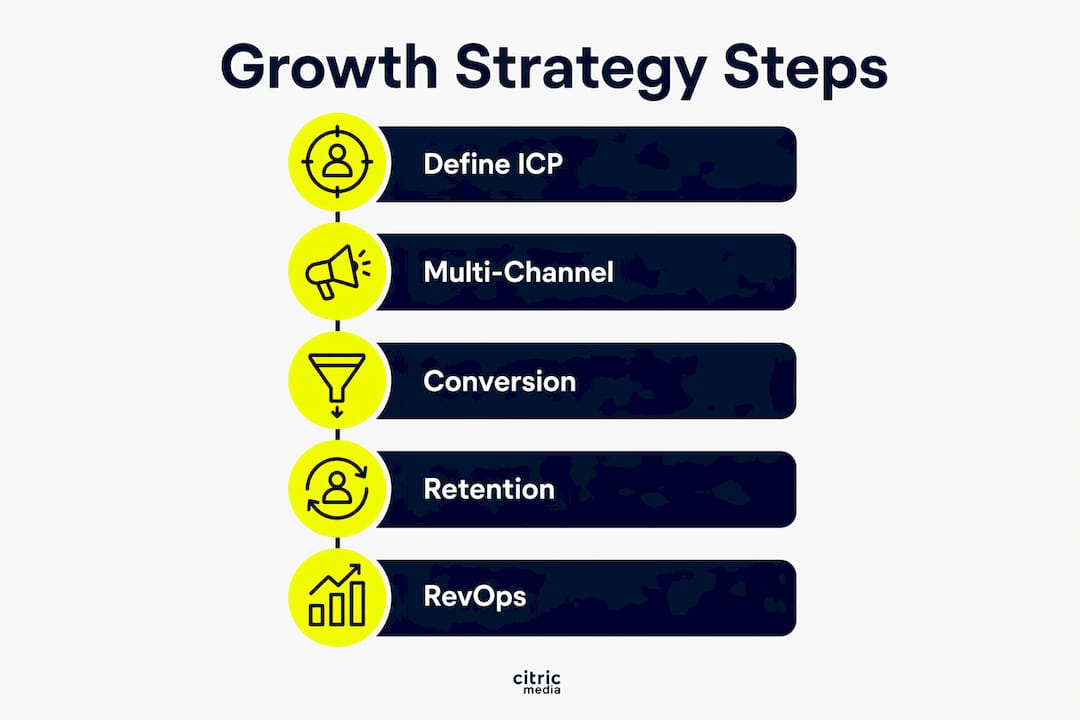
A comprehensive growth system includes five interdependent components: Ideal Customer Profile definition, a multi-channel acquisition engine, conversion architecture, retention programmes, and growth operations with analytics. Each component reinforces the others. Neglect one and the whole system underperforms.
Ideal Customer Profile (ICP): Your ICP is built from firmographic data (company size, sector, revenue) and behavioural signals (content consumption, buying triggers, objection patterns). Without a precise ICP, your messaging is generic, your ad spend is wasted, and your sales team chases the wrong prospects. UK SMEs often skip this step and pay for it in poor conversion rates.

Multi-channel acquisition engine: High-performing B2B businesses in 2026 use three to five active acquisition channels to build predictable growth. That means combining SEO, Google Ads, LinkedIn thought leadership, and email nurture sequences rather than relying on a single source. Single-channel dependency is one of the most common and most avoidable growth risks for SMEs. You can explore lead generation strategies that work specifically for UK businesses to see how these channels integrate in practice.
Conversion architecture: Traffic without conversion is just cost. This component covers lead routing, qualification frameworks such as BANT or MEDDIC, and sales process optimisation. Every stage of the funnel needs a defined owner and a measurable exit criterion.
Retention and expansion: Acquiring a new customer costs up to five times more than retaining an existing one. This makes upselling, cross-selling, and loyalty programmes the most capital-efficient growth levers available to any SME. Retention is not a customer service function. It is a revenue function.
Growth operations and analytics: Revenue Operations (RevOps) unifies your data infrastructure, reporting cadence, and accountability processes. Companies with formal RevOps models report 36% higher revenue growth than those without. That gap is too large to ignore.
Pro Tip: Before adding a new acquisition channel, audit your conversion rate on existing traffic. Doubling your conversion rate from 1% to 2% has the same revenue impact as doubling your traffic, at a fraction of the cost.
Growth tactics vs sustainable systems: what is the real difference?
Growth hacking refers to short-term, often experimental techniques designed to produce rapid spikes in user acquisition or revenue. Tactics like referral incentives, viral loops, and limited-time offers can work, but they decay quickly. The moment you stop running them, growth stops too.
Sustainable growth systems, by contrast, produce compounding returns. An SEO programme that ranks your site for high-intent queries keeps generating leads whether or not you are actively managing it that week. A retention programme that automatically triggers renewal conversations keeps revenue from leaking. Multichannel marketing creates a predictable pipeline and reduces the risk of overreliance on any single source. The structural difference is that systems work while you sleep; tactics require constant attention.
One of the most damaging patterns in SME growth planning is what practitioners call “wishful budgeting.” This is the practice of allocating spend based on hoped-for outcomes rather than historical data. It leads to overcommitment on unproven channels and underinvestment in what is already working.
The 70-20-10 budgeting framework offers a disciplined alternative: allocate 70% of your budget to proven channels, 20% to promising but unproven ones, and 10% to genuine experiments. This structure prevents you from gambling your growth budget on the latest trend while still leaving room for learning and adaptation.
| Approach | Characteristics | Outcome |
|---|---|---|
| Growth hacking | Short-term, tactic-led, high effort | Spikes that decay without ongoing input |
| Sustainable systems | Structural, data-driven, compounding | Predictable revenue growth over time |
| Wishful budgeting | Hope-based allocation, no historical anchor | Wasted spend and missed targets |
| 70-20-10 framework | Proven/promising/experimental split | Balanced risk with room for innovation |
Pro Tip: Review your channel attribution data quarterly. If more than 60% of your leads come from a single source, you have a concentration risk that no amount of tactical activity will fix without structural diversification.
What role does leadership play in a business growth strategy?
Growth strategy is a CEO-level responsibility that integrates finance, operations, technology, and talent. It is not a marketing department initiative with a budget line. This distinction matters because growth decisions, such as entering a new market, acquiring a competitor, or launching a new product line, require cross-functional alignment that only senior leadership can drive.
Before committing to any expansion decision, rigorous market research is non-negotiable. Entry modes including export, partnership, licensing, and acquisition each carry different cost, control, and risk profiles. Effective expansion strategies balance speed, cost, control, and risk, and choosing the wrong entry mode can set a business back by years.
The operational integration requirements for growth include:
- Finance: Scenario modelling, cash flow forecasting, and capital allocation tied to growth milestones
- Operations: Capacity planning, process documentation, and supplier scalability
- Technology: CRM implementation, marketing automation, and data infrastructure
- Talent: Hiring plans aligned to growth stages, not just current headcount needs
- Governance: Clear decision rights defined early in expansion to enable fast but compliant moves into new markets
The governance point is frequently underestimated. Without defined decision rights, expansion slows to a crawl as every choice escalates to the leadership team. Defining who can approve what, at what spend threshold, and with what reporting obligation, removes that bottleneck without sacrificing compliance.
A growth strategy also acts as a constraint. A well-defined strategy clarifies what you will not do, which prevents the reactive, opportunistic decision-making that scatters resources and stalls momentum. Saying no to a promising but off-strategy opportunity is one of the hardest and most valuable things a leadership team can do.
How can UK SMEs implement a growth strategy step by step?
The right starting point depends on your current revenue stage. A useful framework organises maturity into three phases: Foundation, Scale-Up, and Optimise. Most UK SMEs reading this article sit in the first two.
Assess your current maturity. Map your existing capabilities against the five growth system components. Where are the gaps? A business with no defined ICP and a single acquisition channel is at Foundation stage regardless of its revenue. Be honest about this.
Define your ICP before spending on acquisition. If you are early-stage, this is your single most important task. Interview your best ten clients. Identify the firmographic and behavioural patterns they share. Build your messaging, channel selection, and content strategy around that profile.
Build one or two acquisition channels properly before adding more. Depth beats breadth at this stage. A well-optimised Google Ads account and a consistent SEO programme will outperform five half-built channels every time. Understanding why digital marketing investment pays off at this stage is worth the time.
Introduce retention mechanics early. A 5% increase in retention can raise profits by 25% to 95%, according to Harvard Business Review. Set up automated renewal reminders, post-purchase check-ins, and a structured upsell sequence before you scale acquisition spend. Practical customer retention strategies can make this process far more systematic.
Set goals using OKRs and KPIs. Companies using OKRs achieve 60% higher growth and complete goals 43% more effectively when combined with weekly reviews. Set three to five Objectives per quarter, each with two to four measurable Key Results. Review progress weekly, not monthly.
Run 90-day sprint cycles. Annual plans become obsolete within weeks of being written. A 90-day cycle gives you enough runway to execute meaningfully while remaining close enough to reality to course-correct. Pair each sprint with a weekly business review covering pipeline, conversion rates, and retention metrics.
Apply the 70-20-10 budget framework. Allocate your growth budget with discipline. Protect the 70% on proven channels. Use the 20% to test one or two promising new approaches. Reserve the 10% for genuine experiments with defined learning objectives and clear kill criteria.
Pro Tip: Link your OKRs directly to your CRM and analytics dashboards. If a Key Result cannot be measured automatically, it will be measured inconsistently, which makes your weekly reviews unreliable and your quarterly retrospectives meaningless.
Key takeaways
A business growth strategy works because it integrates ICP definition, multi-channel acquisition, retention, and RevOps into a single compounding system rather than a collection of disconnected tactics.
| Point | Details |
|---|---|
| Define your ICP first | Firmographic and behavioural data must anchor every acquisition and retention decision. |
| Use multi-channel acquisition | Three to five active channels build predictable pipelines and reduce single-source risk. |
| Prioritise retention early | A 5% retention increase can raise profits by up to 95%, making it the highest-ROI growth lever. |
| Apply 70-20-10 budgeting | Allocate spend across proven, promising, and experimental channels to balance risk and learning. |
| Make growth a CEO responsibility | Cross-functional integration across finance, ops, and talent is required for sustainable scale. |
Growth strategy is not a document. It is a discipline.
My blunt observation after working with UK SMEs across a range of sectors is this: most businesses do not fail because they lack ideas. They fail because they chase too many ideas at once and execute none of them well.
The most common mistake I see is treating growth strategy as a planning exercise rather than an operating system. A leadership team spends two days offsite, produces a 40-page strategy document, and then returns to the day-to-day with no change in behaviour, budget allocation, or reporting cadence. Six months later, the document is out of date and the business is reacting to market conditions rather than shaping them.
The businesses I have seen grow consistently share one habit: they select a small number of priorities, build the systems to execute them, and review performance with genuine rigour every single week. They also invest in growth operations early, before they feel they can afford to. That investment in data infrastructure, CRM discipline, and attribution modelling is what separates businesses that scale from those that plateau.
If you are reading this as an SME owner, my advice is to resist the pull of the next tactic and instead ask: do we have a system? If the answer is no, that is where to start. Explore B2B marketing strategies that are built for the UK market to see what a structured approach looks like in practice.
— Martin
How Citricmedia helps UK SMEs build growth systems that deliver
Citricmedia has spent over 27 years building performance-driven digital marketing programmes for UK SMEs. The focus is not on vanity metrics. It is on generating high-quality enquiries, leads, and sales through channels that compound over time.
Whether you need a structured SEO programme to build long-term organic visibility, a Google Ads account that converts at a profitable cost per acquisition, or a paid social strategy that reaches decision-makers on LinkedIn and Meta, Citricmedia builds the multi-channel acquisition engines that underpin sustainable growth. Every engagement is grounded in data, tied to measurable outcomes, and designed to scale with your business. If you are ready to move from reactive tactics to a structured growth system, get in touch with the Citricmedia team today.
FAQ
What is a business growth strategy in simple terms?
A business growth strategy is an integrated plan that aligns your marketing, sales, operations, and finance functions to achieve deliberate, sustainable expansion. It defines your priorities, your channels, your targets, and what you will not pursue.
What are the main types of growth strategy for UK SMEs?
The four primary types are market penetration (selling more to existing customers), market development (entering new markets), product development (launching new offerings), and diversification (new products in new markets). Most UK SMEs should focus on market penetration and market development before attempting the others.
How does retention fit into a business growth strategy?
Retention is a core growth lever, not a support function. Acquiring a new customer costs up to five times more than keeping an existing one, and a 5% improvement in retention can increase profits by 25% to 95%. Any growth strategy that ignores retention is structurally incomplete.
How do OKRs support a growth strategy?
OKRs (Objectives and Key Results) translate your growth strategy into measurable quarterly commitments. Companies using OKRs achieve 60% higher growth and complete goals 43% more effectively when paired with weekly performance reviews, making them one of the most practical governance tools available to SME leadership teams.
When should a UK SME invest in RevOps?
Earlier than most SMEs think. Companies with formal Revenue Operations models report 36% higher revenue growth than those without. Even a basic RevOps setup, covering CRM discipline, attribution reporting, and a weekly business review, delivers measurable accountability improvements within the first quarter.