Digital MarketingMarketing
Performance metrics are defined as quantifiable measurements used regularly to track progress toward strategic business objectives, serving as a control panel that helps stakeholders monitor efficiency and effectiveness over time. For business owners and marketing professionals, understanding the role of performance metrics is the difference between spending budget on instinct and spending it on evidence. The frameworks covered here, including KGI, KPI, and KSF structures, real-time monitoring, and metric governance, give you the tools to measure what matters and act on it with confidence.
What are performance metrics and how do they connect to business goals?
Performance metrics are not simply numbers on a dashboard. They are design choices tied to strategy, and the framework you use to select them determines whether your marketing data drives decisions or just fills reports.
The most useful framework for digital marketing connects three distinct layers: Key Goal Indicators (KGI), Key Performance Indicators (KPI), and Key Success Factors (KSF). Each layer serves a different purpose.
A KGI is the ultimate business outcome you are working toward, such as revenue, profit, or customer acquisition volume. A KPI is a process metric that sits beneath the KGI and tracks the activities most likely to produce that outcome, such as qualified leads, organic traffic, or conversion rate. A KSF is a strategic condition that must be true for the KPIs to work, such as brand recognition or product-market fit. The relationship between these three is not decorative. KPIs serve as process metrics that support KGIs, and selecting the wrong KPIs means optimising the wrong activities.

| Point | Details |
|---|---|
| Key Goal Indicator (KGI) | The ultimate business outcome, e.g., annual revenue of £500,000 or 1,000 new customers. |
| Key Performance Indicator (KPI) | A process metric supporting the KGI, e.g., monthly leads, web traffic, or cost per acquisition. |
| Key Success Factor (KSF) | A strategic condition enabling KPI success, e.g., brand awareness or product differentiation. |
Consider a UK-based e-commerce business running Google Ads. Their KGI is £1 million in annual revenue. Their KPIs include monthly paid traffic volume, average order value, and return on ad spend (ROAS). Their KSF is a trusted brand with strong product reviews. If the team focuses only on traffic volume without tracking conversion rate or ROAS, they are optimising a KPI in isolation, which rarely moves the KGI in the right direction.
Pro Tip: Before selecting any KPI, write down the business hypothesis behind it. If you cannot explain why improving that metric should move your KGI, it is the wrong metric to track.
What are the biggest pitfalls when using performance metrics?
Metric fixation is the single most common failure mode in digital marketing measurement. It occurs when a team optimises a proxy metric so aggressively that the original business goal is undermined. Optimising proxies too aggressively damages real results, a finding that applies directly to how marketers use click-through rate, lead volume, and engagement figures.
Goodhart’s Law states that when a measure becomes a target, it ceases to be a good measure. In marketing terms, this plays out constantly. A team tasked with increasing lead volume may lower qualification thresholds to hit the number. Lead volume rises. Sales quality falls. Revenue stays flat or declines. The KPI improved; the KGI did not.
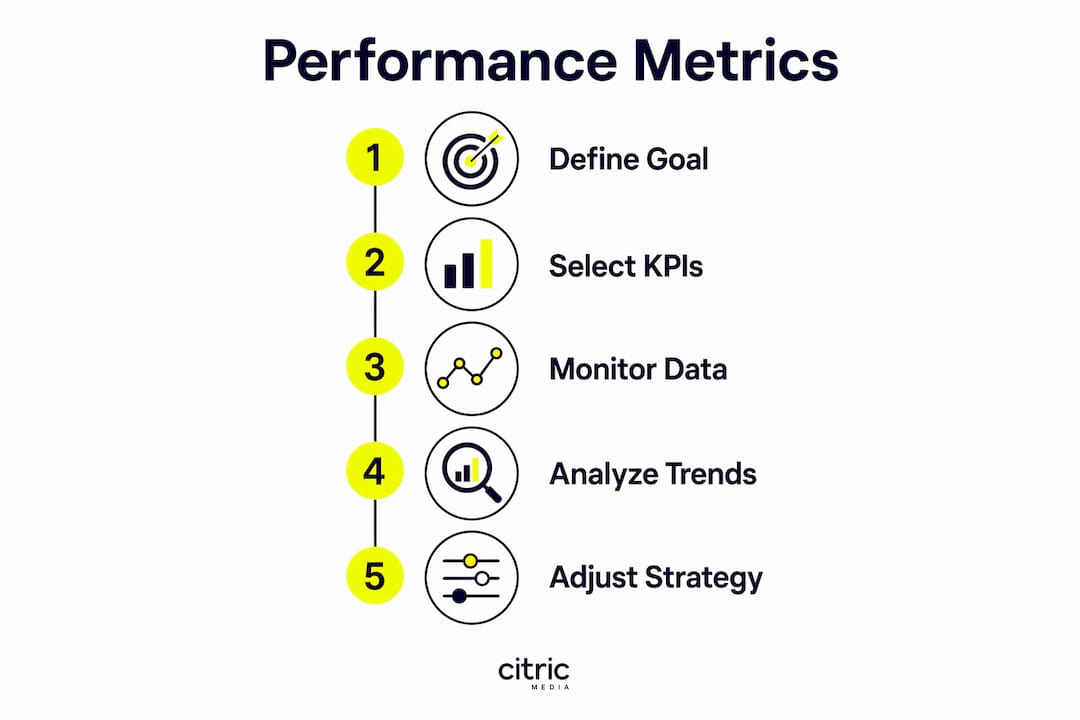
The MIT Sloan Management Review identifies this as a structural problem in KPI design, not a failure of individual judgement. The solution is to treat metrics as design choices subject to oversight rather than objective truths, and to build guardrails that prevent single-metric optimisation from distorting broader outcomes.
Common pitfalls to watch for include:
- Optimising CTR without tracking conversion rate. High click-through rates on poorly targeted ads waste budget and inflate traffic figures without generating revenue.
- Treating lead volume as a success metric without a quality filter. Volume without qualification data tells you nothing about pipeline health.
- Ignoring time-horizon effects. A campaign that performs well over 30 days may cannibalise brand equity over 12 months.
- Reporting metrics without ownership. If no one is accountable for acting on a metric, it is a vanity figure.
- Using too many metrics simultaneously. Dashboards with 40 KPIs produce paralysis, not clarity.
Pro Tip: Add at least one guardrail metric for every primary KPI. If your primary KPI is lead volume, your guardrail should be lead-to-sale conversion rate. If one improves while the other falls, you have a problem worth investigating.
How does real-time performance monitoring improve marketing strategy?
Performance monitoring and performance measurement are related but distinct. Measurement captures a number at a point in time. Monitoring shows trends and future trajectory, enabling teams to make data-driven decisions rather than gut judgements. The operational difference is significant for any business running paid digital campaigns.
Big Data analytics has changed what monitoring looks like in practice. Near real-time performance feedback through improved data processing allows marketing teams to spot underperforming campaigns within hours rather than weeks. This matters enormously when you are spending daily budgets on Google Ads or paid social. A campaign that is underperforming on day three does not need to run until day 30 before you intervene.
Channel-level data makes this even more precise. According to the State of Google Ads 2026 report by Lyra PPC, Performance Max campaigns delivered 9.32x ROAS compared to 2.61x for Search campaigns in 2026 data. That gap is not a reason to abandon Search. It is a reason to understand what each channel does differently and to set channel-specific ROAS targets rather than applying a single benchmark across your entire account.
| Campaign Type | ROAS (2026 Data) | Primary Use Case |
|---|---|---|
| Performance Max | 9.32x | Broad audience reach across Google channels |
| Search | 2.61x | High-intent keyword targeting |
Effective monitoring goes beyond pulling reports. Monitoring requires analysis, communication, and next steps. A weekly ROAS report that sits in a shared folder without a review meeting, a decision, and an assigned action is measurement without monitoring. The operational layer, meaning who reviews the data, when, and what they do with it, is where most businesses lose value from their analytics investment. For practical guidance on building this layer, Citricmedia’s resource on monitoring digital campaign results covers the process in detail.
How to use performance metrics effectively: best practices
Selecting the right metrics and acting on them consistently requires a structured approach. The following five steps reflect what works in practice for UK SMEs running digital marketing campaigns.
Align metrics to your business model hypothesis. Every KPI should connect to a stated assumption about how your business generates value. If you believe organic search drives brand trust, which drives repeat purchase, then your KPI tree should include organic traffic, branded search volume, and repeat purchase rate. KPI frameworks must be tied to business model hypotheses to drive meaningful improvements.
Tier your metrics by decision level. Senior leadership needs KGIs reviewed monthly. Campaign managers need KPIs reviewed weekly. Tactical teams need operational metrics reviewed daily. A clear KPI hierarchy prevents dashboards from becoming noisy and helps each team focus on the metrics they can actually influence.
Apply SMART criteria to every KPI. Each indicator should be Specific, Measurable, Achievable, Relevant, and Time-bound. “Improve conversions” is not a KPI. “Increase paid search conversion rate from 2.1% to 3.0% by the end of Q3 2026” is a KPI. The specificity is what makes it useful.
Embed metrics in a decision loop. Embedding metrics with clear ownership, cadence, and action steps turns data into optimisation rather than descriptive statistics. Assign a named owner to each KPI. Set a review cadence. Define the threshold at which action is required. Without these three elements, metrics are decorative.
Build governance into your reporting structure. Performance metrics are most useful when tied to organisational processes with defined ownership and review cycles. This means scheduled review meetings, documented decisions, and a record of what changed as a result of the data. Governance is what separates businesses that learn from their data from those that simply collect it.
Balancing short-term and long-term indicators is also worth deliberate attention. Effective measurement requires balancing short-term versus long-term goals and financial versus non-financial indicators. A campaign that drives immediate ROAS but erodes brand search volume over six months is not a success by any meaningful measure. For deeper reading on connecting metrics to campaign optimisation for leads and sales, Citricmedia’s blog covers the practical application in detail.
Key takeaways
Performance metrics only create value when they are selected deliberately, monitored continuously, and embedded in a decision loop with clear ownership and defined action thresholds.
| Point | Details |
|---|---|
| Use a three-tier framework | Connect KGIs, KPIs, and KSFs to link daily marketing actions to business outcomes. |
| Guard against metric fixation | Add a guardrail metric for every primary KPI to prevent single-metric optimisation from distorting results. |
| Monitor, do not just measure | Combine data analysis, communication, and assigned actions to turn numbers into decisions. |
| Segment by channel | Set channel-specific ROAS targets; Performance Max and Search deliver very different returns. |
| Build governance in | Assign ownership, set review cadence, and document decisions to make metrics operationally useful. |
Why most businesses are measuring the wrong things
I have spent years reviewing KPI frameworks for digital marketing clients, and the same pattern appears repeatedly. Businesses select metrics that are easy to report rather than metrics that are hard to ignore. Click-through rate is easy to pull from Google Ads. Whether that click eventually became a profitable customer is harder to trace, so it gets left out of the weekly report.
The uncomfortable truth is that most marketing dashboards are built around data availability rather than strategic relevance. Teams report what the platform gives them, not what the business actually needs to know. This is not laziness. It is a structural problem. When no one has defined the KGI, there is no anchor for selecting KPIs, and the dashboard fills up with proxy metrics that feel meaningful but rarely drive decisions.
What I have found actually works is starting with the revenue number and working backwards. What conversion rate do we need? What traffic volume does that require? What cost per click can we afford given our margin? That chain of reasoning produces a KPI tree that is genuinely connected to business outcomes. It also makes it obvious which metrics to cut from the dashboard entirely.
The other misstep I see consistently is treating monitoring as a monthly activity. By the time a monthly report lands, the budget has already been spent. Real-time monitoring, even at a basic level using Google Ads automated alerts or a simple weekly check-in, gives you the ability to intervene before a poor campaign runs its full course. That is where the real value of performance marketing benefits becomes tangible for UK SMEs.
— Martin
How Citricmedia can help you measure what matters
Knowing which metrics to track is one thing. Building the systems, campaigns, and reporting structures to act on them consistently is another challenge entirely.
Citricmedia has spent over 27 years helping UK businesses generate measurable results through Google Ads, SEO, paid social, and Bing Advertising. We build KPI frameworks aligned to your specific business goals, not generic dashboards copied from a template. Every campaign we manage includes defined ROAS targets, tiered reporting, and regular review cycles with clear ownership. If you are ready to move from reporting numbers to making decisions, explore our digital marketing services and find out how we can build a measurement structure that actually drives growth.
FAQ
What is the role of performance metrics in digital marketing?
Performance metrics are quantifiable measurements that track progress toward business objectives, acting as a control panel for marketing decisions. They connect daily campaign activity to strategic goals like revenue and customer acquisition.
What is the difference between performance monitoring and measurement?
Measurement captures a number at a point in time, while performance monitoring tracks trends and future trajectory to enable timely decisions. Monitoring includes analysis, communication, and assigned next steps, not just data collection.
What are KGI, KPI, and KSF in marketing?
KGI is the ultimate business goal such as revenue, KPI is a process metric supporting that goal such as leads or traffic, and KSF is a strategic condition enabling success such as brand awareness. Together they form a connected metric hierarchy.
What is goodhart’s law and why does it matter for marketers?
Goodhart’s Law states that when a measure becomes a target, it ceases to be a good measure. In marketing, this means over-optimising a proxy metric like lead volume can damage the actual business outcome you are trying to achieve.
How often should performance metrics be reviewed?
Review cadence should match decision level: KGIs monthly for leadership, KPIs weekly for campaign managers, and operational metrics daily for tactical teams. Metrics reviewed without a defined action threshold and named owner rarely produce change.