Digital MarketingGoogle
The future of SEO in 2026 is defined by one structural shift: visibility now means being cited within AI-generated answers, not ranking on page one. Google’s I/O 2026 update delivered the biggest change to the search box in over 25 years, replacing traditional results with AI-generated responses, interactive widgets, and background research agents powered by Gemini 3.5. For digital marketers and business owners, this is not a gradual evolution. It is a fundamental reset of how search engine optimisation works, what success looks like, and which brands get found at all.
What has changed in search technology and user behaviour in 2026?
Google’s 2026 transformation into a native AI platform has restructured the entire search experience. Where users once scanned ten blue links, they now receive synthesised answers, follow-up conversation prompts, and widget-based results that rarely require a click. The implications for organic traffic are significant and, for many businesses, already visible in their analytics.
The most consequential change is the arrival of background search agents. These autonomous systems run continuous research on behalf of users without requiring repeated queries. A user sets a task, such as finding the best accountant in Leeds or comparing B2B software options, and the agent monitors sources, updates its synthesis, and delivers conclusions over time. AI agents operating 24/7 blur the lines between search, discovery, and decision-making, which means your content must be discoverable and credible at any moment, not just when someone types a query.
User behaviour has shifted accordingly:
- Zero-click searches are now the norm for informational queries, with users accepting AI-synthesised answers without visiting source pages.
- Multimodal inputs are growing fast. Users search with images, voice, and text simultaneously, and AI interprets context across all three.
- Conversational follow-ups replace keyword refinement. Users ask AI to clarify, compare, or expand rather than running new searches.
- 64% of marketers predict a significant decline in traditional search usage as Generative Engine Optimisation (GEO) dominates user reach. This signals a structural redistribution of traffic, not a temporary dip.
The practical consequence is that click-through rates from organic listings are falling for many query types. Brands that relied on high-volume informational traffic to feed their funnels are feeling this most acutely. The question is no longer how to rank. It is how to become the source AI trusts.
How is SEO strategy evolving for AI-generated citations?
The discipline now sits under two related frameworks: Generative Engine Optimisation (GEO) and Answer Engine Optimisation (AEO). Both prioritise being cited within AI-generated responses over achieving a specific ranking position. GEO as a practice requires a fundamentally different content architecture than traditional SEO, one built around extractability, verifiability, and contextual clarity.

Here is how the two approaches compare directly:
| Traditional SEO | AI-era SEO (GEO and AEO) |
|---|---|
| Optimise for ranking position | Optimise for citation frequency in AI answers |
| Keyword-focused individual pages | Topical authority clusters with deep interlinking |
| Click-through rate as primary metric | Share of voice in AI-generated responses |
| Metadata and backlinks as core signals | Structured data, E-E-A-T, and answer-first formatting |
| Periodic audits and campaign cycles | Continuous automated monitoring and real-time updates |
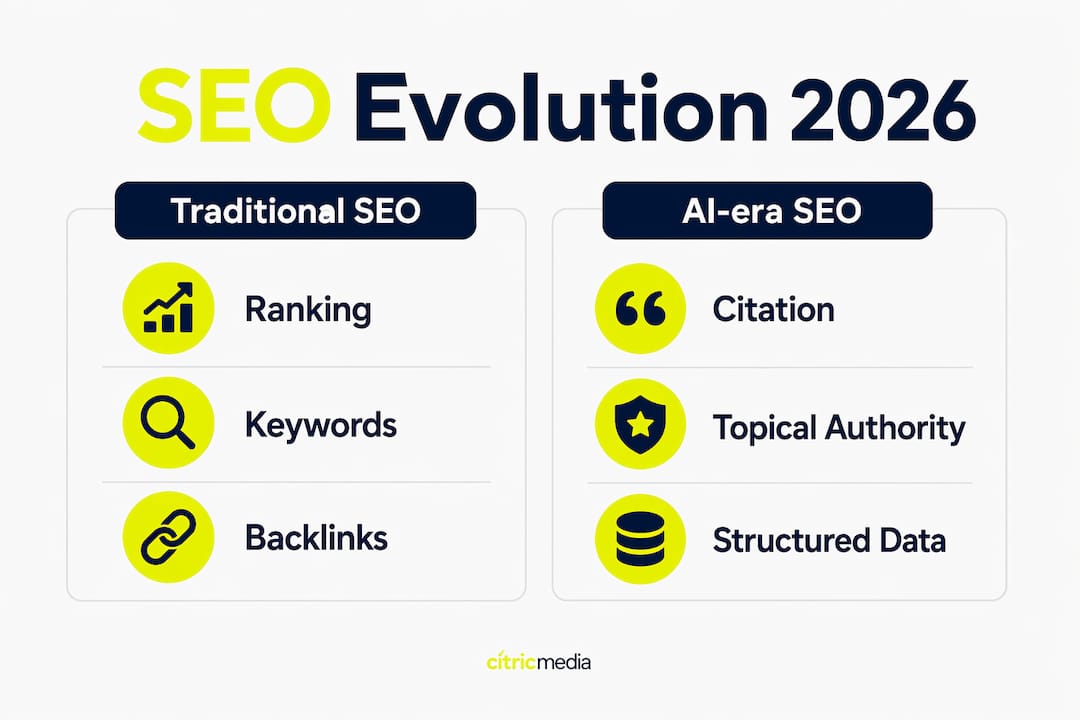
The shift towards topical authority clusters is particularly significant. AI background agents prefer sources with interconnected, expert-level content coverage over isolated pages targeting single keywords. A business that publishes one strong article on a topic is far less likely to be cited than one that has built a comprehensive cluster of related, well-structured content.
E-E-A-T signals, which stand for Experience, Expertise, Authoritativeness, and Trustworthiness, have moved from a quality consideration to a citation prerequisite. AI systems evaluate whether a source is credible before surfacing it in a synthesised answer. Author credentials, cited sources, consistent factual accuracy, and clear organisational identity all feed into this assessment.
Structured data is no longer an advanced optimisation tactic. It is the baseline. Answer-first content formatting and FAQ schema are the highest-impact changes you can make to improve AI extractability. Every core page should carry schema markup that tells AI systems precisely what the content is, who wrote it, and what question it answers.
Pro Tip: Write your H1 and opening paragraph as if answering a direct question. AI systems extract the first clear, concise claim they find. If your page opens with context-setting prose rather than a direct answer, you are handing citations to competitors who lead with the fact.
What practical steps should marketers take to adapt their SEO?
Adapting to AI-first search engine optimisation in 2026 requires operational changes, not just content tweaks. The following steps reflect what the highest-performing SEO teams are doing right now.
Implement answer-first formatting on every core page. Open with a direct definition or claim, then expand with evidence. This mirrors how AI systems extract and cite content. Pages that bury the key point in paragraph three are rarely cited.
Add FAQ schema to your most important pages. Schema-encoded FAQs give AI systems a structured, machine-readable format to pull from. This is one of the fastest wins available and requires minimal technical resource for most CMS platforms.
Build topical clusters with deliberate internal linking. Map your content into subject areas and connect related pages with contextual links. This signals depth of expertise to both Google and AI agents. A cluster on, say, VAT for small businesses should include pages on registration, filing, penalties, and exemptions, all linked coherently.
Adopt continuous content monitoring. Top SEO teams use automated loops detecting performance signals in real time rather than running quarterly audits. Tools that flag content decay, broken schema, or drops in AI referral traffic allow you to act before rankings and citations erode.
Establish AI content governance standards. Marketing leaders must set brand standards and guardrails for AI-generated content to protect trust and quality at scale. This means defining tone, factual verification processes, and approval workflows before AI-assisted content goes live.
Align your SEO and paid search strategies. As organic AI citations reduce click volume for some queries, Google Ads and Bing Advertising become more important for capturing demand that AI answers do not fully satisfy. Citricmedia’s experience across both channels shows that the brands performing best in 2026 treat paid and organic as complementary, not competing.
Pro Tip: Only one-third of marketers actively invest in structured data and clean internal architectures. This is the opportunity gap. If your competitors are not doing it, getting your schema in order now creates a durable advantage that compounds over time.
How will SEO measurement and performance tracking evolve?
Traditional metrics tell an incomplete story in 2026. Ranking position and organic session volume remain useful reference points, but they do not reveal how often AI systems incorporate your content into synthesised answers. That gap is where most businesses are flying blind.
The new performance indicators you need to track include:
- Citation frequency. How often does your content appear as a source within AI-generated answers across Google, Perplexity, and other AI search platforms?
- Share of model. What proportion of AI-generated responses in your category reference your brand or content?
- AI referral traffic. Some AI platforms pass referral data. Tracking this separately from standard organic traffic reveals which content is genuinely driving AI-sourced visits.
- Zero-click impression data. Google Search Console provides impression data even when clicks do not follow. Rising impressions with flat or falling clicks often indicate your content is being surfaced in AI answers but not clicked through.
Standard dashboards do not reveal how often AI systems incorporate your content into synthesised answers. New infrastructure is required, and effective measurement systems translate these multifaceted signals into prioritised actions such as content refreshes, schema fixes, and authority building. The goal is not more data. It is a tighter feedback loop between what AI systems are doing with your content and what your team does next.
For SMEs, the practical starting point is to track new SEO performance indicators alongside traditional metrics rather than replacing them entirely. A blended dashboard covering rankings, AI citation signals, page performance, and business outcomes gives you the full picture without creating dashboard overload.
Key takeaways
SEO success in 2026 requires optimising for AI citation frequency, topical authority, and structured data, not ranking position alone.
| Point | Details |
|---|---|
| AI citation over ranking | Being cited in AI-generated answers is now the primary measure of SEO visibility. |
| Structured data is baseline | FAQ schema and answer-first formatting are minimum requirements, not advanced tactics. |
| Topical clusters win | Interconnected expert content clusters outperform isolated keyword-focused pages for AI citation. |
| Continuous monitoring is critical | Automated, real-time SEO monitoring replaces periodic audits in an AI-volatile search environment. |
| Governance protects brand trust | Setting AI content standards and guardrails is as important as technical optimisation. |
My blunt view on where SEO is heading
I have worked in digital marketing long enough to have seen several moments described as “the end of SEO.” None of them were. But what Google announced at I/O 2026 is genuinely different in character, not just in degree.
What strikes me most is how many businesses are still measuring success by ranking position while their actual visibility in AI-generated answers is either unknown or declining. The goal of SEO in 2026 is not to rank first but to be cited correctly and frequently by AI-generated answers. That requires a different mindset, different content architecture, and different measurement tools.
The businesses I see adapting fastest are not necessarily the ones with the biggest budgets. They are the ones that have committed to content governance, invested in structured data early, and built genuine topical depth rather than chasing individual keywords. The adapting to AI search platforms challenge is real, but it rewards the disciplined.
My advice is to start with what you can control. Audit your top ten pages for answer-first formatting and schema coverage. Build one topical cluster properly before expanding. Set a governance process for AI-assisted content. These are not glamorous steps, but they are the ones that compound. Businesses that treat this as a long-term operating model rather than a one-off project will be the ones still visible when the next wave of AI search changes arrives.
— Martin
How Citricmedia can help you future-proof your SEO
Citricmedia has spent over 27 years helping UK businesses generate measurable results from digital marketing, and the shift to AI-first search is something we are actively helping clients navigate right now.
Our SEO services cover the full spectrum of what 2026 demands: schema markup implementation, content restructuring for AI extractability, topical cluster development, and continuous performance monitoring. We also integrate SEO strategy with Google Ads and paid social to ensure your visibility holds even as AI Overviews reduce click volume on certain query types. If you want to understand why investing in SEO still delivers strong returns in an AI-driven search environment, or you are ready to reshape your current strategy, we would welcome the conversation.
FAQ
What is Generative Engine Optimisation (GEO)?
Generative Engine Optimisation (GEO) is the practice of structuring content so that AI-powered search engines cite it within generated answers. It prioritises extractability, structured data, and topical authority over traditional ranking signals.
How does AI search affect organic traffic in 2026?
AI-generated answers reduce click-through rates for informational queries because users receive synthesised responses without visiting source pages. Brands must track AI citation frequency and referral traffic alongside traditional organic session data.
What is the most important technical change for SEO in 2026?
Implementing FAQ schema and answer-first content formatting on core pages is the highest-impact technical change. These two elements directly improve the probability that AI systems extract and cite your content in generated responses.
How do you measure SEO performance in an AI-first search environment?
Effective measurement combines traditional rankings and organic traffic with new indicators including citation frequency, share of model, AI referral traffic, and zero-click impression data from Google Search Console.
Is traditional SEO still relevant in 2026?
Traditional SEO signals such as backlinks, page speed, and metadata remain relevant as foundational inputs, but they are insufficient alone. Digital marketing strategies for 2026 must layer AI citation optimisation, structured data, and continuous monitoring on top of these foundations to achieve full visibility.