Lead Generation
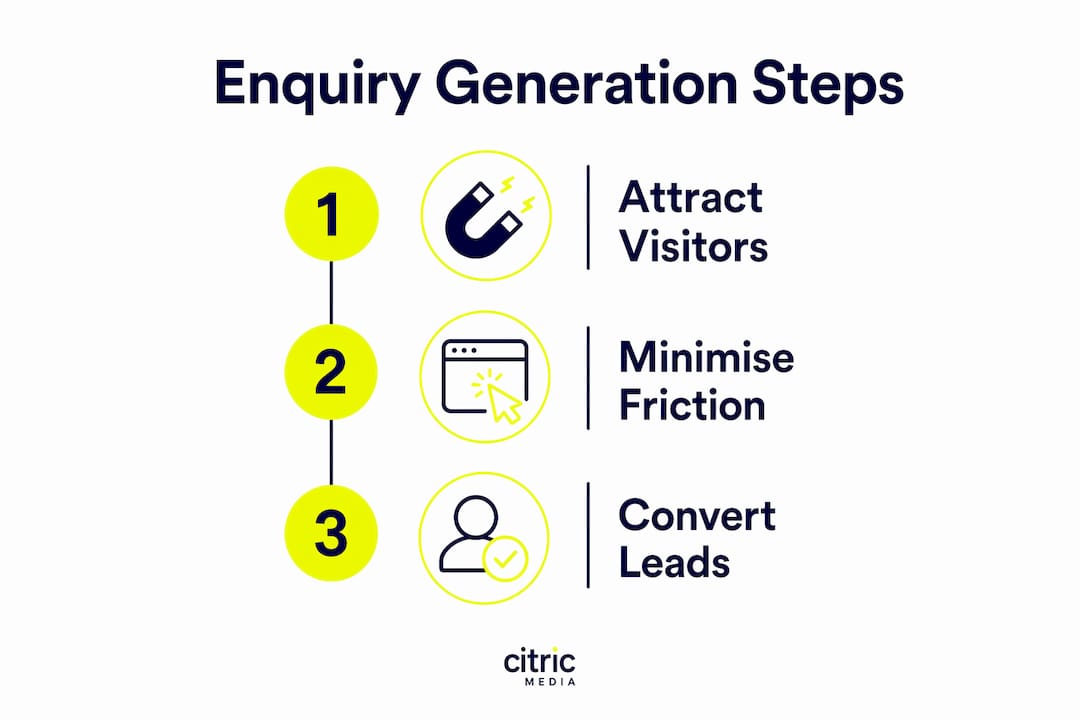
Online enquiry generation is the practice of converting targeted website visitors into measurable, trackable enquiries such as phone calls, form submissions, quote requests, and bookings that feed directly into your sales pipeline. In industry terms, this sits within the broader discipline of lead generation, which aims to fill your pipeline with prospects who are primed and ready to buy. For UK business owners and marketing managers, understanding this process is the difference between a website that costs money and one that makes it. The core mechanism is straightforward: attract the right visitors, remove the barriers between them and a conversion, and capture their contact details so your sales team can follow up.
What is online enquiry generation and why does it matter?
Online enquiry generation turns website visitors into actionable enquiries like calls and form submissions, providing contact details that allow sales follow-up to begin. This matters because without a structured process, traffic is just a vanity metric. A business receiving 10,000 monthly visitors but converting fewer than 0.5% of them into enquiries is leaving substantial revenue on the table.
The process sits at the intersection of digital marketing and sales. Visitors arrive via Google Ads, SEO, Bing Advertising, or paid social media, and the enquiry generation system determines whether they leave silently or raise their hand. Quality lead generation improves sales efficiency and conversion likelihood, meaning your sales team spends time on warm prospects rather than cold outreach.

For UK SMEs in particular, a well-functioning enquiry generation process creates revenue predictability. When you know that a certain volume of traffic produces a reliable number of enquiries, you can plan hiring, capacity, and marketing spend with confidence. That predictability is what separates businesses that grow steadily from those that lurch between feast and famine.
What are the key components that drive successful online enquiry generation?
Five building blocks underpin consistent enquiry generation: audience intent matching, a clear offer, effective conversion paths, trust signals, and measurement. Each one compounds the others. Fixing your form but ignoring your messaging will still produce weak results.
Here is how each component functions in practice:
- Audience intent matching. Your offer must align with what the visitor actually wants at that moment. A visitor searching “emergency boiler repair London” needs a phone number and a promise of same-day service, not a brochure download.
- Clear messaging and offer clarity. Ambiguous headlines and vague value propositions create friction before a visitor even reaches your form. State what you do, who you do it for, and what happens next.
- Conversion paths. These include short contact forms, click-to-call buttons, quote request tools, and booking widgets. Each path should require minimal effort from the visitor. A lead is generated via forms, subscriptions, downloads, or quote requests, and typically includes at least contact information and identity details.
- Trust signals. Reviews, accreditations, case studies, and client logos reduce perceived risk. A visitor who trusts you is far more likely to submit their details.
- Measurement and tracking. Without attribution data, you cannot tell which pages, channels, or messages are producing enquiries. Tracking is not optional; it is the feedback loop that allows you to improve.
Pro Tip: Place your primary call-to-action above the fold on every service page. Visitors who have to scroll to find a contact option are significantly less likely to enquire.
Conversion friction, defined as anything that makes it harder for a visitor to take the next step, is the biggest single driver of inconsistent enquiries. Addressing it across messaging, user experience, and form design is where most businesses find the fastest gains. You can explore lead generation strategies that address these friction points in detail.
What common challenges hinder online enquiry generation?
Conversion friction takes many forms, and most businesses underestimate how many friction points exist on their own websites. The good news is that small businesses can improve conversion rates 2 to 4 times by fixing clarity, trust, form friction, calls-to-action, and mobile experience. These fixes require judgment rather than large-scale testing and can often be implemented in an afternoon.
The most common obstacles, in order of impact, are:
- Unclear positioning. Visitors cannot immediately tell what you do or whether you serve their location or industry. They leave within seconds.
- Weak or absent offers. A generic “contact us” button competes poorly against a specific “get a free quote in 24 hours” prompt. Specificity converts.
- Overly long forms. Each additional form field reduces submission rates by 4 to 8%. A form asking for name, company, job title, phone, email, budget, and project description will lose the majority of potential enquiries before they are submitted.
- No post-submission expectation setting. Visitors who do not know what happens after they click “submit” feel uncertain. A simple confirmation message stating “We will call you within two hours” removes that anxiety.
- Poor mobile usability. If your call-to-action button is small, your form fields are cramped, or your page loads slowly on a mobile connection, you are losing the majority of your traffic before it converts.
Pro Tip: After any change to a form or call-to-action, allow at least 30 days of data before drawing conclusions. Short measurement windows produce misleading results and lead to premature reversals of changes that were actually working.
The distinction between small-business conversion rate optimisation and enterprise methods matters here. Large organisations run statistically significant A/B tests across millions of sessions. Most UK SMEs do not have that traffic volume. The practical approach is to make one considered change at a time, measure it over 30 to 60 days, and build a record of what works for your specific audience.
How is online enquiry generation tracked and measured effectively?
Tracking enquiry generation accurately requires capturing source data alongside conversion events, rather than relying solely on traffic counts. Traffic volume tells you how many people visited. Enquiry attribution tells you which channel, campaign, or page produced each conversion. These are entirely different insights with entirely different implications for budget decisions.
The measurement framework breaks down into three layers:
The first layer is funnel event tracking. This means recording page views, micro-conversions such as form field interactions and scroll depth, and full conversions such as form submissions and phone calls. Tools like Google Analytics 4, combined with Google Tag Manager, allow you to set up these events without developer involvement for most standard implementations.
The second layer is source attribution using UTM parameters. When you run a Google Ads campaign or a paid social campaign on Meta or LinkedIn, tagging your URLs with UTM parameters means every enquiry can be traced back to its origin. Leads grouped by UTM source enable informed channel performance analysis and budget allocation. Without this data, you are guessing which channels deserve more investment.
The third layer is the metrics you actually report on. The table below shows the difference between vanity metrics and performance metrics:
| Metric | Type | What it tells you |
|---|---|---|
| Total website sessions | Vanity | How many people visited, nothing more |
| Enquiries per 100 visitors | Performance | The efficiency of your conversion process |
| Form completion rate | Performance | Whether your form is creating friction |
| Enquiries by traffic source | Performance | Which channels produce real business value |
| Cost per enquiry | Performance | Whether your marketing spend is justified |
Focusing on enquiries per visitor rather than raw traffic is the single most important mindset shift for business owners. A campaign that drives 500 targeted visitors and produces 25 enquiries outperforms one that drives 5,000 untargeted visitors and produces 10. You can read more about monitoring digital campaign results to build a reporting framework around these metrics.
What best practices improve online enquiry generation?
The most reliable improvements come from compounding small, well-considered changes rather than periodic redesigns. Reducing form fields from eight to roughly three can increase enquiry submissions by 30 to 60%. That single change, applied to a busy service page, can transform the commercial performance of a website without touching the design or the traffic strategy.
The following practices consistently produce results across service businesses in the UK:
- Keep forms to three or four fields. Name, phone number, and a brief description of the enquiry is sufficient to start a conversation. Forms serve as permission slips to begin a dialogue; detailed qualification belongs in the follow-up call or email, not on the form itself.
- Write calls-to-action that describe the outcome, not the action. “Get your free quote” outperforms “Submit” every time. The visitor needs to see the benefit, not the mechanics.
- Use session recording tools. Platforms such as Microsoft Clarity and Hotjar show you exactly where visitors drop off, which form fields cause hesitation, and which sections of a page receive the most attention. This replaces guesswork with evidence.
- Place trust signals adjacent to your form. A five-star Google review or a recognisable client logo positioned next to your contact form reduces the perceived risk of submitting details to an unknown business.
- Test mobile usability personally. Open your own website on a mobile device and attempt to complete an enquiry. If it takes more than 30 seconds or requires pinching and zooming, you have a conversion problem.
The table below contrasts two common approaches to form design:
| Approach | Fields required | Typical completion rate | Lead quality |
|---|---|---|---|
| Long qualification form | 7 to 10 fields | Low | Higher upfront, lower volume |
| Short permission-slip form | 3 to 4 fields | High | Qualified in follow-up, higher volume |
The short form wins on volume without sacrificing quality, provided your follow-up process is prompt and structured. Small changes such as headline clarity and adding click-to-call buttons can show measurable impact within 30 to 60 days. For a deeper look at generating high-quality leads from UK audiences, the guide on high-quality online leads covers the qualification side of this process in detail.
Key takeaways
Effective online enquiry generation requires audience intent alignment, friction-free conversion paths, and source-level tracking working together as a single system.
| Point | Details |
|---|---|
| Definition is precise | Online enquiry generation converts website visitors into trackable calls, forms, and bookings for sales follow-up. |
| Five components matter | Audience intent, clear offers, conversion paths, trust signals, and measurement all compound each other’s impact. |
| Short forms convert better | Reducing form fields to three or four can lift submission rates by 30 to 60%; qualify leads in follow-up contact. |
| Attribution beats traffic counts | Grouping enquiries by UTM source reveals which channels produce real business value, not just visits. |
| Small fixes compound quickly | Clarity, trust signals, and mobile usability improvements can produce 2 to 4 times better conversion rates for SMEs. |
Why most businesses are solving the wrong problem
I have reviewed hundreds of UK SME websites over the years, and the pattern is consistent. Business owners invest in driving more traffic when their actual problem is that the traffic they already have is not converting. More visitors through a leaky funnel just means more wasted budget.
The mindset shift I always recommend is this: treat your enquiry generation process as a growth engine, not a website feature. A form is not decoration. A call-to-action is not a courtesy. Every element of your conversion path either earns its place or costs you money.
The businesses I see grow steadily are the ones that review their enquiry data monthly, make one deliberate change at a time, and connect their marketing performance directly to sales outcomes. They do not chase the latest tactic. They fix the fundamentals and then build on top of them. Integrating your enquiry tracking with your CRM or sales follow-up process is where the real compounding begins. An enquiry that sits uncontacted for 48 hours loses most of its commercial value regardless of how well your website performed. The marketing funnel does not end at the form submission; it ends at the closed sale.
— Martin
How Citricmedia can help you generate more online enquiries
Citricmedia has spent over 27 years helping UK businesses build enquiry generation systems that produce measurable, repeatable results. Whether your challenge is low conversion rates on existing traffic, poor attribution data, or a website that simply is not structured to convert, the team at Citricmedia builds the conversion paths, tracking infrastructure, and channel strategies that address the root cause rather than the symptom.
From Google Ads and SEO to paid social and Bing Advertising, Citricmedia designs campaigns around enquiry outcomes, not just clicks. If you want to understand exactly where your current process is losing potential enquiries, explore Citricmedia’s services and request an audit of your current enquiry performance. The data will tell you precisely where to focus first.
FAQ
What is the difference between a lead and an enquiry?
An enquiry is a specific type of lead where a prospect has actively contacted a business, typically via a form, phone call, or booking request. A lead is the broader term covering any prospect who has shown interest, including those acquired through downloads or subscriptions.
How many form fields should an online enquiry form have?
Three to four fields is the recommended maximum for most service businesses. Research shows that reducing fields from eight to three can increase submission rates by 30 to 60%, with detailed qualification handled during the follow-up call or email.
How do I know which marketing channel is generating my enquiries?
UTM parameters added to campaign URLs, combined with conversion event tracking in Google Analytics 4, allow you to group enquiries by source. This reveals which channels, such as Google Ads, SEO, or paid social, are producing actual business value rather than just traffic.
How quickly can I improve my online enquiry generation?
Focused fixes to headline clarity, call-to-action copy, trust signal placement, and mobile usability can be implemented within days and show measurable impact within 30 to 60 days. These changes do not require large budgets or developer resources for most standard websites.
Is online enquiry generation the same as lead generation?
Online enquiry generation is a specific application of lead generation, focused on converting website visitors into direct contact requests. Lead generation is the broader discipline covering all methods of attracting and capturing prospect interest, including content downloads, event registrations, and paid list acquisition.