Search engine ranking is defined as the position a webpage holds on a search engine results page (SERP) for a given query, determined by algorithms that assess relevance, quality, and user experience signals. For business owners and marketers, that position is not an abstract metric. The first result on a SERP averages a click-through rate (CTR) of 39.8%, while position three drops to just 10.2%. That gap represents a significant difference in traffic, leads, and revenue. Understanding what is search engine ranking, and what drives it, is the foundation of any credible digital marketing strategy. The modern SERP has also grown far more complex, with 97% of Google queries now returning at least one rich feature such as snippets, maps, videos, or AI-generated summaries alongside organic listings.
What is search engine ranking and how does it work?
Search engine ranking is the outcome of a continuous algorithmic process. Google, Bing, and other search engines crawl and index billions of pages, then score each one against hundreds of signals to decide which pages best answer a given query. The industry term for this process is search engine optimisation (SEO), and understanding it is the first step toward improving your position.
Relevance, quality, and intent
Algorithms assess two things above all else: does this page answer the query, and does it do so better than competing pages? Relevance is measured through keyword usage, topic coverage, and how well the content matches the user’s search intent. Quality is assessed through signals like backlinks from trusted sites, content depth, and user engagement metrics such as time on page and bounce rate.

Search intent is the reason behind a query. A user searching “best accounting software for small business” wants a comparison, not a definition. If your page delivers a definition instead, it will not rank well regardless of how technically sound it is. Diagnosing search intent and matching your content format to what the SERP already rewards is a core SEO discipline.
Technical signals and Core Web Vitals
Technical health is a non-negotiable ranking factor. Google’s Core Web Vitals set clear performance targets: Largest Contentful Paint (LCP) under 2.5 seconds, Interaction to Next Paint (INP) under 200 milliseconds, and Cumulative Layout Shift (CLS) under 0.1. Pages that miss these thresholds signal a poor user experience, which directly suppresses rankings. Mobile friendliness, secure HTTPS connections, and clean site architecture all feed into the same technical scoring.
Pro Tip: Use Google Search Console’s Core Web Vitals report to identify underperforming URLs before they drag down your wider site ranking.
What are the key search engine ranking factors?
Ranking factors fall into four broad categories. Understanding each one helps you prioritise where to focus your effort.
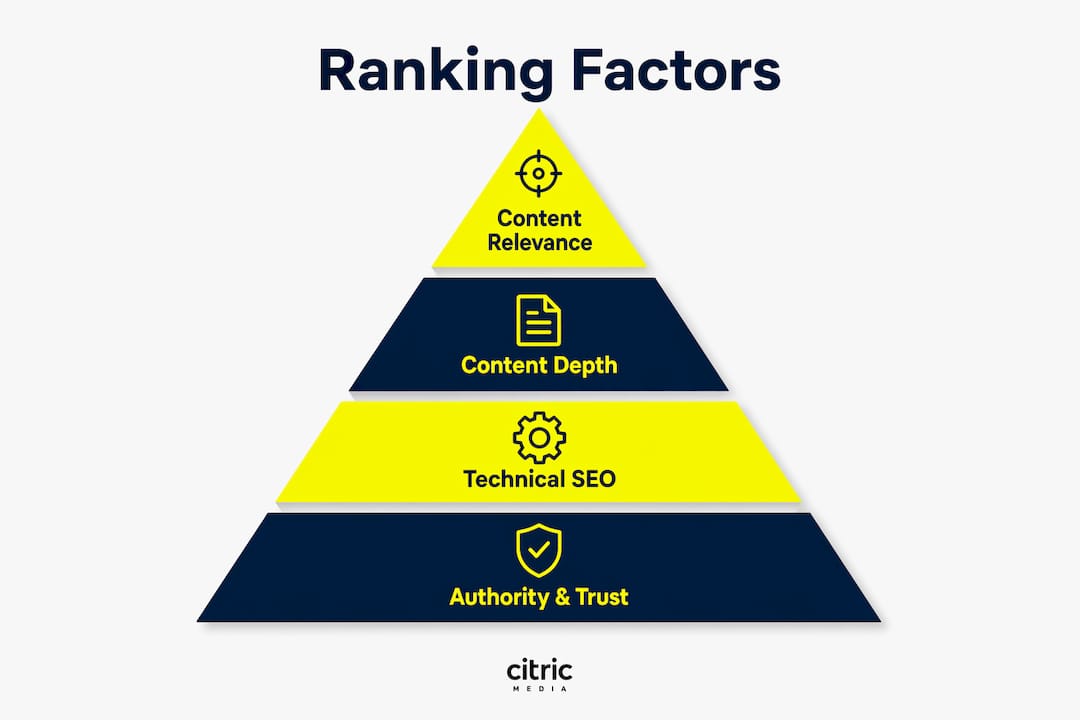
| Ranking factor | What it means in practice |
|---|---|
| Content relevance | Your page must match the query’s intent and cover the topic with sufficient depth |
| Content format | If top results use comparison tables, a long essay will underperform regardless of quality |
| Technical health | Core Web Vitals, mobile performance, and page speed all affect ranking directly |
| Authority signals | Backlinks from trusted domains and outbound links to authoritative sources build credibility |
| User engagement | CTR, dwell time, and low bounce rates signal to Google that your page satisfies users |
Content depth and format alignment
Pages ranking in the top five average over 2,500 words. That figure reflects topical authority, not padding. Google rewards pages that cover a subject thoroughly because they are more likely to satisfy a wide range of related queries. Shorter pages can rank for narrow, low-competition queries, but competing in most commercial categories requires genuine depth.
Format matters as much as length. If a query’s top results are quick comparison tables, a lengthy essay will generally underperform because Google prioritises formats that match user intent precisely. Before writing any piece of content, analyse the top five results for your target query and note the dominant format.
Authority and trust signals
Backlinks from reputable domains remain one of the strongest ranking signals. Each quality backlink acts as a vote of confidence in your content. Outbound links to authoritative sources such as .gov or .edu domains also signal trustworthiness to search engines and increase the likelihood of your content being cited in AI-generated overviews. Many marketers avoid outbound links for fear of losing traffic, but the trust signal they provide outweighs that concern.
How can business owners improve their search rankings in 2026?
A structured, measurable approach covering technical health, content quality, and performance tracking outperforms keyword chasing alone. The following steps give you a practical framework.
- Audit your technical baseline. Run a crawl using a recognised SEO audit tool to identify broken links, slow pages, and Core Web Vitals failures. Fix critical errors before investing in new content.
- Map your content to search intent. For each target keyword, examine the top five SERP results. Note the format, word count, and headings. Build your content to match or exceed what already ranks.
- Add authoritative outbound citations. Link to credible external sources within your content. This signals trustworthiness and improves your chances of appearing in AI overview panels.
- Implement structured data. FAQ schema, How-To schema, and Article schema help search engines understand your content and surface it in rich results. Top 3 placement or citation inside AI summaries is the new benchmark, and structured data is the clearest path to achieving it.
- Track the right KPIs. Monitor CTR, average position, organic sessions, and conversion rate alongside rankings. A page ranking fifth with a high conversion rate may deliver more business value than a page ranking first with poor engagement.
- Build internal links. Connect related pages on your site to distribute authority and help Google understand your site’s topical structure. A well-linked site ranks more pages, not just individual articles.
Pro Tip: Revisit your top-performing pages every quarter. Updating content with fresh data, new examples, and improved formatting consistently recovers lost rankings faster than publishing new pages.
Understanding how SEO drives marketing success for SMEs helps you connect ranking improvements directly to business outcomes rather than treating SEO as a standalone activity.
What challenges affect interpreting search rankings today?
Rankings are no longer the single measure of search visibility. Several forces complicate how you read and act on ranking data.
- AI Overviews reduce CTR significantly. For some queries, the top organic position CTR drops from 34% to 2.6% when an AI-generated answer panel appears above it. Ranking first no longer guarantees the traffic it once did.
- Zero-click searches are growing. Users increasingly get their answer directly from the SERP without clicking any result. Featured snippets, knowledge panels, and AI summaries all contribute to this pattern. Your content may be answering queries without generating a single visit.
- Personalisation and location shift results. Two users searching the same query in different locations or with different search histories will see different results. A ranking report shows an average position, not what any individual user sees.
- Search behaviour is fragmenting. Younger audiences increasingly use platforms like YouTube, TikTok, and Reddit as search tools. Organic Google rankings matter enormously, but they are one channel within a broader search engine marketing picture.
The practical response is to measure what rankings produce, not just where you sit. Track qualified traffic, lead volume, and revenue attributed to organic search. A business ranking eighth but converting well is outperforming a competitor ranking second with poor engagement. Aligning SEO with business goals, rather than chasing positions for their own sake, is what separates effective marketers from those spinning their wheels.
Key takeaways
Search engine ranking determines your organic visibility, but position alone is not the measure of success. Matching content format to search intent, maintaining technical health, and tracking conversions alongside rankings produces the most reliable business results.
| Point | Details |
|---|---|
| Position drives traffic sharply | The first SERP result averages 39.8% CTR; position three drops to 10.2%, so top placement matters. |
| Content format is a ranking signal | Match your content format to what already ranks for your target query, not just your preferred style. |
| Technical health is non-negotiable | Core Web Vitals targets (LCP under 2.5s, INP under 200ms, CLS under 0.1) directly affect ranking. |
| AI Overviews change the CTR equation | Top organic CTR can fall from 34% to 2.6% when AI panels appear; structured data helps you stay visible. |
| Measure business outcomes, not just rank | Track CTR, conversions, and qualified traffic alongside position to judge SEO performance accurately. |
Our honest view on what search engine ranking really means for your business
I have worked in digital marketing long enough to watch SEO go through several cycles of panic and reinvention. The fundamentals have not changed as much as the noise suggests. What has changed is the bar for quality and the complexity of the SERP itself.
The businesses I see struggling most are those treating ranking as the end goal. They celebrate a move from position six to position three without asking whether that shift produced a single additional enquiry. Ranking is a leading indicator, not a result. The result is qualified traffic that converts.
What I advocate consistently is diagnosing intent before writing a single word. Look at what Google already rewards for your target query. If the top results are short, structured comparison pages, write a short, structured comparison page. If they are long, authoritative guides, match that depth. Trying to rank a format Google has already decided it does not want for that query is wasted effort.
The AI Overview shift is real and worth taking seriously. Structured data, citation-rich content, and outbound links to authoritative sources are no longer optional extras. They are the mechanism by which your content gets cited inside AI panels rather than buried beneath them. The future of SEO in 2026 belongs to businesses that treat their content as a trustworthy reference, not a sales brochure.
— Martin
How Citricmedia helps you rank and grow
Citricmedia has spent over 27 years helping UK SMEs turn search visibility into measurable business growth. Our SEO work covers technical audits, content strategy aligned to search intent, and structured data implementation built for the AI-driven SERP.
If you are ready to move beyond guessing why your rankings are not converting, see how we drive SEO results for businesses like yours. For a broader view of the investment case, our guide on why SEO matters for SMEs sets out the commercial logic clearly. Get in touch with Citricmedia and put your rankings to work.
FAQ
What is search engine ranking in simple terms?
Search engine ranking is the position your webpage appears in on a search results page for a specific query. The higher the position, the more clicks and traffic your page typically receives.
What are the most important search engine ranking factors?
The most influential factors are content relevance to search intent, content depth, technical performance (including Core Web Vitals), backlink quality, and user engagement signals such as CTR and dwell time.
How do AI Overviews affect my search ranking?
AI Overviews can reduce CTR for top organic results dramatically, with some queries seeing the first position CTR fall from 34% to 2.6%. Implementing structured data such as FAQ schema improves your chances of being cited within those panels.
How long does it take to improve search rankings?
Ranking improvements typically take three to six months for established sites and longer for new domains. Technical fixes and content updates to existing pages tend to produce faster results than publishing entirely new content.
Does ranking position directly equal business success?
Not automatically. A page ranking fifth with strong conversion rates can outperform a page ranking first with poor engagement. Tracking qualified traffic, leads, and revenue alongside position gives a far more accurate picture of SEO performance.