General
Cost per acquisition (CPA) is defined as the total cost a business pays to gain one paying customer or valuable conversion through a specific marketing campaign. Unlike Cost per Click (CPC) or Cost per Impression (CPM), CPA ties spend directly to business outcomes such as sales, leads, or sign-ups. That distinction makes it one of the most useful metrics in any performance marketer’s toolkit. Platforms like Google Ads, Meta Ads, and HubSpot all surface CPA data natively, which means you can act on it without building complex custom reports.
What is cost per acquisition and how is it calculated?
CPA is calculated by dividing total campaign costs by the number of acquisitions achieved. The formula is straightforward:
Total Campaign Cost ÷ Number of Acquisitions = CPA
A £3,000 Google Ads campaign that generates 60 conversions produces a CPA of £50. That number tells you exactly what each conversion costs, which makes budget decisions far easier to justify.

What costs should you include?
Most marketers include direct ad spend in their CPA calculation, but that approach understates the true cost. A more accurate figure includes:
- Ad spend across Google Ads, Bing Advertising, Meta Ads, and LinkedIn
- Creative production costs such as copywriting, design, and video
- Tooling costs such as landing page software, tracking platforms, and CRM licences
- Agency or management fees if you work with an external partner
Leaving out creative or tooling costs is one of the most common calculation errors. It makes CPA look lower than it really is, which leads to over-investment in campaigns that are not actually profitable.
Defining what counts as an acquisition
The definition of an acquisition varies by business type. An e-commerce brand counts a completed purchase. A B2B software company might count a demo request or a qualified lead. A law firm might count a phone enquiry. Consistency matters here. If your definition shifts between reporting periods, your CPA figures become incomparable and useless for trend analysis.
Pro Tip: Set a single, written definition of “acquisition” before you launch any campaign. Share it with every team member who touches reporting. Changing the definition mid-campaign is one of the fastest ways to corrupt your data.
| Cost type | Include in CPA? |
|---|---|
| Paid ad spend | Yes, always |
| Creative and design fees | Yes, for accurate CPA |
| Agency management fees | Yes, for true cost picture |
| Organic content costs | No, unless tied to a specific campaign |
| General overheads (rent, salaries) | No, these belong in CAC |
CPA vs customer acquisition cost: what is the difference?
CPA and customer acquisition cost (CAC) are related but measure different things. Confusing them leads to poor budget decisions.
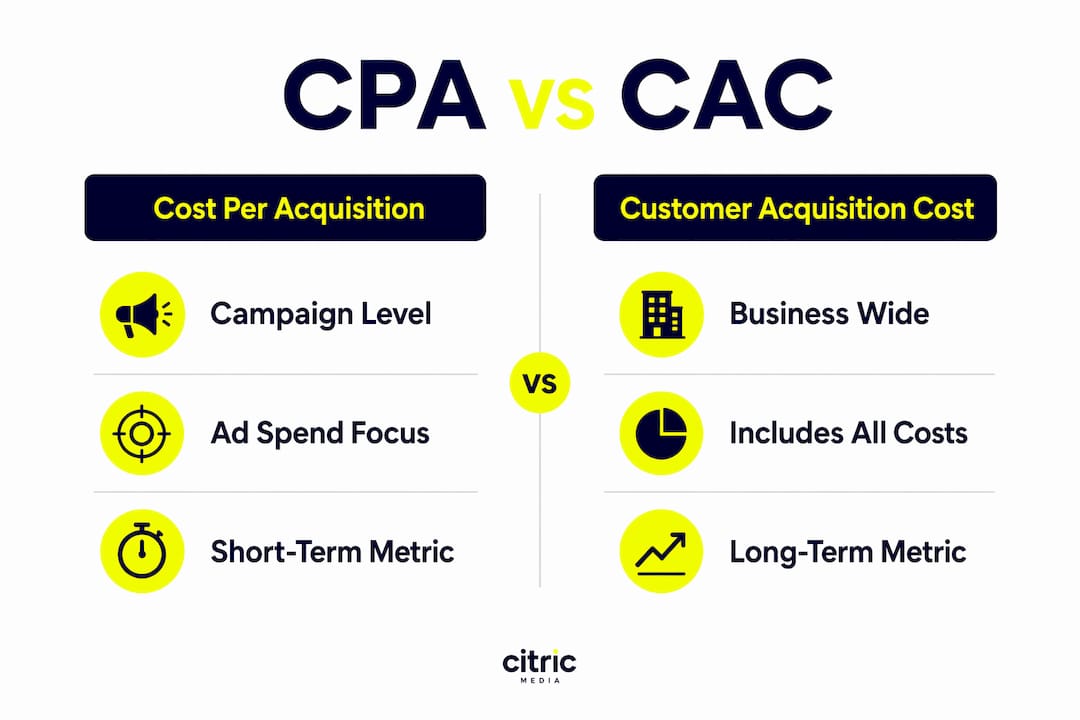
CPA is a campaign-level efficiency metric. It tells you what a specific channel or campaign costs per conversion. CAC is a business-level metric. It includes all sales and marketing expenditure, including salaries, tools, events, and overheads, divided by the total number of new customers won in a period.
UK B2B businesses typically see CAC benchmarks ranging from £200 to nearly £600, depending on sector and sales cycle length. That range reflects the full weight of sales team costs and marketing infrastructure. A CPA figure from a single Google Ads campaign will almost always look lower, because it excludes those wider costs.
Why marketers focus on CPA for channel decisions
CPA is the right metric when you want to compare channel efficiency. It answers the question: which campaign or platform delivers conversions at the lowest cost? CAC answers a different question: is the business acquiring customers profitably overall? Both matter, but they operate at different levels of analysis.
| Metric | Scope | What it includes | Best used for |
|---|---|---|---|
| CPA | Campaign or channel level | Ad spend, creative, tooling | Comparing channel efficiency |
| CAC | Business level | All sales and marketing costs | Assessing overall profitability |
Use CPA to make day-to-day campaign decisions. Use CAC to assess whether your entire go-to-market model is financially sound.
Why does CPA matter alongside other marketing metrics?
CPA is not a standalone measure of success. CPA should be analysed alongside Average Order Value (AOV) and Customer Lifetime Value (CLV) to determine a profitable maximum CPA. Without that context, a low CPA can mask a deeply unprofitable campaign.
Consider this: a £30 CPA sounds excellent until you realise the average order value is £25. The campaign is losing money on every conversion. Conversely, a £120 CPA might be entirely acceptable if the CLV of each customer is £1,200 over three years.
How CPA fits with AOV and CLV
The relationship between these three metrics sets your maximum acceptable CPA. A simple way to frame it: your CPA must sit comfortably below your gross profit per acquisition. If your AOV is £200 and your gross margin is 40%, your gross profit per sale is £80. A CPA above £80 means the campaign loses money before overheads.
CLV extends this thinking further. If customers typically reorder three times, your true value per acquisition is three times the first-order gross profit. That gives you more room to spend on acquisition without sacrificing profitability.
- AOV sets the revenue ceiling per transaction
- CLV reveals the long-term value of each acquired customer
- CPA must sit below gross profit per acquisition to be sustainable
CRM data from platforms like Salesforce or HubSpot helps you prioritise high-potential prospects rather than chasing volume at any cost. Focusing purely on reducing CPA can lower lead quality and volume if you are not simultaneously filtering for prospect fit.
Pro Tip: Calculate your maximum acceptable CPA before you set campaign budgets. The formula is: (AOV × Gross Margin) × CLV multiplier. Use this figure as your CPA ceiling, not an arbitrary target pulled from industry benchmarks.
How to reduce cost per acquisition effectively
Reducing CPA without sacrificing conversion volume requires a structured approach. Random changes to bids or budgets rarely work and often make things worse.
Fix your tracking infrastructure first. Fragmented tracking data causes wasted spend on untracked conversions and leads to random optimisation mistakes. Before you touch a single bid, verify that Google Tag Manager, GA4, and your ad platform conversion tags are firing correctly on every key action.
Improve landing page conversion rates. Raising a landing page conversion rate from 2% to 3% produces a 33% reduction in CPA without increasing ad spend or traffic volume. That is the single highest-leverage action most UK businesses can take right now. Test headlines, calls to action, form length, and page load speed using tools like Google Optimize or VWO.
Apply the 80/20 rule to your campaigns. Focusing budget on key geographic segments and top-performing audience segments can significantly lower CPA. Identify the 20% of keywords, audiences, or placements driving 80% of your conversions, then shift budget toward them.
Pause underperforming campaigns systematically. Pausing ads or keywords with no conversions in the past 90 days is a critical step in effective CPA management. This is not pessimism. It is disciplined budget allocation.
Use remarketing and email marketing for cost efficiency. Remarketing audiences on Google Ads and Meta Ads consistently deliver lower CPAs than cold prospecting. Email marketing to existing enquirers via Mailchimp or Klaviyo costs a fraction of paid acquisition and often converts at a higher rate.
You can also review your campaign optimisation approach to identify which of these levers will have the greatest impact on your specific campaigns.
Common mistakes when managing CPA metrics
Most CPA problems are not caused by poor campaigns. They are caused by poor measurement and inconsistent decision-making.
- Random optimisation. Changing bids, pausing keywords, or shifting budgets without sufficient conversion data is the most common and costly mistake. Decisions made on fewer than 30 conversions per segment are statistically unreliable.
- Ignoring landing page quality. Marketers frequently focus on ad creative and bidding while leaving a slow, poorly structured landing page untouched. The landing page is often where the CPA battle is won or lost.
- Confusing CPA with CAC. Reporting a campaign CPA to the board as if it represents the full cost of customer acquisition misleads decision-makers and distorts investment planning.
- Over-focusing on CPA reduction. Focusing only on CPA reduction can reduce lead volume or quality without enhanced CRM prioritisation. A lower CPA that brings in weaker leads is not progress.
- Inconsistent acquisition definitions. Switching between “form fill,” “qualified lead,” and “booked call” as your acquisition event makes trend data meaningless.
“The goal is not the lowest CPA. The goal is the most profitable CPA relative to the value of each customer acquired.”
Monitoring your campaigns consistently is the foundation of good CPA management. Citricmedia’s guide on monitoring digital campaign results covers the reporting cadence and metrics that keep CPA decisions grounded in real data.
Key takeaways
CPA is the cost per conversion in a campaign, and it only becomes a useful metric when measured consistently, set against CLV and AOV, and supported by reliable tracking infrastructure.
| Point | Details |
|---|---|
| CPA formula | Divide total campaign cost by number of acquisitions to get your CPA figure. |
| CPA vs CAC | CPA measures campaign efficiency; CAC measures total business acquisition cost including overheads. |
| Set a CPA ceiling | Calculate maximum acceptable CPA using AOV, gross margin, and CLV before setting budgets. |
| Landing pages drive CPA | A 1% conversion rate improvement on a landing page can cut CPA by a third without extra spend. |
| Fix tracking first | Inaccurate tracking data causes random optimisation and wastes budget before any campaign change helps. |
CPA in practice: what I have learned from UK campaigns
Working across hundreds of UK campaigns over the years, the pattern I see most often is this: businesses obsess over their CPA figure while neglecting the two things that actually control it, which are landing page quality and tracking accuracy. They will spend hours adjusting bids on Google Ads or Meta while their conversion tag is misfiring and their landing page loads in six seconds on mobile.
My blunt view is that CPA is a lagging indicator. It tells you what already happened. The leading indicators are conversion rate, tracking completeness, and audience quality. Get those right and CPA falls naturally. Chase CPA directly and you often end up cutting the wrong things.
The other lesson I keep returning to is the importance of defining your maximum acceptable CPA before a campaign launches, not after. Once a campaign is live and spending, there is enormous pressure to justify the spend. Having a pre-agreed ceiling removes that bias and makes pausing decisions much easier to defend internally.
For UK SMEs in particular, the 80/20 principle is underused. Most businesses are running campaigns across too many geographies, too many keywords, and too many audience segments simultaneously. Concentrating budget on the segments with proven conversion history almost always lowers CPA faster than any bid strategy change.
The PPC campaign checklist for UK SMEs is worth working through if you want a structured way to audit your current setup against these principles.
— Martin
How Citricmedia helps UK businesses reduce CPA
Citricmedia has spent over 27 years helping UK SMEs generate high-quality leads and sales through performance-driven digital marketing. The focus is always on measurable outcomes, not vanity metrics.
Whether you are running Google Ads, Bing Advertising, or paid social campaigns, Citricmedia’s team works directly on tracking implementation, landing page performance, and campaign structure to bring CPA down without sacrificing lead quality. The paid social advertising guide for UK SMEs is a strong starting point if paid social is a channel you want to improve. For a broader view of how Citricmedia supports digital growth, visit the Citricmedia homepage.
FAQ
What is the cost per acquisition formula?
CPA equals total campaign cost divided by the number of acquisitions. For example, a £3,000 campaign with 60 conversions produces a CPA of £50.
What is a good CPA for UK businesses?
A good CPA is one that sits below your gross profit per acquisition. UK B2B CAC benchmarks range from £200 to nearly £600, but your acceptable CPA depends on your AOV, margin, and CLV.
How does CPA differ from CAC?
CPA measures the cost per conversion within a specific campaign or channel. CAC is a broader business metric that includes all sales and marketing costs, including salaries and overheads.
How do I reduce cost per acquisition without cutting budget?
Improving your landing page conversion rate is the most effective lever. Raising conversion rate from 2% to 3% reduces CPA by 33% without increasing ad spend.
Why is tracking infrastructure important for CPA?
Broken or incomplete tracking causes inaccurate CPA data, which leads to poor optimisation decisions and wasted spend on campaigns that appear to be underperforming but may not be.