Marketing
Strategic methodology is the structured process organisations use to connect high-level goals with day-to-day actions and measurable results. For SME leaders, understanding this process is not a luxury. It is the difference between reacting to circumstances and deliberately shaping them. The S.T.A.R. methodology links strategies, tactics, actions, and results into a single coherent chain, giving leaders a diagnostic tool when performance falls short. Citricmedia has applied this kind of structured thinking across digital marketing for over 27 years, and the pattern is consistent: businesses with a clear methodology outperform those operating on instinct alone.
What are the fundamental components of strategic methodology?
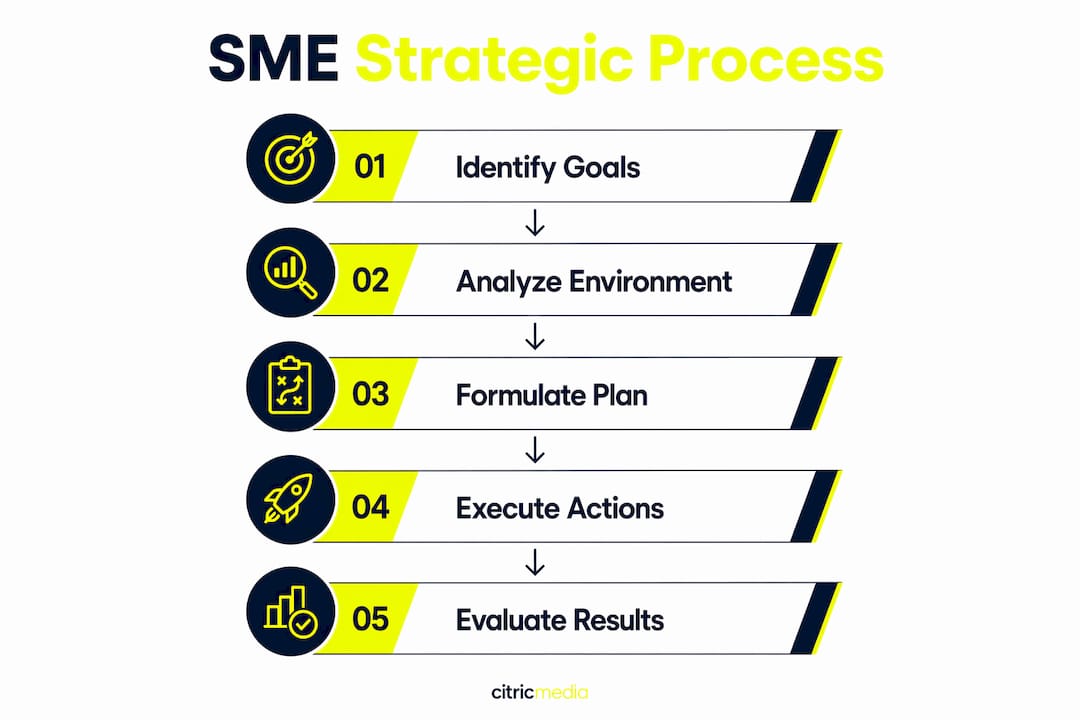
Strategic methodology in business is defined by five sequential steps: identification of strategic position, analysis and research, strategy formulation, execution and management, and evaluation of performance. Each step builds on the last. Skipping analysis to rush into formulation is one of the most common mistakes SME leaders make.
The five steps work as follows:
- Identify your strategic position. Assess where your business stands relative to competitors, customers, and market conditions. Use tools like SWOT analysis to surface honest gaps.
- Analyse and research. Gather data on market trends, customer behaviour, and internal capabilities. This step determines whether your assumptions are grounded in reality.
- Formulate your strategy. Define SMART goals: specific, measurable, achievable, relevant, and time-bound. Vague ambitions produce vague results.
- Execute and manage. Assign clear ownership for each action. Without named accountability, execution stalls at the first obstacle.
- Evaluate performance. Review results against targets. Feed findings back into the next planning cycle.
The S.T.A.R. framework maps directly onto this process. Strategies set direction, tactics define the method, actions specify the work, and results confirm whether the approach succeeded. The feedback loop within S.T.A.R. is particularly valuable: when results disappoint, you can trace the failure back to a specific stage rather than blaming the plan as a whole.
Pro Tip: Write your SMART goals before you choose your tactics. Leaders who pick channels or tools first often discover their goals were never measurable to begin with.

Linking strategy to operational reality is where most frameworks earn their keep. A plan that lives only in a boardroom presentation has no operational value. The importance of strategic planning lies precisely in its translation from intent to daily action.
How do strategic methodologies benefit SMEs?
SMEs gain three concrete advantages from applying a structured methodology: better resource allocation, faster and more confident decision-making, and the ability to adapt when conditions change.
- Resource alignment. When every team member understands the strategy, they prioritise work that moves the business forward. Without that alignment, effort scatters across competing priorities.
- Decision confidence. A clear framework gives leaders a reference point when new opportunities or threats appear. The question shifts from “what should we do?” to “does this fit our current strategy?”
- Adaptive capacity. Agile, collaborative approaches that refine probabilistic future scenarios manage uncertainty far better than rigid top-down models. This matters enormously for SMEs, which face market shifts with fewer buffers than large enterprises.
- Performance visibility. A practical monitoring rhythm of weekly or biweekly check-ins for execution, monthly performance reviews, and quarterly strategic refreshes keeps leaders informed without drowning them in meetings.
That monitoring cadence deserves emphasis. Weekly check-ins catch execution blockers early. Monthly reviews surface trends before they become crises. Quarterly sessions are the moment to ask whether the strategy itself still fits the market. This three-tier rhythm is one of the most underused benefits of strategic frameworks in SME settings.
The benefits of strategic frameworks compound over time. A business that reviews and refines its approach quarterly builds institutional knowledge that a business operating on gut feel simply cannot match. Tracking performance metrics is the practical expression of this principle in digital marketing contexts.
What pitfalls occur when implementing strategic methodologies?
The most damaging pitfall is treating the strategy document as the finished product. Long-term success requires treating strategic planning as an adaptive framework rather than a static document. When the annual plan sits in a folder and nobody revisits it until the following year, the business loses the entire benefit of having planned at all.
Three further pitfalls appear repeatedly in SME settings:
- Broken feedback loops. Without a mechanism to trace poor results back through strategy, tactics, and execution, leaders repeat the same mistakes. The S.T.A.R. diagnostic approach exists precisely to prevent this.
- Framework rigidity. Applying a methodology without adapting it to your specific context produces bureaucracy, not clarity. Strategy research must be calibrated to fit deadlines and client needs, not applied as a ritual.
- Backward-facing meetings. Most status update meetings report what happened last week. That is useful only if it informs a decision about next week. Transforming meetings from status updates to decision-support sessions adds genuine value. Ask “what decision do we need to make today?” rather than “what did we complete?”
Pro Tip: Before your next strategy meeting, send one question in advance: “What is the one blocker preventing us from hitting this month’s target?” Answers will shift the conversation from reporting to problem-solving immediately.
The common thread across these pitfalls is passivity. Strategy fails when leaders treat it as something done to the business once a year rather than something practised continuously. Strategic methodology and decision making are inseparable: the methodology only works if it actively informs choices.
How can SMEs implement strategic methodologies effectively?
Effective implementation starts with choosing a framework that fits your actual constraints, not the one that looks most impressive in a presentation. Strategy research is a deadline-driven craft, not a framework ritual. An SME with a team of twelve does not need the same planning architecture as a multinational.
The table below contrasts two common implementation approaches for SMEs:
| Approach | Best suited for | Key strength | Main risk |
|---|---|---|---|
| Annual plan with quarterly reviews | Stable markets, established teams | Clear long-term direction | Becomes static if reviews are skipped |
| Rolling 90-day cycles | Fast-moving markets, growth phase | High adaptability | Can lose sight of long-term goals |
Both approaches work. The choice depends on how quickly your market moves and how mature your planning process already is.
Building alignment is the next critical step. Every person responsible for executing part of the strategy needs to understand their specific role and how it connects to the broader goal. Ownership without context produces compliance. Ownership with context produces commitment.
A practical implementation rhythm for most SMEs looks like this: weekly team check-ins focused on blockers, monthly reviews of key metrics and trends, and quarterly sessions to reassess whether the strategy still fits the market. This mirrors the monitoring cadence recommended by IE Business School and keeps strategy alive as a management process rather than an annual event.
Pro Tip: Assign a single owner to each strategic objective, not a team. Shared ownership diffuses accountability. When everyone is responsible, no one is.
A small business marketing workflow that integrates these review rhythms into existing routines is far more likely to stick than one that requires entirely new habits. Start with the cadence you can sustain, then build from there.
Key takeaways
Strategic methodology works because it connects goals to actions, assigns accountability, and creates a feedback loop that allows continuous improvement rather than annual guesswork.
| Point | Details |
|---|---|
| Five-step process | Identification, analysis, formulation, execution, and evaluation form the core of any sound strategic methodology. |
| S.T.A.R. framework | Linking strategies, tactics, actions, and results gives leaders a diagnostic tool when performance falls short. |
| Three-tier monitoring | Weekly, monthly, and quarterly reviews keep strategy active and prevent plans from becoming static documents. |
| Adaptive over rigid | Treating strategy as a living process rather than a fixed plan is the single biggest differentiator between SMEs that grow and those that stall. |
| Accountability by name | Assigning one owner per objective, not a group, is the fastest way to close the gap between planning and execution. |
My honest view on strategy in SMEs
I have worked with enough SME leaders to know that the word “strategy” often triggers one of two reactions: either a polished document appears that nobody reads, or the conversation gets deferred because there is always something more urgent. Both responses are understandable. Neither is acceptable if you are serious about growth.
The frameworks matter less than most consultants will tell you. What matters is the habit of asking hard questions on a regular cadence and being willing to act on the answers. I have seen businesses using a simple one-page plan outperform competitors with elaborate strategy decks, because the simple plan was actually used.
The shift from top-down, rigid models to agile, collaborative planning is not just an academic recommendation. It reflects how the best-run SMEs I have observed actually operate. They treat strategy as a conversation, not a decree. They update their assumptions when the data changes. They hold people accountable without making accountability feel punitive.
The craft element is real. Knowing when to apply a framework strictly and when to adapt it takes experience. No article, including this one, can fully substitute for that judgement. What you can do is build the habit of structured reflection now, and refine your approach as you learn what works for your specific business.
— Martin
How Citricmedia applies strategic methodology to digital marketing
Citricmedia has spent over 27 years helping UK SMEs translate business goals into measurable digital results. That work is grounded in the same principles covered here: clear objectives, defined tactics, named accountability, and regular performance reviews.
If you want to see how strategic digital marketing applies to your specific growth targets, Citricmedia’s team works with SMEs across Google Ads, SEO, paid social, and performance hosting. Every engagement starts with understanding your strategic position before recommending a single channel. For SMEs ready to connect planning with execution, digital marketing for SMEs is a practical starting point.
FAQ
What is strategic methodology in business?
Strategic methodology is the structured process of identifying goals, analysing the environment, formulating a plan, executing it, and evaluating results. The five-step process provides a repeatable framework for turning organisational intent into measurable outcomes.
Why does strategic planning matter for SMEs specifically?
SMEs operate with fewer resources and less margin for error than large enterprises, making deliberate planning more critical, not less. A clear methodology helps SME leaders prioritise, allocate resources efficiently, and adapt quickly when market conditions shift.
What is the S.T.A.R. methodology?
S.T.A.R. stands for Strategies, Tactics, Actions, and Results. It links each planning layer to the next and includes a feedback loop that allows leaders to diagnose exactly where a plan broke down.
How often should SMEs review their strategy?
A practical cadence includes weekly or biweekly execution check-ins, monthly performance reviews, and quarterly strategic refreshes. This rhythm keeps the plan current without consuming excessive management time.
What is the biggest mistake SMEs make with strategic frameworks?
The most common mistake is treating the strategy document as the end product rather than the starting point. Effective strategic planning requires ongoing adaptation, regular reviews, and active use in decision-making meetings.