Digital MarketingMarketingMarketing Technique
Generating a lead feels like progress. And it is. But here’s the uncomfortable reality most small business owners discover too late: the majority of prospects who enquire today won’t buy today. Understanding what is lead nurturing is the difference between a pipeline that converts and a list of contacts that goes cold. Lead nurturing is the process of building relationships with prospects by delivering relevant, personalised content over multiple touchpoints, guiding them through the sales journey until they’re genuinely ready to commit.
Table of Contents
- What is lead nurturing and why does it matter?
- How automated lead nurturing works for small businesses
- UK compliance and permission-based lead nurturing via email
- Lead nurturing versus lead generation: a clear comparison
- Best practices for successful lead nurturing in UK SMEs
- The human touch in lead nurturing: why automation isn’t enough
- How Citricmedia supports UK SMEs with effective lead nurturing
- Frequently asked questions
Key Takeaways
| Point | Details |
|---|---|
| Lead nurturing definition | It is building ongoing personalised relationships with prospects to guide them to purchase readiness. |
| Automated nurturing benefits | Automation enables consistent, targeted communication and lead scoring for timely sales engagement. |
| UK legal compliance | UK email nurturing must include opt-in consent and a clear unsubscribe option to comply with GDPR and PECR. |
| Difference from lead generation | Lead generation finds new leads, while lead nurturing converts them into customers over time. |
| Human and automation balance | Effective nurturing combines automated content delivery with personal sales interactions for best results. |
What is lead nurturing and why does it matter?
At its core, lead nurturing picks up where lead generation ends. You’ve attracted someone to your website, they’ve filled in a form, maybe downloaded a guide or requested a quote. That’s the start of a relationship, not the close of a sale. The question is what happens next.
Lead nurturing builds relationships with potential customers by providing relevant and personalised content through the sales funnel to keep your business top-of-mind until they’re ready to buy. For UK SMEs, this matters enormously. You’re not running a high-volume enterprise with a large sales team chasing every enquiry. You need every lead to count.
Most prospects need six to eight touchpoints before they make a purchasing decision. Without a deliberate nurturing process, most small businesses deliver one or two, then give up. That means the investment you made in attracting the lead via Google Ads, SEO, or social media generates no return.
Consider the digital marketing steps for SMEs as a funnel: the top attracts attention, but the middle and bottom require consistency, trust, and timing. Lead nurturing is what fills that gap.
Here’s what effective lead nurturing actually delivers:
- Fewer wasted leads. Prospects stay warm rather than going cold between initial contact and purchase.
- Higher conversion rates. Nurtured leads make larger purchases and convert at higher rates than non-nurtured contacts.
- Better sales efficiency. Your sales team only speaks to prospects who are genuinely ready, rather than cold-calling every enquiry.
- Stronger brand credibility. Consistent, helpful communication builds trust before a sale is ever discussed.
“The businesses that win aren’t necessarily the ones that generate the most leads. They’re the ones that do the most with the leads they already have.”
Understanding the importance of lead nurturing is, frankly, the first step to fixing a leaky sales funnel. The second step is automating it properly.
How automated lead nurturing works for small businesses
Manual nurturing doesn’t scale. Sending individual follow-up emails to every prospect, adjusting messaging based on their behaviour, tracking who opened what and when — doing that for fifty leads simultaneously is unrealistic for most SMEs. That’s where automation changes everything.
Automated lead nurturing uses software to engage prospects with tailored content based on their buyer journey stage and behaviour, updating lead scores so your sales team knows exactly when to follow up. The software does the heavy lifting. You set the rules once, and the system executes consistently.
Here’s how it works in practice for a UK SME:
- A prospect downloads your service brochure and enters an automated email sequence.
- Three days later, they receive a follow-up email with a relevant case study.
- They click through to your pricing page. That action triggers a lead score increase.
- Once their score crosses a threshold, a notification goes to your sales team to call them directly.
This is the lead nurturing process working as it should. Every action a prospect takes gives you information. Good automation tools use that information to personalise the next step.
Lead scoring is particularly valuable here. It assigns numerical values to specific behaviours — opening an email, visiting your pricing page, watching a product video. The higher the score, the more sales-ready the lead. Without automation, you’d never track this at all across a sizeable list.
Pro Tip: Don’t build your automation sequences around what you want to say. Build them around what questions your prospects are actually asking at each stage of their decision. Interview your best customers about their journey and use those insights to shape every email in the workflow.
The result is an automation-led approach to lead nurturing workflows that feels personal even when it’s running without human input — until the moment human input is exactly what’s needed.

UK compliance and permission-based lead nurturing via email
Running email-based lead nurturing in the UK isn’t just a marketing question. It’s a legal one. UK GDPR and the Privacy and Electronic Communications Regulations (PECR) set out clear rules about how businesses can contact prospects, and the penalties for getting it wrong are significant.
UK GDPR and PECR require lawful bases for marketing emails and an easy opt-out in every message, with consent that must be recorded and respected. For B2C marketing specifically, you need explicit opt-in consent before adding someone to a nurturing sequence.
Follow this compliance checklist before launching any lead nurturing email campaign:
- Obtain clear opt-in consent at the point of data capture. Pre-ticked boxes don’t count under UK GDPR. The prospect must actively agree to receive marketing communications.
- Document when and how consent was given. Your CRM or automation platform should record a timestamp and source for every contact.
- Include an unsubscribe link in every email. This isn’t optional. Every marketing email must make it straightforward for recipients to opt out.
- Process opt-outs immediately. When someone unsubscribes, your automation system must suppress that contact. Sending further marketing to an opted-out contact is a direct PECR breach.
- Review consent periodically. Consent given two or three years ago may no longer be considered “fresh.” Consider re-permission campaigns for older contacts.
Pro Tip: Treat your unsubscribe rate as a signal, not just a loss. A spike in opt-outs usually means your content has become too promotional, your send frequency is too high, or your list has aged beyond relevance. Fix the cause, not just the symptom.
Understanding these rules is a core part of any digital marketing guide for SMEs operating in the UK market. Getting compliance right means your nurturing can run confidently and at scale.
Lead nurturing versus lead generation: a clear comparison
These two terms often get conflated, and that confusion leads to real strategic mistakes. Lead generation and lead nurturing are not the same thing. They serve different purposes at different stages of the sales funnel, but they depend on each other completely.
Lead generation captures new leads using paid ads and SEO, while lead nurturing moves leads toward a purchase using email campaigns, retargeting, and AI-driven insights.
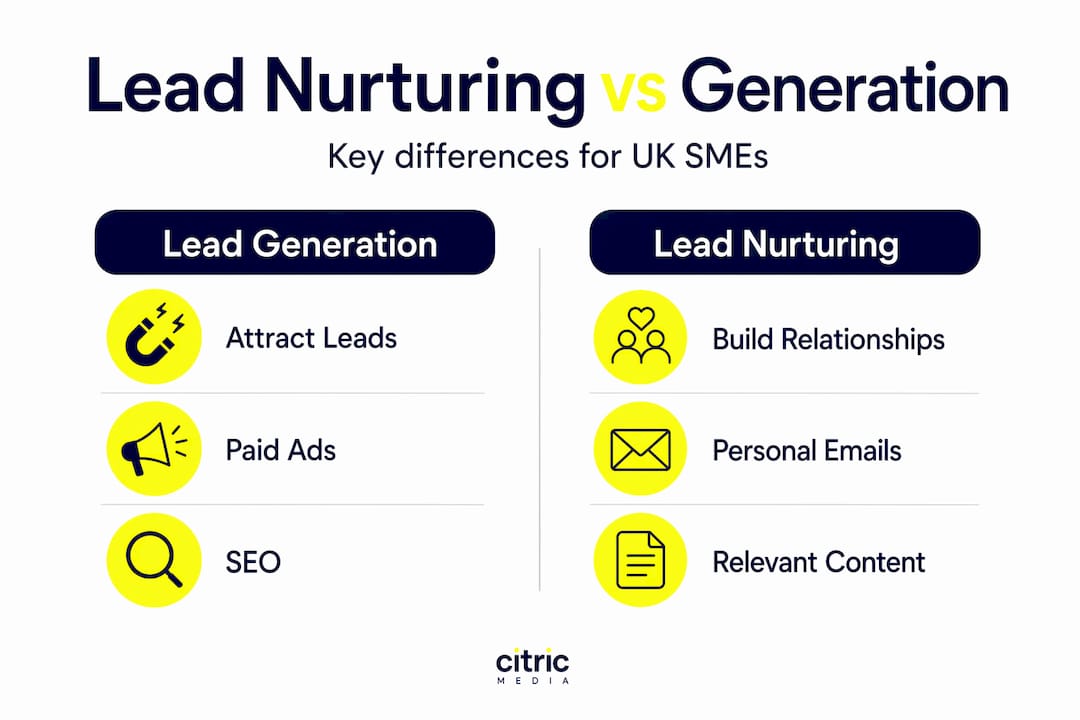
Here’s a direct comparison:
| Factor | Lead generation | Lead nurturing |
|---|---|---|
| Primary goal | Attract new contacts | Convert existing contacts |
| Main tactics | PPC, SEO, paid social, content | Email sequences, retargeting, CRM workflows |
| Timeframe | Immediate | Weeks to months |
| Audience | Cold prospects | Warm prospects |
| Success metric | Number of leads captured | Conversion rate and pipeline value |
| Content type | Ads, landing pages, lead magnets | Case studies, guides, personalised emails |
| Team ownership | Marketing | Marketing and sales jointly |
The key insight here is that most businesses over-invest in lead generation and under-invest in lead nurturing. Generating more leads into a broken nurturing process just multiplies the waste. Fix the nurture first, then scale the generation.
For UK SMEs using paid social advertising to attract leads, this distinction is especially important. You can spend aggressively on Facebook or LinkedIn campaigns and see strong lead volumes. But without a structured nurturing process behind them, the cost per acquisition climbs steadily and results plateau.
The two functions must work in tandem. Lead generation fills the top of your funnel. Lead nurturing is how you get value from everything in it.
Best practices for successful lead nurturing in UK SMEs
The mechanics of lead nurturing are one thing. Doing it well is another. Many SMEs set up basic email sequences and wonder why conversion rates remain flat. Usually, the problem is one of three things: wrong timing, wrong content, or wrong frequency.
Treat nurturing cadence as behaviour-driven rather than calendar-driven, adjusting frequency based on lead engagement to reduce fatigue and unsubscribes. This is one of the most important shifts you can make in how you think about lead nurturing techniques.
Here are the practices we’d encourage every UK SME to implement:
- Segment your leads by intent, not just by source. Someone who requested a demo has different needs from someone who downloaded a general guide. Treat them differently from day one.
- Lead with value before you lead with offers. The first three emails in any sequence should educate, inform, or solve a problem. Pitch too early and you lose the trust you haven’t yet built.
- Use multi-channel nurturing. Email is essential, but retargeting ads, LinkedIn messaging, and even SMS can reinforce your message across channels without being intrusive.
- Set re-engagement triggers for inactive leads. If a contact hasn’t opened an email in 60 days, a re-engagement sequence with a different subject line or a direct question can revive interest — or cleanly remove disengaged contacts from your list.
- Keep your CRM and automation platform properly synced. Opted-out contacts must be suppressed in both systems. A mismatch here is where compliance breaches happen.
Pro Tip: Before building a new nurturing sequence, map out the three most common objections your prospects raise before buying. Design a specific email in your sequence that addresses each one directly. This is more valuable than sending generic “just checking in” messages.
Investing properly in digital marketing for SMEs means building the infrastructure to nurture leads well, not just generate them quickly.
The human touch in lead nurturing: why automation isn’t enough
Here’s where I’d push back against a narrative that’s become a little too convenient in digital marketing circles. Automation is genuinely powerful. It scales what humans can’t. But it doesn’t replace what humans do best.
AI and automation optimise lead scoring and next-best actions but still require human involvement for relationship-building and closing sales. We’ve seen this play out repeatedly with UK SMEs. The businesses that generate the best conversion rates from their nurturing programmes aren’t the ones with the most sophisticated automation. They’re the ones where a sales person picks up the phone at exactly the right moment, armed with the context that automation provides.
Think about what automation can’t do. It can’t sense hesitation in a reply. It can’t read between the lines of a one-word response. It can’t build the kind of rapport that makes a prospect feel genuinely understood rather than processed.
The most effective lead nurturing process we’ve seen treats automation as infrastructure and human engagement as the finishing move. Automation keeps prospects warm, scores their readiness, and surfaces the right moment. Then a real person takes over.
For B2B marketing essentials for SMEs, this balance matters even more. B2B sales cycles are longer, relationships are more complex, and buying committees mean multiple stakeholders need different messages. Automation handles the volume. Humans close the deal.
Don’t let the appeal of “set it and forget it” lead you into building a nurturing programme that’s technically running but genuinely connecting with nobody. The goal isn’t to automate your way to a sale. It’s to use automation to make every human interaction more timely, informed, and effective.
How Citricmedia supports UK SMEs with effective lead nurturing
If reading this has made you realise your current setup is generating leads but not converting them, that’s actually the best place to start.
At Citricmedia, we’ve spent over 27 years helping UK SMEs build digital marketing programmes that generate enquiries and turn them into customers. We design tailored lead nurturing strategies that fit your sales cycle, your audience, and your compliance obligations. From email automation workflows to paid social campaigns that feed well-qualified leads into your funnel, we handle both the generation and nurturing side of the equation. We also ensure everything we build is UK GDPR and PECR compliant from day one, so you can scale with confidence. If you’re ready to invest in digital marketing that actually converts, we’d welcome the conversation.
Frequently asked questions
What is the difference between lead nurturing and lead generation?
Lead generation captures new prospects using methods like SEO and paid ads, while lead nurturing engages those existing leads over time with relevant content to convert them into customers. As Revenue.io notes, lead generation captures new leads and lead nurturing moves them toward a purchase.
How does automated lead nurturing benefit small businesses?
Automation helps small businesses engage many leads consistently with personalised content and lead scoring, saving time and improving conversion rates without requiring a large sales team. Automated nurturing software updates lead scores to help your sales team identify the best time to reach out.
What UK legal rules apply to email lead nurturing?
UK GDPR and PECR require clear opt-in consent for B2C marketing emails, an easy unsubscribe option in every message, and immediate processing of all opt-outs.
Why is a human touch still important in lead nurturing?
Automation improves efficiency and surfaces the right moment to engage, but human sales reps build trust and close deals by responding personally to prospect needs. AI and automation still require human involvement for relationship-building and closing sales.
How can UK SMEs avoid over-emailing leads?
Adjust contact frequency based on actual engagement behaviour rather than sending on a fixed schedule. Behaviour-driven nurturing cadences reduce unsubscribe rates and keep your list healthier over time.