General
Many UK small and medium-sized enterprises invest in SEO expecting their phone to ring the moment they reach page one. It rarely works quite that simply. The truth is that search engine optimisation touches every part of your digital presence, from the trust signals that convince a prospect to click, to the technical foundations that determine whether Google can even find your pages. This guide cuts through the noise, drawing on evidence-based insights and practical experience to show you precisely how SEO functions within a broader digital marketing strategy, and why understanding its nuanced role is the difference between growth and stagnation.
Table of Contents
- Why SEO remains the backbone of digital marketing
- How SEO drives visibility and measurable business growth
- Technical SEO: The unseen engine behind digital marketing success
- Integrating SEO with other digital marketing channels
- The uncomfortable truth about SEO: It’s not all about the rankings
- How to harness expert support for better SEO results
- Frequently asked questions
Key Takeaways
| Point | Details |
|---|---|
| SEO anchors visibility | SEO remains the foundation for online discoverability and business growth for UK SMEs. |
| Rankings aren’t enough | Strong SEO results require strategy beyond first-page rankings, focusing on user intent and conversion design. |
| Metrics need context | CTR and traffic benchmarks must be read within the context of changing SERP features to guide decisions. |
| Technical setup is vital | A solid technical SEO foundation underpins all other digital marketing activity and prevents missed opportunities. |
| Channel integration maximises ROI | Combining SEO with paid, content, and social campaigns amplifies impact and overall marketing results. |
Why SEO remains the backbone of digital marketing
Organic search is still how most people begin their buying journey. Before a prospect calls you, fills in a form, or visits your premises, they almost certainly searched for something on Google. That moment of discoverability, where your brand appears at the right time for the right query, is what investing in SEO for UK SMEs is fundamentally about.

SEO does something that most other channels cannot replicate: it builds compound value over time. A well-optimised page continues attracting qualified visitors months and even years after it was first published, long after the effort has been invested. Paid advertising stops the moment your budget runs out. Content and social posts fade into timelines. SEO, done properly, keeps working.
Beyond discoverability, SEO plays a quieter but equally important role in trust-building. Appearing consistently in organic results signals authority to your audience. Searchers inherently assign credibility to businesses that rank prominently because Google’s algorithm, however imperfect, filters out unreliable sources over time. That perception of trustworthiness is difficult to manufacture through any other channel.
Here is how SEO functions as a backbone across your wider digital marketing activity:
- Brand authority: Consistent organic visibility across relevant queries positions your business as a market leader in the eyes of potential customers.
- Lead generation support: Organic traffic feeds the top of your conversion funnel, particularly when targeting informational and research-phase queries.
- Content amplification: SEO-optimised content performs better on social and earns more inbound links, extending its reach without additional ad spend.
- Multichannel data: SEO analytics reveal the exact language your customers use, informing ad copy, email campaigns, and product development.
“Great SEO is not about gaming an algorithm. It is about making your business the most relevant, trustworthy, and accessible answer to your customer’s question.”
It is also worth understanding how click-through rates actually behave in modern search. CTR at position varies dramatically depending on which SERP features are present, including AI Overviews, local packs, featured snippets, and shopping results. Position one in a clean text result looks very different from position one surrounded by rich features that draw attention elsewhere. This is crucial context for UK SMEs measuring SEO performance.
Pro Tip: Do not benchmark your organic CTR against generic industry figures without first checking which SERP features appear for your target keywords. A local pack or AI Overview above your result changes everything.
Supporting digital marketing for SME growth requires treating SEO not as a separate discipline, but as the connective tissue binding your whole online presence together.
How SEO drives visibility and measurable business growth
Ranking well is a means to an end, not the end itself. The genuine measure of SEO success for a UK SME is whether organic visibility translates into enquiries, leads, and ultimately sales. Closing that gap between rankings and revenue requires a more careful, contextual reading of your data.
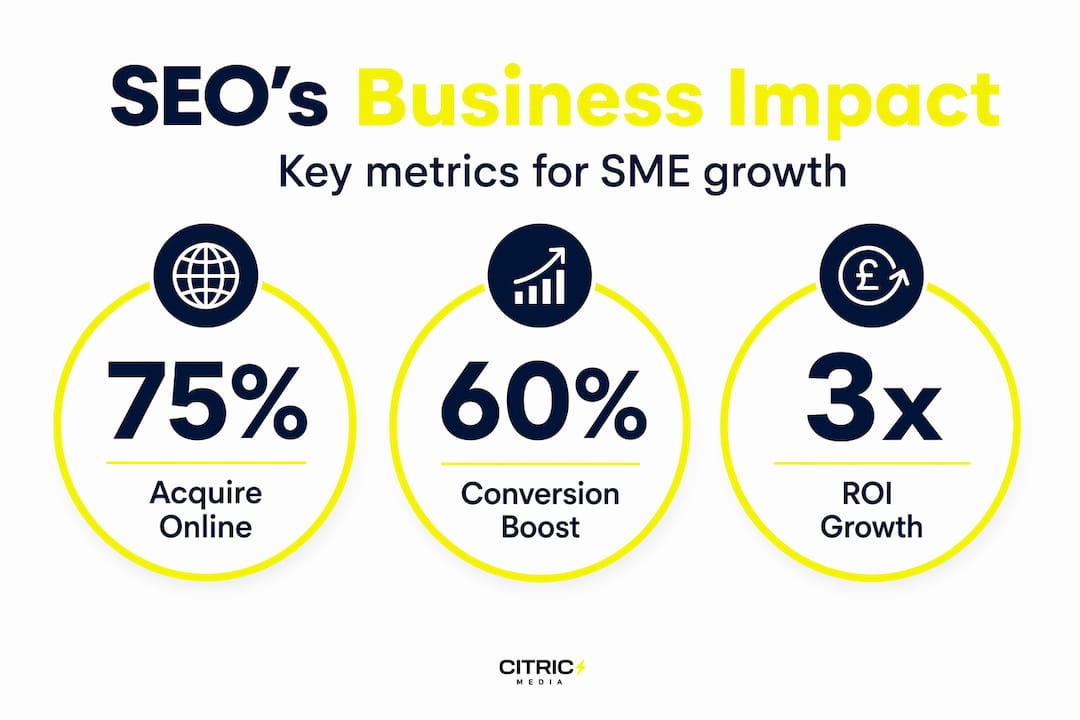
SEO benchmarks are starting points, not targets. The SERP feature mix, including AI Overviews, snippets, local packs, and image carousels, dramatically changes click behaviour. An SME in a niche B2B sector may see very different click-through rates from one in retail, even at identical ranking positions. Planning without that context leads to misaligned expectations and misdirected budget.
Here is a practical overview of how visibility metrics map to business outcomes:
| SEO metric | What it actually indicates | Business relevance for SMEs |
|---|---|---|
| Organic impressions | How often your pages appear in search | Brand reach and topic authority |
| Click-through rate (CTR) | Relevance of title and meta description | Quality of first impression |
| Organic sessions | Volume of search-driven visits | Traffic potential for conversion |
| Bounce rate | Page relevance to query intent | Alignment of content with user expectation |
| Goal completions | Enquiries, calls, form fills from organic | Direct revenue contribution |
| Keyword ranking position | SERP placement for target queries | Competitive visibility indicator |
The distinction between impressions and conversions is where many SME SEO campaigns fall apart. A business may attract several thousand monthly organic visits but generate almost no leads, because rankings do not guarantee proportional enquiries when pages fail to match buying intent. Ranking for “what is a conveyancing solicitor” when you want to attract people ready to instruct a solicitor is a clear mismatch between content and commercial intent.
Intent mapping is the practice of aligning each page on your site with the precise stage of the buying journey it serves. Informational pages educate and build trust. Commercial pages guide comparison. Transactional pages convert. When each type of page is crafted with its role in mind, the performance benefits of SEO become measurable, not merely theoretical.
Common SME pitfalls to avoid when measuring SEO impact:
- Relying on rankings alone: Position three for a head keyword is far less valuable than position one for a high-intent long-tail query with clear purchase signals.
- Ignoring landing page quality: High-traffic pages with unclear calls to action, slow load times, or thin content will consistently underperform regardless of ranking position.
- Misreading traffic benchmarks: A dip in traffic following a Google algorithm update is not always a loss; it may reflect reduced visibility for low-intent queries that were never going to convert.
- Neglecting local search nuances: UK SMEs serving specific regions need to optimise for local intent, Google Business Profile, and location-based SERP features.
Technical SEO: The unseen engine behind digital marketing success
If content is the voice of your SEO strategy, technical SEO is the infrastructure that lets that voice be heard. It works largely out of sight, buried in site architecture, server configurations, and code. Yet its impact on your digital marketing results is profound and often underestimated by UK SMEs.
Technical misconfigurations such as indexing failures, canonicalisation errors, or crawl budget wasted on low-value pages can quietly undo months of content and link-building effort. Google simply cannot rank pages it cannot find, understand, or trust. The most brilliantly written service page is worthless if it is blocked by a misconfigured robots.txt file or buried three clicks deep in site navigation.
Here is a comparison of common technical issues and their likely business impact:
| Technical issue | Severity | Likely impact on SME results |
|---|---|---|
| Pages blocked from indexing | Critical | Key pages invisible to search engines |
| Duplicate content / canonicalisation errors | High | Ranking dilution across similar pages |
| Slow page load speed | High | Higher bounce rate, lower conversions |
| Missing or broken structured data | Medium | Fewer rich results, lower CTR |
| Broken internal links | Medium | Poor crawlability, reduced link equity flow |
| Non-mobile-friendly design | High | Penalties in mobile-first indexing |
| Missing XML sitemap | Medium | Slower discovery of new or updated pages |
Prioritising technical fixes requires a systematic approach. We recommend working through technical improvements in this order:
- Crawlability and indexation first. Confirm Google can access and index your most important pages. Use Google Search Console to identify any crawl errors or coverage issues immediately.
- Page speed and Core Web Vitals second. Google’s ranking algorithm now incorporates real-world user experience signals. Slow pages cost you both rankings and conversions.
- Mobile usability third. With the majority of UK searches now occurring on mobile devices, a site that performs poorly on smaller screens is at a structural disadvantage.
- Structured data fourth. Implementing schema markup for your business type, products, or reviews improves eligibility for rich results and increases CTR without requiring a ranking improvement.
- Internal linking architecture fifth. A logical internal link structure distributes authority across your site and helps Google understand content hierarchy and topical relevance.
Pro Tip: Before investing heavily in new content creation, run a technical audit on your existing site. You may find that fixing crawl issues and improving page speed delivers faster ranking improvements than publishing new pages.
Understanding and acting on essential B2B digital marketing steps always includes a robust technical foundation. Without it, every other effort is built on unstable ground.
Integrating SEO with other digital marketing channels
SEO does not operate in a silo, and treating it that way is one of the most costly mistakes an SME can make. The real power of organic search comes from its synergy with paid media, content marketing, email, and social campaigns. When these channels share data, messaging, and goals, the results multiply.
Consider how SEO and paid search work together. Keyword data from your Google Ads campaigns reveals which search terms actually convert, not just which ones drive clicks. That intelligence feeds directly into your organic keyword strategy, allowing you to prioritise pages for terms with proven commercial value. Conversely, your organic rankings reduce the number of branded and non-branded terms you need to bid on aggressively, lowering your paid cost-per-click over time.
The relationship with content marketing is equally productive. SEO tells you what your audience is searching for. Content marketing creates the resources that satisfy those searches. When both work from the same keyword and intent data, every piece of content serves a clear role in your digital strategy rather than being published and forgotten.
Paid social advertising for SMEs also benefits from SEO insight. Your highest-performing organic pages, measured by engagement and conversion data, are natural candidates for promotion via paid social. You already know the content resonates with your audience. Amplifying it through social ads extends reach without the risk of promoting untested material.
Key integration points for UK SMEs to focus on:
- Shared keyword intelligence: Use organic keyword data to inform paid ad copy, social captions, and email subject lines for message consistency.
- Retargeting organic visitors: Use paid social and display advertising to re-engage users who discovered your business through organic search but did not convert.
- Content performance signals: Let organic engagement data guide which topics to expand into pillar content or video, creating deeper authority around your key subject areas.
- Consistent brand messaging: Organic and paid channels must carry identical value propositions and calls to action to build coherent brand recognition.
It is also important to understand that SEO is not a project with a finish line. SERP benchmarks change as AI Overviews, algorithm updates, and competitor activity shift the landscape continuously. Building SEO into a regular cycle of auditing, content review, and technical maintenance is what separates businesses that sustain growth from those that peak and plateau. Approach it as a step-by-step digital marketing strategy, where each component reinforces the others over time.
The uncomfortable truth about SEO: It’s not all about the rankings
We have worked with enough UK SMEs over the years to recognise a very familiar pattern. A business invests in SEO, achieves solid page one rankings, and then wonders why the phone is not ringing. The rankings are real. The traffic may even be growing. But the leads are not materialising in proportion to the visibility.
The uncomfortable truth is that a high ranking for the wrong query is worth nothing commercially. Worse, it can create a false sense of progress that delays the harder conversation about intent alignment and conversion-path design. Strong rankings without intent alignment rarely generate proportional leads, because rankings alone do not tell Google or your visitors that you are the right business for their specific need at this specific moment.
My blunt view: the SME leaders who get the best long-term results from SEO are those who stop asking “where are we ranking?” and start asking “are the right people finding us, and are we giving them a compelling reason to act?” Those are fundamentally different questions, and the second set is considerably harder to answer. But it is the only set worth spending your energy on.
What I see consistently is that businesses which invest in understanding user intent before they optimise, which map their content to the full buying journey rather than clustering around high-volume head terms, and which treat their landing pages as genuine sales assets rather than SEO targets, are the ones that convert organic visibility into real revenue. Rankings become a trailing indicator of success rather than the goal itself.
If you are currently evaluating your digital strategy, choosing the right digital agency is partly about finding a partner who asks these harder questions with you, not one who simply reports positions in a spreadsheet each month.
How to harness expert support for better SEO results
Understanding SEO’s role is one thing. Executing it consistently alongside your core business operations is another challenge entirely, and this is where the right expertise multiplies your return considerably.
At Citric Media, we work specifically with UK SMEs to build SEO strategies that are grounded in commercial intent, technically sound, and fully integrated with your wider digital marketing activity. Whether you are starting from scratch or looking to accelerate existing efforts, our SEO for UK business growth approach covers everything from technical audits and keyword strategy through to content planning and conversion optimisation. We also connect organic performance with the performance marketing advantages of paid channels, so your investment works harder across every touchpoint. With over 27 years of experience, we bring the kind of perspective that only comes from seeing what genuinely drives growth for businesses like yours.
Frequently asked questions
Is SEO still relevant for small businesses in 2026?
Yes, SEO remains critical for SMEs because it drives sustainable search visibility and supports multi-channel digital strategies. CTR and performance vary by SERP feature, but organic search still underpins how most UK buyers discover businesses.
How long does SEO take to show results for UK SMEs?
Most SMEs begin seeing noticeable growth within 4 to 12 months, depending on competition level and technical foundation. Technical misconfigurations such as indexing failures or canonicalisation errors can significantly delay results if they are not resolved early in the process.
What SEO mistakes should SMEs avoid most?
The most damaging mistakes are focusing only on rankings, neglecting technical setup, and failing to align pages with genuine user intent. Intent mapping and conversion-path design are as important as keyword targeting for generating real leads.
How does technical SEO impact digital marketing results?
Technical SEO ensures your content is discoverable, correctly indexed, and trusted by search engines, which enables every other area of your digital marketing to perform. Technical auditing and prioritisation are a core part of any effective SEO methodology, not an optional extra.