General
For many UK small and medium-sized enterprises, social media sits in an awkward position: too important to ignore, yet too difficult to justify without clear evidence of return. Budget is tight, time is short, and the pressure to prove that every pound of marketing spend is working hard makes hesitation understandable. This guide cuts through that uncertainty. We outline the measurable benefits of social media marketing specifically for UK SMEs, compare the major platforms on cost and performance, and give you a practical framework for integrating social with your wider digital strategy to generate quality leads and sustainable online visibility.
Table of Contents
- How social media marketing drives measurable results for SMEs
- The top social media marketing benefits for UK SMEs
- Which platforms perform best: Social media options compared
- Maximising impact: How to blend social media with other digital marketing
- Why most SMEs miss out on social media marketing’s true value
- Take your social media marketing to the next level
- Frequently asked questions
Key Takeaways
| Point | Details |
|---|---|
| Leads at lower costs | Social media ads enable SMEs to generate high-quality leads more affordably than traditional channels. |
| Tailored platform choice | Selecting the right social channel boosts results by targeting the ideal audience for your UK SME. |
| Integrated strategies win | Blending social media with SEO and other digital tactics compounds your marketing returns. |
| Track what matters | Focus on leads and conversions, not just vanity metrics, for consistent SME growth. |
How social media marketing drives measurable results for SMEs
The value question around social media is no longer theoretical. Paid social campaigns, when structured correctly, consistently deliver quantifiable outcomes: qualified leads, lower cost per acquisition, and compounding brand awareness that supports digital marketing growth across every channel you operate.
The numbers are grounding. Across industries, Facebook CPL benchmarks sit between $18 and $45, while Instagram typically ranges from $22 to $60 per lead. More encouragingly, well-targeted local campaigns can perform significantly below those averages. One documented example shows a campaign generating 258 leads at just £1.47 cost per lead, which illustrates that with sharp audience segmentation and strong creative, the economics can be exceptional even on modest budgets.
Here are the three core ways social media drives real results for UK SMEs:
Lead capture through targeted advertising. Paid social platforms allow you to define your audience with remarkable precision, filtering by location, job title, interests, income bracket, and behaviours. For a UK SME targeting customers within a 20-mile radius, this level of granularity can make the difference between a campaign that converts and one that simply burns budget.
Brand awareness and recall. Consistent social presence across Facebook, Instagram, or LinkedIn keeps your business visible between purchase decisions. A customer who encounters your brand repeatedly across their feed is far more likely to think of you when the need arises, even if they never clicked an ad the first time.
Audience insight and feedback loops. Social platforms generate rich behavioural data. Engagement patterns, comment sentiment, and click-through behaviour all tell you what your audience actually cares about, intelligence you can feed back into your ad creative, landing page copy, and content calendar.
Pro Tip: When writing a call to action for a social ad, be specific about the outcome. “Get a free quote in 60 seconds” consistently outperforms “Contact us today” because it sets a clear expectation and reduces the perceived effort of responding.
The top social media marketing benefits for UK SMEs
With measurable outcomes established, let’s break down the core advantages UK SMEs can secure through social channels.
The headline benefits are well-documented, but understanding the nuances behind each one is what separates businesses that thrive on social from those that spin their wheels:
- Increased online visibility across platforms where your target audience already spends significant time each day
- Enhanced brand credibility through consistent, professional content that signals reliability and expertise
- Two-way communication that builds genuine customer relationships and encourages repeat business
- Precise ad targeting that minimises wasted spend and maximises the relevance of every impression
- Measurable ROI when tracked against the right KPIs, giving you clear evidence of what is and is not working
However, two persistent pitfalls hold many UK SMEs back. First, organic reach is low, typically falling below 3 to 5% of your follower base on most platforms. This means relying solely on unpaid posts is rarely sufficient for meaningful reach or lead generation. Second, many SMEs struggle with KPI selection, measuring success by follower count or post likes rather than enquiries, qualified leads, or revenue. These vanity metrics feel encouraging but rarely translate into business growth.
The solution is a blended approach. Organic content builds trust, community, and long-term brand equity. Paid social, explored in detail in our paid social guide, amplifies your best-performing content and drives direct response at scale. When the two work in concert, the results compound in ways that neither achieves independently. You can also read about broader performance marketing benefits for SMEs to see how social fits into a wider growth picture.
“The focus must shift from quantity of leads to quality. SMEs that track meaningful KPIs and combine social with other digital channels consistently outperform those chasing follower growth alone.”
Pro Tip: Prioritise engagement rate and conversion rate over follower count. A highly engaged audience of 2,000 people is worth considerably more than a disengaged following of 20,000.
Which platforms perform best: Social media options compared
Once SMEs understand the benefits, the next challenge is choosing the right platforms for maximum ROI. Spreading effort thinly across every channel is one of the most common mistakes we see. Instead, the goal is to identify where your specific audience is most active and where your budget will generate the strongest return.
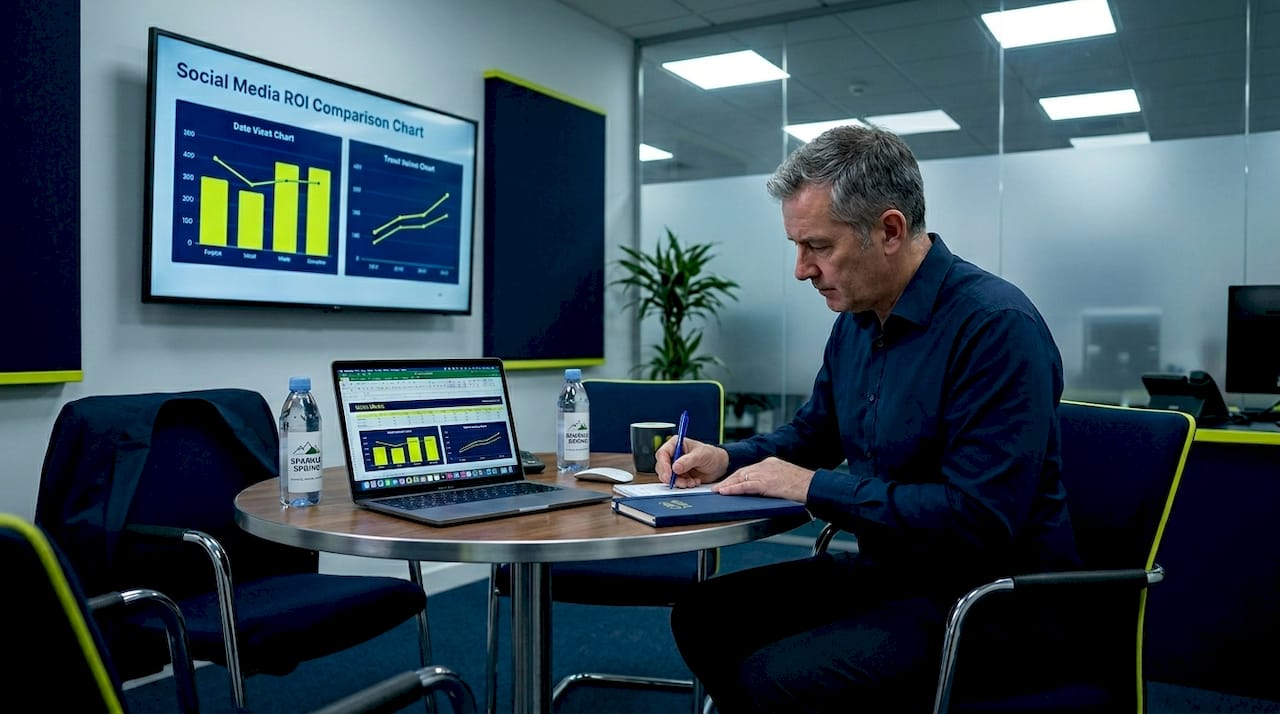
The table below compares the four major platforms on the metrics that matter most to UK SMEs:
| Platform | Primary audience | Typical CPL | ROAS benchmark | Best use case for SMEs |
|---|---|---|---|---|
| Broad, 25 to 65+ | $18 to $45 | 3.5:1 to 4.0:1 | Lead generation, local awareness, retargeting | |
| 18 to 45, visual | $22 to $60 | 3.0:1 to 3.8:1 | Product showcasing, brand building, e-commerce | |
| Professionals, B2B | $50 to $120 | 2.5:1 to 3.5:1 | B2B lead generation, professional services | |
| TikTok | 18 to 34, highly active | $15 to $40 | 4.1:1 best for young audiences | Brand awareness, viral content, younger demographics |
A few points from this data deserve unpacking. TikTok’s 4.1:1 ROAS is striking, and for SMEs targeting younger audiences it genuinely represents an underpriced opportunity right now. However, it demands consistent short-form video content, which requires investment in creative production. For most UK SMEs selling services or B2C products to a broad adult audience, Facebook remains the most reliable starting point because of its mature targeting infrastructure and high local user penetration.
LinkedIn carries a higher CPL, often $50 to $120, but for B2B focused SMEs, the lead quality frequently justifies that premium. A single converted B2B client can generate thousands of pounds in revenue, making even a £100 cost per lead highly profitable at typical conversion rates.
Key considerations when selecting platforms:
- Match platform demographics to your customer profile before spending a penny
- Test a small budget across two platforms before committing to one
- Use social ad targeting tips to build custom audiences from your existing customer data
- Align platform choice with your content production capability, not just audience size
- Consider how social activity can support your SEO strategies for SMEs through brand search uplift and referral traffic
Worryingly, 31% of SMEs currently track social ROI poorly or not at all. Platform selection is only one piece of the puzzle. Without consistent measurement frameworks, even the right platform choice will yield inconclusive results.
Maximising impact: How to blend social media with other digital marketing
To supercharge performance, SMEs must smartly weave social media into wider marketing programmes. Treating social as a standalone activity leaves significant value on the table.
Research consistently highlights that combining social with SEO produces compounding returns. Social content increases brand visibility, which drives branded search volume, which in turn strengthens your domain authority over time. It is a reinforcing cycle, not a one-off campaign.
The table below illustrates the typical performance uplift SMEs see when combining social media with SEO versus running either channel in isolation:
| Strategy | Lead volume index | Cost per lead | Brand search uplift | Audience reach |
|---|---|---|---|---|
| Social only | 1.0x baseline | High | Low | Paid audience |
| SEO only | 1.2x baseline | Medium | Medium | Organic search |
| Social + SEO combined | 2.1x baseline | Lower | High | Both channels |
The compounding effect is clear. Businesses that integrate both channels see more than double the lead volume compared to social alone, with lower average cost per lead.
Here are the practical steps to integrate social with your wider digital marketing:
Audit your current content. Identify your highest-performing social posts and use those topics to inform your SEO content plan. Audience engagement on social is a direct signal of what your market actually wants to read.
Build retargeting audiences from SEO traffic. Install your Facebook or LinkedIn pixel on your website and create retargeting campaigns targeting users who visited high-intent pages. This turns organic search visitors into paid social leads.
Coordinate campaign messaging. When running a Google Ads campaign, mirror the same offer and messaging in your paid social activity. Consistent cross-channel messaging significantly improves conversion rates.
Use social proof in SEO content. Reviews and comments generated through social can be woven into landing pages and blog posts to strengthen trust signals and on-page engagement. Explore our SEO visibility tips for practical implementation guidance.
Review and iterate monthly. Use the digital marketing steps framework to align social and SEO reporting in a single dashboard, so you can see the full customer journey rather than isolated channel performance.
Pro Tip: Export your social platform audience insights monthly and cross-reference them with your Google Analytics search data. Patterns in what topics your social audience engages with often predict which SEO content will rank and convert well.
Why most SMEs miss out on social media marketing’s true value
Here is my honest assessment after observing hundreds of UK SMEs invest in social media: the majority are measuring the wrong things, and that single habit is costing them the results they could be achieving.
Most articles celebrate easy wins, a surge in followers after a viral post, a spike in impressions, a campaign that generated hundreds of clicks. But followers do not pay invoices. Impressions do not fill order books. These metrics feel reassuring because they are easy to observe, but as the research confirms, SMEs struggle with KPI selection, and the failure to focus on quality leads over quantity is one of the most persistent problems in the industry.
The businesses we see achieving the strongest, most sustainable results share a common approach. They treat social media as one input in a broader measurement ecosystem, integrating data from their CRM, their email platform, and their SEO analytics to understand the full customer journey. They do not evaluate a Facebook campaign in isolation. They ask: did this campaign contribute to an increase in qualified enquiries, and did those enquiries convert to revenue?
The uncomfortable truth is that a modest, well-targeted campaign generating 30 quality leads per month will almost always outperform a viral post that attracts 3,000 followers who have no intention of buying. Sustainable business growth comes from the former. Ego comes from the latter.
Our recommendation is straightforward: audit your current social KPIs today. If your primary metrics are followers, likes, and reach, reset them. Replace them with cost per lead, lead-to-conversion rate, and revenue attributed to social. That simple reframe, explored in more depth in our digital marketing perspective, often unlocks clarity that transforms how SMEs invest in and evaluate their social activity.
Take your social media marketing to the next level
If this article has shifted how you think about social media marketing for your business, the natural next step is putting these ideas into practice with a strategy built specifically around your goals and audience.
At Citric Media, we have spent over 27 years helping UK SMEs generate high-quality leads and build online visibility through performance-driven digital marketing. Whether you need a hands-on paid social advertising strategy, expert guidance on SEO for SME growth, or a full SME digital marketing guide tailored to your sector, our team can help. We focus on measurable results, not vanity metrics, because we know that is what actually matters to growing businesses. Get in touch to discuss how we can build a social media strategy that delivers real commercial outcomes for your business.
Frequently asked questions
What is the most cost-effective social media platform for UK SMEs?
Facebook and Instagram typically deliver the lowest cost per lead for UK SMEs, with Facebook benchmarks at $18 to $45 and Instagram ranging from $22 to $60, though results depend heavily on targeting quality and ad creative.
How can SMEs measure the true ROI of their social media marketing?
Track quality leads, engagement rates, and attributed sales rather than followers or impressions, noting that 31% of SMEs currently struggle to measure social ROI effectively and miss opportunities to optimise accordingly.
What is the benefit of blending social media with SEO strategies?
Combining social with SEO helps UK SMEs reach broader audiences across both paid and organic channels, builds brand trust, and can more than double lead volume compared to running either channel in isolation.
Is organic social media still effective for small businesses?
Organic social reach has declined significantly and now typically falls below 3 to 5% of your follower base, meaning most SMEs need a paid component to achieve meaningful visibility and consistent lead generation.