Digital Marketing
UK SMEs collectively waste millions of pounds each year running digital marketing campaigns that simply do not perform. The culprit, more often than not, is not the channel itself but the absence of a regular, structured audit. Without one, budget drains into underperforming ads, neglected SEO signals, and broken conversion paths while competitors capture the leads you should be winning. This guide walks you through every stage of a practical digital marketing audit, from gathering the right tools to interpreting your results, so you can turn your digital channels from costly guesswork into reliable, measurable lead sources.
Table of Contents
- Why regular digital marketing audits matter for UK SMEs
- Gather your tools, data and benchmarks
- Step-by-step digital marketing audit process
- Troubleshooting: common audit mistakes and how to fix them
- Interpreting your audit results and mapping next actions
- Why most UK SMEs misinterpret digital audit insights (and how to change that)
- Get bespoke digital audit support for your UK SME
- Frequently asked questions
Key Takeaways
| Point | Details |
|---|---|
| Audit regularly | Quarterly or annual audits are essential for UK SMEs to stay competitive. |
| Use benchmarks | Compare your results against UK-specific metrics for mobile, speed, and engagement. |
| Prioritise quick wins | After each audit, tackle easy fixes and content gaps that deliver immediate results. |
| Document actions | Assign owners and deadlines to every audit insight for genuine improvement. |
| Leverage best tools | Rely on proven platforms like Google Analytics and Search Console for comprehensive insights. |
Why regular digital marketing audits matter for UK SMEs
Most UK SMEs invest in digital marketing with genuine intent, yet far too many never pause to evaluate whether those investments are actually working. An audit is not a one-off exercise reserved for moments of crisis. It is a structured, repeatable process that reveals where budget is being wasted, where opportunities are being missed, and where the gaps between your current performance and your competitors’ sit.
The numbers are striking. Businesses that audit regularly are 313% more likely to succeed, according to Smart Insights. That statistic alone should shift the way you think about auditing from optional admin to strategic necessity.
There are also some UK-specific realities worth noting. Over 60% of UK web traffic now comes from mobile devices. If your site has not been audited for mobile-first performance recently, a substantial portion of your potential customers are likely encountering slow pages, broken layouts, or clunky forms. Understanding the digital marketing benefits for SMEs goes hand in hand with knowing how to measure them regularly.
Audits are not a single-channel concern either. A thorough review spans:
- Technical site health (page speed, crawlability, broken links)
- SEO performance (keyword rankings, backlink profile, on-page signals)
- Paid search and display (Google Ads, Bing, budget allocation, Quality Scores)
- Social media (engagement rates, audience growth, paid social ROI)
- Content quality (relevance, gaps, conversion alignment)
- Local SEO (Google Business Profile, local citations, reviews)
Businesses that follow B2B digital marketing steps with regular audits built into their planning cycles consistently outperform those running on instinct alone.
| Audit frequency | Typical outcome for UK SMEs |
|---|---|
| No audit | Budget waste, missed opportunities, declining rankings |
| Annual audit | Baseline awareness, slow course corrections |
| Quarterly audit | Faster optimisation cycles, better lead quality |
| Monthly audit | Agile response to algorithm changes and market shifts |
Having established why audits are critical, we can now move on to what you need to get started.
Gather your tools, data and benchmarks
Before you audit a single channel, you need to assemble the right materials. Diving into data without the proper tools is like trying to diagnose a fault without a diagnostic reader. You will miss things that matter.
The essential toolkit for a UK SME digital marketing audit includes:
- Google Analytics 4 for traffic analysis, goal tracking, and audience behaviour
- Google Search Console for organic search performance, indexing errors, and Core Web Vitals
- SEMrush or Ahrefs for keyword rankings, backlink audits, and competitor gap analysis
- UTM tracking parameters to identify which campaigns and sources drive actual conversions
- Your social media platforms’ native analytics (Meta Business Suite, LinkedIn Analytics, and so on)
- Google PageSpeed Insights or GTmetrix for page load performance data
Once your tools are in place, you need clear benchmarks to measure against. Vague comparisons produce vague conclusions. According to 2026 UK audit guidance, page speed should sit below 2 to 4 seconds, social engagement benchmarks are Instagram above 1% and Facebook above 0.5%, and 40% of UK consumers expect a social media response within one hour. These are your reference points, not aspirations.
Reviewing SEO best practices alongside your audit toolkit helps ensure you are applying current ranking signals rather than outdated assumptions. The landscape shifts, and benchmarks shift with it.

| Tool | Primary purpose | Audit use |
|---|---|---|
| Google Analytics 4 | Traffic and conversion data | Channel attribution, goal tracking |
| Google Search Console | Organic search health | Indexing, Core Web Vitals, CTR |
| SEMrush / Ahrefs | SEO and competitor analysis | Keyword gaps, backlink profile |
| UTM parameters | Campaign tracking | Source, medium, and campaign attribution |
| PageSpeed Insights | Site performance | Load time, mobile performance |
| Native social analytics | Social performance | Engagement, reach, follower growth |
Pro Tip: Export your data at the start of each quarter and save it in a shared folder. Historical comparisons are where the real insight lives. You cannot spot a trend with a single snapshot.
Following actionable digital marketing steps means ensuring every tool serves a clearly defined audit objective rather than producing data for its own sake. With your tools and benchmarks identified, it is time to systematically audit each digital channel.
Step-by-step digital marketing audit process
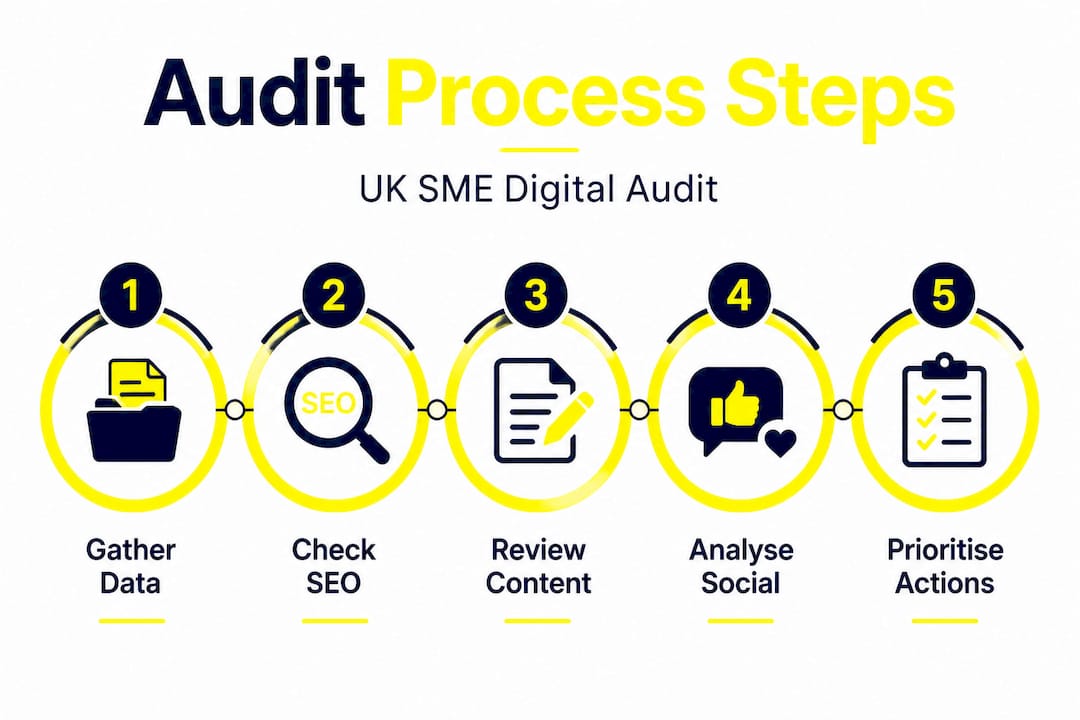
A well-structured audit follows a logical sequence, moving from strategic clarity through to granular channel analysis. Skipping steps or jumping straight to tactics is one of the most common mistakes we see. Here is the process we recommend, aligned with proven audit frameworks used by UK businesses:
- Define your objectives. What does success look like for this audit cycle? Lead volume, cost per lead, organic traffic growth? Fix the goal before you touch any data.
- Website technical and UX review. Check page speed, mobile responsiveness, broken links, crawl errors, and Core Web Vitals. A technically flawed site undermines every other channel.
- SEO assessment. Evaluate keyword rankings, on-page optimisation, meta data quality, internal linking structure, and backlink health. Identify pages losing ground.
- Content audit. Review existing content for relevance, accuracy, and conversion alignment. Thin pages hurt SEO and fail to reassure prospective buyers.
- Social media review. Analyse posting frequency, engagement rates against benchmarks, audience growth trajectory, and paid social performance.
- Local SEO. Audit your Google Business Profile for completeness, review consistency across local directories, and assess your recent review activity.
- PPC and paid search audit. Review campaign structure, keyword match types, Quality Scores, bid strategies, and conversion tracking. Our Google Ads auditing approach always examines wasted spend first.
- Analytics and tracking verification. Confirm that GA4 goals are firing correctly, UTM parameters are consistent, and conversion events are attributed accurately.
- Conversion path analysis. Walk through every key user journey from ad click or organic result to form submission or purchase. Identify friction points.
- Competitor analysis. Benchmark your performance against two or three key competitors. Where are they outranking you? What content are they producing? Where is their paid spend focused?
Pro Tip: After completing your audit, identify the three actions that will deliver the fastest, most measurable improvement. Quick wins build internal buy-in and fund the longer-term work. Use your marketing audit guide findings to sequence your next quarter’s priorities.
| Audit step | Key output | Common SME finding |
|---|---|---|
| Technical/UX | Crawl and speed report | Slow mobile load times |
| SEO | Ranking and gap report | Thin content on key pages |
| PPC | Waste and Quality Score report | Budget lost on broad match |
| Social | Engagement benchmark report | Inconsistent posting cadence |
| Conversion paths | Journey friction map | Drop-off at enquiry forms |
The step-by-step approach ensures you cover every critical channel, but understanding the results is equally important.
Troubleshooting: common audit mistakes and how to fix them
Even when UK SMEs commit to auditing, the process itself is often undermined by predictable errors. Knowing what to watch for saves time and prevents false conclusions.
Research into UK SME audit habits shows that most SMEs miss engagement tracking, fail to check mobile speed adequately, and ignore attribution setup entirely. Those three omissions alone can render an audit misleading rather than useful.
The most frequently encountered mistakes include:
- Auditing traffic without tracking conversions. High traffic with poor lead volume is a conversion problem, not a marketing problem. Without conversion tracking in place, you cannot diagnose it.
- Treating SEO in isolation. SEO findings need to be cross-referenced with content quality and technical health. A keyword ranking assessment is incomplete without those layers.
- Ignoring attribution. If your UTM parameters are inconsistently applied, you will misattribute leads and misfund channels. Fix attribution before drawing conclusions.
- Only running an annual audit. Markets move, algorithms update, and competitors shift strategy. Annual-only audits leave you reacting months too late.
- Focusing on vanity metrics. Follower counts and page views feel reassuring but rarely correlate with revenue. Track engagement, enquiries, and cost per lead instead.
“An audit that produces a spreadsheet of observations but no assigned action items is an exercise in data collection, not business improvement. The document is not the outcome; the change is.”
Reviewing digital audit tips from a performance perspective means looking critically at every metric through the lens of revenue impact. Understanding the performance marketing benefits of proper tracking sharpens that focus considerably.
Addressing common pitfalls now enables SMEs to turn audits into a repeatable growth mechanism.
Interpreting your audit results and mapping next actions
Completing the audit is only halfway. The real value is in what you do with the findings. We see many UK SMEs produce thorough audit reports that gather dust because the conclusions were never connected to a clear, owned action plan.
The prioritisation logic is straightforward. After competitor analysis, quick wins should be addressed first, followed by updating, deleting, or filling gaps in content. That principle applies across channels: fix what is broken and losing you leads today, then build what will compound growth over the next quarter.
Here is how to translate findings into action:
- Categorise every finding as a quick win (addressable within one week), a medium-term project (two to six weeks), or a strategic initiative (one to three months).
- Assign ownership. Every action item needs a named individual responsible for it. Shared responsibility is no responsibility.
- Set deadlines. Without a date attached, an action remains an aspiration. Even rough deadlines create accountability.
- Measure the change. Revisit each action point at your next audit cycle and confirm whether the fix moved the relevant metric.
- Build a review schedule. Quarterly audits are the standard for active UK SMEs. Fast-growing businesses, or those running significant paid budgets, may benefit from monthly reviews of core metrics.
Investing in paid social advertising or expanding SEO visibility without a clear baseline from your audit means you are scaling without direction. The audit gives you that foundation.
| Priority tier | Examples | Target completion |
|---|---|---|
| Quick wins | Fix broken links, update meta descriptions, correct UTM errors | Within 1 week |
| Medium-term | Improve page load times, revise thin content, restructure PPC campaigns | 2 to 6 weeks |
| Strategic | Build new content hubs, implement schema markup, develop link acquisition plan | 1 to 3 months |
Moving from execution to action, it is vital to build a habit of learning and adapting after each audit.
Why most UK SMEs misinterpret digital audit insights (and how to change that)
After working with UK SMEs across many sectors over more than two decades, one pattern stands out clearly: the problem is rarely the data. The data is usually there, often in abundance. The problem is the interpretation, and more specifically, the tendency to fixate on what is easiest to see rather than what is most commercially important.
SEO traffic and social follower counts are visible, easy to pull into a report, and feel like evidence of progress. Conversion paths, attribution accuracy, and cost per qualified lead are harder to untangle but infinitely more connected to actual revenue. Most SMEs overinvest their audit attention in the former and underinvest in the latter. That imbalance is where growth opportunities disappear.
There is also a structural problem we see repeatedly. Audits get conducted once, usually after a period of poor performance, and the findings produce a list of recommendations. That list gets partly actioned, then filed. Three months later, nobody can remember what the original findings were, who was supposed to do what, or whether the changes made any difference. The audit becomes a formality rather than a mechanism.
The fix is not a more detailed audit template. It is accountability infrastructure. Document every recommendation clearly, assign a single owner to each item, and attach a deadline. Review those items explicitly at the start of each planning cycle. If a recommendation has not been actioned, the team needs to either implement it or make a conscious decision to deprioritise it and explain why. That discipline, applied consistently, is what separates SMEs that improve from those that audit perpetually without changing much. Exploring structured digital marketing steps with that accountability layer built in is where the real performance gains emerge.
My blunt assessment is this: a basic audit actioned thoroughly will outperform an exhaustive audit left on a shelf. Execution beats analysis, every time.
Get bespoke digital audit support for your UK SME
A thorough digital marketing audit reveals where your budget is working and where it is quietly eroding. Knowing what to look for is one thing; having the experience to interpret findings and implement changes that actually move commercial metrics is another.
At Citric Media, we have spent over 27 years helping UK SMEs get more from their digital channels through precise, performance-driven strategies. Whether you need a detailed digital marketing guide to structure your own audit or a specialist team to conduct one on your behalf and implement the findings, we are equipped to support you. From Google Ads and SEO to paid social and site performance, our approach is built around measurable results and clear accountability. If your digital marketing spend deserves better scrutiny and stronger returns, let us help you get there.
Frequently asked questions
How often should UK SMEs perform a digital marketing audit?
Most fast-moving UK SMEs benefit from quarterly audits, with an annual audit being the absolute minimum for any business running active digital channels.
What are the top benchmarks UK SMEs should track?
Page speed below 2 to 4 seconds, mobile responsiveness, Instagram engagement above 1%, Facebook above 0.5%, and social response times under one hour are the core benchmarks for UK SMEs.
How can a digital audit boost lead generation for SMEs?
Regular audits identify technical issues, underperforming channels, and weak conversion paths, enabling SMEs to redirect budget toward what works. Businesses that audit are 313% more likely to achieve measurable success, according to Smart Insights.
What tools are essential for a digital marketing audit?
Google Analytics 4, Google Search Console, SEMrush or Ahrefs, UTM tracking parameters, and your native social media analytics platforms form the essential toolkit for any UK SME audit.
How do I know which audit actions to prioritise?
After competitor analysis, address quick wins first, then systematically update, delete, or fill content gaps before moving on to longer-term strategic improvements.