Digital Marketing
Digital marketing is one of those phrases that gets thrown around constantly, yet for many UK SME owners, it remains genuinely unclear what it actually means in practice. Is it a website? A few social media posts? Running some Google Ads and hoping for the best? The truth is that digital marketing for UK SMEs is far less about maintaining an online presence and far more about achieving real business outcomes: being found by the right people, converting those visitors into enquiries, and keeping customers engaged over time. This guide cuts through the noise and gives you a clear, practical framework.
Table of Contents
- What SME digital marketing really means
- Core pillars of SME digital marketing
- Measuring digital marketing that matters to SMEs
- How to avoid wasted effort: practical UK SME tips
- Why most SME digital marketing fails and what to do instead
- Take your SME digital marketing further with expert support
- Frequently asked questions
Key Takeaways
| Point | Details |
|---|---|
| Purpose-driven marketing | Successful SME digital marketing drives real results by focusing on reach, conversion, and customer retention. |
| Measure what matters | Prioritise business impact metrics—like leads, conversions, and ROI—not just online impressions. |
| Consistency over busyness | SMEs achieve more when they stick with a few high-impact channels and avoid random or sporadic campaigns. |
| Automate and refine | Use automation and tight feedback loops to ensure digital essentials are never missed and continually improve results. |
What SME digital marketing really means
Let’s be direct. Most small and medium-sized business owners we speak to have tried something digital at some point. Perhaps they boosted a Facebook post, set up a Google Business Profile, or had a website built a few years ago. Yet enquiries remain inconsistent, and it is difficult to know what, if anything, is actually working.
The problem is not effort. It is direction.
“For SMEs, the practical focus is less about ‘being online’ and more about outcomes such as getting found, converting visits into leads and enquiries, and then retaining customers through ongoing digital touchpoints.”
This distinction matters enormously. When you think of digital marketing purely as presence — ticking the box of having a website and a few social accounts — you end up with what practitioners call random activity. You spend money and time, but nothing compounds. There is no momentum, no clear signal about what is driving results, and no reliable pipeline of new leads.
Purposeful, outcome-focused digital marketing looks entirely different. Every activity is chosen because it serves a specific goal in the customer journey. SEO for SME growth, for example, is not just about ranking on Google for its own sake. It is about placing your business in front of people who are actively searching for what you offer, at the precise moment they are ready to enquire.
The core components of purposeful SME digital marketing include:
- Being found: Through search engine optimisation, Google Ads, local search, and content that answers your customers’ real questions.
- Building trust: Through a clear, fast, well-designed website that communicates your credibility and proof of results.
- Converting visitors: Through compelling calls to action, clear contact pathways, and landing pages that remove friction.
- Retaining and growing: Through email, remarketing, and ongoing digital touchpoints that keep your brand visible after the first sale.
Consistency is the underlying theme here. Sporadic effort produces sporadic results. The SMEs that generate a reliable flow of leads are those that treat digital marketing as a system, not a series of one-off experiments. If you are looking for a practical starting point, a step-by-step marketing plan can help you build that system methodically.
Pro Tip: Before spending a pound on any digital channel, write down one clear outcome you want from it. If you cannot state the expected result, the activity is probably random and should be paused.
Core pillars of SME digital marketing
With a clearer definition established, it is time to break digital marketing down into manageable building blocks. One of the most useful frameworks for UK SMEs is the Reach, Act, Convert, Engage model. As SME-focused strategy guidance describes it, the goal is helping the right people discover your business, trust it, and take the next step, with automation ensuring the essentials happen consistently rather than being left to chance.
Here is what each pillar means in practice:
Reach: Getting your business in front of people who do not yet know you exist. This includes paid search on Google and Bing, social media advertising, display campaigns, and organic search. The critical question here is: where do your ideal customers spend time, and what are they searching for?
Act: Encouraging visitors to engage with your content or take an initial step, such as reading a key page, signing up for a resource, or requesting a quote. This is where strong website copy, clear navigation, and well-structured landing pages do the heavy lifting.
Convert: Turning interested visitors into genuine leads or sales. Conversion depends on trust signals (reviews, case studies, accreditations), friction-free contact options, and clear messaging about what makes you the right choice.
Engage: Keeping existing customers and past enquirers warm through email sequences, remarketing campaigns, and regular valuable content. This pillar has an outsized impact on customer lifetime value and repeat business.
Understanding practical digital marketing steps within this framework also helps you avoid one of the most common SME traps: channel-hopping. This is where a business jumps from platform to platform, testing each one briefly before abandoning it when results are not immediate. The framework gives you a structure so that each channel decision is deliberate.
| Approach | Likely outcome |
|---|---|
| Random activity across many channels | Wasted budget, no clear attribution |
| One or two channels, no measurement | Some traffic, unclear return on investment |
| Focused channels with clear goals | Consistent leads, measurable cost per acquisition |
| Focused channels with automation and tracking | Scalable growth, predictable pipeline |
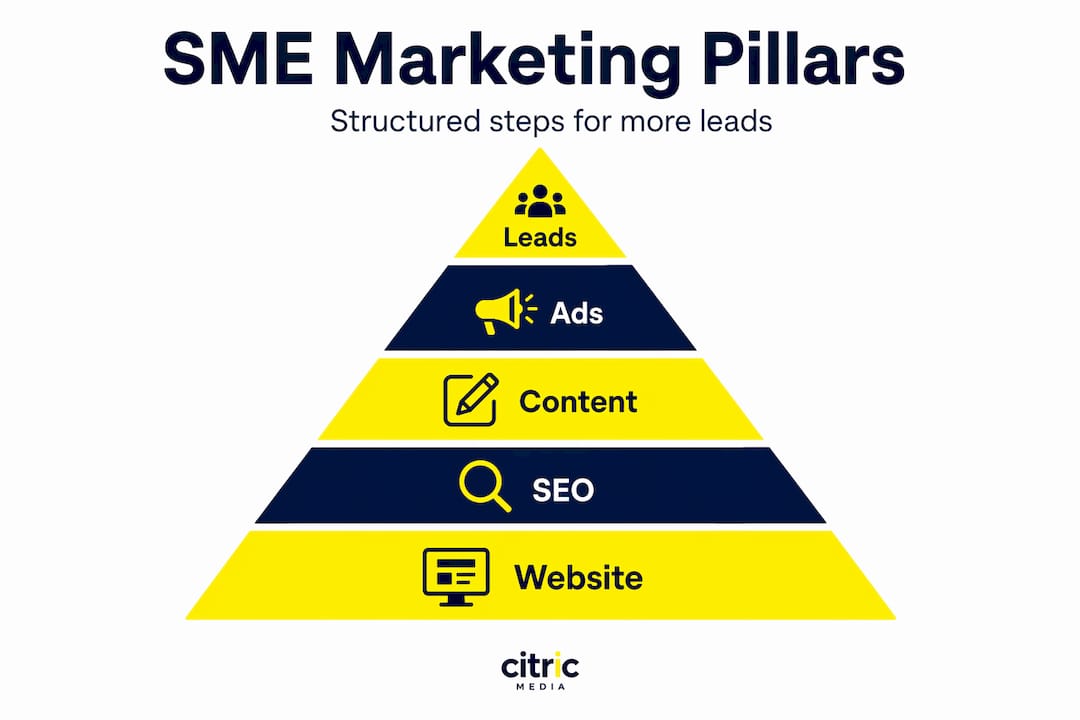
The performance marketing benefits of this structured approach are significant. Rather than guessing which channel might be working, you know precisely what each pound is producing and can reinvest accordingly.

Pro Tip: Pick one pillar where you are clearly weakest right now and fix it before expanding into new channels. Most SMEs skip straight to Reach when their biggest problem is actually Convert.
Measuring digital marketing that matters to SMEs
Having covered what to do, let us explore how SME owners can tell if digital marketing is truly delivering results. This is where many businesses stumble badly. They focus on the numbers that feel good rather than the numbers that actually indicate business growth.
UK SME digital marketing measurement should emphasise lead generation metrics such as cost per lead, conversion rates, and return on investment rather than vanity metrics like impressions or raw click numbers. An impression count in the thousands means very little if none of those viewers ever contacted you.
Here is a practical comparison of which metrics to monitor and which to treat with caution:
| Metric type | Examples | What it actually tells you |
|---|---|---|
| Vanity metric | Impressions, follower count, page views | Reach and visibility, but not business impact |
| Engagement metric | Time on site, pages per visit, email open rate | Interest level, but not conversion |
| Value metric | Cost per lead, conversion rate, customer acquisition cost | Direct business impact and return on investment |
| Revenue metric | Revenue per campaign, customer lifetime value | Ultimate commercial outcome |
The performance KPIs that matter most for most UK SMEs come down to three core figures:
- Cost per lead (CPL): How much does it cost to generate one genuine enquiry? This lets you compare channels and campaigns objectively.
- Lead to customer conversion rate: Of the enquiries you receive, how many become paying customers? This helps you identify whether the problem is marketing or sales.
- Return on advertising spend (ROAS) or overall ROI: Are you generating more in revenue than you are spending to acquire customers? The ROI of digital marketing should be measurable from day one, not something you wait months to assess.
For SMEs operating with limited budgets, even a simple spreadsheet tracking these three numbers weekly can reveal patterns that would otherwise remain invisible. You might discover that your Google Ads campaign is delivering leads at £18 each while your social media ads are costing £75 per lead for the same quality. That insight alone could reshape your budget allocation significantly.
Pro Tip: Set up Google Analytics 4 goal tracking and phone call tracking from the very beginning of any campaign. Retrofitting measurement after the fact means losing crucial early data that informs every subsequent decision.
How to avoid wasted effort: practical UK SME tips
Understanding what and how to measure is vital, but how do SMEs avoid wasting precious time and money? Here are the core practical lessons we have learned working with businesses across the UK over many years.
The single biggest drain on SME digital marketing budgets is random activity. Occasional ads, an unfinished website, emails sent sporadically when someone remembers. This kind of activity can consume meaningful budget without ever building the momentum needed to generate a reliable flow of leads. It is the digital equivalent of filling a leaking bucket.
SME strategy guidance is clear: you should not try every channel at once. Instead, choose a small set of high-intent acquisition channels and conversion paths, then measure tightly. High-intent channels are those where potential customers are actively looking for solutions, such as search advertising and local SEO, rather than passive discovery channels where you are interrupting someone’s browsing.
Here are the practical steps that consistently separate effective SME digital marketing from wasted effort:
- Choose your primary acquisition channel first. For most UK service businesses, this is Google search, either through SEO, paid ads, or both. For product-based businesses, shopping campaigns and paid social can be highly effective. Start with one and master it.
- Build your conversion layer before scaling reach. A poorly converting website will burn your ad budget. Before increasing traffic, ensure your landing pages are clear, your contact options are visible, and your messaging addresses the customer’s real concern.
- Use automation for consistency. Email follow-up sequences, automated reporting dashboards, and scheduled social content ensure your marketing keeps working even when you are focused on running the business.
- Review and refine monthly. Digital marketing is not set-and-forget. Monthly reviews of your core KPIs reveal where budgets should shift and which messages are resonating.
- Consider paid social tips as a complementary layer, not a replacement for search. Social advertising is powerful for building awareness and remarketing to warm audiences, but rarely beats high-intent search for direct lead generation.
- For B2B-focused SMEs, the approach differs somewhat. Following B2B SME steps that account for longer sales cycles and multiple decision-makers will produce far better results than applying a B2C playbook.
The businesses we see consistently generating strong returns are those that have systematised even a few of these steps. They know their cost per lead. They have an email sequence that nurtures prospects who did not convert immediately. They review their data monthly and make one or two focused adjustments. It is not glamorous, but it works.
Why most SME digital marketing fails and what to do instead
Here is the honest assessment, based on over two decades of working with UK businesses across a wide range of sectors.
Most SME digital marketing fails not because of bad tools, insufficient budget, or the wrong platforms. It fails because of inconsistency and the absence of a feedback loop. Businesses invest in a short burst of activity, see mixed results, lose confidence, and either stop altogether or leap to a different channel in search of a quicker win. The cycle repeats, and no real progress is made.
The businesses that succeed are rarely those with the largest budgets. They are the ones that commit to a small number of channels, measure what matters, and refine over time. They treat digital marketing as a business function, not a one-time project.
There is also a deeper issue that rarely gets discussed openly: many SME owners are sold on the idea that digital marketing should produce dramatic results quickly. In some cases, particularly with highly targeted Google Ads campaigns, results can come fast. But for SEO and content-driven approaches, the compounding effects take months to build. Expecting instant transformation sets up a pattern of abandonment before results materialise.
My pragmatic recommendation is this: follow proven SME frameworks that sequence your activity logically, from getting the basics right (a fast, clear website) through to scaling what works (amplifying channels that already produce leads). Resist the temptation to be everywhere. Being excellent in two channels consistently outperforms being mediocre in six.
The businesses winning at digital marketing right now are not necessarily doing more than their competitors. They are simply doing fewer things better, measuring them honestly, and staying the course long enough for momentum to build.
Take your SME digital marketing further with expert support
Knowing what to do is one thing. Implementing it consistently while running a business is another challenge entirely. For many UK SMEs, the gap between understanding digital marketing and actually generating a reliable flow of leads comes down to resource, expertise, and accountability.
At Citric Media, we have spent over 27 years helping UK SMEs move from inconsistent digital activity to structured, measurable campaigns that produce real business growth. Whether you are starting from scratch or looking to improve what you already have, our step-by-step SME marketing resources and expert team can help you build a system that actually works. Explore the benefits of digital marketing done properly and find out how we can support your growth journey.
Frequently asked questions
What is the difference between SME digital marketing and traditional marketing?
SME digital marketing uses online channels to reach and convert target customers directly, providing measurable data at every step, whilst traditional marketing relies on offline tactics such as print, broadcast, and direct mail that are harder to attribute to specific outcomes.
What are the most effective digital channels for UK SMEs?
The most effective channels are those that reach high-intent prospects, particularly search engine marketing and local SEO, because strategy guidance consistently stresses choosing a small set of proven channels over spreading budget thinly across every available platform.
How can UK SMEs measure digital marketing ROI effectively?
Track key metrics such as cost per lead, customer acquisition cost, and conversion rates rather than impressions or clicks alone, because meaningful measurement focuses on what genuinely drives business growth rather than what simply looks impressive in a report.
What are the biggest mistakes SMEs make with digital marketing?
The most damaging mistake is inconsistent, random activity without a clear plan, which consumes budget without building momentum, followed closely by trying too many channels simultaneously before any single one has been properly optimised and measured.