Digital Marketing
Many UK SMEs spend thousands on digital marketing every year without a clear picture of what’s actually working. Clicks, impressions, and page views fill up dashboards, but the question that matters most often goes unanswered: what did that spend actually generate? Performance marketing directly addresses this gap. Unlike traditional digital advertising, it ties every pound of budget to a measurable result. This guide explains what performance marketing is, how its core principles work, how it compares to brand marketing, and how your SME can start applying it to generate quality leads and real sales growth.
Table of Contents
- What is performance marketing?
- Core principles of performance marketing
- Performance marketing vs. brand marketing
- How UK SMEs can apply performance marketing
- Our perspective: The uncomfortable truth about performance marketing for SMEs
- Ready to make your SME marketing measurable?
- Frequently asked questions
Key Takeaways
| Point | Details |
|---|---|
| Pay for real results | Performance marketing only charges for measurable actions like clicks or sales, not just ad views. |
| Balance is crucial | Combining performance campaigns with brand-building drives the best long-term SME growth. |
| Track every pound | Careful tracking ensures you know which marketing spend creates actual business value. |
| Start with the right channels | Paid search and social campaigns are often the best entry points for SME performance marketing. |
| Avoid common pitfalls | Don’t over-optimise easy metrics—focus on real leads and sales while supporting your brand. |
What is performance marketing?
At its most straightforward, performance marketing is a results-oriented digital marketing approach where advertisers pay only for specific, measurable actions such as clicks, leads, sales, or installs, rather than for impressions or views. That distinction matters enormously for SMEs working with finite budgets. You are not paying for the chance that someone sees your advert. You are paying for what actually happens next.
To understand the terminology you will encounter, here are the four key metrics performance marketers work with:
- CPC (cost per click): The amount paid each time someone clicks your advert. Common in paid search and display campaigns.
- CPL (cost per lead): What you pay for each enquiry or sign-up your campaign generates. Highly relevant for service-based businesses.
- CPA (cost per acquisition): The cost of acquiring a paying customer. Often the ultimate measure of campaign efficiency.
- ROAS (return on ad spend): Revenue generated for every pound spent on advertising. A ROAS of 4 means £4 back for every £1 spent.
The channels most associated with performance marketing include paid search (Google Ads, Bing Ads), paid social media (Meta, LinkedIn), and affiliate networks where publishers earn a commission on results they drive. Each of these channels allows precise targeting, real-time tracking, and direct accountability in a way that offline or awareness-focused channels simply cannot match.
“Performance marketing means your spend is accountable. Every pound has a job, and you can see whether it did that job.”
This is where performance marketing diverges sharply from brand or awareness marketing. A brand campaign might earn you reach, recognition, and goodwill, but measuring its direct contribution to revenue is notoriously difficult. Performance marketing, by contrast, is built on attribution. You can see which campaign, which keyword, or which advert triggered the conversion. For SMEs exploring digital marketing steps for SMEs, this accountability is often the single most compelling reason to start here.
The ROI clarity that performance marketing offers does not mean it is without complexity. Bidding strategies, audience targeting, and landing page optimisation all play significant roles in whether your campaigns deliver profitable outcomes. However, the transparency of the model means you can identify what is working quickly and redirect budget accordingly. For resource-constrained SMEs, that agility is genuinely valuable.
Core principles of performance marketing
Not every digital channel qualifies as performance marketing, even if it carries a cost. Understanding the three defining principles helps you distinguish genuine performance activity from channels that simply carry a price tag.
The foundation is measurability. Every pound spent must be accountable for a tangible outcome. If you cannot track the action a user takes after engaging with your advert, then you cannot optimise for it. This requires proper analytics setup, conversion tracking, and clear goal definitions before any campaign launches.

The second principle is biddability. Performance channels are those where advertisers actively control how much they spend per action, audience segment, or placement. Google Ads, for instance, allows you to bid on specific search terms, set maximum CPCs, and adjust bids by device, time of day, or geography. This control is what separates performance marketing from buying a fixed media placement.
The third principle is optimisability, and it is arguably the most powerful. Because results are measured in real time, you can adjust budgets, ad copy, targeting, and landing pages continuously. Campaigns improve as data accumulates. An ad that underperforms gets paused; one that delivers results gets more budget. This iterative loop is what makes performance marketing so compelling for SMEs.
Here is what genuinely qualifies as performance activity:
- Paid search campaigns with conversion tracking
- Paid social with lead generation or purchase objectives
- Affiliate marketing with commission-on-conversion structures
- Programmatic display with CPA or CPL targets
What does not qualify? Sponsorships, podcast adverts, or even some forms of content marketing, where attribution is indirect and action-based payment is not possible. As measurable, biddable, and optimisable criteria confirm, not all activities fit the performance model, and forcing them into it creates misleading data.
Pro Tip: Do not abandon brand-building activity in favour of pure performance. A widely recommended approach is a 60/40 blend, with 60% of your marketing investment in brand and 40% in direct performance channels. This prevents your paid activity from cannibalising organic demand over time.
When choosing a digital agency to manage performance campaigns, confirm that they apply these three principles rigorously. Agencies that report on impressions and reach as primary KPIs for a performance brief are misaligned with your goals.
Performance marketing vs. brand marketing
SMEs often face a binary choice in their minds: run ads that drive leads now, or invest in brand awareness for the future. The reality is more nuanced, and the most sustainable growth comes from running both in proportion.
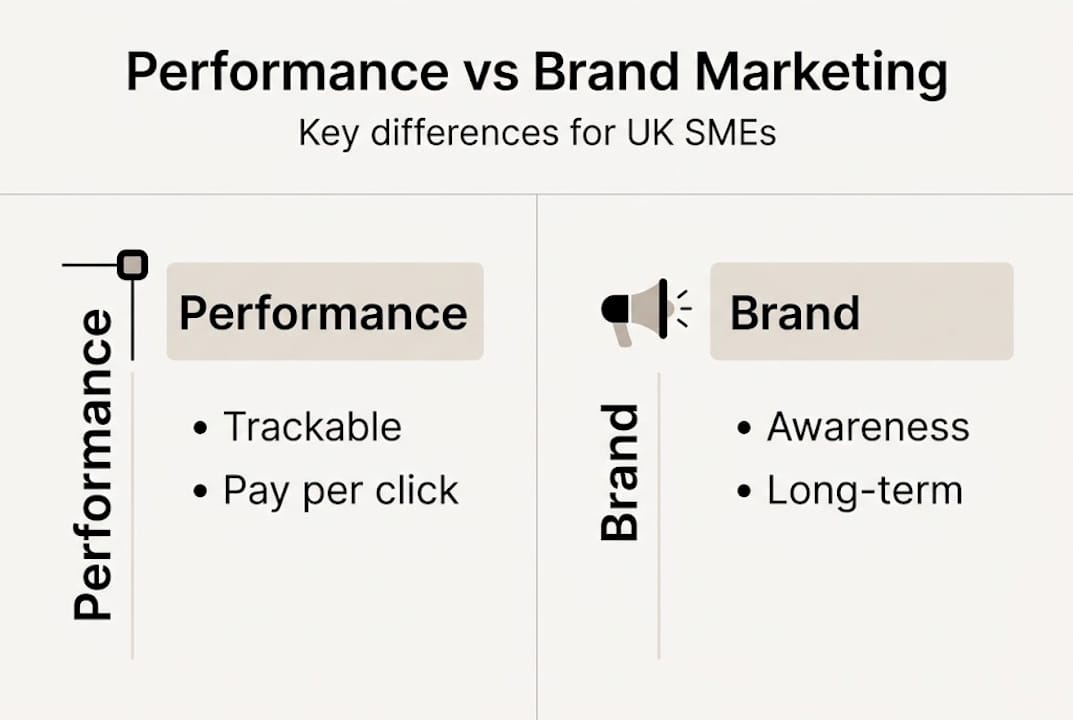
| Feature | Performance marketing | Brand marketing |
|---|---|---|
| Payment model | Pay per action (click, lead, sale) | Pay for exposure (impressions, reach) |
| Primary goal | Immediate, measurable conversions | Long-term awareness and trust |
| Measurement | Direct attribution via tracking | Indirect, survey-based or modelled |
| Time horizon | Short to medium term | Medium to long term |
| Risk | Higher short-term waste if poorly set up | Harder to justify ROI quickly |
| Ideal for | Lead generation, sales, sign-ups | New markets, repositioning, loyalty |
The table above makes it clear that neither approach is superior in isolation. A 60/40 brand to performance split is widely considered optimal, with brand investment sustaining demand and performance activity converting it. SMEs that chase only last-click or direct-response metrics often find their campaigns becoming progressively more expensive as the pool of already-interested buyers shrinks.
If you already run brand campaigns and want to integrate performance activity, here is a practical approach:
- Audit your current activity. Identify what you are spending and what measurable outcomes, if any, it produces.
- Define your performance goals. Be specific: number of leads per month, target CPL, or minimum ROAS.
- Choose one channel to start. Paid search is usually the most immediate for SMEs with existing demand.
- Set up tracking first. No conversions tracked means no performance data. This is non-negotiable.
- Run both in parallel. Let brand campaigns build awareness while performance campaigns convert intent.
For SMEs exploring digital marketing growth strategies, this integrated approach consistently outperforms a siloed, performance-only strategy over a twelve-month horizon.
How UK SMEs can apply performance marketing
Knowing the theory is one thing. Applying it with limited budget, limited time, and limited in-house expertise is another challenge entirely. Here is a grounded, step-by-step starting point for SMEs ready to commit to measurable results.
- Set clear, quantifiable goals. “More leads” is not a goal. “50 enquiries per month at a CPL of £25” is a goal you can optimise towards.
- Choose your primary channel. For most UK SMEs, Google Ads for SMEs offers the most direct route to capturing existing search demand.
- Install conversion tracking before you spend. Google Tag Manager, Google Ads conversion tracking, and GA4 goals should all be verified before the first pound is committed.
- Start with a focused budget. A tightly managed £500 to £1,000 per month on one channel will teach you far more than £3,000 spread thinly across five.
- Review and optimise weekly. Check search term reports, pause underperforming keywords, and test new ad copy regularly.
Here is a practical reference table for SME digital marketing benchmarks across common performance channels:
| Channel | Typical SME KPI | Average UK cost range | Outcome benchmark |
|---|---|---|---|
| Google Search Ads | CPL | £15 to £80 per lead | 2 to 5% conversion rate |
| Meta Ads (lead gen) | CPL | £8 to £40 per lead | 1 to 3% conversion rate |
| LinkedIn Ads | CPL | £40 to £120 per lead | 0.5 to 2% conversion rate |
| Affiliate marketing | CPA | 5 to 15% of sale value | Varies by sector |
Warning signs that your performance campaigns are going wrong include a high volume of low-quality leads, conversion tracking that does not fire consistently, and a budget being consumed by cheap traffic that never converts. These are not rare problems. They are the default outcome when campaigns are launched without proper foundations.
Pro Tip: Ensure conversion tracking is verified and tested before scaling any campaign budget. A single misconfigured tag can render weeks of performance data meaningless. Performance marketing effectiveness depends entirely on the quality of your measurability infrastructure.
For your monthly review rhythm, examine your cost per lead trend, lead quality feedback from your sales team, and campaign Quality Scores. Weekly, focus on search terms, negative keywords, and ad copy performance. That cadence, sustained over time, is what separates SMEs that scale successfully from those that give up after three months.
Our perspective: The uncomfortable truth about performance marketing for SMEs
We have worked in performance marketing for over 27 years, and there is something most advisers skip past when pitching this discipline to SMEs. Performance marketing is exceptionally good at harvesting existing demand. It is far less effective at creating it.
If ten people a month are searching for your service in your area, no amount of Google Ads optimisation will make that twenty. You can capture all ten efficiently, yes, but the ceiling is real. SMEs that over-rely on data-driven performance channels often hit a growth plateau and cannot diagnose why. The honest answer, uncomfortable as it is, is that they stopped investing in the top of the funnel.
Creative, brand-building, and content activity feels less accountable. It is harder to justify in a board meeting. But consistently, businesses that maintain the discipline of choosing a digital agency capable of managing both brand and performance together outgrow those that treat marketing as a direct-response machine. Start small with performance marketing, absolutely. But plan holistically from day one.
Ready to make your SME marketing measurable?
If your marketing spend feels opaque and results feel unpredictable, performance marketing offers a genuinely better framework for accountability. But the difference between running campaigns and running campaigns that scale profitably often comes down to setup, strategy, and sustained optimisation.
At Citric Media, we have spent over 27 years helping UK SMEs build performance marketing programmes that generate quality leads and measurable sales growth. From managing Google Ads services to designing full-funnel strategies across paid social, SEO, and beyond, we bring the expertise and transparency your business deserves. If you are ready to stop guessing and start measuring, explore Citric Media solutions and find out how we can put your budget to work with purpose.
Frequently asked questions
How is performance marketing different from traditional digital advertising?
Performance marketing charges you only when a measurable action is taken, such as a click or sale, while traditional advertising charges for exposure regardless of whether any action follows.
Which channels are best for SME performance marketing?
Paid search, paid social, and affiliate marketing are the most effective channels for SMEs seeking transparent, measurable growth from their digital spend.
What is a 60/40 brand to performance split?
Experts recommend investing 60% of your budget in brand-building and 40% in measurable performance campaigns. This 60/40 split supports long-term growth whilst maintaining short-term lead generation.
How can SMEs avoid common performance marketing mistakes?
Focus on lead quality over volume, verify your conversion tracking before spending, and avoid the trap of ignoring brand demand creation in favour of easily measured but shallow metrics.