Google
Most marketing managers at UK SMEs share the same quiet frustration: money goes into campaigns, leads trickle in, but the connection between the two remains murky. Which channel actually drove that enquiry? Which ad copy converted? Without clear answers, budgets get allocated by instinct rather than evidence. Leading marketers integrating modern analytics approaches report up to 70% higher revenue growth, and that gap between gut-feeling decisions and data-driven ones is precisely where your competitive advantage either grows or stalls. This guide walks you through exactly how to close that gap.
Table of Contents
- Why analytics is the backbone of digital marketing
- Key analytics methods and tools every SME should use
- Putting analytics to work: Real-world examples from UK SMEs
- Overcoming common analytics challenges for SMEs
- A smarter SME approach: What most marketing managers miss about analytics
- Ready to leverage analytics? Citricmedia’s solutions for UK SMEs
- Frequently asked questions
Key Takeaways
| Point | Details |
|---|---|
| Data-driven advantage | Analytics unlocks measurable results and more effective marketing for UK SMEs. |
| Essential frameworks | MMM, incrementality testing, and MTA are crucial for smarter campaign decisions. |
| Practical application | Real SME examples show analytics boosts lead generation when used correctly. |
| Avoid pitfalls | Focus on actionable metrics and blend AI technology with human insight for best results. |
Why analytics is the backbone of digital marketing
Analytics is not simply a reporting function you check at the end of the month. It is the mechanism that connects every campaign decision to real business outcomes, turning raw numbers into a coherent picture of what works, what wastes budget, and where your next lead is most likely to come from.
Traditional marketing planning at many SMEs still relies on a familiar pattern: a channel performs reasonably well, so you keep spending on it. A new platform looks promising, so you test it with a modest budget. These decisions are not entirely irrational, but they lack the precision that modern analytics provides. The difference between a gut-feeling approach and a data-driven one is not just philosophical. It is measurable in cost per lead, conversion rate, and ultimately revenue.
Consider the core benefits that analytics delivers when properly implemented:
- Targeting precision: Analytics reveals which audience segments, geographies, and device types produce the highest-quality leads, allowing you to concentrate spend where it matters.
- Improved ROI: When you know which campaigns convert, you stop funding the ones that do not. Budget efficiency improves almost automatically.
- Measurable lead generation: Rather than estimating campaign contribution, analytics assigns tangible metrics to each channel, making accountability straightforward.
- Campaign agility: Real-time data allows you to adjust bids, creative, and targeting mid-campaign rather than waiting until the budget is exhausted.
- Strategic alignment: Aligning KPIs with business outcomes ensures that marketing activity contributes directly to growth targets rather than vanity metrics.
“The most effective marketing organisations treat analytics as a strategic input, not an afterthought. They build measurement frameworks before campaigns launch, not after.”
For SMEs running Google Adwords analytics, the practical implication is significant. Knowing your cost per conversion by keyword, match type, and ad group allows you to scale what performs and pause what does not, with confidence rather than guesswork. And when you understand digital marketing ROI at a granular level, every pound of your budget becomes accountable.
The organisations that use analytics as a strategic backbone, rather than a retrospective scorecard, consistently outperform those that treat data as a post-campaign exercise.
Key analytics methods and tools every SME should use
Understanding why analytics matters, let’s look at the key methods and tools SME marketers should use to make sense of their data and drive better decisions.
Three frameworks stand out as particularly valuable for UK SMEs. Marketing Mix Modelling (MMM) examines how different marketing channels contribute to overall outcomes over time. It is especially useful for understanding the long-term effect of brand awareness campaigns alongside performance channels. Running MMM monthly, as 39% of leading marketers now do, enables faster course correction and better alignment with business goals.
Incrementality testing answers the question that MMM sometimes leaves open: would those customers have converted anyway, even without your campaign? By running controlled experiments where a test group sees your ads and a control group does not, you isolate the true incremental impact of your spend. It is a rigorous method that removes the noise of organic conversions from your paid attribution.
Multi-Touch Attribution (MTA) maps the customer journey across multiple touchpoints, assigning credit to each interaction that contributed to a conversion. Rather than giving all credit to the last click (a common default that distorts decision-making), MTA reveals how your SEO, paid social, and email activity work together.

Here is a quick comparison of these three frameworks:
| Framework | Best for | Data requirement | SME suitability |
|---|---|---|---|
| MMM | Long-term channel mix decisions | Aggregate, historical | Medium |
| Incrementality testing | Proving true campaign impact | Controlled experiments | Medium to high |
| MTA | Journey-level attribution | User-level tracking | High with right tools |
For practical tooling, explore analytics tools for marketers that scale without enterprise-level budgets. Google Analytics 4, Looker Studio, and HubSpot are strong starting points for most SMEs.
Also, do not overlook the basics. Understanding bounce rate analytics correctly, for instance, prevents the common error of misreading user engagement signals. Pair this with a structured digital marketing guide to ensure your measurement approach aligns with your broader strategy.
Pro Tip: Build dashboards that surface three to five business-critical metrics rather than displaying every data point available. Dashboards designed for action, not admiration, produce faster and better decisions.
Putting analytics to work: Real-world examples from UK SMEs
Now that we know which frameworks and tools matter, let’s see how SMEs use analytics in practice to convert data into tangible lead growth.
Applying advanced analytics delivers significantly improved lead generation and marketing performance for companies willing to move beyond surface-level reporting. Here is a typical process an SME might follow:
- Define the outcome first. Before collecting a single data point, identify the specific business outcome you are measuring, such as qualified enquiries, demo bookings, or form completions.
- Audit existing data sources. Map every touchpoint in your customer journey and confirm that tracking is correctly implemented across your website, CRM, and ad platforms.
- Establish a baseline. Calculate your current cost per lead, conversion rate by channel, and customer acquisition cost so you have a benchmark against which to measure improvement.
- Run structured tests. Apply incrementality testing or A/B experiments to isolate the effect of specific campaign changes, rather than changing multiple variables simultaneously.
- Interpret and act. Shift budget toward channels and creatives that demonstrate genuine incremental impact. Document decisions and their outcomes to build institutional knowledge.
- Review and iterate monthly. Analytics is not a one-time exercise. Treat measurement as an ongoing discipline, refining your model as more data accumulates.
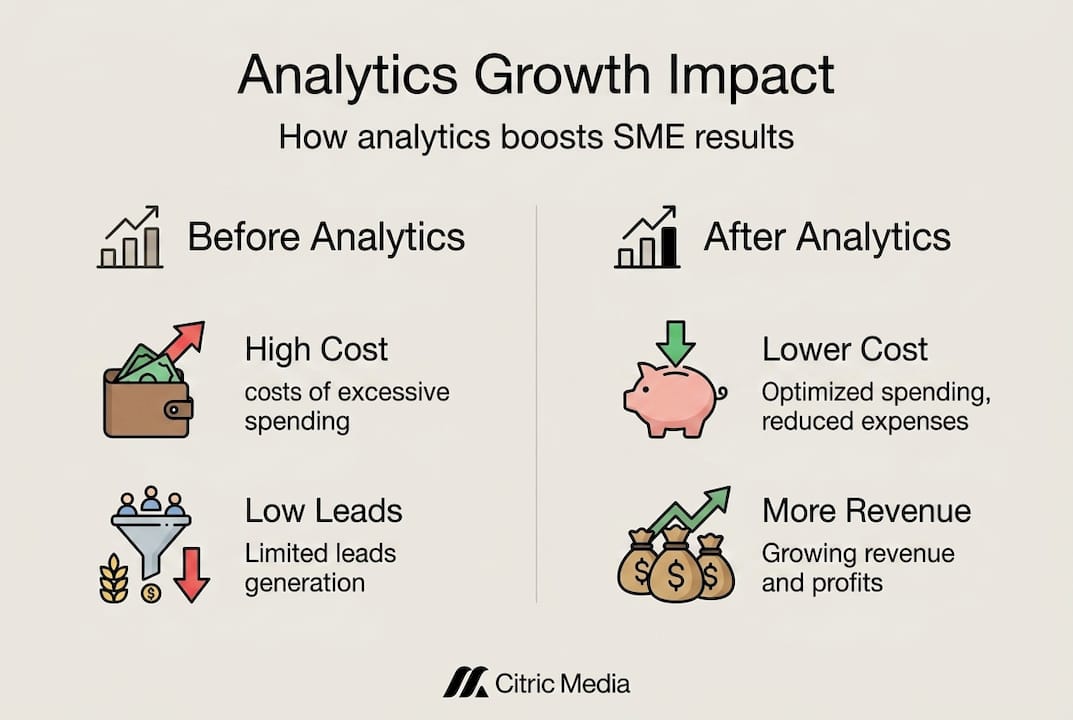
The results this process can produce are substantial. Below is an illustrative data table based on typical SME outcomes when moving from basic to advanced analytics:
| Metric | Before analytics | After analytics | Improvement |
|---|---|---|---|
| Cost per lead | £85 | £52 | 39% reduction |
| Lead volume (monthly) | 120 | 198 | 65% increase |
| Conversion rate | 2.1% | 3.4% | 62% increase |
| Budget wasted on low-ROI channels | 38% | 11% | 71% reduction |
The shift that AI analytics enables is also significant: it moves analysts from data preparation into genuine strategy, but human oversight remains essential to interpret findings correctly. Explore performance marketing benefits to understand how this connects to measurable commercial outcomes, and review our SME marketing guide for a structured approach to building on these foundations.
Overcoming common analytics challenges for SMEs
Having seen practical examples, it is crucial to address common challenges and how SMEs can avoid them before they undermine otherwise sound analytics strategies.
The three most frequent problems we see are data overload, unclear attribution, and the absence of actionable insights despite abundant reporting. Each is solvable, but each requires deliberate effort.
Data overload occurs when every available metric is tracked without a clear rationale. The result is a reporting environment that generates noise rather than clarity. The solution is to start with your desired business outcome and work backwards to identify only the metrics that directly indicate progress toward it.
Unclear attribution remains one of the thorniest issues in digital marketing. When a lead interacts with your brand through organic search, a remarketing ad, and a LinkedIn post before converting, which channel gets the credit? MTA frameworks help, but even they require clean data and consistent tracking to function reliably.
Vanity metrics are perhaps the most insidious challenge. Impressions, page views, and follower counts feel like progress because they are large numbers, but they rarely correlate with lead generation or revenue. Focusing on business outcome metrics, such as cost per qualified lead, pipeline contribution, and customer lifetime value, keeps your analytics effort commercially grounded.
Solutions to these challenges include:
- Establish a measurement framework before campaigns go live, not retrospectively.
- Implement consistent UTM tagging across every digital channel for clean attribution data.
- Review paid social analytics to understand how social platforms attribute conversions differently from search channels.
- Seek guidance from digital agency solutions when internal resource or expertise is limited.
Human oversight remains essential for creative judgement in AI-powered analytics environments. Algorithms identify patterns efficiently, but they cannot determine whether a brand message is appropriate, timely, or strategically sound. That judgement sits with you.
Pro Tip: Replace your weekly “how did we perform?” report with a “what should we do differently?” review. The shift in framing transforms analytics from a backward-looking audit into a forward-looking strategic tool.
A smarter SME approach: What most marketing managers miss about analytics
Here is the uncomfortable truth we observe repeatedly: most SMEs use analytics as a reporting tool rather than a strategic driver. They measure what happened last month. They rarely use data to shape what should happen next.
The organisations that genuinely pull ahead do something different. They connect their data directly with creative strategy, asking not just “which ad got the most clicks?” but “what does this behavioural data tell us about what our customers actually need?” That shift in question changes everything.
The future of effective SME marketing sits at the intersection of AI-driven analysis and human strategic insight. AI raises the floor by automating pattern recognition and anomaly detection. Human marketers raise the ceiling by applying context, creativity, and competitive understanding that no algorithm replicates. The SMEs that blend both will outperform those that lean exclusively on either.
Our actionable SME guides are built on precisely this philosophy: analytics as a strategic input, always in service of a clearly defined commercial goal.
Ready to leverage analytics? Citricmedia’s solutions for UK SMEs
With a clear understanding of analytics, here is how UK SMEs can take action with Citricmedia.
At Citricmedia, we have spent over 27 years helping UK SMEs turn digital marketing data into measurable lead growth. We do not believe in reporting for its own sake. Every insight we surface is tied to a specific commercial outcome, whether that is reducing your cost per lead, increasing qualified enquiries, or improving your return on ad spend.
Our team can help you build the right measurement framework, choose the right tools, and interpret your data with strategic clarity. From SEO visibility for SMEs to paid social and performance campaigns, our analytics-first approach runs through everything we do. Start with our digital marketing step-by-step resource, or get in touch to discuss how we can help your business grow.
Frequently asked questions
How can analytics improve digital marketing for SMEs?
Marketing analytics drives measurable growth by enabling evidence-based decisions, optimising targeting, and revealing which activities deliver the most leads rather than the most noise.
Which analytics methods are most effective for small businesses?
Marketing Mix Modelling, incrementality testing, and Multi-Touch Attribution are the most recommended frameworks. 39% of leading marketers run MMM monthly and drive business-aligned outcomes as a result.
Should SMEs adopt AI-powered analytics?
Yes, but with deliberate balance. AI shifts analysts to more strategic roles, yet human oversight remains essential to ensure creative and strategic decisions are contextually sound.
What is the first step for SMEs starting with analytics?
Begin by identifying your most important business outcome, then track only the KPIs that directly reflect progress toward it. Linking KPIs to business outcomes is where meaningful accountability begins.