Digital Marketing
Most SME owners assume digital marketing is a creative game. Get the visuals right, write punchy copy, post consistently, and the leads will follow. That assumption is expensive. The businesses quietly outperforming their competitors are not necessarily the most creative ones; they are the most data-literate. They know which campaigns convert, which audiences respond, and exactly where budget is being wasted. If your marketing decisions still rely on instinct over evidence, this guide will show you precisely what you are missing and how to fix it, starting today.
Table of Contents
- How data powers digital marketing strategies
- Data-driven lead generation: Turning insights into prospects
- From data to sales: Optimising conversion and campaigns
- Choosing and implementing the best data tools for UK SMEs
- Why the most successful SMEs obsess over data
- Boost your SME’s growth with data-driven digital marketing
- Frequently asked questions
Key Takeaways
| Point | Details |
|---|---|
| Data drives decisions | SMEs must use analytics and metrics to inform every digital marketing move. |
| Lead quality improves | Segmenting audiences with data leads to higher-quality prospects and more conversions. |
| Sales grow faster | Ongoing analysis and campaign optimisation turn insights into sustained sales increases. |
| Accessible tools available | Affordable platforms exist so UK SMEs can easily implement data-driven marketing. |
How data powers digital marketing strategies
Data is not a back-office concern. It is the foundation upon which every effective digital marketing decision should be built. When you understand what your audience does, where they come from, and what makes them act, you stop guessing and start growing.
Digital marketing analytics is central to refining campaigns, cutting waste, and scaling what works. Without it, you are essentially spending budget in the dark.
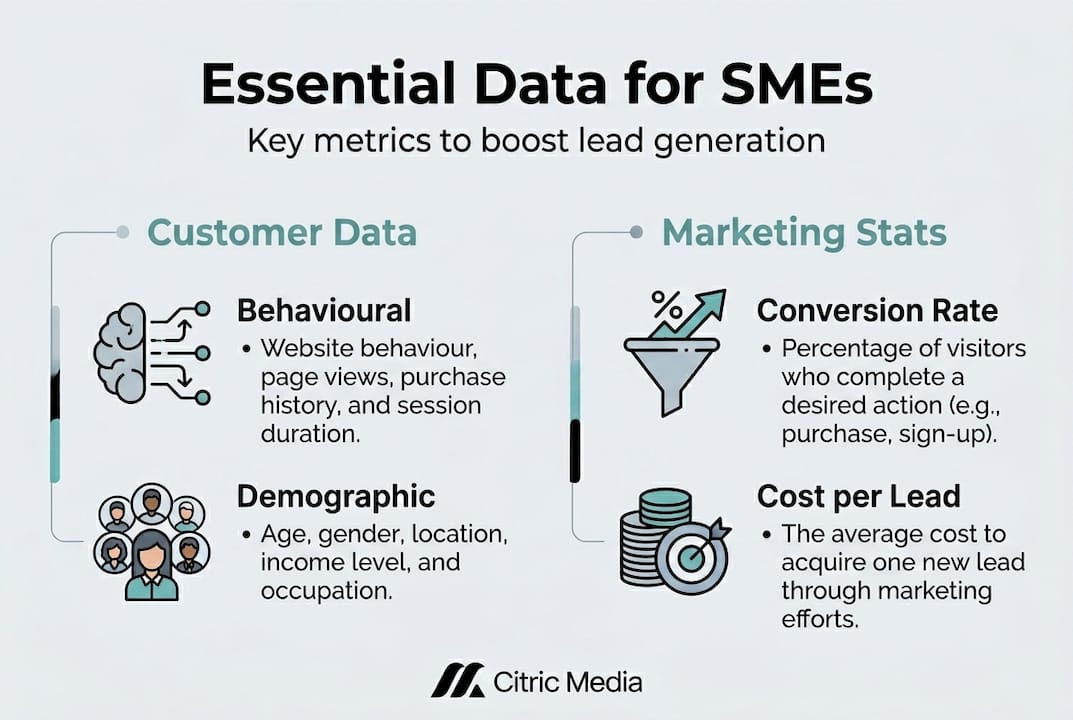
The types of data that genuinely move the needle for SMEs include:
- Behavioural data: How visitors navigate your site, which pages they visit, and where they drop off
- Demographic data: Age, location, device type, and interests of your audience
- Conversion data: Which traffic sources, ads, or landing pages are driving enquiries and sales
- Engagement data: Email open rates, social media interactions, and time on page
Together, these data types give you a complete picture of your customer journey. And misreading one metric can distort the whole view. For instance, many SMEs panic over a high bounce rate without understanding context. Reviewing bounce rate insights properly can reveal whether visitors are leaving because content is poor or because they found exactly what they needed instantly.
| Data type | What it tells you | Marketing use |
|---|---|---|
| Behavioural | User journey and friction points | Improve UX and landing pages |
| Demographic | Who your audience is | Refine targeting and messaging |
| Conversion | What drives action | Allocate budget to winning channels |
| Engagement | Content and ad resonance | Optimise creative and timing |
Pro Tip: Do not track everything at once. Start with three core metrics: lead conversion rate, cost per lead, and traffic source quality. Master those before expanding your data stack.
The practical implication is clear. SMEs that build analytics into their weekly routine are better positioned to reallocate budgets quickly, respond to seasonal shifts, and prevent underperforming campaigns from running unchecked.
Data-driven lead generation: Turning insights into prospects
Effective lead generation is not about casting the widest net. It is about knowing precisely which segment of your audience is most likely to convert, and then directing your energy and budget there.

Effective lead generation requires actionable insights from data, not assumptions built on broad demographics alone. The shift from traditional to data-driven lead generation is significant.
| Approach | Traditional | Data-driven |
|---|---|---|
| Targeting | Broad audience segments | Precise, behaviour-based segments |
| Messaging | Generic copy | Personalised based on intent signals |
| Measurement | Difficult to attribute | Clear source and conversion tracking |
| Cost efficiency | Often high cost per lead | Continuously optimised spend |
“The businesses generating the most qualified leads in 2026 are not the loudest ones. They are the ones who understand their data well enough to say exactly who they want to reach and why.”
Here is a practical four-step process for implementing data-driven lead generation in your SME:
- Capture: Install tracking on your website and forms to record where enquiries originate, which pages they visited, and what they searched before arriving
- Segment: Group your leads by behaviour, source, and intent. A visitor who read three product pages behaves very differently from one who bounced after the homepage
- Personalise: Use those segments to tailor your follow-up communications. Automated email sequences triggered by specific actions significantly improve nurture rates
- Refine: Review lead quality monthly. If a channel is sending traffic that never converts, cut it or test new messaging before spending further
Audience segmentation is where many SMEs leave significant value untapped. Sending the same message to everyone on your list is the digital equivalent of posting leaflets through every door on the street. Data lets you knock on the right doors with the right message at the right moment.
From data to sales: Optimising conversion and campaigns
Attracting leads is only half the work. Converting them into paying customers requires a disciplined approach to campaign monitoring and ongoing refinement. Continuous monitoring of digital campaigns leads to measurably higher sales over time, and the businesses that build this habit early tend to compound their results steadily.
The key metrics to track when moving leads through to sales include:
- Conversion rate by channel: Are Google Ads leads converting better than organic search? If so, why, and can you replicate that?
- Cost per acquisition (CPA): How much are you spending to generate each sale? Tracking this prevents budget drift
- Funnel drop-off points: Where are leads going cold? Identifying these stages lets you intervene with targeted content or follow-up sequences
- Return on ad spend (ROAS): For paid campaigns, this single figure tells you whether you are generating profit or burning budget
A/B testing is one of the most underused tactics among UK SMEs. Testing two versions of a landing page, email subject line, or ad creative costs nothing but time, yet the insights it produces can shift conversion rates materially. Even a 1% improvement in conversion rate across several hundred monthly leads compounds into significant additional revenue across a year.
Pro Tip: Before increasing ad spend, focus on improving your conversion rate first. A campaign converting at 5% will deliver twice the results of the same budget converting at 2.5%, without spending an extra penny.
Retargeting is another powerful lever. Visitors who browsed your site but did not enquire are warm prospects. Serving them relevant ads based on the specific pages they viewed, rather than generic brand messages, draws them back with context. Understanding bounce rate patterns alongside retargeting data helps you identify whether these visitors need more information or a stronger incentive to act.
Choosing and implementing the best data tools for UK SMEs
The good news is that you do not need an enterprise-level data infrastructure to make smart marketing decisions. Software platforms can simplify data management considerably for SMEs, and most of the most powerful tools are either free or very affordable at scale.
Here is a practical overview of tools suited to most UK SMEs:
- Google Analytics 4 (GA4): Free and powerful. Tracks user behaviour, traffic sources, goal completions, and ecommerce performance. The learning curve is worth it
- Google Search Console: Shows you how your site performs in organic search, which queries drive traffic, and any technical issues affecting visibility
- CRM platforms (e.g., HubSpot, Zoho): Centralise your lead and customer data, track communication history, and automate follow-up sequences
- Meta Business Suite: Provides audience insights, ad performance data, and engagement metrics for Facebook and Instagram campaigns
- Google Ads dashboard: Essential if you are running paid search. It shows impression share, quality scores, CPC trends, and conversion data in one place
| Tool | Cost | Primary use | Skill level needed |
|---|---|---|---|
| Google Analytics 4 | Free | Website behaviour tracking | Intermediate |
| Google Search Console | Free | Organic search performance | Beginner |
| HubSpot CRM | Free tier available | Lead management and nurture | Beginner |
| Meta Business Suite | Free | Social media insights and ads | Beginner |
| Google Ads | Pay per click | Paid search campaign data | Intermediate |
When choosing marketing platforms, start with the tools that align with where your leads currently come from. If paid search is your primary channel, prioritise Google Ads data. If social media drives most of your traffic, Meta Business Suite is your starting point.
Data security matters too. Ensure any platform you use is GDPR-compliant, particularly if you are storing customer contact data within a CRM. Investing in the right data tools early prevents costly migrations later and builds a reliable foundation for scaling your campaigns.
Why the most successful SMEs obsess over data
Here is an uncomfortable truth: most SMEs fail at data not because they lack tools, but because they lack commitment. They install Google Analytics, glance at a dashboard occasionally, and then make decisions based on gut feeling anyway.
The SMEs we see achieving consistent growth through SME growth strategies share one trait. They treat data as a management discipline, not a marketing afterthought. They review campaign performance weekly, they question every budget decision with evidence, and they accept when the data contradicts their instincts.
Creativity still matters. A compelling offer and well-crafted message will always outperform a bland one. But creativity without data is like driving with your eyes closed. You might stay on the road for a while, but you will not get far without a near miss. The businesses that split into winners and losers over the next few years will almost certainly be divided along this line: those who use data to guide every decision versus those who treat it as optional. Obsessing over your numbers is not tedious. It is the smartest competitive advantage available to any UK SME right now.
Boost your SME’s growth with data-driven digital marketing
Understanding data-driven marketing is one thing. Implementing it consistently while running a business is another challenge entirely. That is where Citric Media comes in.
With over 27 years of experience helping UK SMEs generate high-quality leads and sales through performance-driven campaigns, we know exactly which levers to pull and when. Whether you are looking to learn about SME marketing growth, follow a digital marketing step-by-step approach, or launch targeted Google Ads for SMEs, we can build and manage the data-driven strategy your business needs to grow sustainably and profitably. Get in touch with our team today to start the conversation.
Frequently asked questions
What types of data are most valuable for digital marketing?
Customer behaviour, demographics, and conversion rates are the core data types SME marketers should prioritise tracking from the outset.
Why is analytics important for SME marketing?
Analytics improve campaign performance by revealing which tactics are working, helping you refine campaigns and ensuring every pound of marketing budget is spent where it delivers results.
What are affordable tools for SMEs to use for data-driven marketing?
Software platforms simplify this considerably. Google Analytics, CRM platforms such as HubSpot, and social media dashboards are cost-effective options suitable for most UK SMEs at any growth stage.
How can data improve lead generation for SMEs?
Segmentation boosts lead quality by enabling SMEs to personalise communications, target high-intent audiences, and identify the prospects most likely to convert into paying customers.