Digital MarketingMarketingMarketing TechniqueOnline Marketing
Most business owners assume a marketing funnel is a tidy, straight-line process: stranger sees your ad, stranger buys your product, job done. That assumption is costing them leads. The marketing funnel definition has always described the journey a prospect takes from first discovering your brand to becoming a paying customer, but in 2026, that journey looks nothing like a straight line. Modern buyers research across devices, discover brands on social media, and sometimes complete an entire consideration cycle within a single platform session. This guide cuts through the theory to give you a clear, current picture.
Table of Contents
- Key takeaways
- What is a marketing funnel?
- How modern behaviour breaks the funnel
- Marketing funnel vs sales funnel
- Modern funnel alternatives: influence systems and ABM
- How to create a marketing funnel that works now
- My honest take on the funnel in 2026
- How Citricmedia can help you build a better funnel
- FAQ
Key takeaways
| Point | Details |
|---|---|
| Funnel stages still matter | Awareness, consideration, conversion, retention, and advocacy each require distinct tactics and metrics. |
| Modern journeys are non-linear | Buyers loop, skip stages, and compress multiple funnel phases into one platform session. |
| Marketing and sales funnels differ | Marketing funnels track audience behaviour in aggregate; sales funnels focus on individual opportunity readiness. |
| Influence systems are replacing stage logic | Scoring behavioural signals gives a more accurate picture of conversion probability than stage position alone. |
| Continuous optimisation wins | Weekly testing and content updates outperform traditional quarterly campaign cycles in fast-moving channels. |
What is a marketing funnel?
A marketing funnel is a model that maps the stages a potential customer moves through before making a purchase decision, and ideally beyond it into loyalty and advocacy. The term “funnel” reflects the reality that many people enter at the top with initial awareness, but fewer reach the bottom as a confirmed buyer. It is a useful mental model for organising your marketing activity, allocating budget, and measuring where you are losing people.
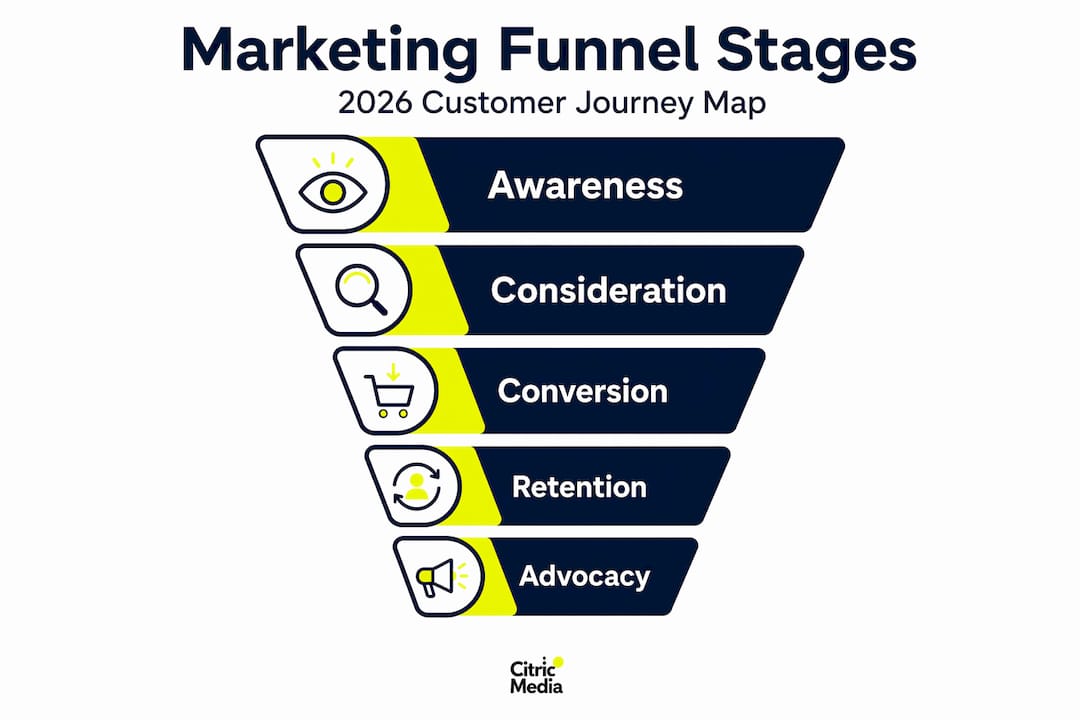
The classic stages of a marketing funnel are awareness, consideration, conversion, retention, and advocacy. Each stage demands a different type of content, channel, and message. Below is a practical comparison of what each one involves.
| Stage | Goal | Typical tactics | Key metric |
|---|---|---|---|
| Awareness | Reach new audiences | SEO, paid social, PR, video | Impressions, reach |
| Consideration | Build preference | Blog content, email, retargeting | Engagement, time on site |
| Conversion | Drive purchase or enquiry | Landing pages, offers, PPC | Conversion rate, CPA |
| Retention | Encourage repeat behaviour | Email, loyalty programmes, onboarding | Churn rate, LTV |
| Advocacy | Generate referrals and reviews | Referral schemes, community building | NPS, reviews |
The importance of marketing funnels lies in that structure. Without it, you end up spending money on the wrong message at the wrong moment. A prospect who has never heard of you needs a very different experience from one who visited your pricing page three times this week.
Pro Tip: Map your existing content to each funnel stage before creating anything new. Most businesses discover they have a glut of awareness content and almost nothing to support the consideration and conversion stages.
How modern behaviour breaks the funnel
Here is where the textbook version of the funnel starts to crack. McKinsey and Deloitte research confirms that buyers have circular, iterative journeys rather than linear ones. A prospect might see your Instagram reel, search your brand on TikTok, read a review on Reddit, visit your website, leave without converting, see a retargeting ad a week later, and then purchase. That is five touchpoints across four platforms before a single sale.

What makes this harder still is discovery compression. According to an EMARKETER March 2026 survey, 66.6% of US consumers now use social media as a search engine. That means awareness and consideration collapse into a single interaction. Someone finds your brand via a TikTok search, watches a product demonstration video, reads the comments for social proof, and taps the link to buy. Three funnel stages happen in under three minutes.
Several forces are reshaping how you need to think about funnel design:
- AI-powered search surfaces answers before a user even lands on a website, meaning your top-of-funnel content may be consumed without a single click to your domain.
- Multi-device behaviour means a prospect who researched on mobile and converted on desktop can look like two separate users in your analytics, warping your attribution data.
- Social search platforms like TikTok and Instagram are now primary discovery channels, particularly for younger demographics, requiring video-first content strategies that traditional funnel models never accounted for.
- Review and community platforms operate as unofficial mid-funnel environments that you cannot directly control but must actively monitor and participate in.
“Strict adherence to linear funnel stages risks misallocation of marketing budgets and misses modern buyer behaviours entirely.” — EMARKETER, 2026
The practical implication for your content strategy is significant. You cannot afford to create awareness content only at the top of the funnel. Every piece of content you publish should carry enough context that a first-time viewer could also convert, because increasingly, they are expected to.
Marketing funnel vs sales funnel
These two terms are used interchangeably in most articles, and that is a mistake that causes real operational problems. A marketing funnel is audience-centric, tracking behaviour in aggregate across large groups of prospects. A sales funnel is opportunity-centric, focused on individual buyers and their readiness to purchase.
The distinction matters because the two funnels feed each other. Your marketing team fills the top of the funnel with qualified leads. Your sales team then works those leads individually through to a closed deal. When those two processes are misaligned, you get pipeline leakage: leads that marketing considers ready, but sales considers cold, and vice versa.
The clearest place to see this misalignment is in the MQL versus SQL distinction. A Marketing Qualified Lead (MQL) has demonstrated enough engagement with your marketing content to be flagged as promising. A Sales Qualified Lead (SQL) has been assessed by a sales person and confirmed as a genuine buying opportunity.
| Lead type | Who qualifies it | Criteria example | Typical action |
|---|---|---|---|
| MQL | Marketing team | Downloaded two guides, visited pricing page | Entered nurture sequence |
| SQL | Sales team | Requested a demo, has budget confirmed | Direct sales outreach |
The gap between those two states is where revenue disappears. Only about 13% of B2B MQLs convert into sales conversations, which means 87% of the leads marketing produces never generate a sales dialogue. Better alignment on definitions, scoring criteria, and handoff processes closes that gap considerably.
Pro Tip: Hold a joint session with your marketing and sales teams to agree on exactly what constitutes an MQL and an SQL. Write it down, review it quarterly, and adjust the scoring as you gather conversion data.
Modern funnel alternatives: influence systems and ABM
Given the limitations of the traditional stage model, more sophisticated frameworks are emerging. Two worth understanding in depth are influence systems and account-based marketing (ABM) funnels.
An influence system replaces stage position with behavioural signal scoring. Rather than asking “which stage is this lead at?”, you ask “how strong is the evidence that this prospect is building conviction?” High-intent signals such as pricing page visits, repeat brand searches, or video watch completions above 75% carry more weight than low-intent signals like a single blog visit. The goal is to engineer conditions that cause conviction to accumulate, rather than nudging someone mechanically from one stage to the next.
Account-based marketing takes a different angle, particularly relevant for B2B businesses. Rather than targeting individuals, ABM engages multiple stakeholders across an entire buying committee. A software purchase at an enterprise level might involve a finance director, an IT lead, a department manager, and a procurement officer. Each needs different content and messaging, but they all need to reach conviction simultaneously.
To implement these frameworks practically, work through the following steps:
- Audit your current tracking. Identify which behavioural signals you are already capturing (page visits, email opens, content downloads) and which you are missing.
- Define conviction indicators. Agree with your sales team on which three to five actions most reliably predict a purchasing decision, and assign weighted scores to each.
- Solve your identity problem. Fragmented identity across devices causes misinformed optimisation. Implement a Customer Data Platform (CDP) or unified CRM that stitches sessions across devices and channels into a single customer profile.
- Segment by account for B2B. If you sell to organisations rather than individuals, shift your reporting from lead-level to account-level. Track how many stakeholders within a target account have engaged, and at what depth.
- Build content for committees. For each major buyer persona in a B2B committee, create assets that address their specific concerns, whether that is ROI for finance, security for IT, or usability for end users.
For B2B SME digital marketing, this committee-aware approach often doubles pipeline quality without increasing budget, because you stop losing deals to internal stakeholders who were never addressed.
How to create a marketing funnel that works now
Building an effective funnel in 2026 requires more than mapping content to stages. Here is what separates funnels that generate consistent leads from those that stagnate.
Start by defining your audience precisely. Not just demographics, but the specific anxieties, questions, and alternatives they are weighing at each point in their decision. Then map your sales team’s process alongside that, so your funnel reflects how buying actually happens in your market, not how a textbook says it should.
When choosing the right type of funnel for your business model, the approach differs considerably:
- For B2B services, a longer nurture-heavy funnel with case studies, webinars, and direct outreach at the SQL stage tends to perform best, reflecting longer decision cycles.
- For ecommerce, a tighter funnel with strong social proof, urgency mechanics, and abandoned cart recovery focuses on the conversion and retention stages.
- For online courses, a value ladder approach works well: a free resource leads to a low-cost entry product, which builds trust toward a mid or high-ticket offer. This is one area where coaching websites that convert consistently outperform generic landing pages.
- For local service businesses, the funnel is typically shorter but relies heavily on Google Business Profile, reviews, and local SEO to compress awareness and consideration into a single search.
On the content side, prioritise video at every stage where your audience uses social platforms to research. Young audiences are bypassing Google entirely for TikTok and Instagram searches, which means text-heavy blogs alone will not cover your awareness stage adequately.
Finally, move away from quarterly optimisation cycles. Weekly testing and content updates consistently outperform traditional campaign rhythms in fast-moving channels. Set a weekly review cadence for your paid channels and a fortnightly review for content performance. Small, fast adjustments compound into significant improvements.
Pro Tip: Do not optimise for the metric that is easiest to measure. Optimise for the metric that most closely predicts revenue. That is usually qualified pipeline value, not traffic or impressions.
My honest take on the funnel in 2026
In my experience working with business owners and marketers across a wide range of sectors, the most common mistake I see is not a lack of funnel knowledge. It is a reluctance to act on what the data is already showing.
I have sat with clients who have analytics dashboards full of evidence that their mid-funnel content is failing, but who keep pouring budget into awareness campaigns because the top-of-funnel numbers look reassuring. Traffic is vanity. What matters is whether conviction is building.
What I have learned is that the businesses who grow consistently are not the ones with the most sophisticated funnel diagrams. They are the ones who check what is actually happening with real buyers, adjust quickly, and resist the temptation to treat their funnel as a fixed structure. The funnel is a hypothesis. Every week of data either confirms or challenges it. Treat it that way.
The shift toward influence systems and behavioural scoring is not a trend to bookmark for later. It is the gap between businesses that generate predictable pipeline and those that wonder why their leads are not converting. My blunt view: if your marketing funnel still looks the same as it did three years ago, it is already costing you money.
— Martin
How Citricmedia can help you build a better funnel
If this article has surfaced gaps in your current approach, you are not alone. Most UK SMEs we speak with have the intent but not the infrastructure to run a properly segmented, data-driven funnel.
Citricmedia has over 27 years of experience helping UK businesses generate high-quality leads through performance marketing, paid social, SEO, and Google Ads. We do not just map funnels on whiteboards. We build and manage the campaigns, content, and tracking systems that make them work. Whether you need to understand your lead generation options or explore how performance marketing can tie your funnel stages to measurable outcomes, we are ready to help. Get in touch with our team and let us look at what your funnel is actually doing.
FAQ
What is a marketing funnel in simple terms?
A marketing funnel describes the journey a potential customer takes from first becoming aware of your brand to making a purchase and beyond. It helps marketers organise activity, allocate budget, and identify where prospects are dropping out.
What are the main stages of a marketing funnel?
The core stages are awareness, consideration, conversion, retention, and advocacy. Each stage requires different content, channels, and metrics to move prospects forward effectively.
What is the difference between a marketing funnel and a sales funnel?
A marketing funnel tracks audience behaviour in aggregate and focuses on demand generation, while a sales funnel tracks individual opportunities and readiness to buy. Both need to be aligned to prevent pipeline leakage.
How do modern buyer behaviours affect the marketing funnel?
Modern buyers rarely follow a linear path. Social media search, AI-powered discovery, and multi-device usage mean that multiple funnel stages can collapse into a single platform session, requiring content that can serve both awareness and conversion simultaneously.
What types of marketing funnels work best for B2B businesses?
Account-based marketing funnels that target multiple stakeholders within a buying committee tend to outperform single-lead models in B2B. Tracking engagement at account level rather than individual lead level gives a more accurate picture of deal readiness.