Digital Marketing
Many UK business owners invest consistently in digital marketing and still find themselves stuck. The traffic trickles in, leads are inconsistent, and the cost per acquisition creeps upward with every campaign. The problem is rarely effort. It is architecture. Following the right scalable digital marketing steps means building systems that produce exponentially more output without requiring proportional increases in budget or headcount. True scalability means growth in output grows exponentially while resource input grows logarithmically. This guide gives you a clear, practical path to get there.
Table of Contents
- Key takeaways
- Before you scale: getting the foundations right
- The scalable digital marketing steps that drive real results
- Common pitfalls when scaling your marketing
- Verifying results and optimising for sustained growth
- My honest take on what actually drives scale
- How Citricmedia helps UK businesses scale their marketing
- FAQ
Key takeaways
| Point | Details |
|---|---|
| Define unit economics first | Know your customer acquisition cost and lifetime value before scaling any channel. |
| Build reusable content systems | A pillar and cluster content model generates leads at significantly lower cost than outbound methods. |
| Automate with clear criteria | Marketing automation only works when you have documented rules, not when you set it and forget it. |
| Validate before you scale | Use A/B testing with statistical significance before committing larger budgets to any tactic. |
| Measure leading and lagging indicators | Dashboards should show both early signals and revenue outcomes to guide quarterly budget decisions. |
Before you scale: getting the foundations right
Most marketing fails to scale because it is treated as a series of isolated projects rather than a system. Before you touch budgets or channels, you need to establish what scalable marketing actually means for your business. It is not simply doing more of what you are already doing. It is creating repeatable, documented processes that grow output without a proportional rise in cost or effort.
Start with your numbers. You cannot make intelligent scaling decisions without knowing your customer acquisition cost (CAC), your customer lifetime value (LTV), and your target return on ad spend. These unit economics are the guardrails that tell you whether a channel deserves more investment or should be wound down. Many marketing managers skip this step and end up chasing vanity metrics like impressions or follower counts that bear no relationship to revenue.
Next, get serious about audience segmentation. Vague targeting is expensive targeting. Build clear customer profiles that go beyond demographics and include purchase intent signals, pain points, and the specific problems your product or service resolves. The more precisely you define who you are speaking to, the more efficiently your content and paid campaigns will perform at scale.
Before you build out any campaigns, take stock of what you already have:
- Existing content assets and their performance data
- Your current CRM and whether it integrates with your marketing platform
- Email sequences and lead nurturing workflows already in place
- Tracking and analytics set-up, including conversion events in Google Analytics and your ad platforms
- A marketing automation tool capable of handling segmented journeys
Pro Tip: If your CRM and ad platforms are not sharing data with each other, you are flying blind. Set up proper integrations before you scale a single campaign, or you will have no reliable attribution to make decisions from.
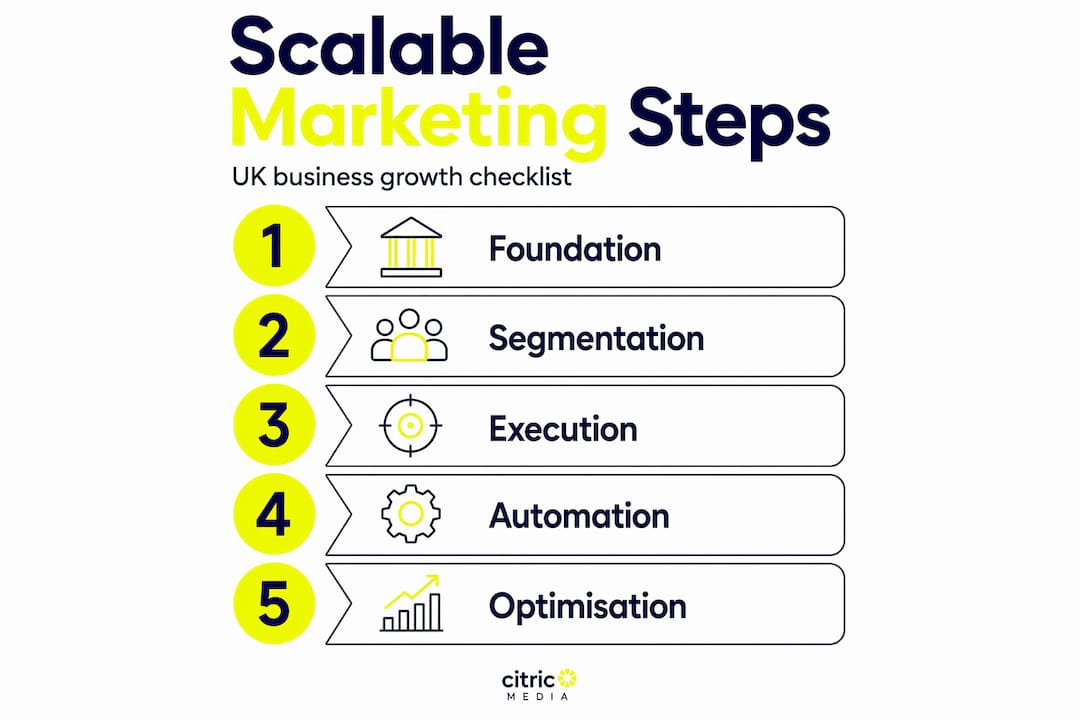
A structured campaign framework covering objective alignment, audience segmentation, asset inventory, testing protocols, and scaling rules removes the ambiguity that kills most growth efforts before they start.
The scalable digital marketing steps that drive real results
With your foundations in place, you can move to execution. These are the practical steps to scale marketing output without scaling costs at the same rate.
Build a content engine, not a content calendar. Content marketing generates 3x more leads than traditional outbound at 62% lower cost. The key is a pillar and cluster model: one authoritative piece on a broad topic, supported by multiple focused pieces that link back to it. This structure builds topical authority and ranks across a wide range of search queries with each piece of content reinforcing the others.
Implement marketing automation for lead nurturing. Manual follow-up does not scale. Map out your lead journey from first contact to conversion and build automated email sequences that respond to behaviour, not just time delays. Use a marketing automation checklist to verify every trigger, condition, and exit point before you go live.
Establish a testing and learning framework. Every campaign should have a clear hypothesis, a defined sample size, and a minimum runtime before you declare a winner. Scaling a tactic that has not reached statistical significance is one of the most common and costly mistakes in paid media. Set your threshold before you start, not after you see early results.
Use data-driven attribution to validate performance. Last-click attribution misrepresents the contribution of upper-funnel channels. Move to a multi-touch model and layer incrementality testing on top. This means running geo holdout tests or split audiences to understand whether your campaigns are genuinely driving new revenue or simply taking credit for purchases that would have happened anyway.
Scale paid media with modular creatives and automated bidding. Do not create one ad and spend heavily on it. Build a modular creative system: multiple headlines, images, and calls to action that platforms can mix and test algorithmically. Combine this with smart bidding strategies tied to your actual conversion events, not proxy metrics.
Deploy AI for real-time optimisation. AI-driven marketing enables continuous analysis of customer behaviour and predictive adjustments to targeting and budget in real time. Platforms including Google Ads and Meta already use machine learning at the bidding layer. The businesses winning in 2026 are those feeding these systems clean, first-party data from well-integrated CRMs. Companies that excel at personalisation using centralised first-party data generate 40% more revenue than the average.
Pro Tip: Use an AI content marketing platform to repurpose cornerstone content into social posts, email snippets, and short-form video scripts. One well-researched article can fuel a month of multi-channel output without your team writing from scratch every time.
| Channel | Scalability | Best use case |
|---|---|---|
| SEO and content | High | Long-term organic lead generation |
| Paid search (PPC) | Medium to high | Intent-driven demand capture |
| Paid social | Medium | Audience building and retargeting |
| Email automation | Very high | Lead nurturing and retention |
| AI-driven personalisation | High | Revenue uplift from existing traffic |

Common pitfalls when scaling your marketing
Scaling creates pressure. That pressure tends to expose weaknesses in process, data, and team alignment that were invisible at smaller volumes. Knowing where things break helps you avoid the most expensive mistakes.
- Over-segmentation. Splitting audiences into too many micro-segments produces groups too small for meaningful testing. You end up with inconclusive data and no clear direction. Keep segmentation at a level where each group has enough volume to generate statistically valid results.
- Scaling too quickly. Running a campaign for two weeks and deciding it works is not a test. It is guesswork. Commit to minimum runtimes and sample sizes before you scale budget on any tactic.
- Weak leadership alignment. Sustainable scalable marketing requires marketing to be embedded in company culture, not treated as a separate department’s concern. If leadership is not aligned on objectives and willing to fund the testing phase, scaling attempts will stall.
- Undocumented processes. If the knowledge of how your campaigns work lives only in one person’s head, you have a fragility problem. Every workflow, naming convention, and decision rule needs to be written down.
- Automation without oversight. Automated systems can amplify errors as efficiently as they amplify good decisions. Build in regular human review points, especially when bidding strategies or audience rules have changed.
“Scalable marketing is about creating clarity and consistency, not simply increasing effort.” The businesses that scale well treat marketing as an operational discipline, not a creative experiment.
Adapting to the evolving technology environment also matters here. AI tools are developing quickly, and the platforms you rely on today will behave differently in twelve months. Build your processes to accommodate change rather than assuming current tool behaviour is permanent.
Verifying results and optimising for sustained growth
Scaling without measurement is spending without accountability. Setting up reliable performance visibility is how you turn one good campaign into a repeatable growth system.
Your dashboard should cover the full funnel. Do not look only at revenue or only at traffic. You need both leading indicators (click-through rates, cost per lead, email open rates) and lagging indicators (closed revenue, LTV, retention rates) to make sound budget decisions. One without the other gives you an incomplete picture.
| Metric type | Examples | Decision use |
|---|---|---|
| Leading indicators | CTR, CPL, email opens | Early signal of campaign health |
| Lagging indicators | Revenue, LTV, churn rate | Confirms sustainable growth |
| Attribution signals | Assisted conversions, incrementality lift | Validates channel contribution |
Reviewing budget allocation quarterly is a discipline that separates businesses growing with intention from those just spending. Use performance data to shift budget toward channels with the strongest cost-per-acquisition trends, and pull back from those that have plateaued. You are not married to any channel. You are committed to results.
Data-driven decisions for UK SMEs consistently outperform gut-feel approaches, and 76% of growing startups using data-backed marketing achieve page-one search rankings while reducing their customer acquisition costs by 30%.
Integrate feedback loops by reviewing qualitative signals too. Sales team feedback, customer service conversations, and post-purchase surveys often reveal messaging gaps that quantitative data cannot identify. Feed those insights back into your content and campaign briefs regularly.
Documented campaign playbooks with clear budget thresholds and scaling triggers mean your team is not reinventing decisions each quarter. The playbook captures what worked, what did not, and what conditions justify increasing spend.
Pro Tip: Schedule a quarterly creative refresh alongside your budget review. Ad fatigue is real and often mistaken for audience saturation. Refreshing visuals and copy before fatigue sets in keeps your cost per acquisition stable as you grow.
My honest take on what actually drives scale
I have worked with enough UK businesses across enough budget levels to say this with confidence: most scaling problems are process problems dressed up as marketing problems.
When a business tells me their paid search is not scaling, I usually find one of three things. Either they are optimising for proxy metrics that do not connect to revenue, their attribution is broken so they cannot tell what is actually working, or their creative production is a bottleneck that prevents proper testing. Rarely is the problem the channel itself.
What I have also seen is the confusion between activity and architecture. Adding more channels, more posts, or more campaigns is activity. Building a content engine, automating lead nurturing, documenting your playbooks, and running disciplined tests is architecture. Architecture scales. Activity just gets louder.
AI and automation are genuinely useful, but they are a double-edged sword without strategic clarity. I have seen businesses hand their Google Ads accounts over to smart bidding before the conversion tracking was properly configured and watch their cost per acquisition double in a month. The machine learns from what you feed it. Feed it bad data and it will optimise confidently in the wrong direction.
My honest advice is to start smaller than feels comfortable. Run one channel well. Document everything. Prove the unit economics. Then and only then should you scale. The businesses that try to do everything at once typically end up with fragmented data, inconclusive tests, and no clear winner to scale. Incremental, evidence-based growth is not slow. It is the fastest route to a marketing system that genuinely compounds.
— Martin
How Citricmedia helps UK businesses scale their marketing
If you recognise the challenges in this guide, whether that is fragmented attribution, inconsistent lead generation, or campaigns that plateau before they gain momentum, Citricmedia has the experience to help you break through.
With over 27 years working with UK SMEs across performance-driven channels, Citricmedia builds the kind of structured, data-backed marketing systems this guide describes. From SEO strategies that generate compounding organic growth, to performance marketing and lead generation solutions designed for measurable returns, the team focuses on what the numbers say, not what sounds good in a pitch deck. If you want to build marketing that scales without burning through budget on guesswork, speak to Citricmedia about where to start.
FAQ
What are scalable digital marketing steps?
Scalable digital marketing steps are a structured sequence of actions covering foundations, execution, automation, and measurement that allow a business to grow marketing output without proportionally increasing costs. They include defining unit economics, building content systems, implementing automation, and establishing testing frameworks.
What is scalable marketing and why does it matter?
Scalable marketing means creating systems where growth in output outpaces growth in resource input, achieved through automation, reusable assets, and documented processes. It matters because it allows UK businesses to grow leads and revenue without hiring exponentially or increasing ad spend at the same rate.
How long does it take to see results from scalable growth strategies?
SEO and content strategies typically take three to six months to show significant results, while paid media and automation can show measurable improvements within four to eight weeks once properly configured. The key is validating performance before scaling budget, not rushing the process.
How do I know when a campaign is ready to scale?
A campaign is ready to scale when it has reached statistical significance in its testing phase, shows a cost per acquisition within your target unit economics, and has a documented creative and targeting framework that can be replicated across larger budgets without manual reinvention.
How does AI fit into a scalable digital marketing strategy?
AI supports scalable marketing by enabling real-time optimisation of targeting and budget allocation based on live behavioural signals. However, it requires clean first-party data and properly configured conversion tracking to perform reliably. Without those foundations, AI bidding and personalisation tools can amplify poor performance as readily as good performance.