SEO
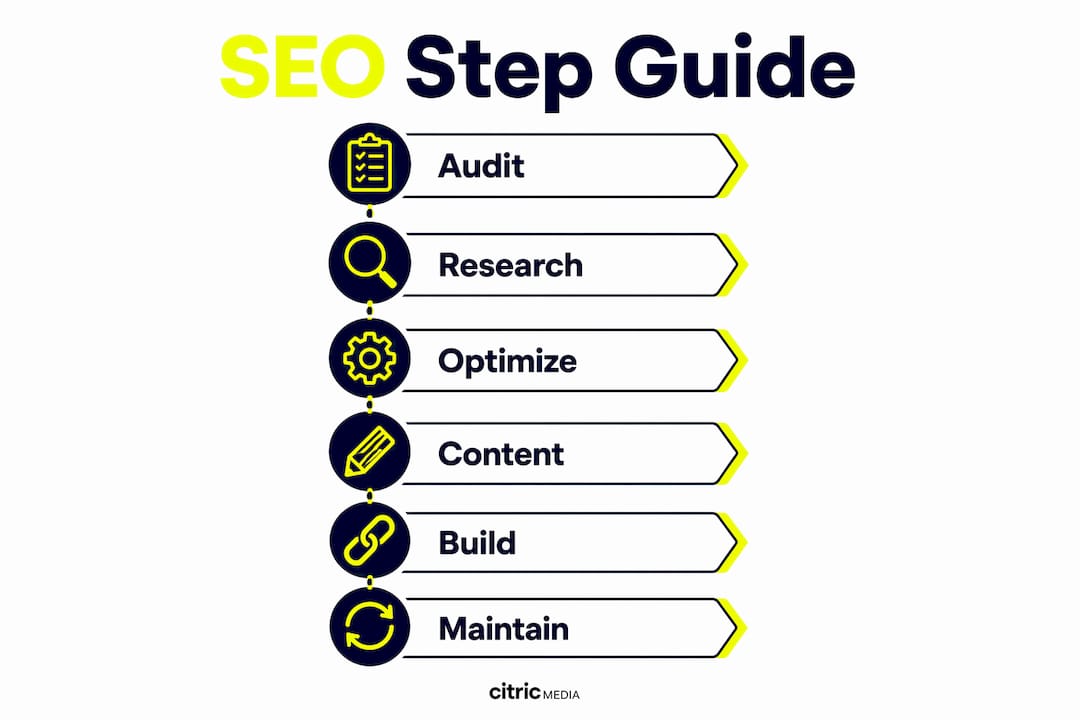
Search engine optimisation (SEO) is the process of improving your website so it ranks higher in Google and other search engines, driving more organic traffic without paying for every click. A proper step by step SEO guide covers four core pillars: Technical SEO, On-Page SEO, Content SEO, and Off-Page SEO. Tools like Google Search Console, Google Analytics, and frameworks like E-E-A-T (Experience, Expertise, Authoritativeness, Trustworthiness) are central to the process. Follow this guide and you will have a working plan to improve your visibility, attract better-quality traffic, and turn your website into a genuine business asset.
What do you need before starting SEO?
Preparation separates businesses that see results from those that spin their wheels. Before writing a single word of content or touching a meta tag, you need the right tools and a clear baseline.
Must-have tools to install first:
- Google Search Console — shows which queries bring visitors, flags indexing errors, and confirms Google can read your site
- Google Analytics 4 — tracks traffic sources, user behaviour, and conversion events
- A keyword research tool — Ahrefs, Semrush, or Mangools KWFinder each offer keyword volume, difficulty scores, and competitor data
- A site audit tool — Screaming Frog (free up to 500 URLs) or Seobility crawls your site and surfaces technical problems
Once those are connected, run an initial audit. You need to know your current state before setting targets. Check for crawl errors, broken links, missing title tags, and slow page speeds. This gives you a priority list rather than a guessing game.
Mapping SEO goals to business outcomes produces better results than chasing keyword rankings alone. A solicitor firm should track enquiry form submissions, not just position one for a generic term. A product retailer should track revenue from organic sessions. Set your goals in those terms from day one.

Pro Tip: Connect Google Search Console and Google Analytics 4 before anything else. Without baseline data, you cannot measure whether your SEO work is actually moving the needle.
How to conduct effective keyword research and analyse search intent
Keyword research is not about finding the highest-volume terms. It is about finding the intersection of volume, relevance, and your realistic ability to outperform competitors.
Follow these steps in order:
- Seed your list with business-relevant topics. Write down every service, product, and question your customers ask. These become your seed keywords in Ahrefs or Semrush.
- Filter by search intent. Every keyword falls into one of four intent types: informational (how does X work), navigational (brand name searches), commercial (best X for Y), or transactional (buy X now). Match your page type to the intent.
- Prioritise question keywords. Queries phrased as questions signal high informational intent and often trigger featured snippets and AI Overviews in Google. These are high-value targets for content pages.
- Assess keyword difficulty honestly. A brand-new site will not rank for “business insurance UK” against established insurers. Target lower-difficulty terms first, build authority, then move up.
- Analyse competitor keywords. Paste a competitor’s domain into Ahrefs Site Explorer or Semrush Organic Research. You will see exactly which keywords drive their traffic. Find gaps where you can do better.
- Map each keyword to a specific page. One page, one primary keyword, supported by three to five related terms. Avoid targeting the same keyword across multiple pages, as this creates cannibalisation.
Beginners frequently write for search engines instead of people, ignoring true search intent. The result is content that ranks briefly and then drops. Align every page 1:1 with what the searcher actually wants to find.
Pro Tip: Use the “People Also Ask” boxes in Google for your target keyword. Each question is a free keyword idea with confirmed search demand.
What are the key technical SEO steps to fix and optimise your website?
Technical SEO is the foundation. Content and links cannot compensate for a site Google cannot crawl or users cannot load quickly. Modern SEO requires your site to be readable by AI-powered engines like ChatGPT and Perplexity, not just Google. Structured, well-organised pages make fact extraction easier for these systems.
Core technical fixes to address:
- Fix indexing errors — in Google Search Console, check the Coverage report. Pages marked “Excluded” or “Crawled but not indexed” need investigation
- Optimise title tags — keep them under 60 characters, include the primary keyword near the start, and make each one unique
- Write compelling meta descriptions — these do not directly affect rankings but they influence click-through rates; aim for 150–160 characters
- Repair broken links — use Screaming Frog to find 404 errors and either redirect or remove the broken links
- Improve site structure — every important page should be reachable within three clicks from the homepage
- Add structured data — Schema.org markup helps Google display rich results (star ratings, FAQs, events) and helps AI engines extract facts accurately
Core Web Vitals vs. basic speed: what matters more?
| Factor | Core Web Vitals | Basic page speed |
|---|---|---|
| What it measures | LCP, INP, CLS (user experience signals) | Overall load time in seconds |
| Google ranking impact | Direct ranking signal since 2021 | Indirect, via bounce rate |
| How to check | Google PageSpeed Insights, Search Console | GTmetrix, Pingdom |
| Priority for UK SMEs | High — fix LCP and CLS first | Medium — address after Core Web Vitals |
Pro Tip: Run your site through Google PageSpeed Insights and fix the “Opportunities” listed there. Compressing images and removing unused JavaScript are the two changes that deliver the fastest gains.
How to create and optimise content to demonstrate E-E-A-T and topical authority
Content is where most UK businesses either win or lose their SEO effort. E-E-A-T principles are not theoretical. They are practical signals Google uses to assess whether your content deserves to rank above AI-generated filler.
E-E-A-T stands for Experience, Expertise, Authoritativeness, and Trustworthiness. Experience means your content reflects real, first-hand knowledge. Expertise means the author demonstrably knows the subject. Authoritativeness means other credible sources reference your work. Trustworthiness means your site is secure, accurate, and transparent.
How to apply E-E-A-T in practice:
- Add author bios with credentials to every article
- Cite sources and link to authoritative references (government sites, academic papers, industry bodies)
- Include original data, case studies, or first-hand observations that AI-generated content cannot replicate
- Keep content factually accurate and update it when information changes
- Display trust signals: SSL certificate, clear contact details, privacy policy, and genuine reviews
Content hubs and topical authority models outperform chasing single keywords over the long term. A content hub works like this: one comprehensive “pillar” page covers a broad topic, and multiple “cluster” pages cover specific subtopics, all linking back to the pillar. This structure signals to Google that your site is a genuine authority on the subject, not a collection of loosely related pages. You can read more about how SEO drives digital marketing success for UK SMEs to see this in action.
Pro Tip: Before publishing, ask yourself: “Does this page contain at least one insight a reader cannot find anywhere else?” If the answer is no, add original data, a client example, or a specific recommendation. That is your information gain.
What strategies should you use for off-page SEO and link building in 2026?
Off-page SEO is primarily about earning links from other websites. Each link acts as a vote of confidence in your content. Google treats links from authoritative, relevant sites as strong ranking signals.
- Analyse competitor backlinks first. In Ahrefs or Semrush, pull the backlink profile of your top three competitors. Look for patterns: which directories, publications, and resource pages link to them? Those are your first targets.
- Guest post on relevant publications. Write genuinely useful articles for industry blogs, trade publications, and regional business sites. The link in your author bio or within the content passes authority back to your site.
- Submit to high-quality directories. For UK businesses, listings in Yell, Thomson Local, and industry-specific directories build both citations and links. Avoid low-quality, paid link directories.
- Earn brand mentions and citations. When journalists or bloggers mention your brand without linking, reach out and ask for a link. Tools like Ahrefs Alerts or Google Alerts notify you of new mentions.
- Create linkable assets. Original research, free tools, detailed guides, and infographics attract links naturally. A UK SME that publishes an annual industry survey will earn links from journalists covering that data.
- Avoid black-hat tactics. Buying links, participating in link schemes, or using private blog networks risks a Google penalty that can wipe out years of progress. The risk is never worth it.
Social signals (shares, engagement on LinkedIn and X) do not directly affect rankings, but they increase content visibility, which leads to more organic links over time.
How to maintain and improve your SEO over time?
SEO is not a one-time project. The businesses that sustain top rankings treat it as an ongoing programme of work.
Continuous content updates and audits drive SEO improvements faster than new content creation alone. This is called historical optimisation. You find pages that ranked well but have slipped, update the information, improve the structure, and often recover rankings within weeks. New content takes months to build authority from scratch.
Ongoing SEO maintenance checklist:
- Run a full site audit every quarter using Screaming Frog or Seobility
- Check Google Search Console weekly for new crawl errors or manual actions
- Review your top 20 pages monthly for ranking changes and traffic drops
- Update any page where the information is more than 12 months old
- Monitor AI citation appearances in ChatGPT and Perplexity for your brand and key topics
- Track conversions from organic traffic, not just rankings
A structured SEO plan often follows an 8-week foundational schedule: technical fixes in weeks one to four, content optimisation in weeks five to eight. After that initial sprint, monthly maintenance keeps momentum going. The future of SEO in 2026 is increasingly shaped by AI search, so monitoring how your content appears in AI-generated answers is now part of the maintenance routine.
Pro Tip: Set a recurring calendar reminder every 90 days to audit your five highest-traffic pages. Small updates, like adding a new statistic or a clearer subheading, can recover lost rankings without a full rewrite.
Key takeaways
Effective SEO requires consistent work across four pillars: technical health, keyword-aligned content, E-E-A-T signals, and authoritative backlinks, all measured against real business outcomes rather than vanity metrics.
| Point | Details |
|---|---|
| Start with tools and an audit | Install Google Search Console and Google Analytics 4 before making any changes. |
| Match content to search intent | Every page must align with what the searcher actually wants, not just the keyword. |
| Fix technical issues first | Crawl errors, slow load times, and broken links undermine all other SEO work. |
| Build topical authority | Use content hubs and clusters rather than chasing isolated keywords. |
| Maintain and update regularly | Historical optimisation of existing pages delivers faster gains than new content alone. |
What I have learnt after 27 years of watching UK businesses do SEO
The most common mistake I see UK SMEs make is treating SEO as a campaign rather than a channel. They invest for three months, see some movement, then stop. Six months later they are back to square one and wondering why it did not stick.
The businesses that win at SEO treat it the way they treat their sales pipeline: something that needs feeding every week. The technical work is genuinely not that complicated once you have done it once. The harder discipline is the consistency: publishing content on a schedule, updating old pages before they decay, and building links steadily rather than in bursts.
I also think most guides underplay the AI search shift. Your content now needs to be optimised for ChatGPT and Perplexity extracting facts, not just Google returning a list of blue links. That means clear definitions, structured answers, and named entities throughout your pages. The businesses that adapt to this now will have a significant advantage over those still writing for 2019-era Google.
My honest advice: start with the technical audit, fix what is broken, then build your content hub around three to five core topics that matter to your business. Do not try to rank for everything. Depth beats breadth every time.
— Martin
How Citricmedia helps UK SMEs build lasting SEO results
Knowing the steps is one thing. Executing them consistently alongside running a business is another challenge entirely.
Citricmedia has spent over 27 years helping UK SMEs turn SEO from a source of frustration into a reliable channel for leads and sales. The team handles everything from technical SEO audits and on-page optimisation to content strategy, link building, and performance reporting. Every engagement is tied to business outcomes: enquiries, conversions, and revenue, not just rankings. If you are ready to put a proper SEO strategy in place, explore Citricmedia’s SEO services and see how the team can help your business grow.
FAQ
What is the first step in an SEO strategy for beginners?
The first step is installing Google Search Console and Google Analytics 4, then running a site audit to identify technical errors. You cannot prioritise fixes or measure progress without that baseline data.
How long does SEO take to show results?
Most websites see measurable ranking improvements within three to six months of consistent work. Technical fixes can produce quicker gains, while new content typically takes longer to build authority.
What is E-E-A-T and why does it matter for SEO?
E-E-A-T stands for Experience, Expertise, Authoritativeness, and Trustworthiness. Google uses these signals to assess content quality, and pages that demonstrate genuine first-hand knowledge consistently outrank thin or AI-generated content.
How do I build backlinks for a UK business website?
Start by analysing competitor backlinks in Ahrefs or Semrush, then target the same directories, publications, and resource pages. Guest posting on relevant UK trade publications and earning citations from local directories are the most reliable starting points.
What is the difference between on-page SEO and technical SEO?
Technical SEO covers site infrastructure: crawlability, speed, indexing, and structured data. On-page SEO covers the content and HTML elements on individual pages, including title tags, headings, and keyword placement.