General
Content quality is defined as the degree to which content delivers genuine value, relevance, and trustworthiness to its intended audience. For business owners and marketers, it is the single factor that determines whether your content attracts qualified visitors, builds lasting brand credibility, or simply disappears into the noise. Google’s E-E-A-T framework (Experience, Expertise, Authoritativeness, and Trustworthiness) now sits at the heart of search rankings, making quality a technical requirement, not just a creative preference. HubSpot’s content strategists confirm that original, distinctive content is the only reliable defence against being replaced by generic AI-generated posts. Understanding why content quality matters is the first step to building a content programme that compounds in value over time.
How does content quality affect SEO performance?
Content quality is the top SEO ranking factor in 2026, outweighing backlinks and technical SEO signals. That is a significant shift from even three years ago, when domain authority and link volume dominated ranking discussions. Google now rewards content that fully and accurately answers user intent, regardless of word count or the number of inbound links pointing to a page.

Google’s E-E-A-T framework is the clearest expression of this shift. It evaluates whether content demonstrates first-hand experience, subject matter expertise, recognised authority, and factual trustworthiness. A page written by a practitioner who has actually done the work scores higher than a page assembled from secondary sources, even if both cover the same topic.
Google’s Helpful Content system adds another layer. It imposes site-wide quality signals, meaning a cluster of thin or unhelpful pages can suppress rankings across your entire domain, not just the weak pages themselves. One underperforming section of your site can drag down content that is genuinely strong.
The practical implication is clear: concise, well-organised content that fully answers a query outperforms lengthy articles padded with filler. Length is not quality. Relevance and accuracy are.
- Experience: Write from direct involvement, not just research.
- Expertise: Demonstrate subject knowledge with specific, verifiable claims.
- Authoritativeness: Build recognition through consistent, cited publishing.
- Trustworthiness: Cite sources, correct errors promptly, and avoid misleading claims.
Pro Tip: Audit your lowest-traffic pages before publishing new content. Removing or improving thin pages can lift your entire domain’s visibility under Google’s site-wide quality signals.
“People-first content is not a stylistic choice. It is a ranking requirement. Businesses that treat content as a box-ticking exercise will find their visibility eroding steadily through 2026 and beyond.” — AdExpert, 2026
What are the business benefits of investing in high-quality content?
The commercial case for quality content is backed by hard numbers. Content marketing generates 3x as many leads as outbound marketing while costing 62% less. Businesses with active, quality-focused blogs generate 67% more leads per month than those without. That gap does not come from publishing more posts. It comes from publishing better ones.
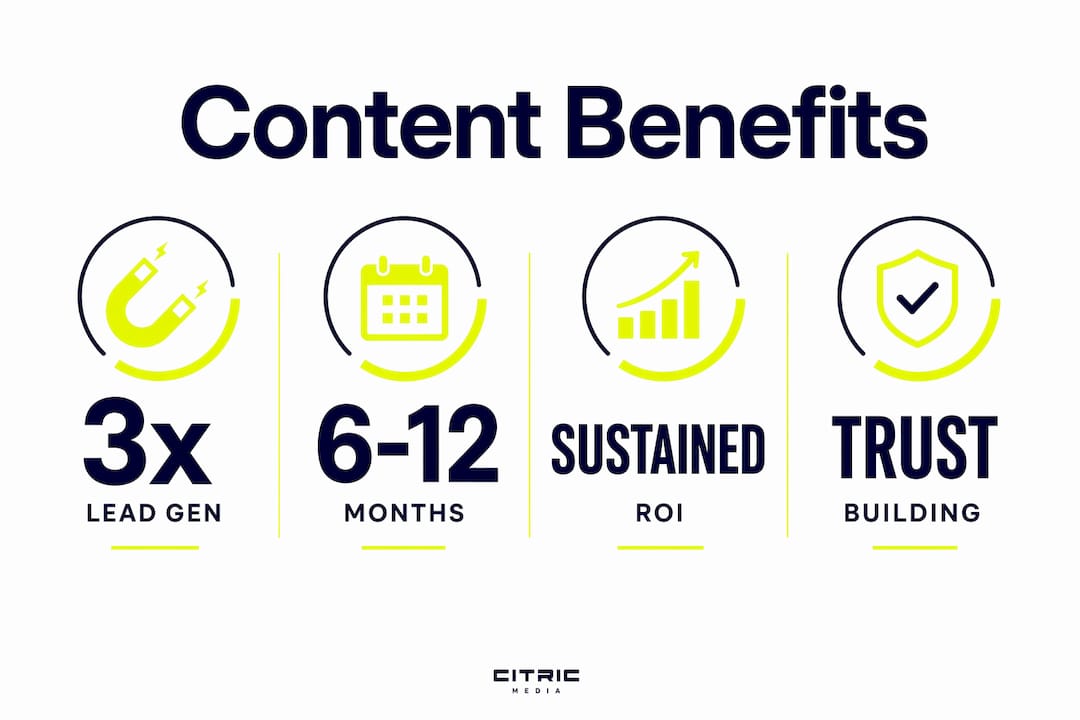
The returns are not immediate, and that is where most businesses stumble. B2B content typically requires 6–12 months to compound in search visibility. The first 90 days often show minimal traffic despite genuine quality. Businesses that abandon their content programme at the three-month mark never see the compounding effect that makes content marketing outperform paid advertising over a 12-month horizon.
Unlike paid ads, quality content does not stop working when the budget runs out. A well-researched article published today can generate qualified enquiries for years. That compounding dynamic is what makes content a capital investment rather than a recurring expense.
| Metric | Outbound marketing | Quality content marketing |
|---|---|---|
| Lead generation | Baseline | 3x more leads |
| Cost per lead | Higher | 62% lower |
| Longevity of results | Stops when spend stops | Compounds over time |
| Brand trust impact | Low | High |
Pro Tip: Track content performance at the 6-month and 12-month marks, not just at 30 days. Most quality content pieces reach their peak traffic well after initial publication.
For UK SMEs specifically, the ROI from content marketing is particularly strong when content is built around proprietary data, client case studies, and sector-specific insight that larger competitors rarely produce at a local level.
How does content quality influence customer engagement and brand reputation?
Consistent, high-quality content builds brand trust in a way that paid advertising cannot replicate. Audiences who repeatedly find accurate, useful answers from your brand develop a preference for it. That preference translates directly into higher conversion rates, longer dwell times, and more organic referrals.
The mechanism is straightforward. Content that matches search intent keeps visitors on the page longer. Longer dwell time signals relevance to Google and increases the probability of a conversion. Content that misses intent, even if technically well-written, produces high bounce rates and low engagement, both of which damage rankings and brand perception simultaneously.
Original insight is the differentiator that matters most. Content built around proprietary data, genuine case studies, or a distinctive professional viewpoint cannot be replicated by a competitor or replaced by an AI tool. That uniqueness is what earns backlinks, social shares, and repeat visits.
Brand consistency across channels reinforces the effect. When your blog, email newsletters, and social media posts all reflect the same level of quality and the same authoritative voice, audiences form a coherent, positive impression of your business. Inconsistency, by contrast, creates doubt.
- Match every piece of content to a specific user question or intent.
- Include at least one original data point, case study, or first-hand observation per article.
- Maintain a consistent publishing schedule to signal reliability to both audiences and search engines.
- Review and update existing content regularly to keep it accurate and current.
- Align tone and depth across all channels so your brand voice is immediately recognisable.
What common pitfalls undermine content quality?
The most damaging mistake businesses make is prioritising volume over quality. Publishing large volumes of mediocre posts actively harms site authority. Google’s post-2023 algorithm updates demote thin, keyword-stuffed content, and the Helpful Content system means those weak pages pull down your stronger ones too.
Generic content is the second major risk. Without unique data or personal experience, content is indistinguishable from thousands of similar pages and is increasingly vulnerable to being outranked by AI-generated summaries in Google’s search results. The businesses that survive this shift are those whose content contains something a machine cannot fabricate: genuine expertise and original perspective.
Impatience is the third pitfall. Businesses that expect content to deliver leads within 30 days and abandon the programme when it does not are making a costly error. The compounding nature of content ROI means early abandonment forfeits the returns that were weeks away from materialising.
Finally, recovering from a site-wide quality penalty takes months and requires improvements across all content, not just the pages that triggered the issue. Partial fixes do not satisfy Google’s site-wide assessment. The only reliable approach is a full content audit followed by systematic improvement.
- Avoid publishing content that adds no new information to what already ranks on page one.
- Do not rely on AI-generated drafts without adding proprietary data, expert commentary, or original analysis.
- Set realistic timelines: measure content performance at 6 and 12 months, not 30 days.
- Conduct a content audit at least twice a year to identify and improve or remove underperforming pages.
- Align every piece of content with a specific business goal and a measurable user intent.
Pro Tip: Before publishing any new content, ask: “Does this page contain at least one thing a competitor cannot easily copy?” If the answer is no, add a case study, a proprietary statistic, or a first-hand observation before it goes live.
Key takeaways
High-quality content is the single most effective way to drive organic search rankings, build brand trust, and generate leads at a lower cost than any outbound method.
| Point | Details |
|---|---|
| Quality outranks quantity | Publishing fewer, better pages improves rankings more than high-volume, low-value output. |
| E-E-A-T is non-negotiable | Google’s framework rewards experience, expertise, authority, and trust in every piece of content. |
| ROI compounds over time | Content marketing delivers its strongest returns at 6–12 months, not in the first 30 days. |
| Site-wide penalties are real | Thin content anywhere on your domain can suppress rankings across all your pages. |
| Original insight is the differentiator | Proprietary data and first-hand experience protect content from AI replication and competitor copying. |
Why I treat content quality as a capital investment, not a cost
My blunt view: most businesses are still treating content as a production task rather than a business asset. They brief writers, publish posts, and move on without ever asking whether the content contains something genuinely useful that a competitor cannot replicate. That approach produces a growing archive of mediocre pages that quietly erode domain authority.
The campaigns I have seen deliver the strongest long-term results share one characteristic. They are built around content that reflects real experience. Not rephrased industry reports, not AI-assisted summaries of what already ranks, but articles grounded in what the business has actually done, measured, and learnt. That kind of content earns trust from readers and from Google simultaneously.
The mindset shift required is patience combined with discipline. You commit to quality on every piece, you track performance at the right intervals, and you resist the temptation to flood the site with thin posts when early traffic is slow. The businesses that hold that line are the ones whose content drives real SEO results 18 months later while competitors are still chasing quick wins.
My recommendation is straightforward. Prioritise proprietary data. Use your own client results, your own sector observations, and your own professional experience as the foundation for every article. That is the content that compounds. Everything else is noise.
— Martin
How Citricmedia helps businesses build content that performs
Citricmedia has spent over 27 years helping UK SMEs generate qualified leads and measurable growth through performance-driven digital marketing. Content quality sits at the centre of that work because it directly determines how well SEO, paid search, and social media campaigns perform together.

If your content is not generating the enquiries your business needs, the issue is rarely volume. It is almost always quality, relevance, and alignment with Google’s E-E-A-T criteria. Citricmedia builds bespoke content strategies that address all three, combining professional SEO expertise with a clear focus on measurable commercial outcomes. Whether you need a full content audit, an ongoing publishing strategy, or a complete digital marketing programme, the team is ready to help you build content that compounds in value over time.
FAQ
What is content quality in marketing?
Content quality refers to how well a piece of content delivers value, relevance, and trustworthiness to its intended audience. Google’s E-E-A-T framework defines it through experience, expertise, authoritativeness, and trustworthiness.
Does content quality affect Google rankings?
Content quality is the top SEO ranking factor in 2026, outweighing backlinks and technical SEO. Google’s Helpful Content system also applies site-wide quality signals, meaning weak content anywhere on your domain can suppress your strongest pages.
How long does it take for quality content to generate leads?
Most B2B content requires 6–12 months to compound in search visibility and lead generation. The first 90 days typically show minimal traffic even when the content is genuinely strong.
What makes content high quality?
High-quality content fully answers user intent, contains original data or first-hand insight, and demonstrates clear expertise. Generic content that could be replicated by an AI tool does not meet the threshold Google or audiences now expect.
Is content marketing more cost-effective than outbound marketing?
Content marketing generates three times as many leads as outbound marketing while costing 62% less. That cost advantage grows over time because quality content continues to generate traffic and enquiries long after it is published.