Digital Marketing
Online visibility is defined as your brand’s measurable presence across search engines, AI platforms, and social media, and it is the single most important driver of digital growth for UK SMEs in 2026. Knowing how to boost online visibility means understanding that it is a cumulative result of presence across multiple channels, not a single tactic. Google, Google AI Overviews, and ChatGPT now all draw on entity recognition, third-party reviews, and content credibility to decide which brands appear in results. Citricmedia works with UK business owners and marketing managers every day who underestimate how many signals feed into that decision. The good news is that each signal is manageable with the right approach.
What are the essential digital channels to boost online visibility?
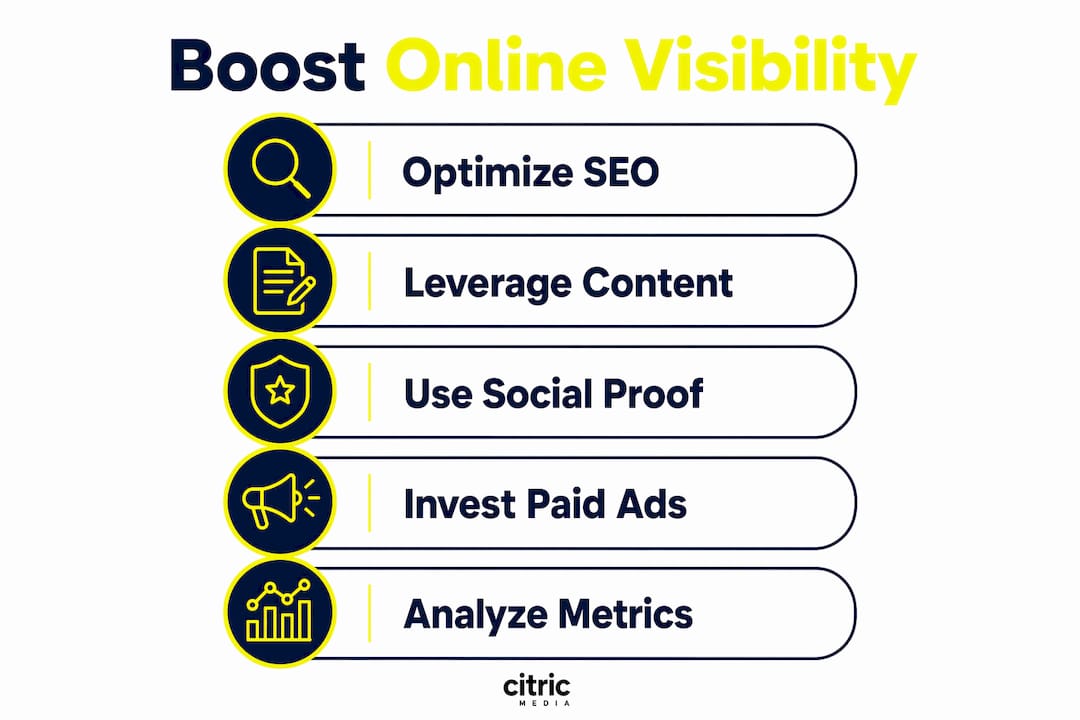
Improving online visibility starts with knowing where your audience actually finds businesses like yours. The channels below are not equal in value, and the order matters.
- Organic search. Google remains the highest-intent discovery channel. When someone searches for your product or service, they are ready to act. Ranking on page one for relevant terms puts you directly in front of buyers at the moment they decide.
- AI-powered search. Google AI Overviews and ChatGPT now answer queries directly. Building trust signals such as entity recognition, third-party validation, and content credibility is central to appearing in these AI-generated answers. Brands that are not optimised for AI search are already losing ground.
- Social media. Platforms like LinkedIn, Instagram, and Facebook build brand familiarity over time. Familiarity reduces friction when a prospect eventually searches for you by name.
- Paid advertising. Google Ads and paid social campaigns provide immediate, targeted reach. They complement organic growth rather than replace it.
- Local business profiles and third-party directories. A complete Google Business Profile improves local search performance and map pack ranking. Third-party review platforms feed trust signals directly into AI recommendation models.
No single channel is sufficient. Consistent presence across multiple platforms is what builds the trust that search engines and AI systems reward.
How can technical SEO improve your website’s visibility?

Technical SEO is the foundation of web visibility. Without it, even excellent content fails to rank. UK business owners often invest in content before fixing the technical issues that prevent Google from indexing their pages at all.
The most critical technical factors are:
- HTTPS and site security. Google has used HTTPS as a ranking signal since 2014. Non-HTTPS sites receive “Not Secure” browser warnings that increase bounce rates and signal untrustworthiness to both visitors and algorithms.
- Core Web Vitals and mobile usability. Poor technical SEO blocks indexing and ranking potential regardless of content quality. Core Web Vitals measure loading speed, interactivity, and visual stability. Google uses these scores as ranking eligibility criteria.
- Structured data (schema markup). Schema markup helps search engines and AI systems parse your content accurately. It increases your chances of appearing in rich results, which occupy more visual space on the results page.
- Internal linking. A clear internal link structure distributes authority across your site and helps Google crawl pages it might otherwise miss. Think of it as drawing a map for search engine bots.
- Title tags and meta descriptions. Unique, keyword-optimised title tags tell Google exactly what each page covers. A well-written meta description lifts click-through rates even when rankings are identical.
Pro Tip: Run a crawl of your site using a technical audit tool before investing in content. Fixing crawlability and indexing issues first means your new content ranks faster.
A useful starting point for UK business owners is the step-by-step SEO guide from Citricmedia, which covers these technical fundamentals in practical detail.
What content strategies effectively enhance online visibility and engagement?
Content is the visible face of your SEO work. The way you structure and write it determines whether Google, AI Overviews, or featured snippets surface it to your audience.
- Use question-based headings with immediate declarative answers. AI snippet-ranking content mirrors user question phrasing with subject-predicate-object sentences. Write the answer in the first sentence under each heading, not the third.
- Align keyword targeting with natural language. Keyword stuffing is penalised. Write for the intent behind the search, not the exact phrase. A page targeting “accountant London” should answer the questions a business owner actually has, not repeat the phrase twenty times.
- Use statistics and citations to build authority. Backlinks remain a top 3 Google ranking factor, and 90.63% of pages receive no organic traffic mainly because they lack backlinks. Citing credible sources earns links naturally and signals expertise to AI systems.
- Repurpose long-form content across channels. A detailed blog post becomes a LinkedIn article, an email newsletter, and a series of social posts. Each version reaches a different segment of your audience and creates additional brand touchpoints.
- Encourage employee advocacy. Employee social profiles posting authentic content act as direct brand visibility channels that AI systems and search engines value highly. A marketing manager sharing a company insight on LinkedIn feeds trust signals into AI brand assessment models.
Pro Tip: Write your most important content answer in the first 50 words under each heading. AI Overviews pull from the top of sections, not the middle.
The future of SEO in 2026 is increasingly shaped by AI parsing of content structure. Getting this right now puts you ahead of competitors who are still writing for 2022.
How can UK businesses use social proof to build trust and visibility?
Social proof and third-party validation are no longer soft marketing concepts. They are hard ranking and citation signals that AI systems actively evaluate.
- Online reviews are the most powerful third-party validation for AI search. Recent, high-volume reviews on platforms that AI systems crawl improve both brand trust and citation likelihood. Actively generating and responding to reviews is not optional in 2026.
- Google Business Profile completeness matters. Detailed, accurate business profile information combined with positive ratings improves local search performance and map pack ranking. Incomplete profiles are a missed opportunity that costs nothing to fix.
- Cross-platform brand consistency builds recognition. When your logo, messaging, and tone match across your website, LinkedIn, and Google Business Profile, AI systems recognise you as a coherent entity. Inconsistency fragments your brand signal.
- Employee profiles extend your reach. Encourage your team to post professionally about their work. Each post is a brand visibility channel that costs nothing and builds authentic credibility.
| Signal type | What it affects |
|---|---|
| Online reviews (volume and recency) | AI citation likelihood and local ranking |
| Google Business Profile completeness | Map pack ranking and local search visibility |
| Cross-platform brand consistency | Entity recognition by AI and search algorithms |
| Employee social activity | Organic brand reach and trust signals |
Measuring the impact of social visibility on search conversion rates is straightforward. Track branded search volume in Google Search Console over time. A rising trend confirms that your social and review activity is building the brand familiarity that drives direct searches.
Understanding why transparency in marketing matters is part of the same picture. Brands that communicate openly build the trust that AI systems and search engines reward.
What role does paid digital advertising play in boosting online visibility?
Paid advertising provides immediate, precisely targeted visibility that organic and social efforts cannot match for speed. Paid media lets businesses control messaging, targeting, and timing to accelerate visibility while organic authority builds over months.
The key paid channels for UK SMEs are:
- Google Ads for high-intent search. Paid search puts your brand at the top of results for queries where buyers are ready to act. It is the fastest way to appear for competitive terms while your organic rankings develop.
- Paid social for brand awareness at scale. LinkedIn campaigns reach decision-makers by job title and industry. Meta campaigns build familiarity with broader audiences. Both accelerate the brand recognition that eventually converts to organic searches.
- Integration with organic strategy. Paid campaigns reveal which keywords and messages convert. That data directly informs your organic content priorities. The two channels make each other more effective when managed together.
The best practice for UK business owners is to treat paid and organic as one strategy, not two budgets. A well-structured Google Ads setup generates immediate leads while your SEO work compounds in the background. Continuous measurement and adjustment of both channels is what separates businesses that grow from those that plateau.
Key takeaways
Online visibility is the cumulative result of consistent, trust-building presence across search engines, AI platforms, social media, and paid channels, and no single tactic delivers it alone.
| Point | Details |
|---|---|
| Technical SEO is the foundation | Fix HTTPS, Core Web Vitals, and crawlability before investing in content. |
| AI search requires structured content | Use question-based headings with declarative answers in the first sentence. |
| Reviews drive AI citation | Generate recent, high-volume reviews on platforms AI systems actively crawl. |
| Paid and organic work together | Use paid search data to inform organic content priorities and vice versa. |
| Employee advocacy builds trust signals | Authentic employee posts on LinkedIn feed brand credibility into AI assessment models. |
What I have learned about lasting online visibility for UK SMEs
My blunt observation after working in digital marketing for over two decades is this: most UK SMEs want a quick fix, and the businesses that actually grow their visibility are the ones that accept there is no such thing.
The pattern I see repeatedly is a business investing in a single channel, seeing modest results, then abandoning it before the compounding effect kicks in. SEO takes months. Social proof builds over quarters. Paid media works immediately but stops the moment the budget does. The businesses that win combine all three and measure them together.
What has changed significantly in the past two years is AI’s role in brand visibility. ChatGPT and Google AI Overviews now surface brands based on entity recognition and trust signals, not just keyword rankings. That means your reviews, your employees’ LinkedIn activity, and your schema markup all feed into whether an AI recommends you. Most business owners have not caught up with this yet. The ones who do will have a real advantage.
My practical advice is to start with the technical foundation, because broken crawlability undermines everything else. Then build content that answers real questions with direct, declarative sentences. Then generate reviews systematically. Then run paid campaigns to accelerate what organic is already doing. That sequence is not glamorous, but it is what SEO-driven digital marketing success actually looks like in practice.
— Martin
How Citricmedia helps UK businesses grow their online presence
Citricmedia has spent over 27 years helping UK SMEs build the kind of digital presence that generates real enquiries, leads, and sales. The agency combines technical SEO, Google Ads, paid social, and content strategy into integrated campaigns that are measured against business outcomes, not vanity metrics.
If you are a UK business owner or marketing manager ready to improve web visibility and drive measurable growth, Citricmedia’s team builds campaigns tailored to your market and objectives. From paid social advertising to performance-driven SEO, every service is designed to deliver results you can track. Visit Citricmedia to see how the agency approaches online visibility for businesses like yours.
FAQ
What is online visibility and why does it matter?
Online visibility is your brand’s measurable presence across search engines, AI platforms, and social media. It matters because businesses that appear consistently across these channels attract more high-intent traffic and generate more leads.
How long does it take to boost online visibility?
Technical SEO improvements can show results within weeks, but meaningful organic ranking gains typically take three to six months. Paid advertising delivers immediate visibility while organic authority builds.
What is the fastest way to increase online presence?
Google Ads and paid social campaigns provide the fastest route to targeted visibility. They should run alongside organic SEO work, not instead of it.
Do online reviews really affect search rankings?
Recent, high-volume reviews on platforms that AI systems crawl improve both local search ranking and AI citation likelihood. Actively managing and responding to reviews is a direct ranking and visibility tactic.
How does technical SEO affect online visibility?
Poor technical SEO blocks Google from indexing your pages regardless of content quality. Fixing Core Web Vitals, HTTPS, and crawlability issues is the prerequisite for any other visibility improvement to work.