Digital MarketingMarketingMarketing TechniqueOnline Marketing
Growing a business online in the current climate takes more than good intentions and a social media account. 68% of UK small businesses plan to increase their marketing budgets in 2026 despite inflation concerns, which tells you something important: the appetite for growth is there, but the pressure to make every pound work harder has never been greater. This reliable digital marketing guide is built for UK SMEs that want a clear, practical roadmap for generating leads and driving sales through performance-focused channels, without wasting budget on guesswork.
Table of Contents
- Understanding your business goals and target audience
- Setting a realistic marketing budget and key performance targets
- Choosing and implementing effective digital marketing channels
- Testing, measuring and optimising your campaigns
- Common pitfalls and how to avoid them
- Reconsidering the role of AI and efficiency in SME digital marketing
- How Citric Media supports UK SMEs with reliable digital marketing solutions
- Frequently asked questions
Key Takeaways
| Point | Details |
|---|---|
| Clear objectives | Defining specific business goals and a focused audience is essential for effective digital marketing. |
| Budget with targets | Set realistic marketing budgets and measurable targets to track success and optimise spend. |
| Channel selection | Choose digital channels like SEO, social media, and email that best fit your business and audience. |
| Test and optimise | Use tools such as A/B testing and analytics to continually improve campaign performance. |
| Leverage AI strategically | Adopting AI thoughtfully can enhance marketing efficiency and competitive advantage for SMEs. |
Understanding your business goals and target audience
Before you select a single channel or write a single ad, you need clarity on two things: what you want to achieve, and who you are trying to reach. This sounds obvious, yet it is precisely where most SME campaigns unravel. Vague objectives like “grow our brand” do not translate into measurable action.
Effective digital marketing strategy starts with knowing your objectives and your audience before touching any platform. For a UK SME, that means connecting your marketing goals directly to business outcomes. If your target is £50,000 in new revenue this quarter, your marketing objective becomes generating a specific number of qualified enquiries at a defined conversion rate.
Defining your audience requires more than a demographic sketch. Think about:
- Location specifics: Are you targeting customers in a particular city, region, or across the UK?
- Purchase intent: Are they actively searching for a solution, or do they need to be made aware of a problem you solve?
- Decision-making process: Are you selling to an individual consumer or a business buyer who requires multiple touchpoints?
- Channel behaviour: Where do your ideal customers actually spend their time online?
Over-broad targeting is one of the most common and costly mistakes in digital marketing planning for SMEs. Attempting to speak to everyone simultaneously means your message resonates with no one, your costs rise, and your results plateau. The tighter your audience definition, the more efficiently your budget performs.
Setting a realistic marketing budget and key performance targets
With your goals and audience defined, the next step is to allocate your marketing budget wisely with clear performance targets.
68% of UK SMEs increasing their marketing spend in 2026 reflects growing ambition, but ambition without a measurement framework can quickly become waste. Budget allocation must be tied to targets that are specific and time-bound. The most practical structure for SMEs follows four steps:
- Calculate your total available budget, including ad spend, agency or freelance fees, software subscriptions, and content production costs.
- Assign spend by channel priority, directing the largest share toward channels with the clearest evidence of return for your sector.
- Set SMART targets for each channel, such as a target cost per lead, a conversion rate for email campaigns, or an organic traffic increase over 90 days.
- Schedule regular budget reviews, at least monthly, to reallocate spend away from underperforming channels and toward those delivering results.
The digital marketing investment benefits for SMEs become tangible only when spend is connected to measurable outcomes. A good rule of thumb: if you cannot define how you will measure the return on a particular activity, do not fund it yet.
Pro Tip: Allocate a small portion of your budget, around 10 to 15 per cent, specifically for testing new channels or ad formats. This keeps your core spend protected whilst allowing you to discover what works before committing fully.

According to business.gov.uk guidance on digital marketing, SMEs should establish clear ROI targets from the outset, treating digital marketing as an investment rather than an overhead.
Choosing and implementing effective digital marketing channels
Now that budgeting is clear, let us explore which digital channels can deliver the best returns for your marketing spend.
Not every channel suits every business, and spreading budget thinly across all of them is a fast route to mediocre results across the board. Here is a side-by-side look at the major channels available to UK SMEs:
| Channel | Typical time to results | Best for | Approximate ROI potential |
|---|---|---|---|
| SEO | 3 to 6 months | Long-term organic traffic and brand authority | High over 12+ months |
| Google Ads / PPC | Immediate | Fast lead generation with measurable targeting | High when optimised |
| Email marketing | Days to weeks | Nurturing existing leads and repeat sales | Very high per £ spent |
| Social media (organic) | Weeks to months | Brand awareness and community engagement | Variable |
| Paid social advertising | Immediate | Targeted audience reach and demand generation | High when well-targeted |
Social media drives business for 68% of UK SMEs, with email marketing cited by 41%, making these two channels the most accessible starting points. But do not overlook SEO. SEO delivers the best long-term ROI of any digital channel, and email marketing consistently offers the highest return per pound of spend for businesses that build their lists carefully.
For SMEs balancing organic and paid activity, the practical advice is this: use paid channels to generate immediate leads and test what messaging works, then feed those learnings into your organic content and SEO strategy. The two are not competitors; they reinforce each other.
Key implementation tips:
- For SEO: Focus on long-tail keywords with local intent, such as “commercial electrician in Leeds” rather than just “electrician.” Read more about investing in SEO for growth and how it compounds over time.
- For paid social: Start with one platform where your audience is concentrated. A well-run campaign on a single platform beats a diluted presence across five. Explore paid social advertising tips for UK SMEs before committing spend.
- For email: Segment your list from day one. A message relevant to a warm lead is fundamentally different from one aimed at a cold prospect.
Pro Tip: AI writing tools can significantly speed up content production for email sequences, social posts, and ad copy, but always review outputs for accuracy and brand tone before publishing.
Testing, measuring and optimising your campaigns
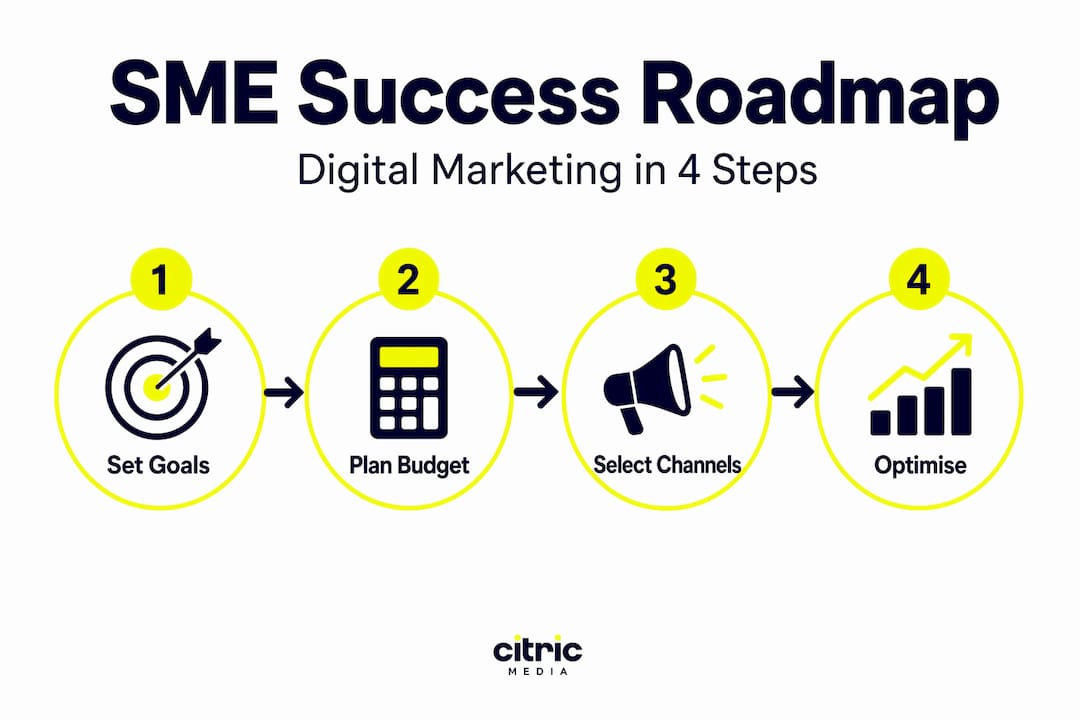
After launching your campaigns, the next critical phase is testing and refining efforts to maximise effectiveness.
Most SME campaigns plateau not because the strategy was wrong, but because nobody adjusted it after launch. Measurement is not a one-off review; it is a continuous discipline. Here is a practical four-step process for ongoing optimisation:
- Establish baseline metrics before you launch, including current website traffic, lead volumes, conversion rates, and average order values.
- Set up A/B tests on your highest-traffic touchpoints, whether that is a landing page headline, an email subject line, or an ad creative. Test one variable at a time to isolate what is driving change.
- Track performance weekly against your SMART targets, using a simple dashboard that surfaces the metrics that matter most to your business outcomes.
- Conduct a formal monthly review to assess channel performance, reallocate budget, and plan the next round of tests.
Google Analytics and A/B testing are the foundations of measuring digital marketing impact effectively for any SME.
| Metric | What it tells you | Review frequency |
|---|---|---|
| Cost per lead | Efficiency of paid acquisition | Weekly |
| Conversion rate | Landing page and offer quality | Weekly |
| Organic traffic | SEO progress | Monthly |
| Email open rate | Subject line and list health | Per campaign |
| Return on ad spend | Paid channel profitability | Weekly |
AI tools are increasingly used for analysing trend data and automating content adjustments, which frees up time for the strategic decisions that genuinely require human judgement. For reference on a structured approach to this, the digital marketing optimisation steps we outline go deeper into attribution modelling and channel review frameworks.
Pro Tip: Schedule a 30-minute “what did we learn this week” session with whoever manages your marketing. Short, regular reviews catch problems early and build a knowledge base that compounds in value over months.
Common pitfalls and how to avoid them
Even with careful planning, there are common traps to watch for. Here is how to avoid them and keep your marketing on track.
The most damaging mistakes UK SMEs make in digital marketing are rarely technical. They are structural and behavioural. Recognising them early is the cheapest form of campaign management there is.
“Lack of customer engagement is the single biggest marketing challenge facing UK SMEs in 2026, cited ahead of budget constraints and finding the right channels.”
That finding matters because engagement is downstream of relevance. If your campaigns are not generating interaction, the first question to ask is whether your messaging matches what your audience actually cares about, not whether you are spending enough.
Common pitfalls and practical fixes:
- Unclear objectives: If your team cannot state in one sentence what a campaign is designed to achieve, pause and redefine before spending. Every campaign should have a single primary goal.
- Over-broad targeting: Narrowing your audience almost always improves results. This feels counterintuitive but is consistently supported by performance data.
- Ignoring analytics: Data sitting in a dashboard changes nothing. Build a habit of reviewing and acting on it. The avoiding digital marketing mistakes section of our investment guide covers this in practical detail.
- Chasing every new channel: Each new platform has a learning curve and a cost. Master the channels that are already generating results before diversifying.
- Burning out your team: Efficiency tools and content calendars are not optional extras for SMEs. They are how you maintain consistent output without overloading the people running your marketing.
Reconsidering the role of AI and efficiency in SME digital marketing
There is a tendency, particularly among businesses newer to digital marketing, to treat AI tools as a finishing touch rather than a structural part of the workflow. My view is that this represents a genuine missed opportunity, and the gap between those who use AI strategically and those who use it as a shortcut for writing captions is already widening.
More than half of UK SME owners already use AI marketing tools, but only a fraction feel they are using them to anywhere near their full potential. That is a significant differentiator available to any business willing to go deeper.
What does going deeper actually mean in practice? It means using AI for audience analysis, not just content generation. It means using predictive tools to identify which customer segments are most likely to convert before you spend money targeting them. It means feeding campaign performance data into AI platforms to surface patterns that would take hours to identify manually. These applications do not replace human expertise; they extend it.
We are operating in an environment where inflation is squeezing margins and marketing budgets are simultaneously increasing. That combination demands efficiency. The businesses that will come out ahead are not those who spend the most, but those who extract the most insight from what they spend. The digital marketing and AI benefits for UK SMEs are real and measurable, but they require deliberate adoption rather than passive experimentation.
Pro Tip: Plan AI adoption in stages. Start with one well-defined use case, such as generating first drafts of ad copy or summarising campaign reports, measure the time and quality improvement, then expand. Gradual adoption avoids the common trap of investing in tools that nobody in the team actually uses consistently.
The trustworthy online marketing strategies in this guide are not static. The ones that perform best in 2026 will be those supported by the analytical depth that AI makes accessible, without losing the human judgement that gives your brand its distinctive voice.
How Citric Media supports UK SMEs with reliable digital marketing solutions
For SMEs ready to accelerate their digital marketing success, Citric Media offers expert services designed to deliver reliable, measurable results.
With over 27 years of experience working with UK businesses, we know that the gap between intention and execution is where most marketing budgets disappear. Our role is to close that gap. Whether you are starting from scratch or trying to improve the performance of existing campaigns, our step-by-step marketing guide for SMEs provides a practical framework you can follow immediately.
We specialise in the channels that generate measurable returns: SEO, Google Ads, Bing Advertising, and paid social. Our paid social advertising services are built around your audience and your budget, not generic templates. If organic visibility is your priority, our SEO services for UK SMEs are designed to build long-term ranking authority in the sectors and locations where your customers are actually searching. Every engagement starts with clear targets and transparent reporting, because results you cannot measure are not results at all.
Frequently asked questions
How long does it take to see results from SEO efforts?
SEO results typically take 3 to 6 months to become noticeable, which means consistent effort and patience are essential rather than optional.
What are the most effective digital marketing channels for UK SMEs?
Social media (68%) and email (41%) currently drive the most business for UK SMEs, whilst SEO offers the strongest long-term return on investment for sustained organic growth.
How can SMEs measure the success of their digital marketing campaigns?
Google Analytics and A/B testing are the core tools for tracking campaign performance, and both are accessible to SMEs without specialist technical knowledge.
How are UK SMEs adopting AI in digital marketing?
Over half of UK SME owners already use AI marketing tools, primarily for data analysis and content creation, though most acknowledge they are not yet using these tools to their full potential.