Marketing Technique
Retargeting is defined as a paid advertising strategy that serves personalised ads to people who have previously visited your website or engaged with your brand online. It is a subset of remarketing, focused specifically on paid channels rather than owned media like email. Retargeting ads increase brand search activity by as much as 1,046%, which shows just how powerfully this technique keeps your brand in front of warm prospects. For digital marketers and business owners, understanding what retargeting is and how to use it well is one of the highest-return skills in paid advertising today.
What is retargeting and how does it work technically?
Retargeting works by embedding a tracking pixel on your website, which sets a small cookie in a visitor’s browser. When that visitor leaves your site and browses elsewhere, the cookie signals ad platforms to serve your ads to that specific person. The result is a personalised ad experience based on real behaviour, not guesswork.
Two core methods drive most retargeting campaigns:
- Pixel-based retargeting: A snippet of code on your site tracks every visitor automatically. Ads follow them across websites, social media platforms, and apps. This method works in real time and requires no data upload from you.
- List-based retargeting: You upload a list of existing contacts, such as email subscribers or past customers, to a platform like Meta or Google. The platform matches those contacts to its users and serves your ads to them directly.
The behavioural signals that trigger retargeting matter enormously. Viewing a product page, abandoning a shopping cart, or spending time on a pricing page all indicate different levels of intent. A visitor who abandoned a cart is far closer to buying than someone who read a blog post. Segmenting by these signals lets you serve the right message at the right moment.
Frequency capping is the mechanism that limits how often a single user sees your ad. Frequency capping prevents ad fatigue and wasted spend, which is one of the most common and costly mistakes in retargeting campaigns. Without a cap, you risk annoying the very people you are trying to win back.

Pro Tip: Set your frequency cap at no more than five impressions per user per week when starting out. Review performance data after two weeks and adjust based on click-through rate trends.
What is the difference between retargeting and remarketing?
The terms are used interchangeably across the industry, but the distinction matters for planning. Retargeting is a subset of remarketing, focused on paid advertising channels. Remarketing is the broader category, which includes owned media channels such as email, SMS, and push notifications alongside paid ads.
Think of it this way: if you send a follow-up email to a customer who abandoned their cart, that is remarketing. If you serve them a display ad on a news website an hour later, that is retargeting. Both strategies pursue the same goal of re-engaging a warm audience, but through different channels and with different data sources.
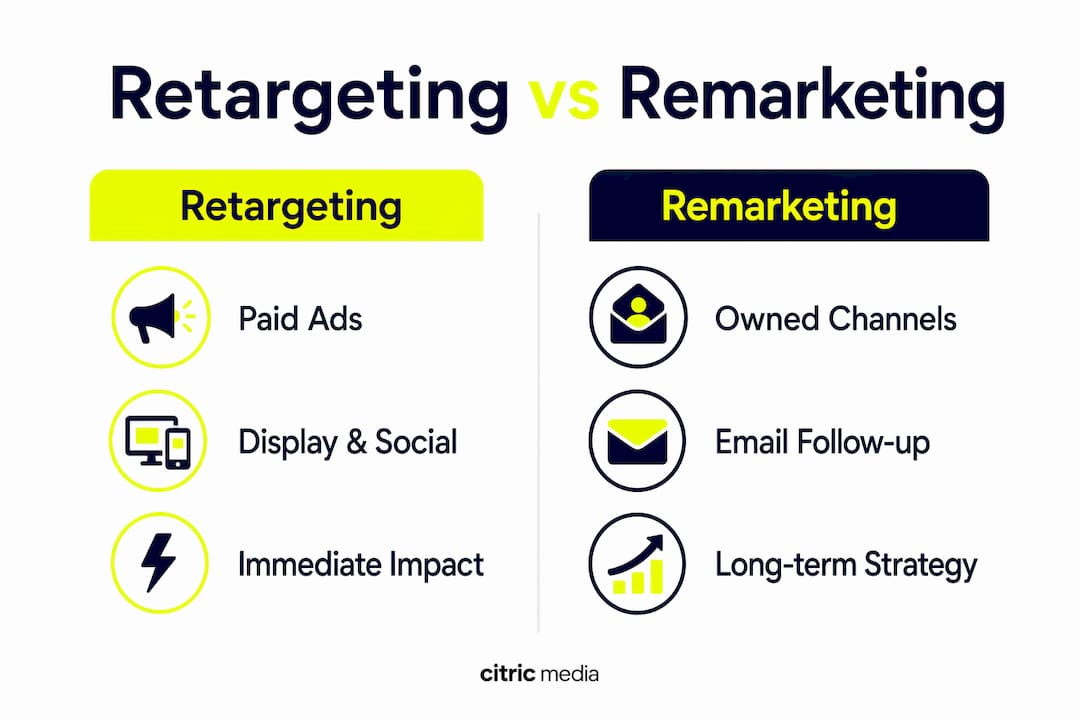
| Dimension | Retargeting | Remarketing |
|---|---|---|
| Channels used | Paid ads (display, social, search) | Email, SMS, push notifications, paid ads |
| Data source | Pixel tracking, first-party lists | CRM data, email lists, behavioural data |
| Typical use case | Re-engage site visitors with ads | Re-engage customers across owned and paid channels |
| Cost model | Pay per click or impression | Largely owned channel costs plus ad spend |
| Best for | High-intent visitors, cart abandoners | Broader re-engagement across the full customer base |
Distinguishing retargeting from remarketing aids strategic clarity. When you know which tool you are using, you can plan budgets, measure results, and assign ownership more accurately. Conflating the two leads to muddled reporting and missed opportunities.
Pro Tip: Build a remarketing strategy that combines retargeting ads with email sequences. A visitor who sees your ad and then receives a personalised email is far more likely to convert than one who encounters only a single touchpoint.
What are the key benefits of retargeting for digital marketers?
The primary benefit of retargeting is budget efficiency. Retargeting focuses spend on warm leads who are statistically more likely to convert, yielding higher return on investment than broad awareness campaigns aimed at cold audiences. You are not paying to introduce your brand. You are paying to close a conversation that already started.
The strategic advantages extend beyond conversion rates:
- Brand recall: Retargeting keeps your brand visible during the consideration phase, when prospects are comparing options and making decisions.
- Personalised messaging: You can tailor ad creative to the exact product or service a visitor viewed, making the ad feel relevant rather than intrusive.
- Shorter sales cycles: Warm audiences need less persuasion. Retargeting compresses the time between first visit and purchase.
- Cross-channel reach: Retargeting follows users across websites, social feeds, and apps, maintaining presence without requiring the user to return to your site.
“High-performing marketers use an integrated multi-channel approach combining ads, email, and social messaging rather than relying solely on isolated retargeting. The channel mix, not any single tactic, drives the strongest results.”
Dynamic retargeting ads personalise content based on the exact products or services a user viewed, significantly increasing conversion rates over generic ads. A user who browsed running shoes sees an ad for those specific shoes, not a generic brand banner. That specificity is what separates effective retargeting from background noise.
How to implement effective retargeting campaigns
Setting up a retargeting campaign requires clear steps, the right platform choices, and disciplined ongoing management. The following process applies whether you are running campaigns on Google, Meta, or both.
- Install your tracking pixel. Place the Google Ads remarketing tag or Meta Pixel on every page of your website. Verify it fires correctly using the platform’s diagnostic tools before launching any campaign.
- Define your audience segments. Group visitors by behaviour. Separate cart abandoners from product page viewers and blog readers. Each segment warrants a different message and bid strategy.
- Build your creative. Match ad creative to the segment’s intent level. Cart abandoners respond well to urgency-based messaging or a limited-time offer. Product page viewers may need social proof or a feature comparison.
- Set frequency caps and exclusions. Cap impressions per user per week. Exclude recent purchasers immediately to avoid wasting spend on people who have already converted.
- Monitor and adjust. Review click-through rate, conversion rate, and cost per acquisition weekly. Pause underperforming segments and reallocate budget to those delivering results.
The following table outlines the key metrics to track and what each one tells you about campaign health:
| Metric | What it measures | Action trigger |
|---|---|---|
| Click-through rate (CTR) | Ad relevance and creative effectiveness | Below 0.5%: refresh creative |
| Conversion rate | How well the landing page converts retargeted visitors | Below target: test landing page variants |
| Frequency | Average number of times a user sees your ad | Above 7 per week: reduce budget or tighten audience |
| Cost per acquisition (CPA) | Efficiency of spend relative to conversions | Rising CPA: review segment quality and bids |
| Return on ad spend (ROAS) | Revenue generated per pound spent | Below 2x: reassess audience and offer |
With third-party cookie deprecation, the most effective retargeting now uses first-party data to build Custom Audiences on platforms like Meta or Google. This means collecting email addresses, phone numbers, and CRM data actively, then uploading those lists to match against platform users. Marketers who rely solely on pixel-based tracking face shrinking audience pools as browsers restrict cookies.
Pro Tip: Integrate your CRM with your ad platforms now. Google Ads tips for UK businesses include Customer Match as a first-party data tool that bypasses cookie restrictions entirely and often outperforms pixel audiences on conversion rate.
For paid social campaign setup, audience segmentation by intent signal is the single biggest lever available. Segment first, then build creative. The reverse order produces generic ads that underperform regardless of budget.
Key takeaways
Retargeting is the most budget-efficient paid advertising method available because it focuses spend on people who have already demonstrated interest in your brand.
| Point | Details |
|---|---|
| Retargeting definition | Paid ads served to previous site visitors or engaged users based on tracked behaviour. |
| Pixel vs list-based | Pixel tracking is automatic and real-time; list-based uses uploaded CRM data for precision targeting. |
| Retargeting vs remarketing | Retargeting covers paid channels only; remarketing includes email, SMS, and owned media too. |
| First-party data is critical | Cookie deprecation makes CRM integration and customer lists the foundation of effective retargeting. |
| Frequency capping | Capping impressions prevents ad fatigue and protects budget from wasted spend on oversaturated users. |
My honest assessment of where retargeting is heading
I have worked across paid advertising campaigns for over two decades, and the shift I am watching most closely right now is the collapse of third-party cookie reliance. Marketers who built their entire retargeting infrastructure on pixel tracking are already feeling the squeeze. Browser restrictions from Safari and Firefox have been eroding pixel audiences for years. Google’s own cookie changes have added further pressure. The businesses that adapted early by building CRM lists and integrating them with Meta and Google are pulling ahead.
What I find underappreciated is how much creative quality still determines outcomes. I see campaigns with excellent audience segmentation fail because the ad creative is generic. A cart abandoner who sees the exact product they left behind, with a clear reason to return, converts at a meaningfully higher rate than one who sees a brand logo and a vague call to action. Segmenting by high-intent actions like cart abandonment and serving dynamic creative is not a nice-to-have. It is the difference between a campaign that pays for itself and one that drains budget.
The other pitfall I see repeatedly is treating retargeting as a standalone tactic. The strongest results come when retargeting ads run alongside email sequences and social content. A prospect who sees your ad, receives a follow-up email, and then encounters your content on LinkedIn is in a very different mental position to one who only saw a banner. Monitoring digital campaign results across all these channels together, not in separate silos, is what reveals the true picture of performance.
My blunt forecast for 2026 and beyond: retargeting will remain one of the highest-ROI tactics in digital advertising, but only for marketers who invest in first-party data infrastructure and treat creative as seriously as audience strategy.
— Martin
How Citricmedia can help you get more from paid advertising
Running retargeting campaigns well requires the right setup, the right data, and continuous management. Many businesses set up a pixel, launch an ad, and wonder why results are flat. The gap is almost always in audience segmentation, creative strategy, or frequency management.

Citricmedia has over 27 years of experience running paid social campaigns and Google Ads for UK SMEs, with a results-first approach that focuses on measurable return on ad spend. Whether you are starting your first retargeting campaign or restructuring an existing one, the team at Citricmedia can build the audience architecture, creative strategy, and reporting framework that turns warm visitors into paying customers. Get in touch to discuss your campaign goals.
FAQ
What is retargeting in simple terms?
Retargeting is a paid advertising method that shows ads to people who have already visited your website or interacted with your brand. It uses tracking pixels or customer lists to identify those individuals and serve them relevant ads across websites, social media, and apps.
How is retargeting different from remarketing?
Retargeting focuses on paid advertising channels, while remarketing is the broader strategy that also includes owned channels like email and SMS. All retargeting is remarketing, but not all remarketing is retargeting.
Does retargeting actually improve conversion rates?
Retargeting improves conversion rates by focusing ad spend on warm audiences who have already shown interest. Dynamic retargeting ads that match the exact product a user viewed perform significantly better than generic brand ads.
What happens when third-party cookies are deprecated?
When third-party cookies are restricted, pixel-based retargeting loses accuracy. The most effective response is to build first-party data through CRM integration and upload customer lists directly to platforms like Meta and Google as Custom Audiences.
How often should retargeting ads be shown to a user?
Frequency capping is essential to prevent ad fatigue. Starting at no more than five impressions per user per week is a sound baseline, with adjustments made based on click-through rate and conversion data after the first two weeks.