
Hosting
Website hosting is the service that stores your website’s files on a server and makes those files accessible to anyone on the internet. Without it, your business simply does not exist online. The importance of website hosting goes far beyond a technical checkbox. It directly shapes how fast your site loads, how often it stays online, how secure your customers’ data remains, and how well Google ranks your pages. For UK small and medium-sized enterprises competing for attention online, hosting is a foundational business decision, not an afterthought.
Why businesses need website hosting for speed and conversions
Loading speed is the most immediate way hosting quality affects your bottom line. A one-second delay in page load time reduces customer conversion rates by approximately 7%. That figure compounds fast. A site generating 500 enquiries a month could lose 35 of them simply because the server is slow.

The physical location of your server matters more than most business owners realise. Servers located near your primary customers reduce latency and improve load times significantly. A UK business targeting British customers should host on UK or European servers, not US-based infrastructure.
Google’s Core Web Vitals measure loading speed, interactivity, and visual stability. Poor scores on these metrics push your site down the search rankings. Hosting features that directly improve these scores include SSD storage, server-side caching, and a content delivery network (CDN). These are not luxury add-ons. They are the difference between a site that ranks and one that does not.
- SSD storage reads data faster than traditional hard drives, cutting server response times.
- Server-side caching stores pre-built versions of your pages so the server does not rebuild them for every visitor.
- CDN integration distributes your content across multiple global servers, reducing the distance data travels to reach each visitor.
- PHP version support affects how quickly your CMS, such as WordPress, processes requests.
Pro Tip: When comparing hosting providers, ask specifically which data centre regions they offer. Selecting one with servers in London or Frankfurt gives UK-based businesses a measurable performance advantage over providers that only offer US locations.
Why is reliable uptime critical for business websites?
Uptime is the percentage of time your website is accessible. Professional hosting targets at least 99.9% uptime, which equates to no more than 8.7 hours of downtime per year. That sounds acceptable until you consider that downtime rarely happens at 3am on a Tuesday.
Downtime during a paid Google Ads or Meta campaign is particularly damaging. You pay for every click, but visitors land on an error page and leave. The ad spend is wasted, and the customer impression is permanent. Unreliable hosting also reduces search engine crawl frequency, which means Google indexes your pages less often and your SEO visibility suffers over time.
The table below shows what different uptime guarantees actually mean in practice.
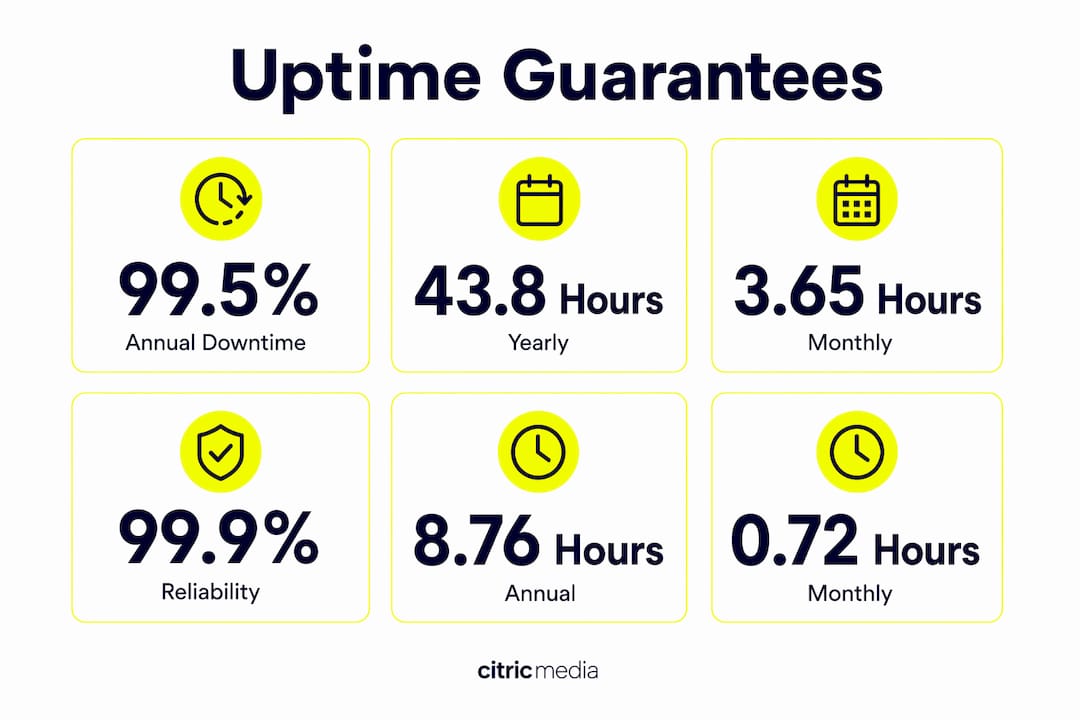
| Uptime guarantee | Annual downtime | Monthly downtime |
|---|---|---|
| 99.5% | 43.8 hours | 3.65 hours |
| 99.9% | 8.7 hours | 43.8 minutes |
| 99.95% | 4.4 hours | 21.9 minutes |
| 99.99% | 52.6 minutes | 4.4 minutes |
Shared hosting plans frequently advertise 99.9% uptime but share server resources across hundreds of websites. When a neighbouring site experiences a traffic spike, your site slows or goes offline. Managed hosting providers dedicate resources and actively monitor server health, making their uptime guarantees far more reliable in practice.
What role does web hosting play in business website security?
Cyber attacks, malware infections, and data breaches are daily threats, and small and medium-sized businesses are increasingly the primary targets. Attackers know that SMEs often run outdated software and lack dedicated IT security teams. Your hosting environment is the first line of defence.
Quality hosting providers include a range of security provisions as standard. The gap between basic shared hosting and managed hosting on this front is significant.
- SSL certificates encrypt data between your site and visitors, protecting payment details and personal information. Google also uses SSL as a ranking signal.
- Web application firewalls (WAF) filter malicious traffic before it reaches your server.
- DDoS protection absorbs large-scale traffic attacks that would otherwise take your site offline.
- Malware scanning detects and removes infected files before they damage your reputation or trigger Google’s safe browsing warnings.
- Automatic updates keep your server software patched against known vulnerabilities.
- Daily backups mean that if the worst happens, you restore from yesterday’s snapshot rather than starting from scratch.
Managed hosting providers handle daily backups, security patching, and server maintenance automatically. This removes the burden from business owners who lack the time or technical knowledge to manage these tasks manually.
Pro Tip: Automating security maintenance through your hosting provider costs far less in the long run than recovering from a hacking incident. A single breach can involve legal fees, customer notification costs, and reputational damage that dwarfs years of managed hosting fees.
How does website hosting support business growth and scalability?
Growth creates a hosting problem that catches many SMEs off guard. A site built on entry-level shared hosting works fine with 200 monthly visitors. It buckles under 2,000. Scalable hosting solutions such as VPS, cloud hosting, and dedicated servers handle sudden traffic spikes without performance degradation. This matters most during marketing campaigns, seasonal peaks, and product launches.
The table below compares the main hosting types on the factors that matter most to growing businesses.
| Hosting type | Scalability | Typical monthly cost | Management required | Best suited for |
|---|---|---|---|---|
| Shared hosting | Low | £5–£15 | Low | Early-stage sites, low traffic |
| VPS hosting | Medium | £20–£60 | Medium | Growing SMEs, moderate traffic |
| Managed hosting | Medium to high | £30–£100+ | Very low | Busy owners, security-focused |
| Cloud hosting | High | Variable | Low to medium | Traffic spikes, fast-growing sites |
| Dedicated server | Very high | £100–£300+ | High | Large sites, high-volume traffic |
Pricing deserves particular attention. Entry-level shared hosting plans typically cost between £5 and £15 per month, but these plans often lack managed security and backups. Renewal pricing frequently increases after initial discount periods, so a plan advertised at £2.99 per month may renew at £9.99 or more. Always verify the standard renewal rate before committing.
Managed hosting removes the technical overhead entirely. Business owners focus on sales, marketing, and operations while the provider handles server performance, updates, and security. For most UK SMEs, that trade-off is worth the additional monthly cost. The benefits of web hosting for businesses extend beyond uptime figures. Reliable hosting directly supports the performance marketing results that campaigns depend on.
How to choose the right web hosting service for your business
Choosing a hosting provider requires assessing several factors simultaneously. Price is the least important of them. The right choice depends on your traffic volume, technical capability, security requirements, and growth plans.
The five hosting types each suit different business profiles. Shared hosting works for brand-new sites with minimal traffic. VPS hosting suits businesses that have outgrown shared resources but do not yet need a dedicated server. Managed hosting suits any business owner who wants performance and security without managing the technical side. Cloud hosting suits businesses with unpredictable or rapidly growing traffic. Dedicated servers suit high-volume sites with specific performance requirements.
Before signing with any provider, ask these questions directly.
- What is the guaranteed uptime in your service level agreement (SLA)?
- Where are your data centres located, and do you have UK or EU options?
- What security features are included as standard, and what costs extra?
- What is the renewal price after the introductory period ends?
- What level of technical support is available, and what are the response times?
- Do you provide daily backups, and how long are backups retained?
- Can I upgrade my plan without migrating to a new server?
Server location relative to your customer base remains one of the most undervalued selection criteria. Selecting a host with data centres near your customers materially reduces latency and improves load times. For UK SMEs, this means prioritising providers with London or Frankfurt infrastructure. The digital marketing tips for SMEs that drive real results all depend on a fast, reliable foundation underneath them.
Key takeaways
Reliable website hosting is the single most undervalued investment a business makes online, directly determining speed, security, uptime, and SEO performance.
| Point | Details |
|---|---|
| Speed affects revenue | A one-second load delay cuts conversion rates by 7%, making fast hosting a direct revenue factor. |
| Uptime has real costs | 99.9% uptime still allows 8.7 hours of downtime annually; managed hosting delivers more consistent reliability. |
| Security starts with hosting | SSL, firewalls, malware scanning, and daily backups should be standard, not optional extras. |
| Scalability prevents lost growth | VPS, cloud, and managed hosting handle traffic spikes that would crash shared hosting plans. |
| Renewal pricing matters | Introductory rates often double or triple on renewal; always verify the standard rate before committing. |
My blunt view on hosting as a business decision
Working with UK SMEs over many years, I have seen the same pattern repeat itself. A business invests thousands in a well-designed website, then hosts it on a £3-per-month shared plan because “it’s just hosting.” Six months later, the site is slow, the Google rankings have dropped, and a competitor with a faster site is taking the enquiries.
Businesses consistently under-invest in hosting relative to what they spend on design and advertising. The logic is understandable. Hosting is invisible when it works. The problem is that poor hosting is also invisible until it causes real damage, and by then the cost of recovery far exceeds what better hosting would have cost.
My view is that hosting should be treated as infrastructure, in the same category as your business premises or your phone system. You would not run your office from a building with a leaking roof because the rent was cheap. The same logic applies here. The importance of website hosting to your SEO visibility alone justifies spending more than the minimum.
The shift I encourage business owners to make is from asking “what is the cheapest hosting I can get away with?” to “what is the minimum hosting quality my business can afford to operate without?” Those are very different questions, and the answers lead to very different outcomes.
— Martin
How Citricmedia supports your hosting and performance decisions
Choosing the right hosting environment is one decision. Making sure your entire digital presence performs at the level your business needs is another.

Citricmedia has spent over 27 years helping UK SMEs build and maintain online presences that generate real enquiries and sales. That work starts with the foundations, including hosting quality, site speed, and security, and extends through SEO, Google Ads, and paid social. If your current hosting is holding back your search rankings or your site’s ability to convert visitors, the team at Citricmedia can assess your setup and recommend the right path forward. Fast, reliable, and secure hosting is where every successful digital marketing campaign begins.
FAQ
What is website hosting and why do businesses need it?
Website hosting is a service that stores your website’s files on a server and makes them accessible via the internet. Without hosting, your business website cannot be reached by customers, search engines, or anyone else online.
How does hosting affect my website’s Google rankings?
Slow or unreliable hosting reduces Google’s crawl frequency and lowers your Core Web Vitals scores, both of which directly damage your search rankings. Choosing a fast, reliable host with UK-based servers is one of the most direct ways to improve SEO performance.
What is the difference between shared hosting and managed hosting?
Shared hosting places your site on a server alongside many other websites, sharing resources and often omitting security management. Managed hosting dedicates resources to your site and includes security patching, backups, and performance monitoring as standard.
How much should a small business spend on website hosting?
Entry-level shared hosting starts at around £5–£15 per month, but managed or VPS hosting typically costs £30–£100 per month and provides significantly better performance and security. Always check the renewal rate, as introductory prices often increase substantially after the first term.
What happens to my website if my hosting goes down?
Downtime makes your site inaccessible to visitors and search engine crawlers. If downtime coincides with a paid advertising campaign, you lose ad spend on clicks that lead nowhere, and repeated downtime signals unreliability to Google, reducing your search visibility over time.