Digital MarketingMarketingMarketing TechniqueOnline Marketing
Many UK SMEs spend considerable time and money on digital marketing activity, yet still feel frustrated by the leads that come through. The problem is rarely a lack of traffic. It is usually a lack of intent alignment, meaning you are attracting visitors who are curious rather than ready to buy. This guide tackles that problem directly, walking you through the preparation, execution, and ongoing optimisation required to generate not just more online leads, but better-qualified, sales-ready prospects. If you run or market an SME and want a practical system that actually improves pipeline quality, this is where to start.
Table of Contents
- What you need before you start
- Step-by-step process to generate qualified online leads
- Troubleshooting: Why leads don’t convert (and what to fix)
- How to analyse and improve your lead generation results
- Why most SME lead generation is inefficient (and how you can stand out)
- Get expert help generating online leads that convert
- Frequently asked questions
Key Takeaways
| Point | Details |
|---|---|
| Lead quality first | Prioritising qualified leads over volume leads to better sales outcomes. |
| Right tools matter | A CRM, landing page, and conversion tracking boost lead management and accountability. |
| Refine and repeat | Consistent analysis and optimisation ensure steady improvements in online lead generation. |
| Fix bottlenecks early | Addressing follow-up and qualification gaps quickly prevents wasted opportunities. |
What you need before you start
Before running a single ad or publishing a single landing page, you need the right infrastructure in place. Many SMEs skip this stage and wonder why their campaigns feel chaotic or produce inconsistent results. The truth is that your ability to capture, track, and convert leads depends entirely on the quality of the foundations you build first.
Your essential pre-launch checklist:
- CRM system: A platform like HubSpot or Salesforce lets you store contact records, log interactions, assign lead scores, and trigger automated follow-up sequences. Without this, leads fall through the cracks daily.
- Defined target audience: Know specifically who you are targeting. Job title, company size, sector, pain point, and buying motivation all matter. Vague targeting produces vague results.
- Clear value proposition: What do you offer that your competitors do not? Make this explicit before you write a single headline or call-to-action (CTA).
- Landing pages: Dedicated pages built around one offer convert far better than sending traffic to your homepage. Each campaign should have its own focused page.
- Offline conversion tracking: This is the mechanism that tells your ad platforms which clicks eventually turned into actual sales, not just form submissions. It is one of the most underused tools available to SMEs.
- Lead scoring criteria: Decide in advance which behaviours and attributes signal a high-quality lead. Scoring lets you prioritise outreach and avoid wasting sales time on poor-fit contacts.
- Email automation workflows: Pre-built nurture sequences that activate when someone enters your funnel ensure no lead is left unattended, regardless of when they come in.
As HubSpot’s lead generation guide makes clear, landing pages, email workflows, and lead scoring work best when they are integrated into a single platform rather than stitched together from separate tools.
The table below summarises the core assets you will need before launching any campaign, and an honest assessment of the effort involved in setting each one up.
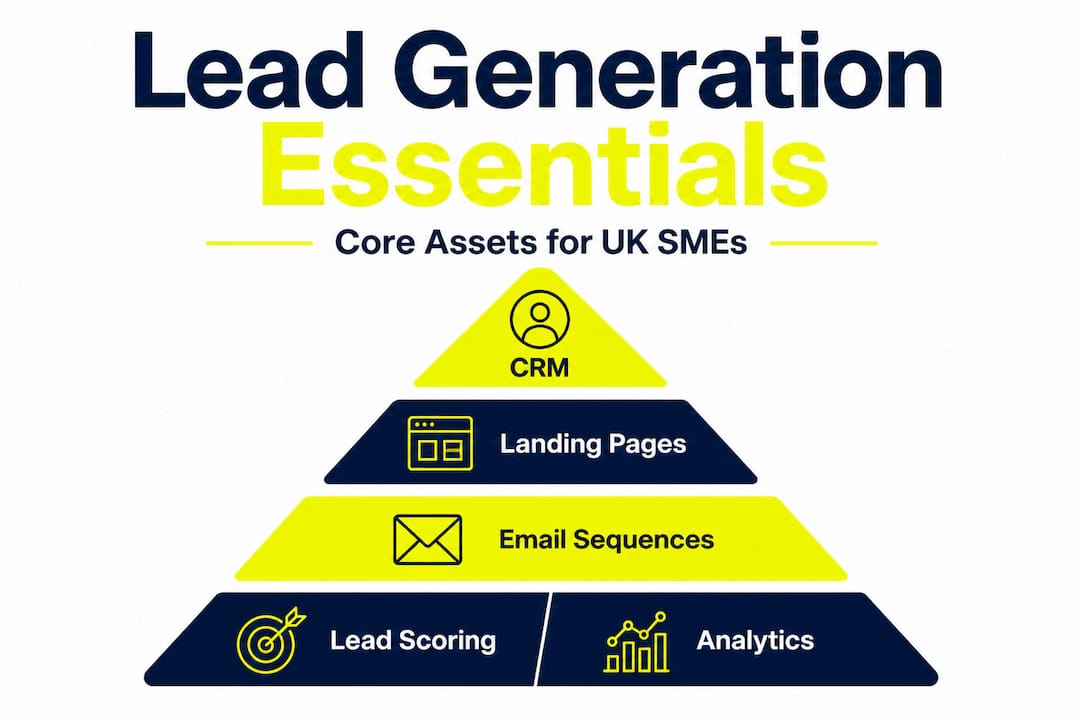
| Asset | Purpose | Setup effort |
|---|---|---|
| CRM | Lead storage, scoring, nurturing | Medium |
| Landing pages | Convert traffic to enquiries | Medium |
| Offline conversion tracking | Measure actual sales outcomes | High |
| Email workflows | Automate follow-up and nurturing | Medium |
| Analytics (GA4 + Search Console) | Traffic and behaviour data | Low |
| Lead scoring model | Qualify and prioritise leads | Medium |
If you are still mapping out your broader B2B digital marketing steps, start there before configuring your CRM or ad accounts. Our digital marketing guide for SMEs also covers channel selection in more detail.
Pro Tip: Do not attempt to set everything up at once. Prioritise your CRM and one landing page first. Run a small test campaign, validate your tracking, and then expand. Perfecting your infrastructure in phases is far more effective than launching with a half-built setup.
Step-by-step process to generate qualified online leads
With your foundations in place, the actual process of generating qualified leads follows a clear and repeatable sequence. Here is how we recommend structuring it.
Define your ideal customer profile (ICP): Be specific. An SME targeting “small businesses” is too broad. Narrow it down to, for example, “UK-based professional services firms with 10 to 50 employees that are currently scaling.” The tighter your ICP, the better your targeting, messaging, and close rate.
Set up your CRM and lead capture forms: Configure your CRM fields to capture the information that matters for qualification. Ask for company size, budget range, or timeline on your forms where appropriate. Shorter forms improve conversion rates, but longer forms pre-qualify leads more effectively. Test both.
Drive targeted traffic through the right channels: Not all channels deliver the same lead quality. Paid search (Google Ads and Bing Ads) captures high-intent traffic from people actively searching for solutions. SEO builds longer-term, sustainable visibility. Paid social (LinkedIn, Meta) suits awareness and nurture. Choose based on your budget and timeline.
A/B test your landing pages: Run split tests on headlines, CTAs, form lengths, and page layouts. Even a modest improvement in landing page conversion rate, say from 3% to 5%, significantly increases the number of leads you generate from the same ad spend.
Activate lead scoring: Score leads based on demographics (company size, sector, job role) and behaviour (pages visited, emails opened, content downloaded). Leads that cross a defined score threshold get prioritised for immediate sales follow-up.
Enable offline conversion tracking: This feeds data from your CRM back to Google Ads or Bing Ads, telling the platform which clicks eventually became customers. When you configure offline conversion tracking, you give ad platforms the signal they need to optimise for actual sales. The results can be dramatic: weekly closed deals can rise from 2 to 7 simply by training ad algorithms on real revenue outcomes rather than just form fills.
Nurture leads through automated sequences: Not every lead is ready to buy on day one. A structured email sequence that delivers relevant content over two to four weeks keeps your brand visible and moves prospects towards a buying decision at their own pace.
Hand qualified leads to sales with context: When a lead crosses your scoring threshold, pass them to your sales team with a summary of their journey: pages visited, emails opened, content downloaded. This context makes the first conversation far more productive.
The digital marketing process behind this framework is consistent whether you are running paid search, SEO, or social campaigns. Understanding why investing in digital marketing pays off long-term also helps stakeholders align on budget expectations.
Channel comparison for UK SMEs:
| Channel | Relative cost | Speed of results | Lead quality |
|---|---|---|---|
| Google Ads | Medium to High | Fast | High (intent-based) |
| SEO | Low ongoing | Slow | High (sustained) |
| Bing Ads | Low to Medium | Fast | Medium to High |
| LinkedIn Ads | High | Medium | High (B2B) |
| Meta Ads | Low to Medium | Fast | Medium |
| Email marketing | Low | Medium | High (nurtured) |
Pro Tip: Use AI-powered personalisation tools in your outbound campaigns. Platforms like HubSpot and Clay can dynamically insert company-specific details into email sequences, making outreach feel hand-written even at scale. Personalised emails consistently outperform generic ones in both open rate and response rate.
Troubleshooting: Why leads don’t convert (and what to fix)
Even with a solid setup, leads sometimes stall before reaching a sale. This is one of the most common frustrations we hear from SMEs. The issue is rarely the channel. It is almost always something in the process between capture and close.
Here are the five most common reasons leads fail to convert, and what to do about each one:
Slow follow-up: Responding to a lead hours or days after they enquire dramatically reduces your chances of conversion. The window of intent is short. Fix this by setting up automated email acknowledgements that fire within minutes of a form submission, followed by a personal call within two hours during business hours.
Irrelevant messaging: If your follow-up email talks about services the lead did not express interest in, they disengage immediately. Fix this by segmenting your CRM by campaign source and service interest, then using dynamic email templates that reflect what the lead actually enquired about.
Poor lead qualification: If your sales team is spending time on every lead equally, they are wasting effort on poor-fit prospects. Fix this by implementing lead scoring and only escalating leads above a defined quality threshold to direct sales contact.
Disconnected sales and marketing processes: When the sales team has no visibility of a lead’s pre-enquiry journey, they start every conversation cold. Fix this by integrating your CRM with your ad platforms and website analytics, so sales can see which pages were visited and which emails were opened before picking up the phone.
Weak landing page or offer: If your offer is unclear or your landing page looks untrustworthy, visitors leave without converting. Fix this by improving page speed, adding social proof (testimonials, case studies, trust badges), and clarifying your CTA.
“Optimising for lead quality, not volume is the single most important shift an SME can make in its lead generation strategy. Volume is a vanity metric. Revenue is what matters.”
Understanding your digital marketing ROI becomes much clearer when you are measuring outcomes like close rate and revenue per lead rather than just form submissions and click-through rates.
How to analyse and improve your lead generation results

Generating leads is only half the job. The other half is knowing which efforts are working, why they are working, and how to do more of the same. This is where most SMEs leave significant value on the table.
The four key metrics every SME should track:
- Cost per lead (CPL): Total spend divided by number of leads generated. Track this per channel and per campaign.
- Qualified lead rate: What percentage of your leads meet your ICP criteria? A low qualified rate means your targeting or messaging needs refinement.
- Close rate: Of the leads that reach a sales conversation, what percentage become customers? This tells you as much about your sales process as your marketing.
- Revenue per lead: The most powerful metric of all. It tells you the true value of each lead source and justifies budget allocation decisions.
Your review and improvement cycle:
- Track: Pull weekly data from your CRM, ad platforms, and analytics. Do not rely on memory or gut feel.
- Analyse: Compare performance across channels, campaigns, and time periods. Look for patterns in what is generating high-quality leads versus what is producing noise.
- Adjust: Make one change at a time. If you change your headline, your form, and your targeting simultaneously, you will not know which change drove the improvement.
- Optimise: Feed learnings back into your campaigns. Update bidding strategies, refine audience segments, and revise landing page copy based on what the data shows.
Common optimisations that consistently move results:
- Tighten geographic targeting in Google Ads to focus on your highest-converting regions
- Reduce form fields to two or three on initial landing pages to improve conversion rates
- Add video testimonials to landing pages to increase trust and dwell time
- Automate lead follow-up to reduce response time to under five minutes
- Exclude low-quality audience segments from paid social campaigns
As offline conversion tracking and integrated CRMs become standard practice, the ability to distinguish between a lead that enquired and a lead that actually bought becomes much sharper. This is how you stop optimising for the wrong outcomes. For a detailed view of analysing digital campaigns effectively, we cover the full measurement framework in our B2B marketing guide.
Pro Tip: Use AI-powered tools like ChatGPT or Gemini alongside your analytics reports to surface patterns faster. Paste in your monthly metrics and ask for a plain-language summary of what is underperforming and why. It will not replace strategic judgement, but it accelerates the analysis phase considerably.
Why most SME lead generation is inefficient (and how you can stand out)
Here is the uncomfortable truth we see repeatedly when working with UK SMEs: most are generating leads, just not the right ones. And the reason is nearly always structural rather than creative.
The most common mistake is treating lead generation as a series of isolated tactics. Run some ads. Send some emails. Post on LinkedIn. Hope for the best. Without a joined-up system, you end up with a leaky funnel where marketing effort evaporates before it reaches your sales team in any useful form.
What actually works is integration. When your CRM, your ad platforms, your landing pages, and your email sequences all communicate with each other, you get a closed-loop system. Marketing can see which leads converted. Sales can see how leads behaved before they enquired. Ad algorithms get trained on real revenue data rather than proxy metrics. The whole machine improves over time rather than staying flat.
Another widely overlooked factor is the alignment between marketing and sales. Many SMEs treat these as separate functions, when in reality they should be a single process with shared goals. When marketing is measured on lead volume and sales is measured on close rate, you get a system that optimises for the wrong things. Align both teams on revenue-per-lead and qualified pipeline value, and watch how quickly the quality conversation improves.
My honest view: the SMEs that will consistently outperform their competitors over the next five years are not those with the biggest ad budgets. They are the ones that build disciplined systems, invest in SEO for sustainable leads, and treat lead quality as a non-negotiable metric. Volume is a starting point. Quality is the goal.
Get expert help generating online leads that convert
If this guide has clarified what is needed but the implementation feels like a significant undertaking alongside your day-to-day responsibilities, you are not alone. Most SMEs reach a point where the gap between knowing what to do and having the capacity to do it well requires outside expertise.
At Citric Media, we have spent over 27 years helping UK SMEs build performance-driven lead generation systems across Google Ads, Bing Ads, SEO, and paid social. We do not just set up campaigns and leave you to it. We integrate tracking, build out CRM connections, and optimise continuously for qualified pipeline rather than vanity metrics. If you are ready to build a lead generation engine that actually scales, our SME marketing roadmap is a practical starting point. Or simply get in touch and tell us where your current approach is falling short. We will give you an honest assessment of what needs to change.
Frequently asked questions
What is the fastest way to generate high-quality online leads?
Targeted Google Ads campaigns with offline conversion tracking deliver rapid, high-quality results for SMEs, with weekly closes rising from as few as 2 to as many as 7 when ad algorithms are trained on real sales data rather than form fills alone.
How do I know if my leads are actually sales-ready?
Leads that complete key actions (such as visiting a pricing page, downloading a guide, or opening multiple emails) and reach a defined lead score threshold within your CRM are far more likely to convert than unscored enquiries.
What role does automation play in lead generation?
Automation tools including email workflows and AI agents streamline nurturing, reduce follow-up response times, and ensure no lead is left unattended, which directly improves conversion rates across the funnel.
Do I need a CRM to generate online leads?
A CRM is not strictly essential to start, but CRM integration makes managing, scoring, and converting leads significantly more effective and is strongly recommended for any SME that wants to scale.
How often should I review my lead generation performance?
Monthly reviews of key metrics such as cost per lead, qualified lead rate, and close rate allow for timely adjustments and ensure your campaigns improve continuously rather than plateauing.