General
Most SMEs invest real money driving traffic to their websites, then watch the majority of visitors leave without ever making contact. The hard truth is that 97% of website visitors don’t convert on their first visit. That’s not a failure of your product or service. It’s simply how buying behaviour works. Remarketing exists precisely to close this gap, bringing those warm prospects back into your orbit at exactly the right moment. In this guide, we’ll explain how remarketing works, which platforms deserve your attention, how to build audiences that actually convert, and how to weave it all into a functioning lead generation funnel.
Table of Contents
- What is remarketing and how does it support lead generation?
- Key remarketing channels and strategies for SMEs
- How to build high-converting remarketing audiences
- Integrating remarketing into your lead generation funnel
- Why most SMEs underuse remarketing—and what you should do differently
- Elevate your lead generation with tailored remarketing support
- Frequently asked questions
Key Takeaways
| Point | Details |
|---|---|
| Remarketing defined | Remarketing targets previous website visitors with personalised ads to boost lead generation. |
| Best channels to use | Google, Facebook, and LinkedIn offer powerful remarketing tools tailored for SME budgets and audiences. |
| Audience segmentation matters | Refined list-building ensures ads reach the right people and increase conversions. |
| Integration for maximum effect | Embedding remarketing within your marketing funnel lifts lead quality and quantity. |
| Stay agile | Continually update and test remarketing campaigns to avoid ad fatigue and wasted spend. |
What is remarketing and how does it support lead generation?
Now that you understand the value of capturing lost web traffic, let’s clarify what remarketing actually is and how it underpins modern lead generation.
Remarketing is the practice of serving targeted advertisements to people who have previously interacted with your website, app, or digital content. When a visitor arrives on your site, a small piece of code, typically called a tracking pixel or cookie, records that visit. From that point forward, you can show that specific person tailored ads across other websites, social platforms, and search results, keeping your brand visible and encouraging them to return.
This is fundamentally different from standard display advertising, where you’re broadcasting to cold audiences based on broad demographic or interest categories. With remarketing, every person you’re targeting has already demonstrated intent. They visited your pricing page. They read your case study. They spent four minutes on your contact form before closing the tab. These are warm signals, and treating them as such is what makes remarketing so powerful for SME lead generation.
Here’s why remarketing consistently outperforms cold display campaigns:
- Relevance: Ads speak directly to actions the visitor already took, making them feel timely rather than intrusive.
- Efficiency: Budget is focused on audiences already familiar with your brand, reducing cost per lead.
- Repetition: Multiple exposures build trust and recall, nudging prospects through the decision-making process.
- Segmentation: Different audience groups can receive different messages, matched to where they are in the buying journey.
- Recapture: Visitors who showed high intent but didn’t enquire can be brought back with a specific offer or prompt.
Research consistently shows that remarketed audiences convert at significantly higher rates than cold traffic, often two to three times higher, depending on the sector and quality of the audience list.
“Remarketing doesn’t create demand. It captures demand that already exists but hasn’t yet reached a decision. For SMEs with limited budgets, that distinction is everything.”
The practical mechanics are straightforward. You install a tracking pixel from your chosen platform, define your audience rules, create your ad creative, and set your campaign live. From there, platforms like Google and Meta handle the delivery, showing your ads to the right people at the right time across millions of sites and apps.
Key remarketing channels and strategies for SMEs
Having defined remarketing’s core principles, let’s examine which platforms offer the best tools and strategies for SMEs to implement it effectively.
Choosing where to run your remarketing campaigns matters enormously. Each platform has a different audience, cost structure, and set of creative options. Understanding these differences helps you allocate budget where it will generate the most relevant leads for your specific business.
| Platform | Strengths | Best for | Avg. cost | Ease of setup |
|---|---|---|---|---|
| Google Display | Massive reach, intent signals | B2C and broad B2B | Low CPC | Moderate |
| Google Search (RLSA) | Targets known visitors searching again | High-intent B2B leads | Higher CPC | Moderate |
| Meta (Facebook/Instagram) | Detailed demographics, visual creative | B2C, local services | Low to mid | Easy |
| Professional targeting, job title/industry | B2B, professional services | Higher CPM | Moderate |
Google Display remarketing places your ads across Google’s vast partner network, reaching visitors as they browse news sites, watch YouTube, or use apps. It’s excellent for brand recall and top-of-funnel nurturing. Remarketing Lists for Search Ads (RLSA) is arguably more powerful for B2B: you adjust bids specifically when a past visitor searches again on Google, ensuring you appear prominently at a moment of active intent. Building effective Google Ads campaigns for remarketing requires structured audience lists and well-crafted ad copy that speaks to where prospects are in the decision process.
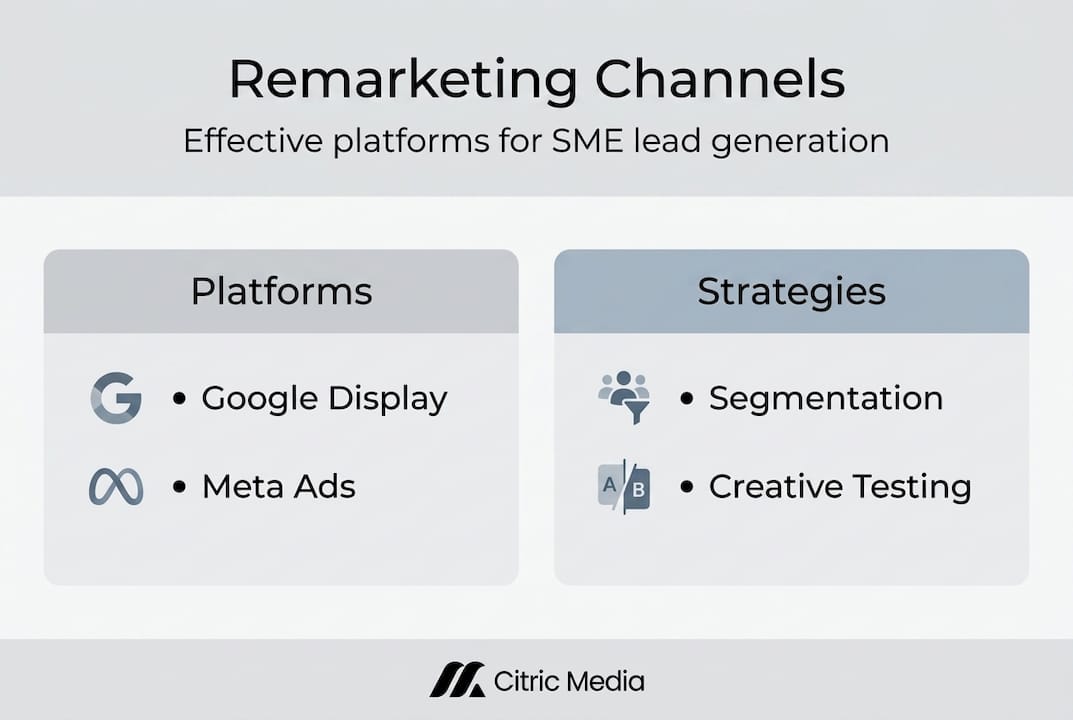
Meta remains excellent for SMEs in consumer-facing sectors, particularly local services and e-commerce adjacent businesses. Its visual format encourages creative experimentation, and its audience matching tools are genuinely sophisticated.
LinkedIn carries higher costs but delivers unmatched precision for professional services firms, software businesses, and anyone targeting decision-makers by job title, company size, or industry.
Our recommended approach for SMEs follows this sequence:
- Define your primary customer profile and determine where they spend time online.
- Install tracking pixels on your website immediately, even before your campaign is live, so you begin building audience data.
- Choose one platform to launch your first remarketing campaign, using your highest-intent audience segment.
- Set frequency caps to avoid showing your ads more than three to five times per week to any single user.
- Rotate creative every four to six weeks to prevent ad fatigue and maintain engagement.
Pro Tip: Start with a single channel rather than spreading budget across all platforms at once. A focused test on one platform gives you clean data to evaluate performance before expanding your investment.
How to build high-converting remarketing audiences
With channels selected, the next critical step is outlining exactly whom to target and how to maximise conversion rates through thoughtful list segmentation.

Building effective remarketing audiences goes well beyond simply adding everyone who visited your website to a single list. The quality of your audience segmentation directly determines the relevance of your messaging, and relevance is the single biggest lever for improving lead quality.
The starting point is understanding what different types of visitor behaviour signal about intent. Someone who read your blog post once is in a very different mental state to someone who visited your pricing page three times in the past week. Treating them identically wastes budget and dilutes your messaging.
| Audience segment | Behaviour signal | Recommended message | Priority level |
|---|---|---|---|
| Pricing page visitors | High commercial intent | Case study or free consultation offer | Very high |
| Service page visitors | Research phase | Testimonial or differentiator-led ad | High |
| Blog readers | Early awareness | Educational content or lead magnet | Medium |
| Cart/form abandoners | Near-conversion | Urgency prompt or reassurance message | Very high |
| All site visitors (30 days) | General interest | Brand awareness ad | Low to medium |
Key audience-building strategies to implement across your remarketing programme:
- Time-based segmentation: Separate visitors from the last 7 days, 14 days, and 30 days. Recent visitors are warmer and should receive higher bids and more direct calls to action.
- Page-depth targeting: Users who visited four or more pages during a session showed significantly more interest. Isolate them and treat them as high-value prospects.
- Exclusion lists: Exclude existing customers and recent converters to avoid wasting spend and irritating people who’ve already bought from you.
- Cross-device audiences: Ensure your pixel and audience configuration captures users across mobile, tablet, and desktop, since many prospects switch devices between research and conversion.
- Engagement-based segments: On Meta in particular, you can build audiences based on video watch time or interaction with specific posts, giving you a highly qualified pool beyond website visitors alone.
Exploring creative remarketing ad approaches for each audience segment helps maintain relevance without your creative going stale. The principle is simple: the closer someone was to converting, the more direct and specific your message should be. For a prospect who nearly completed an enquiry form, a prompt that says “Still thinking it over? We’d love to help” is far more effective than a generic brand awareness message.
Micro-segmentation also prevents the classic mistake of serving irrelevant ads to audiences who have no memory of your brand or showed only passing interest. Prioritising your highest-intent segments ensures that your most persuasive creative and strongest offers reach the people most likely to act on them.
Integrating remarketing into your lead generation funnel
By understanding audiences, you’re poised to turn insights into action. Here’s how to embed remarketing techniques directly into your business’s lead generation engine.
Remarketing isn’t a standalone tactic. It works best when it’s deliberately connected to every stage of your lead generation funnel, reinforcing messages as prospects move from awareness through to enquiry.
Here’s how a typical SME funnel looks with remarketing properly embedded:
- Awareness stage: A prospect clicks a social ad or organic search result and lands on your blog or homepage. They browse briefly but don’t engage further. Your remarketing campaign detects this visit and begins serving brand-building ads, keeping you visible as they continue their research over the following days.
- Consideration stage: The prospect returns via a remarketing ad and visits your service pages. At this point, your audience segmentation kicks in, moving them to a higher-intent list. Ads now feature client testimonials, case studies, or a specific value proposition relevant to the service they viewed.
- Conversion stage: The prospect revisits your contact or pricing page but doesn’t submit an enquiry. Your most targeted remarketing campaign activates, featuring a clear call to action such as a free consultation, a downloadable guide, or a limited-time offer. This is your highest-spend audience, and every pound here is working hardest.
Pro Tip: Set up conversion tracking and UTM parameters from day one so you can attribute leads accurately to your remarketing campaigns. Without proper tracking, you’re flying blind on what’s actually generating returns.
Aligning your creative and landing pages at each stage is equally important. An ad promising a free audit should land on a page offering exactly that, not your homepage. Mismatches between ad promise and landing page experience are one of the leading causes of poor remarketing performance, even when audience segmentation is solid.
For measuring success, focus on these key performance indicators across your remarketing campaigns: cost per lead, lead quality score (if you use a CRM scoring system), assisted conversion rate, and return on ad spend. Understanding how digital marketing for SME growth connects remarketing performance to broader business goals will help you make the case internally for sustained investment.
Remarketing campaigns that are tightly integrated with your CRM also allow for smarter follow-up. When a prospect enquires after seeing several remarketing ads, your sales team has context. They know that person has been engaged for two weeks, visited the pricing page multiple times, and responded to a consultation offer. That intelligence makes sales conversations sharper and conversion rates higher.
Why most SMEs underuse remarketing—and what you should do differently
Having covered the practical steps, let’s step back and reflect on why so many businesses miss out, and how you can sidestep their mistakes.
Here’s an uncomfortable observation from working with SMEs across many sectors: the majority set up a basic remarketing campaign, tick it off the to-do list, and never meaningfully revisit it. The same ad creative runs for months. Audience lists are never refreshed. Frequency caps are either absent or set at levels that send prospects running. And when results plateau, the instinct is to blame the channel rather than the execution.
The real issue is that remarketing is iterative by nature. It rewards the businesses willing to test new creative every month, update audience segments as their service offering evolves, and honestly assess which messages are resonating versus which are simply generating impressions. Ad fatigue is real, and audience refresh cycles matter far more than most SMEs realise.
We’d also push back on the idea that remarketing objectives should be fixed. Your business priorities shift throughout the year, and your remarketing campaigns should shift with them. Launching a new service? Update your audiences and creative immediately. Experiencing a slow enquiry period? Raise bids on your highest-intent segments and test a stronger offer. Remarketing that’s locked to a strategy set six months ago is working against you. Businesses that stay curious, keep testing, and align their remarketing with live business goals consistently outperform those who treat it as a background task. That’s the gap between good results and excellent ones.
Elevate your lead generation with tailored remarketing support
If you’re ready to transform leads with focused remarketing, partnering with specialists can accelerate results significantly.
At Citric Media, we’ve spent over 27 years helping UK SMEs generate high-quality leads through performance-driven digital channels. We understand that remarketing is only as powerful as the strategy, audience intelligence, and creative behind it. Whether you’re just starting out or looking to overhaul an underperforming campaign, our team can help you build remarketing frameworks that deliver measurable returns. Explore our guide to paid social advertising for SMEs or download our digital marketing action plan to see how remarketing fits into a broader growth strategy tailored for your business.
Frequently asked questions
What is the difference between remarketing and retargeting?
Remarketing is the broader term for any campaign designed to re-engage previous users, while retargeting specifically refers to displaying ads to users who visited your site but did not convert. In practice, many platforms use the terms interchangeably.
How soon should I start a remarketing campaign for my SME?
You should set up your tracking pixels and audience lists as early as possible, ideally from the moment your website goes live, so that you’re already building valuable audience data by the time you launch your first paid campaign.
Do remarketing ads really increase leads for small businesses?
Yes, remarketing consistently boosts conversion rates by keeping your brand in front of warm prospects who already showed interest. Businesses that remarket typically see two to three times higher conversion rates compared to cold traffic campaigns.
What’s the ideal budget for SME remarketing campaigns?
Most SMEs start with a modest, tightly focused budget directed at their highest-intent audience segments, then scale spend as they gather performance data and identify which combinations of audience, creative, and offer deliver the strongest return on investment.