Digital Marketing
Most businesses think they are doing omnichannel marketing because they post on social media, run Google Ads, and send email newsletters. They are not. What is omnichannel marketing, really? It is the practice of connecting every channel, platform, and touchpoint into a single, coherent customer journey where context travels with the customer. A shopper who browses on their phone and later visits your store should never have to start from scratch. That is the standard omnichannel sets, and it is considerably harder to achieve than simply being present on multiple channels.
Table of Contents
- Key takeaways
- Omnichannel vs multichannel: what actually sets them apart
- The benefits of omnichannel marketing worth knowing
- The technologies that make omnichannel possible
- How to implement omnichannel: a practical framework
- Common challenges and how to overcome them
- My perspective on what omnichannel marketing actually demands
- How Citricmedia can help you build your omnichannel strategy
- FAQ
Key takeaways
| Point | Details |
|---|---|
| Integration defines omnichannel | Omnichannel connects channels into one journey; multichannel runs them independently. |
| Data is the foundation | A unified customer profile across all touchpoints is what makes personalisation possible. |
| Connectivity beats consistency | Sharing context between touchpoints reduces friction and drives conversions more than visual uniformity alone. |
| Implementation follows a clear process | Collecting cross-channel data, mapping journeys, and iterating with metrics are the non-negotiable steps. |
| Challenges are operational, not theoretical | Unified profiles, inventory alignment, and team coordination are where most omnichannel efforts break down. |
Omnichannel vs multichannel: what actually sets them apart
The confusion between omnichannel and multichannel is understandable because both involve using more than one marketing channel. The distinction, though, is not about quantity. It is about integration.
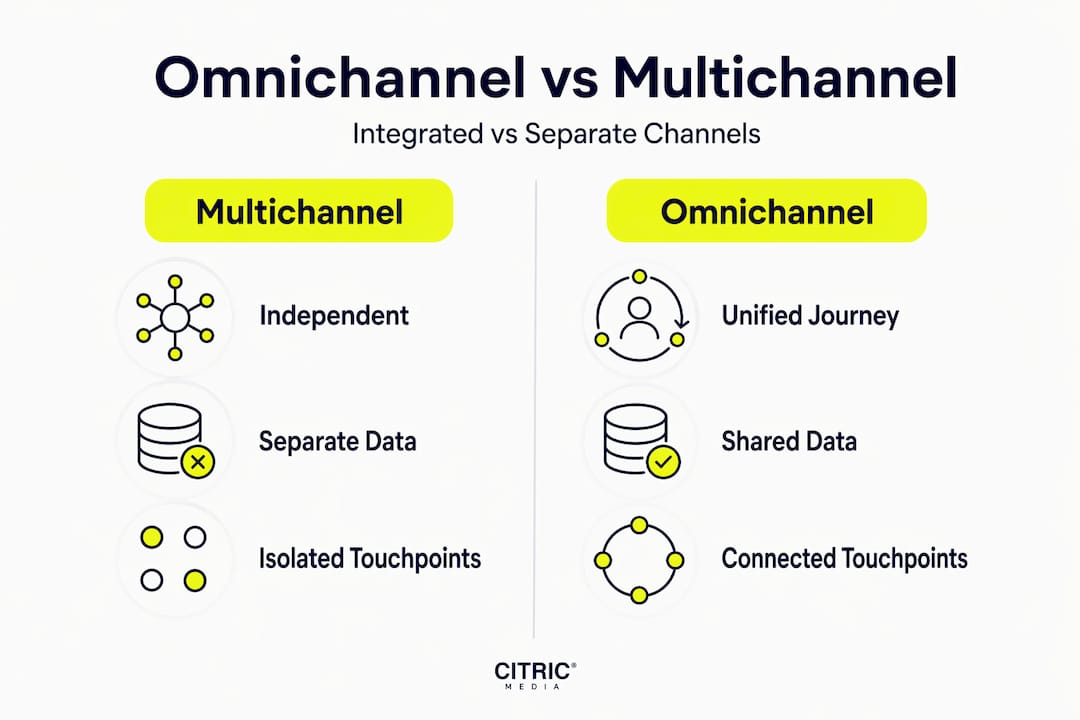
Multichannel marketing means your business is active across several platforms, perhaps email, paid search, and social media. Each channel operates according to its own logic, its own data, and its own goals. A customer who clicks an ad on Facebook and later opens an email from you will receive messages that have no awareness of each other. The result is a fragmented experience that places the burden of continuity on the customer.
Omnichannel marketing delivers a seamless, integrated experience across digital and physical channels by sharing customer data and context between them. When someone starts a purchase on your website and completes it in-store, the system recognises them at every stage. There is no repetition, no confusion, and no lost basket. The key distinction, as both Adobe and Salesforce have highlighted, is that omnichannel integrates touchpoints into a single customer view whereas multichannel treats them as independent silos.

| Feature | Multichannel | Omnichannel |
|---|---|---|
| Channel relationship | Independent | Interconnected |
| Customer data | Siloed per channel | Shared across channels |
| Customer experience | Fragmented | Continuous |
| Messaging | Channel-specific | Consistent and context-aware |
| Primary focus | Reach | Customer journey |
That table is not abstract. It describes two fundamentally different operating models. Moving from multichannel to omnichannel requires rethinking how data flows across your organisation, not just how many platforms you are using.
The benefits of omnichannel marketing worth knowing
The case for adopting an omnichannel marketing strategy goes beyond customer satisfaction. The operational and commercial benefits are measurable.
- Higher conversion rates. When customers can browse on desktop, continue on mobile, and complete a purchase in-store without repeating themselves, fewer of them abandon the journey. Reducing friction at every transition is a direct driver of revenue.
- Stronger loyalty. Consistency builds trust. Customers who receive coherent, relevant messaging across channels are significantly more likely to return. Research with 775 omnichannel shoppers confirmed that connectivity of touchpoints improves loyalty and value co-creation behaviour.
- Deeper personalisation. Real-time data and dynamic customer profiles synthesising behaviour, preferences, and purchase history allow you to serve genuinely tailored content across web, app, and physical channels. That is a meaningful competitive advantage.
- Better use of marketing spend. When channels share data, you avoid paying to re-acquire customers who already converted, or to serve ads to users who have already expressed disinterest.
- Scalability with coherence. A properly connected channel architecture scales without fracturing. Adding a new touchpoint, such as a WhatsApp channel or a connected retail terminal, feeds into the same data layer rather than creating another silo.
Pro Tip: Do not measure channel performance in isolation. If your email open rate is strong but your paid social is underperforming, unified data may reveal that email subscribers are already converting via search. Optimise across the journey, not per channel.
The technologies that make omnichannel possible
Understanding the concept of omnichannel marketing is one thing. Knowing what actually powers it is what separates planners from practitioners.
Customer data platforms and CRMs
A Customer Data Platform, or CDP, collects and unifies customer data from every source: your website, your app, your email platform, your point of sale system. It creates a single, persistent profile for each individual. A CRM manages the relationship and communication layer on top of that profile. Together, they are the backbone of any working omnichannel system. Without them, your channels cannot share context because there is no single truth to share.
Real-time data flow
Static data profiles are not sufficient. When a customer abandons a basket, views a product three times, or opens a support ticket, that information needs to travel instantly across your channels. Real-time data flow ensures that the next email, the next ad, and the next in-store interaction reflect the customer’s most recent behaviour, not data from last Tuesday.
Journey mapping and frequency management tools
- Journey mapping software allows you to visualise every path a customer might take through your channels and identify where context is lost or messaging becomes repetitive.
- Frequency capping tools prevent a single customer from being contacted too often across channels simultaneously, which is a surprisingly common problem in early omnichannel deployments.
- Analytics and A/B testing platforms let you measure which journey variations perform best so you can iterate systematically rather than guessing.
Analytics-driven marketing is not a luxury here. It is the mechanism by which your omnichannel investment actually improves over time.
How to implement omnichannel: a practical framework
Adobe’s omnichannel guidance describes a structured, iterative process that aligns closely with what we see working in practice. Here is how to approach implementation without losing momentum.
- Audit your current data sources. Map every place customer data currently lives: your CRM, your email service provider, your ad platforms, your e-commerce system. Identify gaps and disconnects before you attempt to unify them.
- Build or adopt a unified data layer. Whether you implement a full CDP or connect your existing tools via integration middleware, the goal is a single customer identifier that persists across channels. This is harder than it sounds, and it is where most projects stall.
- Map your customer journeys. Identify the key paths customers take from first awareness through to purchase and retention. Understand what happens at each transition: when someone moves from an ad click to your website, or from your website to your store. Understanding your marketing funnel structure at this stage is directly relevant.
- Segment your audiences. Not every customer needs the same journey. Group customers by behaviour, purchase history, and preferences so you can personalise messaging without having to create individual content for every person.
- Align messaging and manage frequency. Create a messaging framework that governs what each segment receives, across which channels, and how often. Brand consistency and messaging clarity are what make the experience feel coherent rather than coincidental.
- Set metrics and iterate. Define success at the journey level, not the channel level. Measure things like journey completion rate, cross-channel conversion uplift, and repeat purchase rate. Review regularly and refine.
Pro Tip: Start with two or three channels that already have strong individual performance and focus on connecting them properly before expanding. A well-connected two-channel experience outperforms a poorly connected five-channel one every time.
Common challenges and how to overcome them
Even organisations that understand omnichannel marketing in theory frequently struggle with execution. The obstacles are real, and worth anticipating.
- Building the customer context backbone. Establishing a single shared customer profile with consistent identifiers across all systems is the most technically demanding part of omnichannel implementation. It requires integrating disparate data repositories and resolving identity conflicts when the same person appears as multiple records.
- Inventory and fulfilment alignment. Omnichannel retail creates customer expectations that systems must meet. Companies like Walmart and Target have made multi-billion dollar investments in ship-from-store fulfilment, enabling most online orders to be fulfilled from physical stores. For SMEs, the priority is ensuring that what you promise across channels is what your operations can actually deliver.
- Cross-channel team coordination. Most marketing teams are still organised by channel. An SEO team, a paid social team, and an email team with separate KPIs will naturally produce siloed output. Omnichannel requires shared goals, shared data access, and shared accountability.
- Managing journey complexity. As HBR notes on omnichannel journey management, the ecosystem of channels and touchpoints is continuously expanding. Each new channel adds complexity to the journey ecosystem. The solution is not to slow down channel adoption but to prioritise connectivity at every addition, not as an afterthought.
My perspective on what omnichannel marketing actually demands
I have worked with enough businesses to know that the gap between wanting omnichannel and building it is almost entirely an operational gap, not a conceptual one. Most marketing teams understand the idea quickly. What catches them out is the internal reorganisation that genuine integration requires.
In my experience, the biggest misconception is that omnichannel is primarily a technology problem. You can invest in the best CDP on the market and still produce a fragmented experience if your teams are incentivised on channel-specific metrics. The tech enables integration. People and processes determine whether it actually happens.
What I have found genuinely works is starting with the customer journey design before selecting tools. Map where customers currently lose context, where they repeat themselves, and where your messaging contradicts itself. Those pain points tell you exactly what to fix first. Technology selection should follow that analysis, not precede it.
I would also push back on the idea that connectivity between touchpoints is simply about visual or tonal consistency. Consistency matters, but connectivity matters more. A downstream touchpoint that understands what the customer did upstream, without making them repeat it, is worth far more than matching brand colours across platforms. That is the standard to hold your omnichannel programme to.
— Martin
How Citricmedia can help you build your omnichannel strategy
Citricmedia has been helping UK businesses build performance-driven digital marketing programmes for over 27 years. We understand that for SMEs, omnichannel is not about matching the scale of global retailers. It is about connecting the channels you already have, using data intelligently, and creating customer journeys that convert.
Our data-driven digital marketing services are specifically built to help businesses integrate their digital channels, from paid search and SEO to paid social, with a unified view of performance. We also help you understand the role SEO plays in supporting long-term omnichannel visibility. If you are ready to move beyond siloed campaigns and build a marketing programme that actually connects, we would welcome the conversation.
FAQ
What is omnichannel marketing in simple terms?
Omnichannel marketing is the practice of connecting all your marketing channels so that customers experience a continuous, consistent journey regardless of where or how they interact with your brand. Context and data travel with the customer across every touchpoint.
How does omnichannel differ from multichannel marketing?
Multichannel marketing uses several channels independently, with separate data and messaging for each. Omnichannel marketing integrates those channels into a single customer view, so every interaction is informed by what happened before it.
What are the main benefits of omnichannel marketing?
The primary benefits include higher conversion rates from reduced friction, stronger customer loyalty through consistent experiences, and deeper personalisation powered by unified data profiles across all channels.
What technology do I need for omnichannel marketing?
The core requirement is a unified data layer, typically a Customer Data Platform or CRM, that gives every channel access to the same customer profile. Journey mapping tools, analytics platforms, and frequency management systems complete the stack.
How do I start implementing an omnichannel strategy?
Begin by auditing your existing data sources, then build a unified customer identifier across channels. Map your customer journeys to find where context is lost, align your messaging framework, and measure success at the journey level rather than per individual channel.